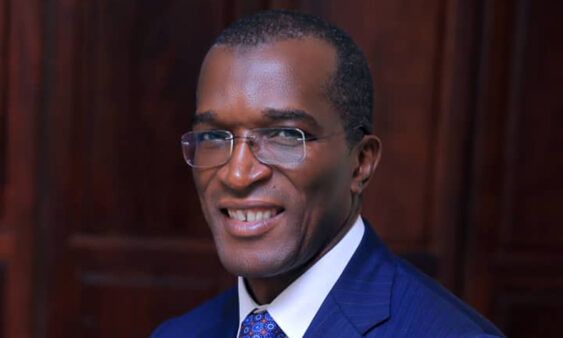
When Mercy K. Kainobwisho assumed office as Registrar General in December 2020, the Uganda Registration Services Bureau (URSB) stood at a critical institutional crossroads.
The country was emerging from the economic disruption of Covid-19, public expectations for government efficiency were rising, and the Bureau itself was navigating legacy systems that no longer matched the demands of a modern economy.
Five years later, URSB has not only improved performance, but it has undergone a structural transformation.
It has evolved from a largely administrative registry into a digitally enabled, high-performing institution positioned at the centre of Uganda’s economic system.
Kainobwisho’s leadership philosophy has, through the years, set the tone, and this started quite early.
In notes published in the URSB five-year performance and results report for the period between June 2020 and June 2025, Kainobwisho says that from the outset of her tenure, her foremost leadership priorities were empowering staff, strengthening staff welfare, and rebuilding organisational culture.
“I firmly believe that sustainable institutional transformation begins with people,” she says, framing the transformation not as a management preference, but as a strategic foundation for reform.
Rather than beginning with systems or policy changes, Kainobwisho focused on institutional culture.
Staffing levels, the report notes, expanded by approximately 44%, accompanied by deliberate investments in staff welfare, training, and tools.
This shift was designed to enable performance, not merely demand it and the result was the emergence of a “no-excuse” performance culture, where staff were both empowered and held accountable.
This internal alignment proved critical by allowing URSB to transition from fragmented operations into a coordinated institution capable of executing complex reforms consistently.
The emphasis on people became the backbone of everything that followed: digital transformation, service expansion, and legal reform, ensuring that changes were not only implemented but sustained.
The digital-led transformation
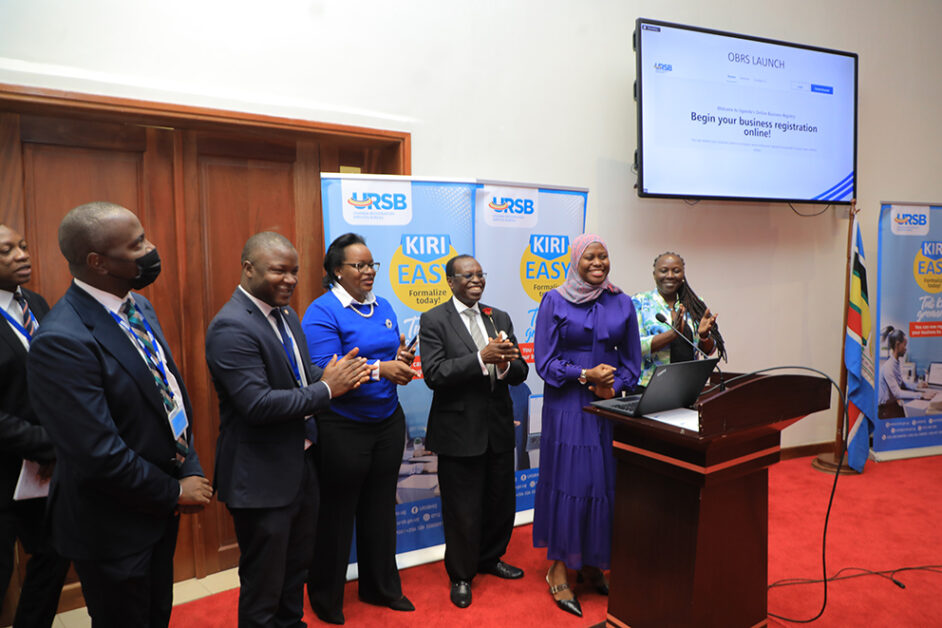
With internal capacity strengthened, URSB undertook one of the most ambitious digital transformations in Uganda’s public sector.
Manual, paper-based processes were replaced with integrated digital systems. Platforms such as the Online Business Registration System (OBRS), the Electronic Document Management System (EDMS), and the fully digital Security Interest in Movable Property Registry (SIMPO) have redefined how services are delivered.
Processes that previously took one to three days have been reduced to hours. Business registration timelines have dropped to as little as two to three hours, while business name registration can be completed in approximately 30 minutes.
These improvements were not simply about speed. They have expanded access to services beyond urban centres, reduced transaction costs, and increased transparency, especially for small and medium enterprises.
As the report notes, modernisation was not an isolated intervention but part of a broader strategic agenda that led to the introduction of legal and operational reforms to align registration systems with digital service delivery, improve compliance, and strengthen institutional oversight.
The numbers that speak
And as a result of these reforms and a digital power infrastructure, the most compelling evidence of URSB’s transformation lies in its performance data.
Over the five years, URSB has recorded an average annual growth of 21.46% in registrations and a 55.2% increase in non-tax revenue, which reflects both improved efficiency and expanded economic participation.
During the period, total revenue has grown from UGX 193.46 billion to UGX 311.08 billion, an increase of more than UGX 117 billion, a growth trajectory that has remained strong in each of the five years.
For instance, in the 2024/25 financial year alone, URSB collected UGX 71.808 billion in non-tax revenue, representing a 9.5% increase from the previous year and the second-highest collection in its history.
At the same time, intellectual property filings have risen significantly, particularly among local innovators, signalling increasing awareness and participation in formal IP systems.
Yet the report is careful to contextualise these figures: These are not just indicators of institutional growth; they represent a “substantial expansion in economic activity captured within formal systems.”
In effect, URSB’s performance reflects a broader national shift toward formalisation, where more businesses, transactions, and assets are brought into regulated frameworks.
Expansion of access to finance
Among all reforms, the Security Interest in Movable Property Registry (SIMPO) stands out as one of the most transformative.
Under her stewardship, during the reporting period, Kainobwisho has seen registrations of security interests in movable property increase by an extraordinary 947.8% compared to the pre-2020 baseline.
This growth signals a fundamental shift in Uganda’s financial ecosystem. Assets such as vehicles, equipment, inventory, and receivables have increasingly become acceptable forms of collateral, reducing reliance on land and fixed assets.
The digital nature of SIMPO further amplifies its impact. The system enables real-time registration, searches, and amendments, improving transparency and lowering transaction costs.
Beyond operational efficiency, SIMPO has become a tool for financial inclusion. During the five years, it expanded access to credit for micro, small, and medium enterprises, including women-owned businesses and enterprises recovering from Covid-19 disruptions.
As the report highlights, the reform has functioned as a form of national financial infrastructure, supporting enterprise resilience and inclusive economic growth.
Repositioning URSB as a national economic engine
Perhaps the most defining achievement of Kainobwisho’s tenure has been redefining URSB’s role within Uganda’s development framework.
 2025: Finance Trust Bank posts 32% growth in deposits; 74% surge in net profit in strongest performance yet
The Bureau has, in the last five years, moved beyond its traditional identity as a registry and positioned itself as a central enabler of economic governance.
The report notes that: “The last five years did not merely improve performance indicators; they redefined the role of URSB within Uganda’s development architecture.”
This transformation has been driven by several structural shifts. Public registers have been repositioned as strategic infrastructure supporting transparency, compliance, and economic activity, while the beneficial ownership frameworks and legal reforms have strengthened corporate accountability and enhanced the integrity of registration systems, respectively.
URSB has also contributed to broader national objectives, including strengthening Uganda’s compliance with international financial standards and supporting its removal from the Financial Action Task Force (FATF) grey list.
In doing so, the Bureau has become a critical interface between government policy and private-sector growth.
Expanding access
The transformation is not limited to systems and policies; it extends to how services reach citizens.
URSB had by June 2025 expanded its footprint to 55 service points nationwide, significantly increasing accessibility.
At the same time, digital platforms have ensured that services can be accessed remotely, creating a hybrid delivery model that balances efficiency with inclusion.
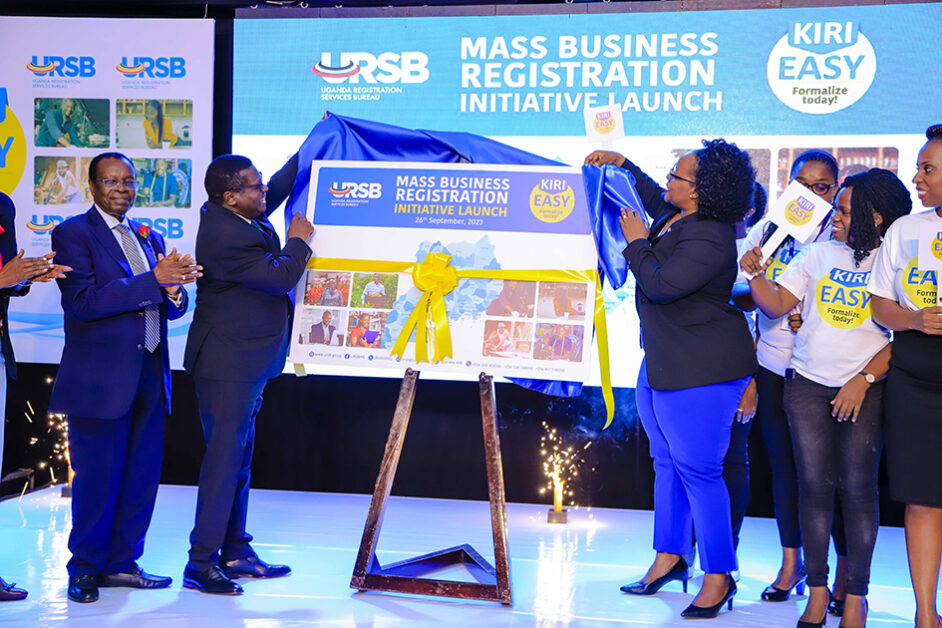
One of the most impactful initiatives during this period has been the Mass Business Registration Initiative, which, through targeted outreach, has registered 11,585 businesses, reached more than 39,000 people, and generated UGX 5.4 billion in revenue.
These efforts are particularly important for bringing informal businesses into the formal economy, expanding awareness, and building trust in registration systems.
Equally, as performance improves, URSB has simultaneously strengthened its governance and legal frameworks.
A series of legislative reforms have addressed structural gaps, modernised company and partnership regulation, and introduced beneficial ownership requirements to enhance corporate transparency.
Within the period, URSB also revised subsidiary legislation, updated administrative procedures, and introduced new compliance mechanisms to align with evolving service delivery models.
Institutionally, URSB pursued ISO 9001:2015 certification, strengthened cybersecurity systems, and enhanced internal controls. These efforts have elevated the Bureau’s credibility and positioned it as a professional, standards-driven organisation.
Internationally, URSB has strengthened partnerships with organisations such as WIPO and ARIPO, reinforcing Uganda’s presence in global intellectual property governance.
Reform with accountability

Thus, Kainobwisho’s leadership is a combination of ambition with discipline, through which, while she has driven rapid transformation, she has ensured that governance, financial management, and accountability systems keep pace.
The Bureau has also seen an increase in its budget from UGX 25.74 billion to UGX 64.813 billion over the period, reflecting expanded mandate and capacity.
At the same time, financial systems have been strengthened to ensure accountability and efficiency.
Even major institutional transitions, such as the transfer of civil registration functions to the National Identification and Registration Authority, have been managed without disruption to service delivery.
This balance between reform and control has ensured that growth translates into sustainable institutional progress.
A foundation for the future
Whereas so much has been achieved under the current reforms, URSB transition must now focus on consolidation and scale.
The next strategic plan will build on the gains of digitalisation, expand partnerships, and deepen formalisation across sectors, not simply to maintain performance, but to extend impact across Uganda’s economy.
Kainobwisho captures this transition clearly, saying: “The foundations laid during the first five years have provided a strong platform for consolidating gains, deepening impact, and continuing to support Uganda’s development and competitiveness objectives.”
Leadership that has transformed an institution
Therefore, over five years, Kainobwisho has done more than lead URSB, but redefined it.
Under her leadership, URSB has achieved sustained growth in registrations, significant increases in revenue, and transformative expansion in access to finance.
It has also modernised its systems, strengthened its legal frameworks, and expanded its reach nationwide.
But beyond metrics, the most significant outcome is structural.
URSB today is no longer just a registry. It is a digitally enabled, performance-driven institution that plays a central role in Uganda’s economic governance and private-sector development.
The transformation is captured not only in numbers, but in institutional identity: From manual to digital, from administrative to strategic, and from fragmented operations to a coordinated, high-performing system.
In five years, URSB has not simply improved; it has matured into a cornerstone of Uganda’s development architecture.