
Annah Nafula
Uganda’s tourism sector has entered 2026 with renewed momentum, delivering what the Ministry of Tourism describes as a “strong growth trajectory.”
According to the Tourism Statistical Abstract 2025, international tourist arrivals rose by 19.7% to 1,642,215 visitors, while tourism receipts climbed 21.3% to UGX 5.83 trillion ($1.62 billion).
On the surface, these numbers tell a compelling recovery story. The sector has not only rebounded from the pandemic shock but has also surpassed pre-pandemic performance benchmarks, reaffirming Uganda’s position as a competitive tourism destination within the region.
Yet beneath this growth narrative lies a more strategic question—one that policymakers, investors, and industry players must now confront: Is Uganda growing fast enough and in the right way—to reach its ambitious $4 billion tourism target by 2028/29?
That target, championed by the Uganda Tourism Board (UTB) under its National Destination Marketing Strategy (NDMS), effectively accelerates the broader national ambition under NDP IV of growing tourism earnings to at least $4 billion by 2029/30.
The NDMS itself is even more ambitious, targeting tourism revenues of up to $5 billion by FY2028/29. This distinction matters because it changes how Uganda’s tourism performance should be measured.
The sector is no longer being judged simply on recovery, but on whether it is growing at the speed and quality required to transform tourism into one of Uganda’s primary economic engines.
The headline numbers: A year of momentum
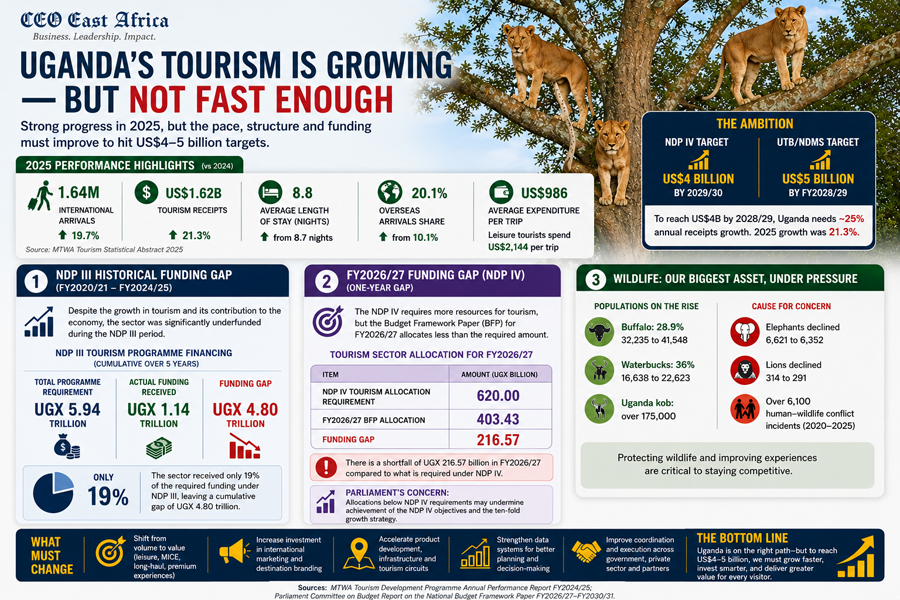
The 2025 Tourism Statistical Abstract paints the picture of a sector firmly in expansion mode. Beyond the headline growth in arrivals and receipts, Uganda’s tourism industry registered notable improvements across several key performance indicators.
The average length of stay increased to 8.8 nights, indicating deeper visitor engagement and greater economic impact per traveller. Overseas arrivals—typically associated with higher spending—more than doubled their share from 10.1% to 20.1%, suggesting early progress in market diversification and stronger penetration into long-haul source markets.
Spending patterns further reinforce this trend. Leisure tourists, the segment most associated with high-value tourism, spent an average of $2,144 per trip, while the overall average expenditure per trip stood at $986.
According to the report, this growth was driven by stronger destination marketing, improved regional mobility, and continued investments in tourism infrastructure. Recovery was broad-based, with growth recorded across both regional and long-haul markets.
Tourism’s wider economic contribution also remains substantial. According to the Tourism Development Programme Annual Performance Report 2024/25, the sector supported 876,512 jobs in 2024, equivalent to 7.5% of total employment, while continuing to contribute significantly to export earnings, hospitality demand, transport activity, and broader service-sector growth.
At face value, therefore, 2025 appears to represent a strong first year in Uganda’s broader tourism growth agenda, one characterised by recovery, renewed confidence, and expanding economic relevance.
From 2024 to 2025: Growth, but not yet transformation
A closer comparison between the 2024 and 2025 Tourism Statistical Abstracts, however, reveals a more nuanced picture.
In 2024, Uganda recorded 1,371,895 international arrivals, while the Tourism Development Programme Annual Performance Report placed tourism receipts at approximately $1.28 billion (UGX 4.8 trillion). Average length of stay was reported at 8.7 nights, while hotel occupancy averaged 53.2%.
By 2025, international arrivals had increased to 1.64 million, while tourism receipts rose to $1.62 billion. Visitors stayed marginally longer, with the average length of stay increasing to 8.8 nights, while the share of leisure tourism increased from approximately 15.7% to 17.2%.
The direction of travel is clearly positive. Uganda is attracting more visitors, keeping them in the country for longer periods, and gradually shifting toward higher-value segments.
However, the pace of change remains incremental rather than transformative. The increase in leisure tourism, arguably the most commercially valuable segment, has been relatively modest, while average expenditure per tourist remains comparatively low for a destination seeking to position itself as a premium African experience.
Taken together, the data points to a sector that is expanding steadily, but not yet fundamentally changing the underlying structure of its tourism economy. Uganda is growing, but it is not yet transforming fast enough.
The $4 billion math: Why pace matters
Uganda’s tourism ambitions are exceptionally high. The UTB National Destination Marketing Strategy seeks to increase tourism revenue from approximately $1.45 billion to $5 billion by the 2028/29 financial year, while the broader NDP IV framework targets at least $4 billion by 2029/30.
These ambitions place tourism at the centre of Uganda’s wider Tenfold Growth Strategy, which positions tourism as one of the country’s strategic export-growth sectors alongside agro-industrialisation, minerals, science and technology, and industrial development.
However, the mathematics behind these targets reveals just how demanding they are. Starting from a base of $1.62 billion in 2025, Uganda would need to sustain annual tourism revenue growth of approximately 25% to reach $4 billion by 2028/29, and closer to 30%–33% annually to approach the NDMS target of $5 billion within the same period.
By comparison, the actual growth recorded in 2025, 21.3%, falls below the required trajectory.While the gap may appear marginal in a single year, the effect compounds significantly over time. If annual growth consistently remains below the required threshold, Uganda risks plateauing between $2.5 billion and $3 billion, falling short of its headline ambitions despite continued expansion.
The challenge facing the sector is therefore no longer simply whether Uganda can grow tourism. The more important question is whether it can grow tourism fast enough and at sufficiently high value to meet the scale of its ambitions.
Volume vs value: Uganda’s structural constraint
The deeper issue lies not just in the pace of growth, but in its composition. The 2025 Tourism Statistical Abstract shows that Uganda’s tourism sector remains heavily dependent on regional markets.
Africa accounts for 79.2% of total arrivals, led by neighbouring countries such as Kenya, Rwanda, South Sudan, Tanzania, and the DR Congo.
At the same time, travel remains dominated by lower-yield segments. Visiting Friends and Relatives (VFR) accounts for 35.4% of arrivals, followed by business travel at 17.3%, while leisure tourism contributes only 17.2% of total arrivals.
This structure matters because different categories of tourists generate vastly different levels of economic value.
Regional and VFR travellers typically spend less per trip, often stay in informal accommodation, and contribute less to structured tourism services such as safaris, guided tours, premium lodges, and destination experiences.
By contrast, leisure and long-haul tourists, particularly from Europe, North America, and Asia, spend significantly more, stay longer, and drive demand for higher-end tourism products.
Uganda’s average expenditure of $986 per trip reflects this imbalance. While leisure tourists spend over $2,144 per trip, they still represent a relatively small share of total arrivals.
The result is a tourism model that remains largely volume-driven rather than value-driven, a structural constraint that limits revenue growth even as visitor numbers continue to rise.
Testing the strategy: Are we aligned?
Uganda’s tourism growth strategy, as articulated in the Tenfold Growth Strategy and the Uganda Tourism Board’s National Destination Marketing Strategy, is anchored on a deliberate shift toward value-driven tourism.
The objective is not simply to attract more visitors, but to attract visitors who stay longer, spend more, and engage more deeply with Uganda’s tourism offerings.
To achieve this transformation, Uganda’s tourism strategies prioritise high-value leisure tourism, MICE tourism, expansion into overseas markets, stronger destination branding, and increased expenditure per visitor. The 2025 performance data shows that Uganda is beginning to move in this direction, but only partially.
On the positive side, the share of overseas arrivals has doubled to 20.1%, the average length of stay has increased, and leisure tourists continue to generate significantly higher spending levels than other visitor segments. However, major gaps remain.
Overall, the spend per tourist remains below $1,000, while leisure tourism still accounts for less than 20% of total arrivals. More importantly, the sector remains structurally dependent on regional traffic, which supports volume growth but does not generate the level of revenue required to achieve Uganda’s long-term ambitions.
The conclusion is therefore clear: Uganda has begun transitioning toward a higher-value tourism model, but the transformation remains in its early stages.
The elephant in the room: Can ambition be funded?
The timing of this analysis is particularly important because it comes at the close of Uganda’s national budgeting cycle. Tourism has consistently been positioned as a strategic growth sector. But the critical question remains:
Is the sector being funded at a level that matches its ambition? There are signs of progress.
For 2025/26, government increased direct funding to the tourism sector to approximately UGX428.5 billion, up from UGX289.6 billion in 2024/25.
Government has also committed approximately UGX2.2 trillion in indirect support, targeting tourism roads, ICT infrastructure, security, and related facilities. On the surface, this appears to represent a significant shift.
But Parliament’s own analysis suggests the funding remains insufficient.
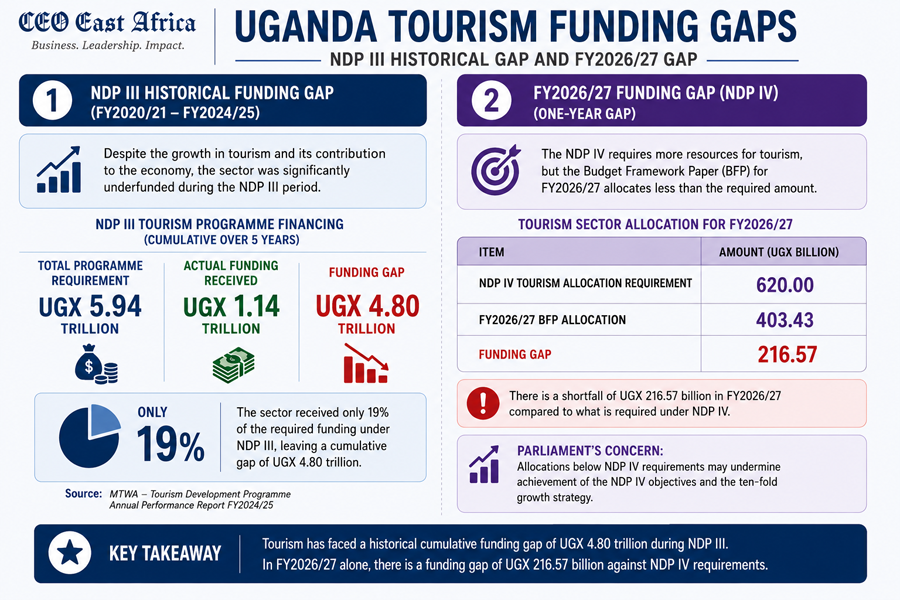
According to Parliament’s Budget Committee report on the National Budget Framework Paper 2026/27–2030/31, the proposed Tourism Development allocation for 2026/27 is UGX403.83 billion, against an NDP IV programme requirement of UGX620 billion.
This leaves a financing gap of approximately UGX216 billion in just one financial year. More importantly, this is not a new problem.
According to the Tourism Development Programme Annual Performance Report 2024/25, the tourism programme required approximately UGX5.94 trillion over the NDP III period but received only UGX1.14 trillion, equivalent to just 19% of planned funding.
The result was a massive UGX4.8 trillion financing gap. The consequences of this underfunding are visible across the tourism sector. Key tourism roads remain incomplete, product diversification has progressed slowly, destination infrastructure remains weak in several regions, conservation financing is constrained, marketing campaigns are inconsistent, and many tourism sites remain underdeveloped.
The contradiction becomes even sharper when examining international tourism promotion. The Auditor General’s Value for Money Audit Report on the Tourism Development Programme revealed that allocations for international tourism promotion declined sharply from UGX2.34 billion in 2022/23 to just UGX487 million in 2024/25, an approximately 80% decline.
This reduction came precisely at the time Uganda was attempting to expand its global tourism footprint. The Ministry of Tourism Strategic Plan 2025/26–2029/30 openly acknowledges this financing challenge. The plan estimates implementation costs of approximately UGX1.341 trillion, against projected Medium-Term Expenditure Framework financing of only UGX527.147 billion, leaving a fresh financing gap of approximately UGX813.953 billion.
Parliament’s Budget Committee further warns that current allocations fall below NDP IV requirements and could undermine the implementation of tourism interventions under the Tenfold Growth Strategy.
The implication is difficult to ignore: Uganda’s tourism ambitions are expanding faster than the sector’s financing base.
Risks beneath the surface
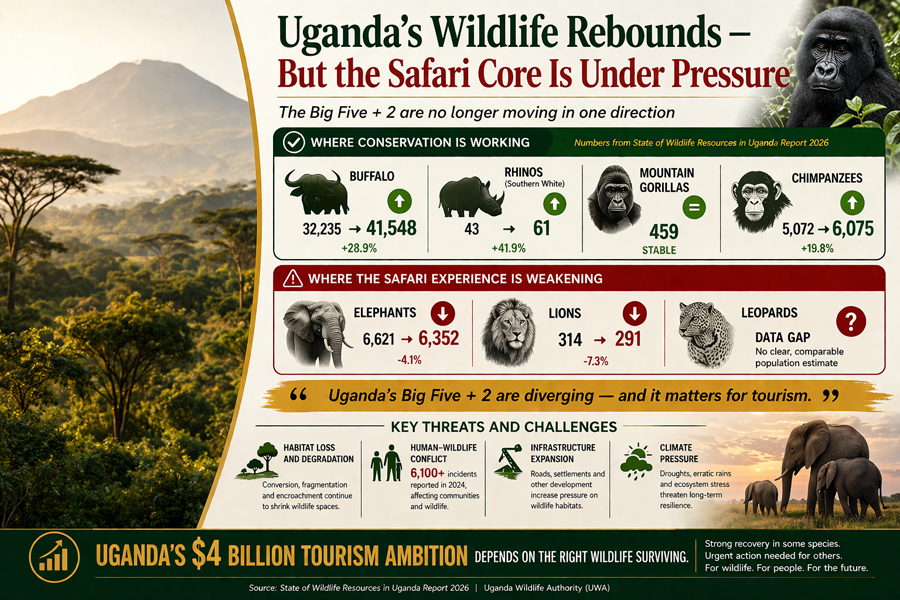
Beyond growth rates and funding, the data also reveals bigger structural risks that could undermine Uganda’s tourism performance over the long term. Foremost among these are growing pressures on wildlife, the country’s single most important tourism asset.
According to the State of Wildlife Resources in Uganda Report 2026, the broader wildlife system is recovering, but not uniformly.
Several herbivore populations are growing strongly. Buffalo populations increased by 28.9%, rising from 32,235 to 41,548, while waterbucks grew by 36%, increasing from 16,638 to 22,623. Uganda kob populations also expanded significantly, rising to more than 175,000.
However, some of Uganda’s flagship safari species are coming under pressure.
Elephant populations declined from 6,621 to 6,352, while lions declined from 314 to 291. Leopards remain poorly quantified nationally, highlighting significant monitoring gaps.
At the same time, over 6,100 human-wildlife conflict incidents were recorded between 2020 and 2025.
This matters because Uganda’s tourism competitiveness is built not on aggregate wildlife numbers, but on iconic experiences. The “Big Five + 2”—lions, elephants, leopards, buffalo, rhinos, plus gorillas and chimpanzees—form the backbone of Uganda’s safari identity.
Any sustained deterioration in these experiences risks weakening Uganda’s competitiveness against regional rivals such as Kenya and Tanzania.
Other structural risks remain equally important.
Tourism infrastructure remains heavily concentrated around Kampala and Entebbe, limiting diversification into secondary tourism circuits in northern, eastern, and western Uganda.
Data quality and statistical consistency also remain emerging concerns. The 2025 Statistical Abstract itself presents expenditure inconsistencies between average spend per trip and segment-level spending figures, highlighting the need for stronger tourism data systems.
The Ministry’s investments in the Tourism Information Management System (TIMS) and Tourism Satellite Account (TSA) framework are important steps forward, but these systems still require deeper integration and consistency.
What must change
If Uganda is to close the gap between current performance and its $4 billion ambition, incremental improvements will not be enough.
The sector must transition from recovery-led growth to transformation-led growth.
First, Uganda must shift decisively from volume to value. The current tourism structure remains too dependent on regional and lower-spending visitor segments. Future growth will need to come increasingly from high-value leisure tourism, MICE tourism, long-haul international travellers, and premium tourism experiences capable of generating higher expenditure per visitor.
Second, international marketing investment must increase substantially. Uganda cannot compete globally while reducing funding for destination promotion.
Third, product development must accelerate. Investment in lodges, attractions, conservation, cultural tourism, and tourism circuits must match the expectations of high-value travellers.
Fourth, stronger tourism data systems will be essential for evidence-based planning, investor confidence, and international benchmarking. Finally, tighter coordination between the Ministry of Tourism, UTB, UWA, local governments, development partners, and the private sector will be critical to delivering execution at scale.
The bottom line
Uganda’s tourism sector has delivered a strong first year of renewed growth. The Ministry of Tourism Tourism Statistical Abstract 2025 confirms that the sector is expanding, recovering, and steadily regaining its footing in the global tourism market. With 1.64 million international arrivals and $1.62 billion in receipts, the rebound is both real and measurable.
But the data also reveals a deeper truth. At 21.3% annual receipts growth, Uganda is progressing strongly, but still below the pace required to comfortably meet the sharper UTB ambition of $4 billion by 2028/29 and the NDMS aspiration of $5 billion by 2028/29.
The gap is not only about growth rates. It is about structure, value, funding, investment, and execution.
The challenge ahead is therefore not simply to grow, but to grow faster, smarter, and with greater value per visitor.
While 2025 proves that Uganda can rebound, the next four years will determine whether it can truly scale up to the multi-billion-dollar tourism economy it now aspires to become.