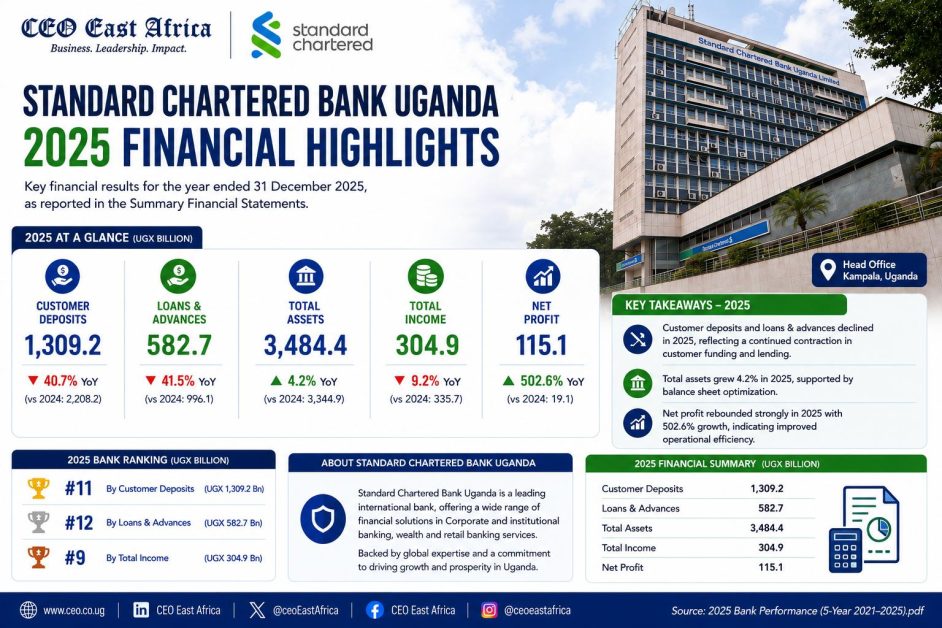
Standard Chartered Bank Uganda delivered one of the most intriguing financial performances in Uganda’s banking sector in 2025, posting a staggering 503% rebound in net profit even as customer deposits and lending contracted sharply.
The bank’s Profit After Tax surged from UGX 19.1 billion in 2024 to UGX 115.1 billion in 2025, while Operating Profit before impairment and tax increased to UGX 146 billion, representing 48% growth compared to 2024.
Yet behind the eye-catching rebound lies a much deeper story about strategic retrenchment, ruthless cost discipline, lower impairments and a deliberate move toward becoming a leaner but more specialised Corporate and Investment Banking institution.
At first glance, some of the numbers appear contradictory.
Customer deposits fell dramatically from UGX 2.21 trillion in 2024 to UGX 1.31 trillion in 2025, representing a decline of approximately UGX 901 billion or 40.8%.
At the same time, the bank’s net loans and advances dropped from UGX 996.1 billion to UGX 582.7 billion, a reduction of UGX 413.4 billion or 41.5%.
Ordinarily, such steep declines in deposits and lending would trigger concerns about liquidity stress, franchise weakness or shrinking market relevance.
But Standard Chartered Uganda’s management says the restructuring reflects strategic repositioning rather than operational distress.
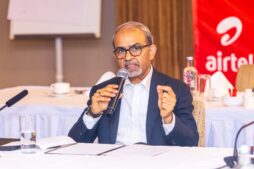
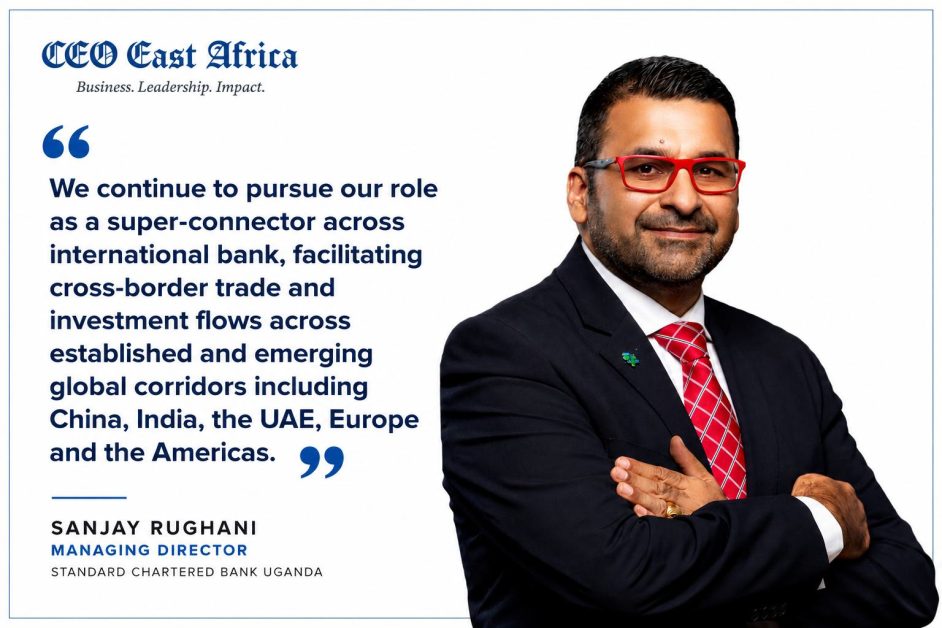
“As part of this strategic sharpening, the sale of our Wealth and Retail Banking business to Absa Bank, subject to regulatory approval, is progressing well and remains on track,” Chief Executive Officer Sanjay Rughani said in the bank’s annual commentary.
“This transaction allows us to focus even more clearly on our Corporate & Investment Banking business, where we have distinctive capability, deep expertise and global connectivity,” he added.
The results increasingly suggest the bank is reducing scale in favour of higher-quality and more targeted banking operations.
“We took deliberate actions to concentrate capital and resources in areas of greatest competitive strength,” Rughani said.
“We simplified our business, strengthened our balance sheet and improved returns on risk-weighted assets.”
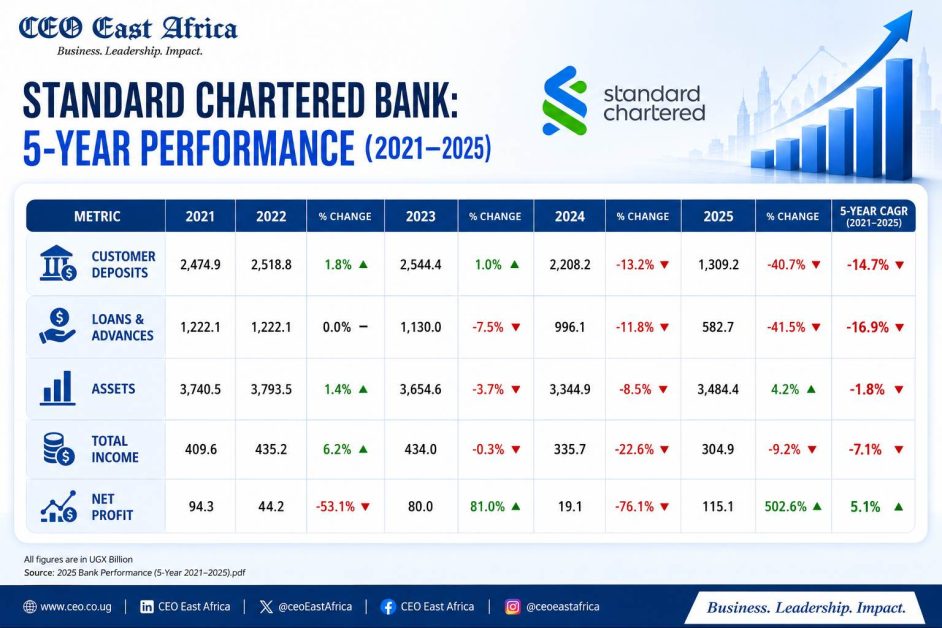
That strategic transition becomes even clearer when viewed over a five-year period.
Standard Chartered Uganda’s customer deposits have steadily declined from UGX 2.47 trillion in 2021 to UGX 1.31 trillion in 2025, representing a cumulative decline of 47.1% over the period.
Its lending book has contracted even faster, shrinking from UGX 1.22 trillion in 2021 to UGX 582.7 billion in 2025, a cumulative decline of 52.3%.
Total income has also trended downward, falling from UGX 409.6 billion in 2021 to UGX 304.9 billion in 2025, equivalent to a negative compound annual growth rate of 7.1%.
Yet despite the shrinking balance sheet, the bank ended 2025 with its strongest net profit in five years.
That paradox tells the real story.
Increasingly, Standard Chartered Uganda appears less interested in being a scale retail bank and more focused on becoming a specialised cross-border corporate and investment banking institution serving multinational corporates, sovereigns, financial institutions and large infrastructure transactions.
Management repeatedly described the bank as a “super-connector across international corridors,” facilitating trade and investment flows between Uganda and markets such as China, India, the UAE, Europe and the Americas.
The bank says it is aligning resources toward Transaction Banking, Financial Markets and Structured Solutions, areas where it believes it has stronger competitive differentiation.
Part of the dramatic profit rebound, however, also reflects recovery from an extraordinary tax distortion in 2024.
In the previous year’s commentary, the bank disclosed that “The Profit After Tax reduced by 76% YoY due to a one-off tax payment recognized under applicable accounting and reporting standards.”
Separately, credible industry sources estimate the one-off tax impact at approximately UGX 88 billion.
That means the 503% rebound, while technically accurate, was amplified significantly by the absence of the prior year’s exceptional tax burden.
Still, even after accounting for the tax normalization effect, the underlying operational recovery remained substantial.
One of the biggest contributors to the turnaround was the sharp decline in loan loss provisions.
Provisions for bad and doubtful debts dropped from UGX 28.9 billion in 2024 to just UGX 4.6 billion in 2025, representing an 84% decline.
This points to improved asset quality, stronger risk selection and tighter credit discipline.
Management emphasised that “strong enterprise risk management remains central to our strategy,” adding that the bank’s “improved asset quality and strengthened capital position reflect this approach.”
At the same time, Standard Chartered Uganda aggressively tightened its cost base under its “Fit for Growth” programme.
Total operating expenses declined from UGX 260.5 billion in 2024 to UGX 183.9 billion in 2025, a reduction of UGX 76.6 billion or nearly 30%.
Personnel expenses also fell from UGX 42.9 billion to UGX 39.3 billion.
The bank says the programme is focused on simplifying operations, standardising processes, digitising workflows and improving operational leverage.
“This has strengthened our cost discipline and positioned us to deliver accelerated and more sustainable growth over time,” the bank said.
Even with lower lending activity, some of the bank’s core income streams remained resilient.
Fees and commission income rose from UGX 21.3 billion to UGX 29.5 billion, while foreign exchange income remained strong at UGX 77.5 billion.
That performance reinforces the bank’s growing dependence on transaction banking, treasury services, cross-border trade flows and structured finance rather than traditional retail-driven lending growth.
Meanwhile, Standard Chartered Uganda continued strengthening its capital position.
The bank’s core capital ratio rose to 26.62%, while the total capital ratio improved to 27.18%, placing it among the better-capitalised banks in Uganda’s financial sector.
Its strategic repositioning also appears increasingly aligned with large-ticket infrastructure and sovereign financing opportunities.
In collaboration with the Ministry of Finance, the bank recently signed financing agreements worth EUR 641.1 million, approximately UGX 2.747 trillion, to support key infrastructure projects in Uganda covering power transmission, water and sanitation as well as critical road infrastructure.
Those transactions underline the direction Standard Chartered Uganda appears to be taking.
The emerging picture is that of a bank consciously moving away from traditional volume-driven banking toward a more specialised, lower-risk and higher-impact operating model.
The five-year trend appears consistent with management’s stated move toward becoming a leaner but more impactful institution focused on areas where it can create “the greatest impact and differentiation.”
Ultimately, Standard Chartered Uganda’s 2025 performance challenges the conventional assumption that bigger balance sheets automatically translate into better profitability.
Instead, the bank appears to be betting that disciplined capital allocation, sharper strategic focus, stronger risk management and operational efficiency can deliver better long-term returns than aggressive balance sheet expansion.
And judging by the numbers, that bet may already be paying off.