
As Uganda’s capital markets mark three decades of growth, the Capital Markets Authority (CMA) stands at a pivotal moment; transitioning from building foundational structures to driving transformative impact.
Since its establishment in 1996, CMA has played a central role in regulating, developing, and deepening the country’s financial markets, fostering investor confidence and expanding access to capital.
Today, with rising participation, growing assets under management, and an increasingly sophisticated ecosystem, the focus has shifted toward scaling impact and supporting national development ambitions.
In this conversation, Josephine Okui Ossiya, Chief Executive, reflects on CMA’s 30-year journey, key milestones, and evolving mandate.
She shares insights on market growth, investor participation, regulatory innovation and outlines CMA’s vision for positioning capital markets at the centre of Uganda’s economic transformation.
Looking back over the past 30 years, how has Capital Markets Authority (CMA)’s mandate evolved, and what key milestones or achievements define its impact today?
Over the past three decades, CMA’s mandate has remained consistent in principle, but its execution and impact have deepened significantly.
What has evolved is not what we do, but how effectively and extensively we do it.
Today, CMA regulates a sophisticated and growing ecosystem of 163 licensed market players across 19 categories.
It oversees two stock exchanges, two securities central depositories, 13 fund managers, eight Collective Investment Scheme (CIS) managers, 23 unit trust schemes, and a growing ecosystem of intermediaries, including dealers, investment advisers, and custodians.
The growth trajectory is compelling. CIS assets under management (AUM) reached UGX 5.66 trillion by December 2025, representing a 47% rise in a single year, something that would have been inconceivable in 1996.
Segregated fund AUM stands at UGX 5.91 trillion, while the Uganda Securities Exchange’s domestic market capitalization has grown to over UGX 15 trillion.
Participation has also expanded meaningfully, with over 206,000 Ugandans holding funded CIS accounts and more than 235,000 holding Securities Central Depository (SCD) accounts, a prerequisite for trading equities and other securities.
Beyond the numbers, our most enduring milestones are institutional. These include the development of the 10-year Capital Markets Development Master Plan in 2017; the establishment of Uganda’s first commodities exchange; the first IPO of Uganda Clays in March 2000; the Stanbic Bank IPO in 2006; and the MTN IPO in 2021, the largest in our history.
Other major milestones include the approval of two securities exchanges and the introduction of a comprehensive new regulatory framework, including updated CIS regulations, ESG disclosure guidelines, a securities industry certification programme to improve practitioner competence, and a Regulatory Sandbox for innovation.
At 30, we are no longer simply building a market; we are building the future architecture of Uganda’s capital formation ecosystem.
How relevant is CMA today in shaping Uganda’s capital markets, and what does success look like over the next decade?
CMA’s relevance is anchored in Uganda’s development ambition. The Tenfold Growth Strategy, which targets a $500 billion economy by 2040, cannot be financed through public resources alone.
The private capital that capital markets can mobilize will be a key component of funding for the development agenda. Capital markets are, therefore, indispensable in mobilizing long-term, patient capital.
Our Strategic Plan 2025/26–2029/30, themed Catalyzing Participation and Harnessing the Capital Markets, is directly aligned with this national agenda.
It is anchored on four pillars: mobilizing long-term capital for private sector growth and infrastructure; expanding stakeholder awareness and participation; harnessing technology for efficiency and accessibility; and strengthening governance and institutional capacity.
Success over the next decade will be defined by a significant increase in listings and capital-raising activity across a wider range of products; a rise in the CIS-to-GDP ratio from the current 2.3% toward regional peer levels such as Kenya’s 4.4%; the emergence of active Sukuk and green bond markets; seamless digital access for retail investors across the country; and, most importantly, a mindset shift in which capital markets become a default, rather than alternative, source of financing.
Our vision is for a capital markets ecosystem that every medium-to-large Ugandan company genuinely considers a viable source of long-term capital.
That is our horizon. We believe this will be our contribution to the Tenfold Growth Strategy. Our ambition is to position Uganda’s capital markets as a central engine of national transformation.

Can you walk us through CMA’s core functions and how they translate into tangible impact for investors, issuers, and the broader economy?
CMA’s mandate translates directly into real economic outcomes through three core functions. First is regulation and approval. We enforce rigorous standards of competence, governance, and financial soundness to ensure trust, credibility, and investor confidence.
Every entity operating in Uganda’s capital markets, from stockbrokers and fund managers to investment advisers, must be vetted and approved by CMA.
We set minimum standards for competence, financial soundness, and conduct. This protects investors and gives issuers confidence that the intermediaries they work with are credible.
Second, we are not passive regulators; we actively build markets. A key part of our mandate is market development. We engage with potential issuers, work with stakeholders to develop the fixed-income space, and partner with like-minded institutions.
Through initiatives such as the Deal Flow Facility (DFF), we enhance issuer readiness and deepen capital access pathways, enabling Ugandan businesses to absorb market-based financing. Ultimately, a well-regulated market is not a constraint; it is a catalyst for participation and growth.
Third, investor protection sits at the heart of CMA’s mandate, and it goes beyond enforcement to empowerment. Through a robust framework of supervision, inspections, and enforcement, we ensure that market participants operate within clear rules and high standards of business conduct.
However, regulation alone is not sufficient. A truly resilient market is built on informed investors who understand both opportunity and risk. That is why investor education is a central pillar of our approach.
We have adopted a multi-channel strategy that combines public awareness campaigns, targeted outreach programmes, digital engagement, and financial literacy initiatives across the country.
Our goal is to demystify capital markets, build confidence, and enable more Ugandans to participate meaningfully in regulated investment opportunities.
Complementing this is the introduction of a toll-free investor line (0800 1000 31), which provides accessible, real-time support and allows investors to seek guidance, verify opportunities, and lodge complaints at no cost.
At CMA, we believe that “an informed investor is a protected investor,” and that is the cornerstone of a functioning market.
How does CMA balance market development with investor protection while ensuring compliance without stifling innovation?
We are guided by proportionality in our regulatory approach. We address this challenge with a clear philosophy: the perceived tension between regulation and innovation is often overstated.
At CMA, we see the two not as opposing forces, but as mutually reinforcing pillars of a healthy and sustainable market ecosystem.
In our experience, well-designed regulation does not stifle innovation; it enables it. A credible regulatory environment builds trust, and trust is what attracts both investors and issuers.
Investors who trust the market participate more actively. Issuers who see a credible regulatory environment are more willing to raise capital. Increased participation, in turn, creates the scale and confidence necessary for innovation to move from experimentation to mainstream adoption.
We operationalize this philosophy through a number of deliberate and practical tools.
The CMA Regulatory Sandbox provides a controlled, supervised environment in which innovators can test new capital markets products, services, and business models under CMA oversight, without the full weight of standard licensing requirements.
This allows us to engage early, understand emerging risks, and co-create appropriate regulatory responses before full-scale deployment.
Our consultative approach to rulemaking ensures that regulation is not developed in isolation. Every major policy or regulatory change is subjected to stakeholder engagement and public exposure, allowing us to incorporate market insights, anticipate unintended consequences, and foster broad-based ownership of the regulatory framework.
In parallel, the securities industry certification programme strengthens the human capital that underpins the market. By raising the competence, ethics, and professionalism of practitioners, we improve the quality of advice and services available to investors, which is ultimately one of the most effective forms of investor protection.
Underlying all of this is our commitment to proportionality. We adopt a risk-based, fit-for-purpose approach to regulation, ensuring that requirements are aligned with the nature, scale, and complexity of activities.
This allows us to maintain strong safeguards without imposing unnecessary barriers to entry or innovation.
In essence, our goal is to create a regulatory environment that is predictable, responsive, and enabling, one that protects the market while also allowing it to evolve, innovate, and grow.
How does CMA collaborate with other regulators and government institutions to strengthen the financial ecosystem?
Capital markets do not operate in isolation; they are deeply interconnected with the broader financial system and the real economy. As such, effective collaboration is not optional; it is essential to building a stable, efficient, and growth-oriented financial ecosystem.
At the domestic level, CMA works closely with fellow regulators through the Financial Sector Stability Forum (FSSF), whichprovides a platform for financial sector regulatory bodies, including Bank of Uganda, CMA, Insurance Regulatory Authority, and Uganda Retirement Benefits Regulatory Authority.
This platform enables coordinated supervision, policy alignment, and information sharing across banking, insurance, pensions, and capital markets. It is particularly important in managing systemic risks, addressing regulatory overlaps, and ensuring that financial sector reforms are coherent rather than fragmented.
For example, as financial products increasingly cut across sectors, such as unit-linked insurance products or pension fund investments in capital markets, this coordination ensures that risks are appropriately monitored and managed across the financial system.
Regionally, CMA plays an active leadership role within the East African Securities Regulators Authorities (EASRA), established in 1997, which brings together securities regulators from Kenya, Uganda, Rwanda, Tanzania, and Burundi.
Through EASRA, we are advancing a shared vision of integrated East African capital markets. This includes harmonization of regulatory frameworks and disclosure standards, coordination of market development initiatives, facilitation of cross-border listings and trading, strengthened supervisory cooperation, regional capacity building through joint training and certification programmes, and knowledge sharing.
The objective is to reduce fragmentation and position East Africa as a single, investable market capable of attracting larger pools of regional and international capital.
At the global level, CMA’s membership in the International Organization of Securities Commissions (IOSCO) helps ensure that Uganda’s regulatory framework is aligned with international best practice and globally recognized principles.
This alignment enhances investor confidence, particularly among institutional and cross-border investors who rely on regulatory credibility and consistency when making allocation decisions.
Beyond formal structures, CMA also collaborates with government ministries such as the Ministry of Finance, development partners such as Financial Sector Deepening Uganda, and market participants to advance initiatives in sustainable finance, digital innovation, and market deepening.
These partnerships are critical in mobilizing technical expertise, unlocking funding, and accelerating implementation.
Taken together, this multi-layered collaboration, domestic, regional, and global, creates a coherent and resilient financial ecosystem.
It strengthens systemic stability, enhances policy effectiveness, and ultimately builds the trust and confidence required for capital markets to thrive and support Uganda’s long-term economic transformation.
What are the biggest regulatory challenges CMA currently faces, and how is it adapting to technological disruption?
Uganda’s capital markets have made significant progress, but several structural constraints must be addressed to unlock their full potential.
One of the most persistent challenges is low liquidity in the equities market. Thin trading volumes constrain price discovery, limit exit opportunities for investors, and reduce the attractiveness of the market to both domestic and foreign institutional investors.
Addressing this requires a coordinated, multi-pronged approach: increasing the pipeline of listings, particularly from high-growth sectors; introducing market-making frameworks to enhance continuous trading and liquidity; broadening the investor base, especially among retail and institutional investors; and strengthening investor confidence through transparency and governance.
Technology is also rapidly transforming how financial markets operate. Digital platforms, mobile-first investing, and the rise of fintech innovation present both opportunity and risk.
They are lowering entry barriers and expanding access, but they also introduce new operational, cyber, and conduct risks. For example, the USE Easy Portal has democratized access to capital markets by enabling any Ugandan with a mobile phone to open a trading account digitally.
In response, CMA is investing in digital supervision and regulatory technology tools to enhance real-time oversight, data-driven surveillance systems to detect market abuse and anomalies, fit-for-purpose regulatory frameworks for fintech and digital platforms, and internal capacity to supervise increasingly technology-driven markets.
Unapproved investment schemes have also become a major challenge, particularly as they appear in many forms and are often amplified through social media and informal networks.
As financial awareness grows, so too does exposure to fraudulent and unregulated schemes. Our response is both preventive and corrective.
It includes sustained investor education campaigns to improve financial literacy and awareness, real-time digital engagement to counter misinformation, a toll-free investor line (0800 1000 31) for verifying opportunities and lodging complaints, and stronger enforcement paired with continued public education to deter misconduct.
Our role is to respond proactively by building a system that is more resilient, inclusive, and future-ready.
How is CMA approaching emerging areas such as fintech, digital assets, and crowdfunding?
We have adopted a forward-looking and proactive approach to emerging financial innovation.
The Regulatory Sandbox remains a cornerstone of this approach, providing a structured and supervised environment in which innovators can test new capital markets products under regulatory oversight.
This allows us to learn alongside innovators, refine regulatory responses, and manage risks before products scale. In parallel, CMA is part of a multi-agency government taskforce developing a policy and regulatory framework for digital assets, ensuring alignment across financial sector regulators.
A crowdfunding regulatory framework is also being developed to unlock alternative financing channels, particularly for SMEs and startups. Our objective is to ensure that innovation evolves within a credible, predictable, and well-governed regulatory perimeter, balancing opportunity with stability, and innovation with investor protection.
From a data and performance standpoint, how have Uganda’s capital markets evolved in recent years, and what key trends and indicators reflect their health and maturity?
Uganda’s capital markets have entered a new phase of growth and participation. Key indicators point to strong momentum.
Collective Investment Schemes (CIS) AUM reached UGX 5.66 trillionin December 2025, a 47.3% year-on-year increase from UGX 3.84 trillion in December 2024.
Funded CIS accounts grew by 14.3% in a single quarter to 206,405. These are not incremental gains; they reflect increased investor confidence driven by a robust regulatory framework. They also signal broader inclusion and growing public awareness.
Segregated fund assets, driven largely by institutional investors, have also grown. AUM managed by CMA-licensed fund managers, primarily on behalf of pension and occupational schemes, stood at UGX 5.91 trillion at the end of December 2025.
In the equity markets, domestic market capitalization has continued to rise, supported by stronger performance among listed companies. It now stands at over UGX 15 trillion, with more than 235,000 Ugandan accounts trading on the securities exchange.
Perhaps the most important shift is behavioural. We are seeing a transition from passive savings to active investment, particularly among retail investors.
This reflects growing awareness, improved access through digital platforms, and increased trust in regulated investment products.
Related
 Bank of Uganda kicks off domestic gold purchase from licensed miners in three-year pilot programme
That shift is foundational, because it signals the emergence of a participatory investment culture, which is critical for long-term market sustainability.
Which sectors and instruments, such as bonds, REITs, and green finance, are driving activity or showing strong growth potential?
Government securities, particularly treasury bills and bonds, remain the dominant asset class in Uganda’s capital markets, accounting for 86.8% of segregated fund AUM and 68.9% of CIS AUM.
This reflects the market’s natural evolution, as government securities offer attractive yields, liquidity, and low default risk. However, the future of Uganda’s capital markets lies in diversification and innovation.
Several growth areas stand out. Uganda is actively positioning itself to access the estimated $4.9 trillion global pool of Sharia-compliant capital through Islamic capital markets, particularly from Middle East and Asian investors.
Islamic capital markets will open Uganda to sovereign wealth funds and other Sharia-compliant investors who have historically been unable to participate in conventional bond issuances.
CMA has been actively involved in stakeholder processes for Uganda’s first Sukuk issuance, and the regulatory framework is being developed to accommodate this asset class.
Second, the draft ESG Disclosure and Sustainability Reporting Guidelines position Uganda to leverage its pipeline of infrastructure, energy, and climate-adaptation projects to attract ESG-focused international capital.
Third, with more than 206,000 accounts and 47% year-on-year AUM growth, CIS is currently the most dynamic segment of Uganda’s retail investment landscape. It provides a scalable and accessible entry point for retail investors.
Fourth, Uganda’s Capital Markets Development Master Plan identifies REITs and infrastructure bonds as important channels for directing long-term capital into real estate and infrastructure.
Uganda’s rapid urbanization and infrastructure deficit create a natural pipeline of underlying assets, and CMA’s regulatory modernization is laying the groundwork for these instruments to be introduced in a structured and credible way.
The strategic imperative is, therefore, to rebalance the market by reducing over-reliance on government securities and building a more diversified, resilient, and inclusive financial ecosystem.
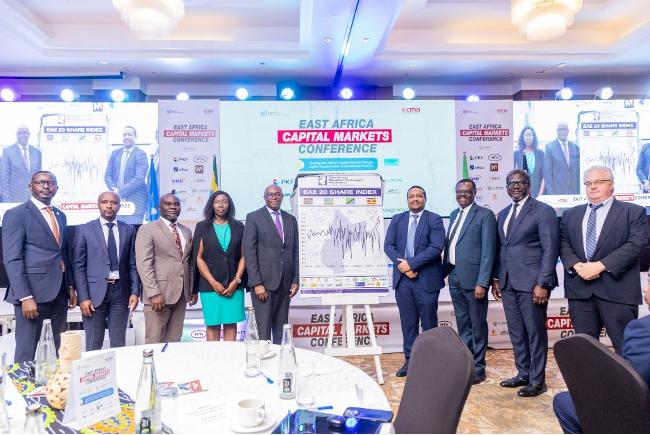
How does Uganda compare regionally within East Africa, and how can it position itself as a competitive investment destination?
Uganda is at a pivotal stage in its capital market development journey, moving from foundational growth toward strategic positioning within East Africa and the broader African investment landscape.
First, Uganda continues to benefit from robust macroeconomic performance, with sustained GDP growth in the range of 6–7%, a relatively stable exchange rate, and inflation maintained within target bands.
This stability provides a critical foundation for long-term investment and enhances investor confidence in local-currency assets.
The S&P sovereign outlook upgrade to positive in November 2025 also strengthened investor confidence.
Second, Uganda offers attractive yields relative to global and frontier markets, particularly in government securities. With yields in the mid-to-high teens across maturities, the market presents compelling risk-adjusted returns, especially in an environment where developed-market yields remain comparatively low.
This makes Uganda attractive to both regional and international fixed-income investors seeking diversification.
Third, the country is supported by a progressively modernizing regulatory framework aligned with global standards and increasingly responsive to market evolution.
Reforms in collective investment schemes, ESG disclosures, digital innovation, and capital-raising frameworks are improving market integrity, investor confidence, and ease of participation for both issuers and investors.
Regional comparisons show both progress and the scale of work ahead. In CIS, Uganda’s AUM-to-GDP ratio of 2.3% compares favourably with Tanzania’s 2%, though it remains behind Kenya’s 4.4%, placing Uganda second in the region with significant room for growth.
Uganda’s average CIS account balance of $7,622 is higher than Kenya’s $1,777, suggesting the need to democratize CIS further. Kenya’s 2.96 million CIS accounts, compared with Uganda’s 206,000, illustrates the participation gap we are working to close.
In equities, the USE’s domestic market capitalization of $4.4 billion compares with the NSE’s $22.8 billion, DSE’s $6.3 billion, and the RSE’s $760 million.
However, Uganda’s 25.3% year-on-year market cap growth in calendar year 2025 was the strongest in the region, and the USE Local Company Index’s 26.2% annual gain highlights the quality of listed companies.
Uganda’s competitive strategy rests on several pillars: strong macroeconomic fundamentals; a large investment opportunity in infrastructure, energy, agribusiness, and minerals under the Tenfold Growth Strategy; development of new instruments such as Sukuk and green bonds; and deeper regional integration through EASRA and EAC frameworks to enable cross-border listings and capital flows.
Importantly, Uganda’s strategy is not to replicate larger markets, but to differentiate deliberately. This means positioning Uganda as a high-growth frontier market with strong fundamentals, a gateway for innovative and sustainable finance instruments, a digitally accessible market with expanding retail participation, and a regionally connected hub within an increasingly integrated East African financial system.
Uganda’s opportunity is therefore not merely to catch up, but to define a distinctive value proposition in the region, one that combines growth, innovation, and accessibility.
Where are the most compelling untapped opportunities in Uganda’s capital markets for local and international investors?
Uganda offers an attractive investment environment characterized by strong economic growth, a young and expanding population, a rapidly modernizing regulatory environment, and a significant financing gap that creates genuine demand for capital.
Uganda’s capital markets, therefore, present significant and still underutilized opportunities across all investor segments, reflecting both the early stage of market development and the scale of the country’s economic ambitions.
For retail investors, the most immediate and scalable opportunity lies in expanding participation through accessible, regulated investment vehicles, especially Collective Investment Schemes (CIS).
Despite strong recent growth, participation remains a fraction of the addressable market, given Uganda’s young, increasingly urbanized, and financially active population.
The convergence of mobile money infrastructure, digital onboarding platforms, and low entry thresholds for CIS products creates a powerful foundation for democratizing access to investment opportunities.
The opportunity is, therefore, not simply incremental growth, but a step-change in financial inclusion, where millions of Ugandans move from informal savings into structured, income-generating investments.
This has major implications for household wealth creation, savings mobilization, and domestic capital formation.
For institutional investors, especially pension funds, insurance companies, and collective investment schemes, the key opportunity lies in portfolio diversification and deeper market engagement.
A significant share of institutional assets remains concentrated in government securities because of their yield, liquidity, and perceived safety.
While understandable, this concentration presents structural limitations in portfolio optimization, risk diversification, and support for private sector financing.
As the market evolves, there is growing opportunity to allocate capital toward long-term financing for established businesses, infrastructure instruments aligned with national development priorities, and alternative assets and private market structures.
CMA’s efforts to support the development of new instruments, strengthen disclosure frameworks, and improve market infrastructure are aimed at creating conditions under which institutional investors can broaden their asset allocation strategies confidently, deepening the market and improving resilience.
For international investors, Uganda offers a compelling frontier-market proposition characterized by high yields (15.8%–17.95% across maturities), strong growth prospects, and an expanding opportunity set.
Key attractions include high-yield sovereign instruments, a growing pipeline of infrastructure and project finance opportunities in energy and transport, and emerging access to new asset classes such as Sukuk and green bonds, which align with global investment trends.
At the same time, regulatory reforms and alignment with international standards are enhancing market transparency, governance, and ease of entry, all of which are critical for cross-border capital.
As Uganda continues to strengthen macroeconomic stability and regulatory credibility, it is increasingly well positioned to attract long-term, patient capital from institutional investors, development finance institutions, and global asset managers.
Taken together, Uganda’s capital markets offer a distinctive proposition anchored in three elements: strong growth fundamentals, attractive yields, and reform momentum. What makes Uganda especially compelling is the convergence of these factors at a time when the market remains relatively underpenetrated.
What strategies is CMA using to increase the number of listed companies, and how can SMEs better access capital markets?
The next phase of growth will not be defined by regulation alone, but by our ability to bring more Ugandan businesses to market. At its core, a strong capital market is built on vibrant, diverse, and growing companies.
Across Uganda, businesses are expanding in agriculture, energy, manufacturing, and technology. Yet only a small number have accessed capital markets for long-term financing.
This does not reflect a lack of potential; rather, it points to gaps in access, awareness, and readiness. Closing that gap is critical. More listings mean greater access to patient capital, more investment opportunities for citizens, deeper and more liquid markets, and stronger economic growth.
At CMA, we are taking a holistic approach to increase listings. We are simplifying regulations to make market entry more efficient while maintaining strong investor protection. At the same time, we are investing in founder education to help business leaders understand how capital markets can support their growth.
Equally important is building a pipeline of market-ready companies. Through initiatives such as deal flow development and issuer readiness programmes, we are helping businesses strengthen governance, improve financial reporting, and prepare for public markets.
For SMEs, access remains a major challenge. That is why we are developing frameworks such as crowdfunding, with the aim of enabling businesses to grow into the market rather than being excluded from it.
Perhaps the most important transformation is cultural. We must move from a mindset in which listing is seen as a last resort to one in which it is viewed as a natural step in a company’s growth journey.
Uganda has the fundamentals: strong growth, a young population, and a rapidly evolving financial ecosystem. The task now is to connect these strengths and ensure that capital markets become a first-choice platform for financing growth.
When more businesses list, the impact extends beyond markets; it drives jobs, investment, and national prosperity.
What role can capital markets play in financing infrastructure and long-term development projects?
Uganda’s infrastructure financing requirement is enormous. The Tenfold Growth Strategy’s ambition to build a $500 billion economy by 2040 requires large-scale investment in roads, energy, railways, water and sanitation, digital infrastructure, and urban development, far beyond what government budgets alone can support.
Capital markets are uniquely suited to infrastructure financing because they provide access to long-term, patient capital aligned with the extended gestation periods and predictable cash flows that characterize infrastructure projects.
A major advantage of capital markets is their ability to pool long-term domestic savings, particularly from pension funds, insurance companies, and collective investment schemes, and channel them into productive investments.
At the same time, well-structured instruments can attract international capital, including development finance institutions and global asset managers seeking stable, yield-generating assets in emerging markets.
This dual mobilization of domestic and external capital is critical to closing Uganda’s infrastructure financing gap. Several instruments are particularly well suited to this purpose.
Infrastructure bonds provide a mechanism for government and corporates to raise long-term funding directly from domestic and international investors. Their maturities match the lifecycle of infrastructure assets and allow efficient asset-liability matching for institutional investors.
Green bonds and Green Sukuk can finance projects in renewable energy, climate-resilient infrastructure, sustainable transport, and water management. As global capital increasingly shifts toward sustainability, Uganda is well positioned to tap ESG-focused investment flows.
Public-private partnership (PPP) structures can also benefit from capital market financing through transparent and scalable instruments. Through securitization and bond issuance, infrastructure projects can be structured in a way that is both bankable and investable.
The task ahead is to continue strengthening the ecosystem through robust regulatory frameworks, bankable project pipelines, clear policy and tax incentives, and strong governance and transparency.
With these elements in place, capital markets can become a central pillar of infrastructure financing in Uganda, bridging the gap between long-term capital and long-term development needs.
What initiatives has CMA implemented to improve financial literacy and broaden investor participation across different demographics?
Financial literacy and investor education are not peripheral activities for CMA; they are core drivers of capital market growth. Without informed investors, participation remains shallow and markets cannot achieve depth or resilience.
At CMA, we take a multi-channel and inclusive approach to investor education. This includes nationwide outreach through traditional media, digital platforms, and community engagements, ensuring that we reach Ugandans across regions and demographics.
We complement this with practical tools such as a toll-free investor line (0800 100031), which provides real-time support for verifying investment opportunities, accessing information, and resolving complaints.
A strong emphasis is placed on targeted inclusion, particularly for youth, women, and underserved communities, who remain underrepresented in formal investment markets.
Ultimately, investor education builds confidence, reduces vulnerability to fraud, and encourages long-term investment behaviour.
An inclusive market is not only equitable; it is also deeper, more liquid, more resilient, and better positioned to support Uganda’s long-term economic growth.
As CMA marks 30 years, what is your vision for the next decade, and what transformative changes would you prioritize for Uganda’s capital markets?
The last 30 years were about building foundations. The next decade represents a decisive shift from foundation-building to impact scaling. Having established the core regulatory frameworks, institutions, and market infrastructure, the focus must now turn to expanding reach, deepening activity, and delivering measurable economic impact.
Our vision centres on five transformative priorities:
Deepening participation:Expanding the investor base is fundamental to market depth and resilience. Our ambition is to grow to one million CIS accounts over the next five years, driven by digital access, targeted financial literacy initiatives, and product innovation.
This will help more Ugandans transition from informal savings to structured, income-generating investments, strengthening domestic capital formation.
Diversifying instruments: A well-functioning market must offer a broad range of instruments that meet the diverse needs of issuers and investors. We will prioritize the development of corporate bonds, infrastructure bonds, REITs, green finance instruments, and Sukuk, reducing over-reliance on government securities and creating a more balanced, innovative, and resilient product ecosystem.
Expanding listings: Increasing both the number and diversity of listed companies is critical. This will be achieved through regulatory simplification, issuer-readiness programmes, policy incentives, and targeted engagement with high-growth sectors. The goal is to make listing a natural and attractive pathway for business growth rather than an exceptional event.
Driving regional integration: Through collaboration within regional frameworks such as the East African Community and EASRA, we aim to enable seamless cross-border capital flows, harmonized regulatory standards, and integrated trading platforms. A more unified regional market will enhance liquidity, scale, and global competitiveness.
Embedding sustainability:Sustainability will be central to market development. By advancing ESG disclosure frameworks, green bonds, and Islamic finance instruments, we will position Uganda to attract responsible and long-term global capital while aligning investment flows with national priorities such as infrastructure, climate resilience, and inclusive growth.
At 30, CMA’s foundations are firmly in place, but the opportunity ahead is far greater. Our ambition is to build a capital market that is not only functional, but transformational, one that mobilizes capital at scale, expands opportunity for citizens and businesses, and serves as a central pillar of Uganda’s long-term prosperity.
The next decade is not about incremental change. It is about redefining the role of capital markets in Uganda’s economic future.