

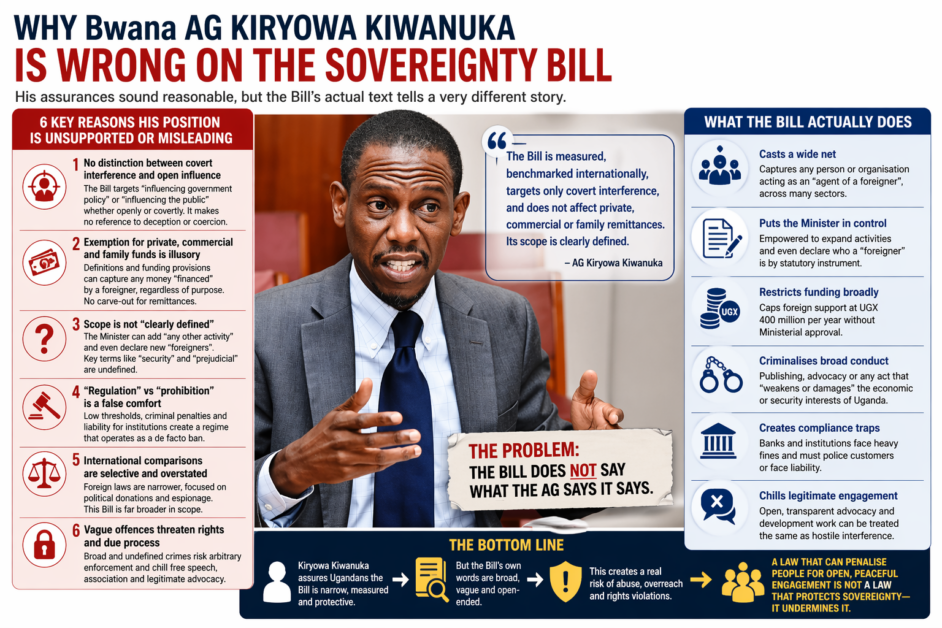
The Attorney General, Mr. Kiryowa Kiwanuka, published a defence of the Protection of Sovereignty Bill, 2026 (the “Bill”), arguing that it is a measured, internationally benchmarked instrument designed to curb covert foreign interference whilst preserving Uganda’s openness to legitimate foreign engagement. The Attorney General’s contentions are attractive in the abstract. The difficulty is that the Bill, as gazetted, does not say what the Attorney General says it says. This paper examines each of the Attorney General’s claims against the language of the Bill itself and identifies six points on which his assurances are unsupported, partially supported, or materially misleading.
I. The Bill does not distinguish between covert interference and open influence
The Attorney General draws a sharp distinction between “foreign influence”, described as open, transparent engagement, and “foreign interference”, described as covert, coercive, or deceptive action, and presents the Bill as targeting only the latter. This is the cornerstone of his defence, and it is wrong.
The operative provisions of the Bill make no reference whatsoever to covertness, deception, or coercion as elements of any offence. Clause 2(2) applies to any person who engages in activities such as “influencing the development of the policy of Government” or “influencing the public to oppose the policy of Government”, regardless of whether the influence is exercised openly or covertly. The definition of “disruptive activities” likewise contains no requirement that the impugned conduct be clandestine or deceptive: paragraph (a) captures any conduct “prejudicial to or threatening the security of Uganda”, and paragraph (g) captures “disrupting or interfering with the lawful activities, business operations, peace or human rights of any person”, irrespective of the manner in which the act is carried out.
The distinction the Attorney General draws is not contained in the Bill and may have remained a policy aspiration. An international nongovernmental organisation (INGO) conducting an entirely public, transparent advocacy campaign on land rights or environmental standards is caught by the same provisions as a hostile intelligence operation. The Bill does not know the difference.
II. The claimed exemption for private, commercial, and family funds is illusory
The Attorney General asserts that a person who receives money from the diaspora “intended for private, commercial or family purposes” will not be required to comply with the Act, and that “the law will only apply to funds that are meant to fund the activities listed in the Bill”. This assurance is only partially supported and, on a careful reading, is illusory.
While Clause 2(1) limits the Act’s application to persons who act “as an agent of a foreigner”, the definition of “agent of a foreigner” turns not on the purpose of the funds received but on whether the person’s activities are “directly or indirectly supervised, directed, controlled, financed, or subsidised by a foreigner”. A person who is “financed” by a foreigner, even for private, commercial or family purposes, could fall within the literal definition.
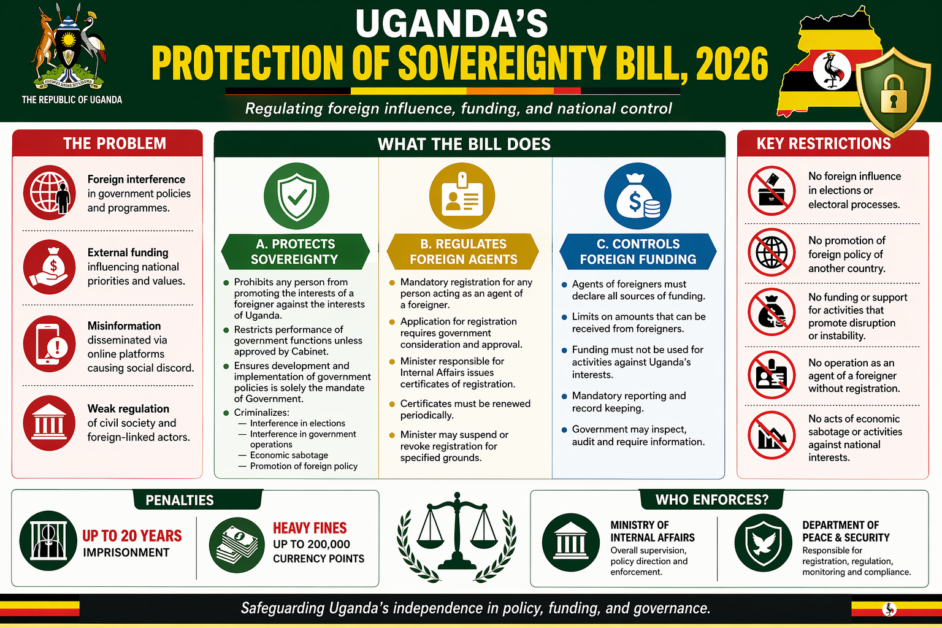
Further, Clause 25(1) requires that before paying out to an agent of a foreigner, the supervised institution first obtain from the agent of a foreigner a declaration of the source of funds (Clause 21) and proof of authorisation from the Minister of Internal Affairs if applicable.
Clause 21 requiring declaration of sources of funds received from a foreigner makes no exemption on purposes of the funds, whether private, commercial or family. If the law intended to only address civil society organisations, it could have achieved this specifically and avoided an overly broad definition of “agent of a foreigner”.
The Attorney General is totally silent on why a Ugandan resident abroad is included in the definition of foreigner. It is this definition that causes funds sent by a Ugandan in the diaspora to be caught by the Bill, which also designates the family of such a Ugandan as agents of foreigners.
More critically, Clause 22(1) restricts any person or agent of a foreigner from obtaining financial support from a foreigner more than UGX 400,000,000 within twelve months “without the written approval of the Minister”, with no carve-out for private, commercial, or family remittances.
The Attorney General’s reassurance depends entirely on his own implied purposive reading that a court may or may not adopt, and that a zealous DPP need not accept.
III. The Bill’s scope is not “clearly defined”
The Attorney General states that “[t]he scope of the Act is clearly defined under the Bill” and confines it to activities promoting a foreigner’s interests against Uganda’s, influencing government policy, influencing public opinion against government policy, and funding political parties or elections. This is not an accurate description of the Bill.
While Clause 2(2) does list those activities, the list is explicitly non-exhaustive: paragraph (i) empowers the Minister to declare “any other activity” by statutory instrument. The definition of “foreigner” is similarly open-ended, as the Minister may “by statutory instrument, declare [any person, institution or body] to be a foreigner” under paragraph (f). Key operative terms, “security”, “prejudicial”, “interests of Uganda”, and “economic sabotage”, are nowhere defined. Clause 13 criminalises publishing information or participating in any act “that weakens or damages the economic system or viability of the country” without further elaboration.
The scope of the Bill is therefore neither fixed nor clearly bounded; it is expandable by Ministerial discretion and subject to prosecutorial interpretation of broadly drafted terms. A scope that can be enlarged by executive fiat at any time is not a “clearly defined” scope. This runs afoul of Article 28(3)(12) and the fundamentals of criminal law that require definition of a criminal offence with specificity and clarity as opposed to vagary and susceptibility to multiple interpretation.
IV. The distinction between “regulation” and “prohibition” is a false comfort
The Attorney General contends that “[t]he Bill does not prohibit foreign funding or cross-border transfer of money. Instead, it intends to regulate foreign funding in order to safeguard Uganda’s sovereignty”. This is technically accurate but materially misleading.
Clause 22(1) does not ban foreign funding outright, but it caps it at UGX 400,000,000, approximately USD 105,000, within any twelve-month period without the written approval of the Minister. For a mid-sized INGO or a commercial enterprise, USD 105,000 represents a fraction of a single programme budget or capital requirement. Breach of this cap is not a regulatory infraction; it is a criminal offence carrying fines of up to UGX 4,000,000,000 for legal entities and up to 20 years’ imprisonment for individuals, with mandatory forfeiture of the said funds to the State.
Clause 25(1) further requires supervised institutions to obtain declarations and proof of Ministerial authorisation before releasing funds to an agent of a foreigner, with a fine of UGX 4,000,000,000 on the institution for non-compliance.
The combined effect of a low cap, criminal sanctions, mandatory forfeiture, and financial institution liability creates a regime that, while not a formal prohibition, operates as a de facto barrier to foreign funding for any organisation unable to secure Ministerial approval. Calling this “regulation” rather than “prohibition” is a distinction without a practical difference for many INGOs and commercial enterprises.
V. The international comparisons are selective and overstated
The Attorney General draws parallels with the UK National Security Act 2023, Australia’s Foreign Influence Transparency Scheme, Singapore’s Foreign Interference (Countermeasures) Act, the US Foreign Agent Registration Act, and Canada’s Bill C-70. He identifies three “common tools” across these regimes: registration, funding bans on political donations, and information controls. The comparison is selective and, in several respects, misleading.
The international comparators cited by the Attorney General are narrower than the Bill in at least four material respects:
- Focus: Other laws target political donations, electoral interference, hostile information campaigns. The Bill covers all activities by agents of foreigners, including health, education, community services, policy advocacy, and any activity the Minister may declare.
- Mens rea: Other regimes require intent or knowledge. The Bill has no mens rea requirement for “disruptive activities”.
- Penalties: Other regimes vary penalties by severity. The Bill imposes up to 20 years’ imprisonment and UGX 4 billion fines across a wide range of offences.
- Judicial oversight: Other regimes allow review or tribunal oversight. The Bill allows ministerial suspension or revocation without court order, hearing, or prior notice.
The 1938 US Foreign Agents Registration Act applies to non-citizens seeking to access US funding.
The Attorney General’s own article acknowledges that “[s]uccess hinges on clear definitions, targeted tools and the wisdom to tell the difference between helpful foreign engagement and covert interference”. On this self-imposed standard, the Bill falls short: its definitions are broad and open-ended, its tools are not targeted, and it draws no operative distinction between helpful engagement and covert interference. If the Attorney General believes that clear definitions and targeted tools are the hallmark of international best practice, then the Bill he defends does not meet that standard.
VI. The Bill is not a financial-ecosystem measure
The Attorney General argues that “[a] law targeting domestic interference by hostile foreign actors should focus on the financial ecosystem, blocking local proxies from accessing funds for that purpose”. If that were all the Bill did, it would be a defensible piece of legislation. But the Bill extends well beyond financial regulation.
Part II of the Bill criminalises exercising government functions without Cabinet approval (Clause 6), developing policy without Cabinet approval (Clause 7), hindering the implementation of government policy (Clause 8), promoting unadopted foreign policy (Clause 10), interfering with electoral processes (Clause 11), interfering with the operations of government (Clause 12), and economic sabotage (Clause 13). These are substantive conduct offences; they criminalise what people say, write, sing, illustrate, advocate, and do, not merely how money moves. An INGO that publishes a policy paper, submits a parliamentary brief, or files a constitutional petition is not operating within the “financial ecosystem”; it is exercising fundamental freedoms under the Constitution, freedom of speech and expression and the civic right to participate in governance of the country not to mention the duties of the citizen under the directive principles of State Policy.
The Bill’s reach therefore significantly exceeds the financial-ecosystem focus the Attorney General himself advocates as the proper approach.
Conclusion
The Attorney General presents a policy rationale that is reasonable in the abstract: Uganda, like any sovereign state, has a legitimate interest in distinguishing genuine foreign engagement from covert interference. The difficulty is not with the rationale but with the instrument. The Bill as gazetted does not operationalise the distinction the Attorney General draws. Several of his central assurances, the exemption of private, commercial or family funds, the clearly defined scope, the characterisation of the regime as mere regulation rather than prohibition, depend on the Attorney General’s own implied limitations that are absent from the statutory text. Without amendments introducing express exemptions, defined terms, mens rea requirements, proportionate penalties, and judicial oversight, the gap between the Attorney General’s stated intent and the Bill’s operative provisions remains substantial.
Bwana AG’s defence of the Bill is, with respect, a defence of a Bill he wishes he had drafted, not the one before Parliament.
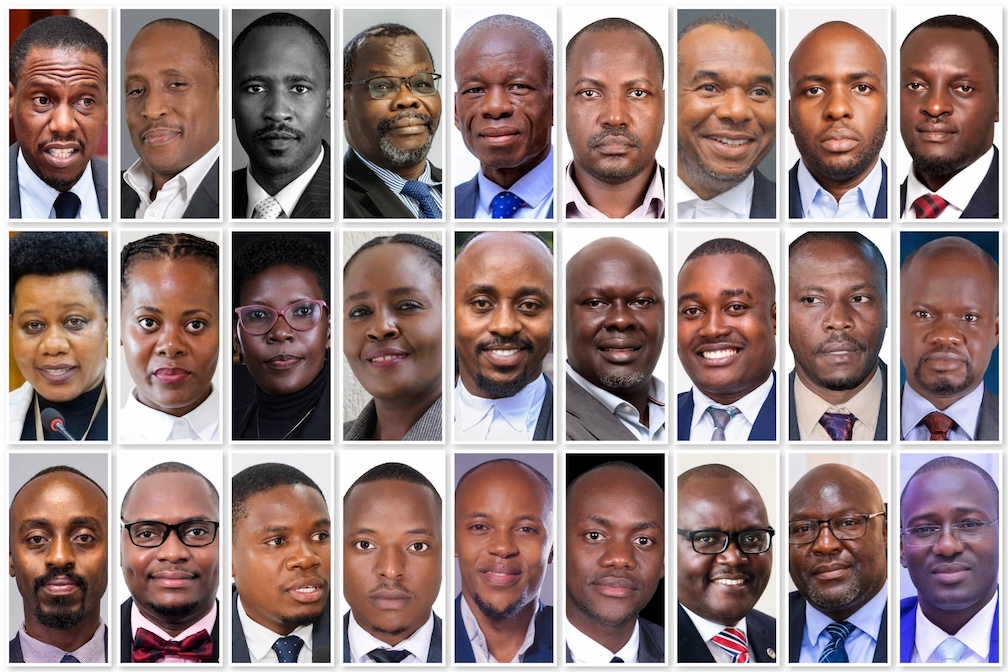
Authors: Dr. Sarah Bireete, Andrew Karamagi, Magelah Peter Gwayaka, Lillian Drabo, Bernard Banturaki, Job Kiija, Michael Okua, Mohmed Mbabazi, Peter Mukiidi Walubiri, Samuel Wanda, Peter Arinaitwe, Kato Tumusiime, Sarah Kasande, Julius K. Warugaba, Paul Mukiibi, Edward Kato Sekabanja, Primah Kwagala, Morgan Muhindo, Dr. Henry Onoria, Kakuru Tumusiime, Anthony Odur, Bruce Kyerere SC, Stephen Kalali, Timothy Amanya, Eron Kiiza, Dr. Ronald Naluwairo, Prof. Chris Mbazira and Phillip Karugaba.







Follow