

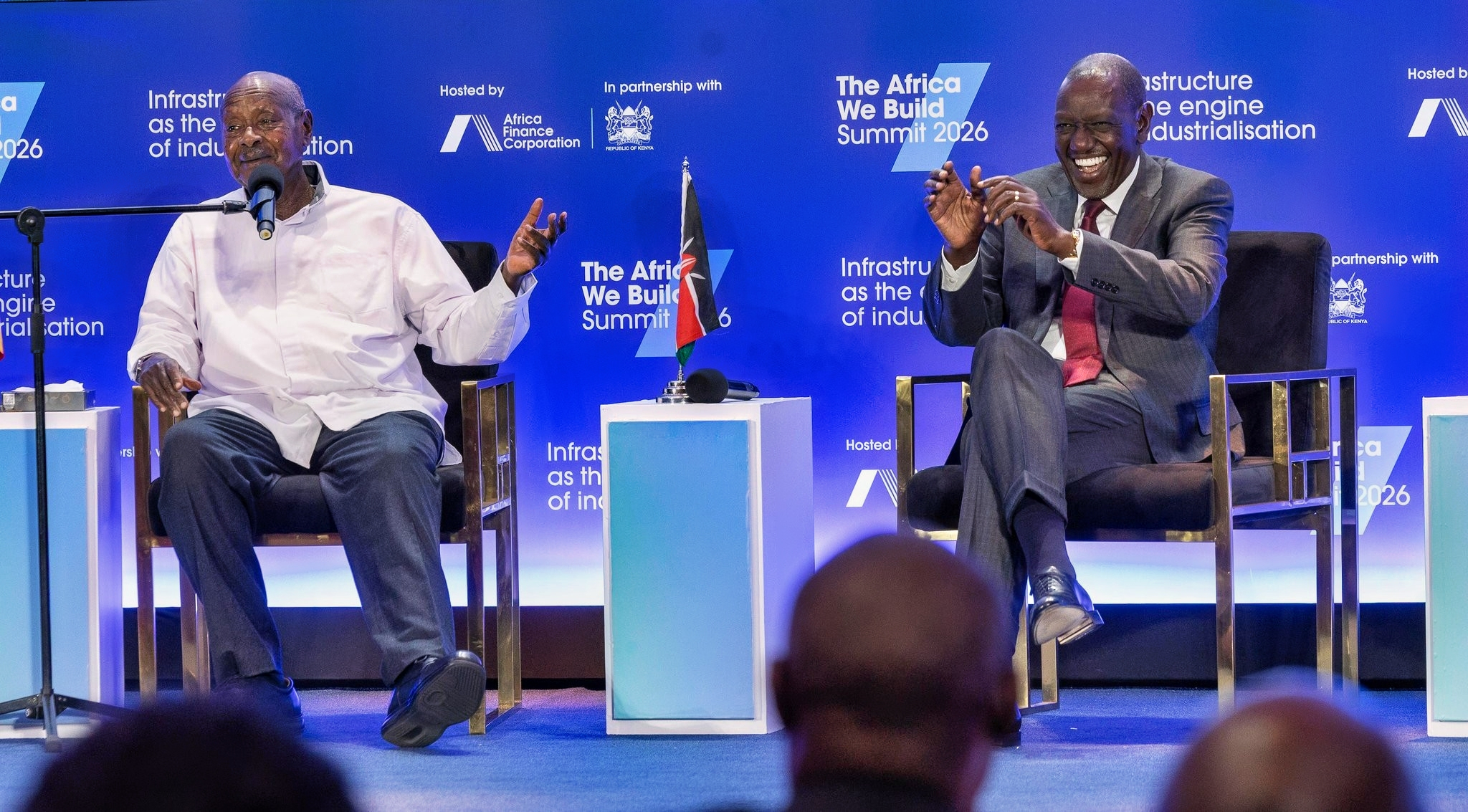
Kenya is prepared to invest in Uganda’s oil refinery project as part of a broader strategy to deepen regional energy cooperation and unlock shared economic potential, President William Ruto has said.
Speaking during the Africa We Build Summit 2026 on Thursday April 23rd, in Nairobi, President Ruto revealed that discussions between Kenya and Uganda are advancing toward joint investments in key petroleum infrastructure, emphasizing long-term regional transformation over short-term gains.
Ruto disclosed that Uganda’s President Yoweri Museveni had previously expressed strong interest in acquiring a stake in the Kenya Pipeline Company (KPC), underscoring the level of commitment to regional integration.
“President Museveni called me and said, ‘I want to buy 50% of Kenya Pipeline, and I don’t care about the price,’” Ruto said. “That is how serious he was. While some were concerned about cost, he could see beyond the price — he could see the opportunity to transform our region.”
In a reciprocal move, Ruto said Kenya is ready to back Uganda’s refinery project, which is expected to play a critical role in reducing East Africa’s dependence on imported petroleum products.
“I want to assure you that the same way Uganda sought to invest in Kenya Pipeline, Kenya is going to invest in your refinery and in the future of our resources together,” he said.
President Yoweri Museveni, in remarks on Uganda’s petroleum journey, attributed delays in oil production to prolonged disagreements with international oil companies over the viability of refining crude locally.
Uganda first discovered oil in 2005, but progress toward commercialisation has been slow, shaped by both policy choices and investor challenges.
The refinery story itself dates back to 2010, when British firm Foster Wheeler completed a feasibility study recommending a 60,000-barrel-per-day refinery. However, financing constraints and location politics quickly emerged as major hurdles.
In 2015, government selected a Russian consortium led by RT Global Resources as the preferred developer, but negotiations later collapsed amid disagreements over risk allocation, equity structure and mounting sanctions. More recently, in June 2023, government terminated the refinery deal with the Albertine Graben Refinery Consortium (AGRC) after its financiers failed to deliver.
Museveni said part of the delay also stemmed from resistance by oil companies, particularly Total, which argued that refineries were not profitable.
“They were telling my people that refineries don’t make money. I asked, if they don’t, why do others build them?” Museveni said, adding that internal assessments showed Uganda’s refinery project has a strong internal rate of return of about 14 percent.
He explained that Uganda insisted on developing a domestic refinery to serve regional markets, rejecting proposals to export all crude. The government eventually agreed on a modular refinery approach, starting with a capacity of 60,000 barrels per day, with plans for expansion.
Museveni added that the refinery would have priority access to Uganda’s crude, with surplus volumes exported via the East African Crude Oil Pipeline (EACOP) through Tanzania. He noted that the pipeline could also serve neighboring countries such as the Democratic Republic of Congo and South Sudan, which have oil reserves.
The Ugandan leader further revealed that the country has multiple oil-rich regions beyond the currently developed fields, describing the existing production area as just one of several prospective provinces.
The remarks come amid growing concern over Africa’s continued reliance on imported refined petroleum despite its significant crude oil production. Ruto noted that the continent produces about 10 million barrels of oil per day, yet remains a net importer of approximately 120 million metric tons of petroleum products annually, costing around $90 billion.
“We meet at a time of global shocks and disruptions stemming from conflicts such as the war in the Gulf,” Ruto said. “Africa must rethink its energy strategy and invest in infrastructure that secures its future.”
He urged African nations to shift focus from short-term cost considerations to long-term economic benefits through joint investments and industrialization.
“The value is not in getting something cheap today, but in building something that earns you opportunities tomorrow,” Ruto added.
The proposed Kenya-Uganda collaboration is seen as a significant step toward strengthening the East African Community’s energy security and fostering economic integration across the region.
Background
On February 25th, 2026, Uganda National Oil Company (UNOC) invested over UGX 918 billion in the recently concluded initial public offering (IPO) of Kenya Pipeline Company (KPC), marking one of the region’s largest state-linked cross-border infrastructure transactions this year.
UNOC confirmed that it acquired 31% of the shares offered to the public in the IPO, which closed on Tuesday.
The acquisition translates into an effective 20.15% shareholding in KPC. The remaining 35% of KPC that was not floated was retained by the government of Kenya.
This means UNOC now controls close to a quarter of the overall shareholding in the pipeline company, positioning it as one of the most significant shareholders in the entity.
The investment positions Uganda as a major shareholder in one of East Africa’s most strategic energy infrastructure companies, deepening Kampala’s commercial and operational footprint within the regional petroleum supply chain.
UNOC Chief Executive Officer Proscovia Nabbanja said the transaction was based on straightforward financial considerations.
“There was no price discount,” she said, emphasising that the deal provided UNOC with numerous strategic concessions tied to broader cooperation arrangements between the two petroleum entities.
She explained that only 65% of KPC’s total shares were floated to the public, meaning UNOC’s 31% purchase applied strictly to the publicly offered portion.
Kenya Pipeline Company issued 11.8 billion shares in the IPO. UNOC purchased approximately 3.66 billion shares at KSh9 per share, bringing the total transaction value to about KSh32.96 billion.
At prevailing exchange rates, the investment is equivalent to roughly $255.7 million, or about UGX 918 billion.
On December 17th, 2025, Parliament approved a proposal authorising UNOC to borrow up to USD 2 billion (UGX 7.12 trillion) from Vitol Bahrain E.C. to finance petroleum infrastructure and related projects.
The funding will support refinery development, storage facilities, pipeline infrastructure and regional logistics investments, including the extension of the finished products pipeline from Eldoret to Kampala.
Uganda is also developing a USD 4 billion, 60,000-barrel-per-day oil refinery in Hoima District in partnership with UAE-based Alpha MBM Investments, with operations expected to begin around 2029–2030.
The broader strategy reflects Uganda’s push to deepen value addition, strengthen energy security and position itself as a key player in East Africa’s petroleum market.








Follow