
The Chief Executives of MTN Uganda and Airtel Uganda, two of the country’s largest telecommunications companies, among its biggest taxpayers, and operators of the dominant mobile money platforms, have come out strongly against the Protection of Sovereignty Bill (2026), warning that in its current form, it is unnecessary, duplicative, overly broad, and potentially harmful to the telecommunications, financial systems, and digital economy.
Their position, formally captured in a joint memorandum to Parliament and co-signed by the Managing Director of Lycamobile Uganda, represents one of the most coordinated and consequential private sector interventions in recent legislative debate.
At the heart of their submission is a clear and consistent message: while the objective of protecting Uganda’s sovereignty is legitimate, the proposed law risks undermining the very infrastructure that powers the country’s financial inclusion, digital transformation, and economic growth.
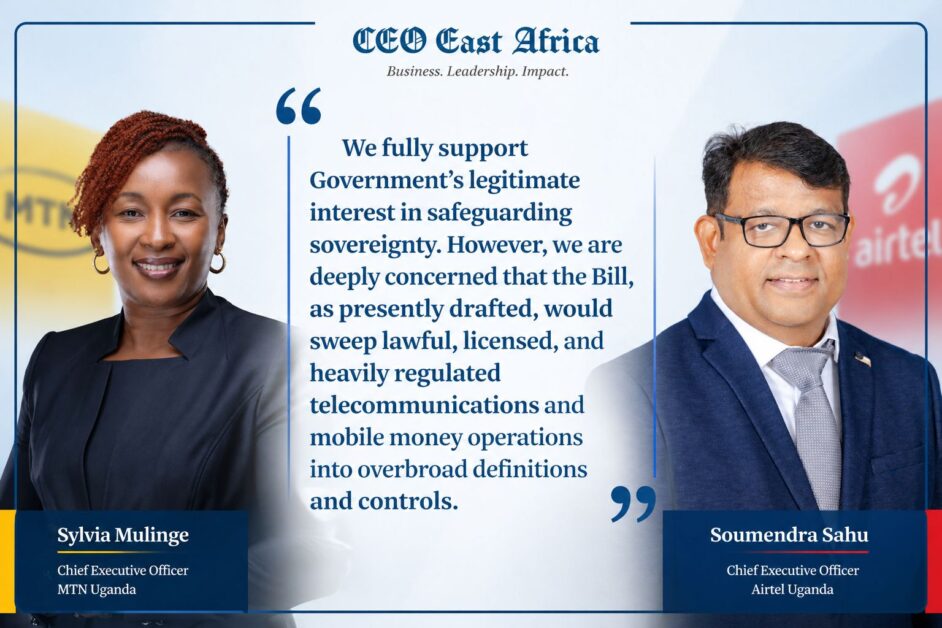
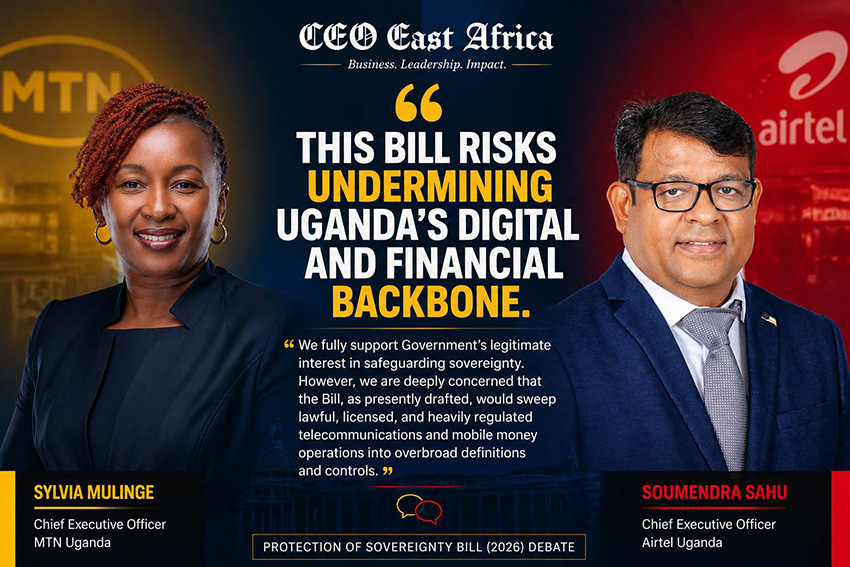
In the memorandum submitted to the Joint Committee on Defence and Internal Affairs and the Committee on Legal and Parliamentary Affairs, telecoms say “we fully support government’s legitimate interest in safeguarding sovereignty [but] we are deeply concerned that the Bill, as presently drafted, would sweep lawful, licensed, and heavily regulated telecommunications and mobile money operations into overbroad definitions and controls.”
This concern forms the backbone of their argument that the Bill does not merely target harmful foreign interference, but instead casts an excessively wide net that captures routine, lawful, and already regulated commercial activity.
A law without a gap to fill
One of the most forceful points raised by the telecoms is that the Bill addresses a problem that is already being managed through existing regulatory frameworks.
Uganda’s telecommunications and financial services sectors are among the most tightly regulated in the region, with oversight from institutions such as Uganda Communications Commission (UCC), Bank of Uganda, and Financial Intelligence Authority.
“The sector is one of the most intensively regulated in Uganda. The concern that foreign actors could use telecommunications infrastructure or mobile money to interfere with Uganda’s sovereignty is a legitimate policy concern. However, it is not currently ungoverned by the Uganda Communications Act, Cap 106, the National Payment Systems Act, the Anti-Money Laundering Act, the Computer Misuse Act, the Regulation of Communication Commission Act, and the direct oversight of UCC, BoU, FIA, the Internal Security Organisation, and the Chieftaincy of Military Intelligence,” the memorandum reads in part.
In effect, the operators argue that the Bill introduces a parallel regulatory regime where one already exists, without adding meaningful new safeguards.
Instead, it risks duplicating processes, creating confusion, and burdening operators with overlapping compliance obligations.
The danger of an overbroad definition
A major flashpoint in the Bill is its definition of an “agent of a foreigner,” which the telecoms argue is so expansive that it could inadvertently classify ordinary business operations as high-risk activities.
“The definition of ‘agent of a foreigner’ captures any person whose activities are directly or indirectly supervised, directed, controlled, financed, or subsidised by a foreigner.”
In practical terms, this could extend to subsidiaries of multinational companies operating in Uganda, routine cross-border telecom arrangements such as roaming, infrastructure sharing agreements and even standard vendor and technology contracts
The telecoms caution that this level of ambiguity risks criminalizing normal commercial conduct.
“The architecture of platform standards, group policies, capital, and roaming infrastructure from those group entities could be construed as indirect foreign influence, capturing ordinary corporate architecture.”
This, they argue, creates a chilling effect on investment and operations, as companies struggle to interpret where compliance ends and liability begins.
A direct hit on mobile money
Perhaps the most consequential concern raised in the memorandum concerns the Bill’s impact on the mobile money ecosystem, arguably one of the country’s greatest financial innovations.
The Bill introduces provisions that would impose strict obligations on “supervised institutions,” including liability for the actions of agents and requirements to verify the source of funds in certain transactions.
Telecoms warn that such provisions could fundamentally disrupt how mobile money works.
“Clause 25 places sweeping obligations on supervised institutions … and imposes vicarious liability on mobile money agents that has fundamentally changed mobile money systems,” the memorandum states.
They further caution that requiring verification of the source of funds for everyday transactions could slow down services and increase costs, which would “either shut down mobile money or make it as operationally cumbersome as the conventional banking system, defeating its purpose”.
Given that mobile money serves millions of Ugandans, many of whom do not have access to traditional banking, this is not a minor concern. It strikes at the core of financial inclusion.
Threat to diaspora lifelines
Another critical issue raised is the potential disruption of diaspora remittances, which are a major source of foreign exchange and household income in Uganda.
According to the memorandum, Uganda receives approximately $1.4 billion annually in diaspora remittances.
“The overwhelming majority of these inflows are processed through mobile money platforms,” the operators note.
However, the Bill could classify diaspora senders as “agents of foreigners,” triggering additional requirements such as declarations and ministerial approvals.
“The practical consequence is a chilling effect on remittances as recipients may be required to declare and obtain ministerial authorisations for routine flows.”
The implications are far-reaching; delays in school fees, medical expenses, and household support, particularly for vulnerable families. More critically, such barriers could drive remittance flows into informal and unregulated channels, undermining the very transparency the Bill seeks to promote.
Investment and operational risks
Beyond financial services, telecoms argue that the Bill introduces uncertainty into the broader business environment. Routine commercial activities, such as paying international vendors, procuring technology, or entering cross-border partnerships, could become subject to additional approvals.
“Ministerial approval for each of these would introduce discretionary political control by an entity with no technical expertise over commercial transactions that are currently regulated through UCC licensing conditions and BOU prudential requirements.”
This, they argue, risks deterring investment at a time when Uganda is positioning itself as a digital and financial hub in the region.
Collateral Damage
The Bill’s implications extend beyond business into corporate social responsibility and humanitarian programmes. Telecoms, through their foundations and partnerships, support initiatives in education, health, agriculture, and refugee assistance.
Telecoms warn that these programmes could be disrupted. “The Bill could inadvertently capture donor-funded partnerships, UNHCR-supported programmes, and corporate social responsibility initiatives, requiring declaration of funding sources and ministerial authorisation.”
Such requirements, they argue, are not only unnecessary but could effectively halt programmes that benefit millions of Ugandans.
Constitutional and rights-based concerns
The memorandum also raises constitutional questions, particularly around freedom of expression, association, and the right to conduct business.
One provision, in particular, has drawn criticism: the so-called “economic sabotage” clause.
“Clause 13 criminalises publishing information that weakens or damages the economic system or stability of the country,” telecoms note.
They warn that this could capture legitimate disclosures by listed companies, market analysis, and even routine investor communications. The result could be a chilling effect on transparency and capital markets.
An unworkable system
Even beyond policy concerns, the operators argue that the Bill is not administratively ready for implementation.
They point out that it proposes the creation of a registry under the Department for Peace and Security—a body with no established technical capacity to regulate telecommunications or financial systems.
“There is no infrastructure, regulatory framework, procedural guidelines, forms, fee schedules, or staffing currently exists within the Department responsible for peace and security to administer a registration process across potentially hundreds of entities.”
The conclusion is stark: implementing the Bill in its current form would create confusion, delays, and legal uncertainty.
A call for targeted reform
Importantly, telecoms are not rejecting the Bill outright. Instead, they propose a series of targeted amendments aimed at preserving its intent while avoiding unintended consequences.
Among their recommendations is exempting licensed telecommunications and payment service providers, narrowing the definition of “agent of a foreigner,” excluding diaspora remittances and humanitarian flows, aligning the Bill with existing AML/CFT frameworks, removing duplicative reporting requirements, and delaying implementation until systems are operational
They also call for greater consultation with sector regulators. “Where the Minister proposes to take enforcement action, the Minister should be required to consult UCC and BoU… to preserve the primacy of the sector-specific regulator.”
Delicate balancing act
Ultimately, the memorandum frames the debate as a delicate balancing act between sovereignty and economic functionality.
The operators acknowledge the importance of safeguarding national interests. But they caution that poorly designed regulation can do more harm than good.
“The communications sector is Uganda’s most consequential infrastructure sector. It connects Ugandans to government services and to financial systems. It has made Uganda’s digital economy possible and is the primary instrument through which Ugandans transact, communicate, and do business.”
Thus, they say, if the Bill is enacted without significant revision, it could undermine one of Uganda’s most successful economic transformations.
The intervention by MTN, Airtel and Lycamobile marks a pivotal moment in the debate over the Protection of Sovereignty Bill (2026).
It brings into sharp focus the tension between regulatory ambition and economic reality.
As Parliament considers the Bill, the question is no longer whether sovereignty should be protected, but how to do so without destabilizing the systems that underpin Uganda’s digital and financial future.