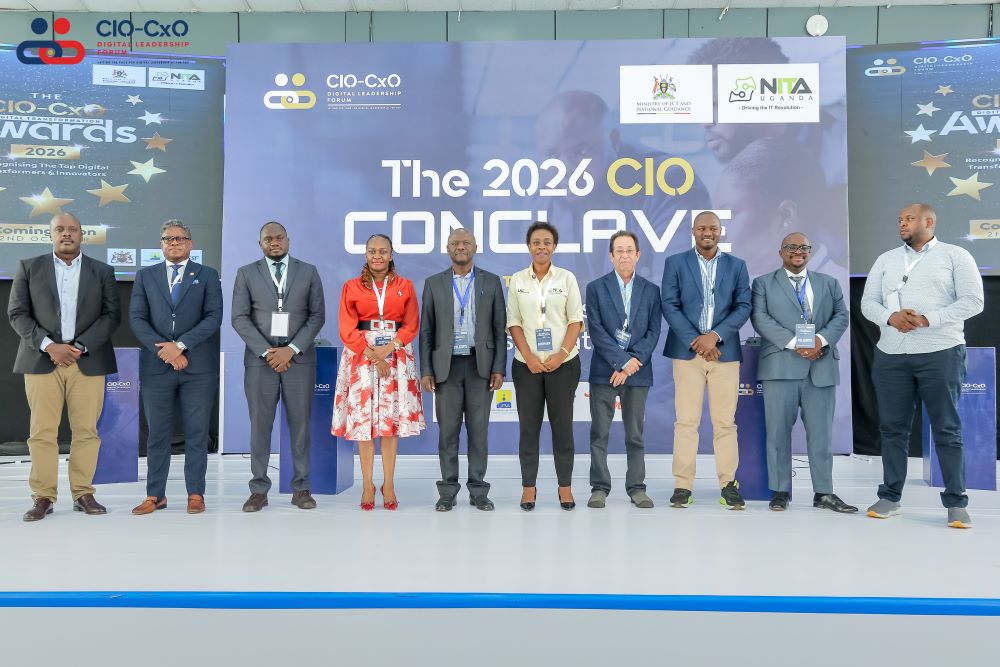
The CIO-CxO Digital Leadership Forum has appointed its inaugural advisory and governing boards, selecting a group of regional technology executives to oversee a mission centered on closing the country’s digital skills gap.
Collin Babirukamu, executive director of IT at the Bank of Uganda, will chair the advisory board. Rowena Turinawe, chief executive of RukaPay, will serve as vice chairperson. The forum, formally incorporated this year, originated from executive roundtables held under the Chatham House Rule to address governance, cybersecurity and artificial intelligence.
Key board members include Ibrahim Senyonga of MTN Business; Janey Racheal Nakato of Pearl Bank; Brian Ajuna of the Uganda Revenue Authority; George Ouma of the National Social Security Fund; Peter Mukuru of the Uganda Development Bank; and Julian Rweju of the National Information Technology Authority Uganda.

Collin Babirukama, the executive director of IT at the Bank of Uganda and chairperson of the CIO-CxO Digital Leadership Forum advisory board, addresses technology leaders during the forum’s inaugural board unveiling in Kampala. Babirukama urged CIOs to prioritize business value and revenue growth over infrastructure-centric thinking to remain relevant in a shifting digital landscape.
Babirukamu urged technology leaders to abandon infrastructure-centric thinking in favor of business value. Modern leadership is measured by how technology drives revenue and delivers measurable impact, Babirukamu said. He warned that those who remain preoccupied with legacy systems and operational details risk becoming obsolete.
Drawing from his career, Babirukamu said reframing technical projects in business terms is essential for gaining executive support. He described how presenting virtualization as a tool for cost optimization and efficiency allowed him to align IT strategies with organizational goals.
He also identified active listening as a vital leadership skill. Rather than pursuing technology for its own sake, he said effective CIOs must understand the specific needs of departments such as finance, risk and operations.
True value is created when technology simplifies processes and provides real-time insights for high-level decision-making, Babirukamu said. He concluded that the modern CIO is no longer a system manager but a transformation agent responsible for innovation and business value.

Eman Conde, a CCIE agent with Alchemy Global Networks LLC, delivers a keynote address at the CIO-CxO Digital Leadership Forum in Kampala. During his remarks, Conde pledged 10 million dollars toward initiatives focused on developing high-quality datasets and fostering innovation, while also committing to support a cohort of Ugandan students from academic certification through to their first employment opportunities.
The forum also launched a strategic initiative to dismantle professional silos and address the gender gap within Uganda’s technology sector.
The forum appointed a governing board, chaired by Jonathan Kayemba, chief technology officer at Logos. The board includes Rita Apell of Stanbic Bank, Daniella Uwimana Rukundo, Douglas Onyango, and Albert Gitta of MTN MoMo.
Kayemba warned that a disconnect exists between legacy leadership models and digitally native employees. Many technology leaders are not embedded at the core of decision-making, Kayemba said. They are often brought in to report, rather than to shape strategy. That must change, he added.
The leadership unveiling coincided with the launch of the National Tech Skills Talent Program (2025–2035). While Uganda produces roughly 700,000 graduates annually, organizations still struggle to find job-ready local talent, Nakato said.
The 10-year roadmap includes the establishment of a National IT Talent Registry to help employers verify certifications. The program aims to equip 50,000 professionals with industry-relevant skills by 2031, with a long-term goal of reaching 200,000 by 2035. Nakato, chief technology officer at Pearl Bank Uganda and a forum member, said the initiative is intended to reduce reliance on expatriate labor and position Uganda as a regional hub for digital outsourcing.
Gideon Nkurunungi, the forum’s executive secretary, told an assembly of technology leaders that the organization is shifting toward a more integrated ecosystem. Nkurunungi highlighted a disparity in the tech workforce, noting that while women represent a significant portion of IT graduates, only about 17 percent transition into professional employment.

Gideon Nkurunungi, executive secretary of the CIO-CxO Digital Leadership Forum, signs the 2026 CIO Conclave sign-off board during the forum’s launch event in Kampala. The board features signatures from inaugural advisory and governing board members, symbolizing a collective commitment to bridging Uganda’s digital skills gap and fostering an integrated technology ecosystem over the next decade.
In response, the forum submitted a CIO Women Sub-Position Paper to address structural challenges. Nkurunungi criticized the current state of technology use in the region as shallow, noting it focuses more on social media consumption than on value creation.
Albert Gitta said digital transformation is creating new employment categories, noting that the mobile money sector now employs more than 120 people in areas that once functioned as a single department. Gitta, who holds a business degree, argued that business acumen is the business card that allows IT leaders to maintain a seat at the executive table.
Joanita Asio Banda, head of emerging technologies at Stanbic Bank Uganda, said true leadership value lies in the ability to apply strategic skills across different platforms rather than becoming attached to specific legacy systems.
The talent workshop convened stakeholders from numerous institutions, including Makerere University, Uganda Christian University, Victoria University, Nkumba University, ISBAT University, Mutesa 1 Royal University, UTAMU University and Ndejje University. Other participants included UICT, SLAU, Seeta University, Bugema University, Team University, Cavendish University and Taibah International School.
Eman Conde, a CCIE agent with Alchemy Global Networks LLC, delivered a keynote address and pledged 10 million dollars toward initiatives focused on developing high-quality datasets and fostering innovation. Conde also pledged to support a cohort of Ugandan students from academic certification through to their first employment opportunities.
Patrick Mundua, commissioner for e-government services at the Ministry of ICT, emphasized the need for technical staff to develop stronger communication and business integration skills to better translate technical concepts into organizational value.