
For a start, could we first recap 2019 for TBWA Uganda; how did it go down for you?
Well, I can say it was a steady year for us. With key clients on both retainer and contract, it became about delivering to those clients. And we’ve been lucky to work with most of our clients for several years so we know their schedule and plans and can plan around these.
But with that stability comes the responsibility to disrupt ourselves or get disrupted instead. We cannot talk about disruption for our clients and continue as we were and this is a journey we are on internally. But being recognized for disruption was I think the biggest win for 2019.
So, how do you think that will shape the years ahead? Where do you see yourselves in the next 5 years?
Recently, we were in a meeting with one of our clients who said, they were not sure where they will be in 3 to 5 years- so for us to also come out and say this is where we will be is a little hard to predict. What we will be doing is probably the easier answer – we will be delivering value to our customers. That’s our purpose. The how, is disruption.
Where we are looking at- both from a process and product perspective, is how to completely disrupt what we are doing, because process issues, such as taking 10 weeks to deliver on a big brief won’t cut it anymore. We need to be much quicker to market; the challenge is how do we turn the 10 weeks into 10 days?
That then brings us to how we’re going to get the data and insights, how we’re going to have the multi-disciplinary teams around one table; how are we setting up spaces and systems to be able to deliver that. 2020 is going to be a busy year for experimentation
I have always been intrigued and I know many people in the advertising industry are, on the way you run the MTN account. I call it a katogo (mix) of many agencies, under one roof but serving the same client. Many would want to know how this is working out. Does this have something to say about the future of agencies in this market? Is the whole idea of one agency doing everything dying out?
Let’s take a few steps back, before the proliferation of specialist agencies all services were provided under one roof. Then specialist agencies started cropping up with their advantages and disadvantages. Of course, you had specialist tools with specialist teams but with that, came a lot of overheads related to people costs and less integrated campaigns and the clients had to manage all these diverse agencies. It was harder to have truly integrated communications because the creative thinking was not necessarily aligned to the media planning or to public relations or to the experiential and so on.

Imagine the Marketing Director who has 6 agencies, each with its own MD, CFO, account teams and overheads. The Marketing Director would have to brief 6 account managers and have to play a coordinating role taking countless hours out of productivity.
Now clients are beginning to look for the best of both worlds; retain the specialist people and tools but under one multi-disciplinary team with one ultimate accountability. McDonalds and MTN are a couple of quick examples that come to mind. So MTN’s agency pitch was at Group level and Omnicom won the pitch. Within Omnicom, there are several specialist agencies that all came together under one roof to deliver to the client.
That’s how we are where we are now and it’s working very well. In this case TBWA is the lead agency running the strategy, account management, creative and production ultimately remaining responsible for the delivery of the integrated communications. PR, digital and media are coming from other specialist Omnicom agencies. So, rather than operating in silos, the client gets the best of both worlds; an integrated offering from specialist agencies with one point of coordination.
So, then, how are you managing that alongside the other clients who have a sort of different working models? How do you strike the balance to make sure your teams are not confused?
It’s actually a lot easier than it sounds because the MTN team that comes from our specialist partners has integrated very well and is part of the wider team. For example there’s the MTN Media team from our partner OMD that coordinates and works well with our own TBWA\Uganda media team, sharing experiences and knowledge as the industry isn’t that big or diverse. There’s a lot more synergies and hardly any conflict, professional or otherwise.
I must admit we were also a little bit worried on how this was going to work but it’s been quite straight forward; a lot smoother than we had anticipated.
Having been around for over 17 years in Uganda’s advertising industry, and having seen a number of market movements, what would you say has changed over the last 10 years and how is that likely to shape the industry going forward? In line with that, what would you say are some of the major trends that are going to shape the industry moving forward that advertising executives should start preparing for?

The immediate thing that comes to mind in terms of what has changed is that Return on Investment (ROI) has come to marketing and it has come to stay. Gone are the days when there was a marketing budget with at most, brand health trackers as the measurement. Today, we’re starting to see ROI being demanded of marketing. Perhaps it’s more stringent on some but certainly in all the marketing plans. We are being asked to show directly, how we are going to produce a return. It’s something that we have to embrace as agencies.
Then we know what digital is doing to the industry. While Digital is a way of doing things, it is also a great equalizer. With over 6 million smart and feature phones in the market, it is so much easier for a start-up to build a competitive brand using digital. And this goes for not just our clients but our industry too. Additionally, with the readily available analytics for clients, experiences and empowerment it offers consumers… the consumer is truly now king!
Thirdly and perhaps more than other industries, data is big. Right now we survive with the basic data we have from National Audience Measurement Surveys (NAMS), some bespoke insights and research led by clients and ourselves and basic analytics on digital. Not for very long though as I reckon in 2 to 3 years having big data and the analytics to draw actionable insights is going to influence a lot of what we do. That’s something we are already planning and working towards as an agency – to have data at the heart of everything we do within 12 months. That said, there will always be room for gut creative and for this we say anecdotal triumphs over data wherever there’s a conflict.
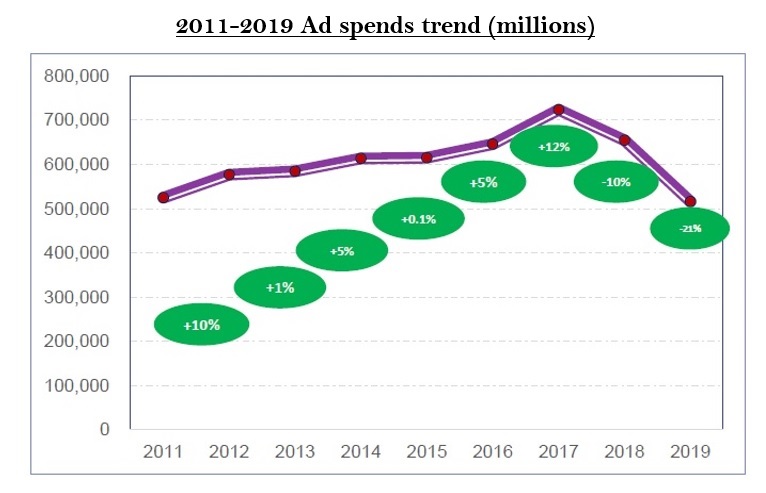
In the face of the 4th Industry Revolution, the future of print as both a medium of communication and advertising is being given a long hard second look. From an advertising spend perspective and basing on the trends for the last 10 years, how much more future would you say is there for print?
I think print will continue to get more and more niche- but much like digital, content is all important. Does it have to be printed? Less and less, I imagine. How many under 35s are reading let alone buying newspapers? They all go to the Twitter, Facebook feeds of these same media houses- Vision Group, Monitor, Observer etc. for their news.
Of course as Tony Glencross (Managing Director of Monitor Publications) likes to remind me, a bad front page headline can destroy a brand but given the amount of ‘fake news’ the same is not true for digital, implying trust in print is still intact. That’s correct but some digital publications will too, soon build reputations then what next for print?
Hypertargeting/Micro targeting and not just on digital but in other media too is going to be much more prolific.
Hypertargeting/Micro targeting- doesn’t that then put an immense challenge to today’s brand managers? How do you stretch the budgets and split the hairs to make sure everybody with their little interests and psychographics is catered to?
I think it requires more effort to get it right but it means that your money will be much better spent. So for example let’s look at the upper end of the market; radio’s relevance and importance will drop as people start to listen to more and more podcasts. So, if you’re stuck in a jam, will you turn up your FM or play a podcast? What if your favorite radio show, say Kalisoliso (ED: Kalisoliso is a humorous radio sports programme on 88.8CBS FM, a local Luganda radio station that airs at 7:30am) were able to deliver a one-hour podcast every day, so you don’t have to worry about missing it ? It’s still the same radio show but now delivered at the listener’s convenience. Your advertising spend will be much better targeted so that if say, there is a podcast on cars then Toyota can advertise in that podcast. While the audience will be likely smaller, it will be to a much more relevant audience with much better context too, probably. This is better than trying to target the guys who between 6am and 8am are driving and hopefully hit 100,000 people out of whom 100 are interested in servicing their cars at Toyota, which is really spraying and praying.
We will have to put in more effort to get it right but once you get it right, the pay back will be immense and worth the effort.
So, if I had money and wanted to invest in a media house; if I wanted to tap into advertising money, between a radio station, a television station and a newspaper, where would you advise me to put my money?
None. I’d say focus on content. Pick a subject/industry and deliver relevant and valuable content and the rest will fall into place. Podcasts, videos, blogs or even radio & TV shows, columns etc. are just the means by which your audience will consume your content. Deliver what they consider to be value and the platform is secondary. The consumer chooses how to consume the content and those platforms (radio, TV and newspapers) are arguably already saturated with options.
So how do all these dynamics affect the future of the advertising industry as we know it today? What’s the future of traditional advertising agencies?

A Christmas ad that cost just £100 for Hafod Hardware in Wales went viral globally in 2019 and was being compared to John Lewis which must have spent hundreds of thousands of British pounds on just the creation of their ads. This sounds like a one-off but we can expect to hear more and more of these.
Millenials and increasingly GenZs, armed with nothing but their smart phones and laptops will develop great content albeit off brief. Can our competitive advantage truly lie in being able to interpret and internalize a brief? How long before they (Millenials and increasingly GenZs) get it on brief?
The communications industry must also embrace data – only then will we be able to develop relevant and insightful communications and marketing solutions that deliver value to our clients and consumers.