
By any standard, the National Drug Authority (NDA) is supposed to be Uganda’s frontline defender of public health—setting rules, enforcing standards, and ensuring that medicines reaching pharmacies and patients are safe, effective, and properly regulated. Yet the latest report from the Auditor General tells a more complicated story. It is a story of an institution that remains compliant on paper, but increasingly strained in practice—where systems falter, execution lags, and the regulator itself appears, at times, caught offside.
At first glance, the NDA emerges with a clean bill of health. The Auditor General confirms that its financial statements fairly present its position in accordance with international standards. For many institutions, that would be the headline. For NDA, it is merely the opening line in a much deeper narrative. Because beyond the formal opinion lies a pattern of operational weaknesses that suggests the real issues are not in how the numbers are reported, but in how the institution actually functions.
The report quietly reveals an uncomfortable paradox: the books may be in order, but the business of regulation is far from seamless.
Billions in Limbo and Systems Under Strain
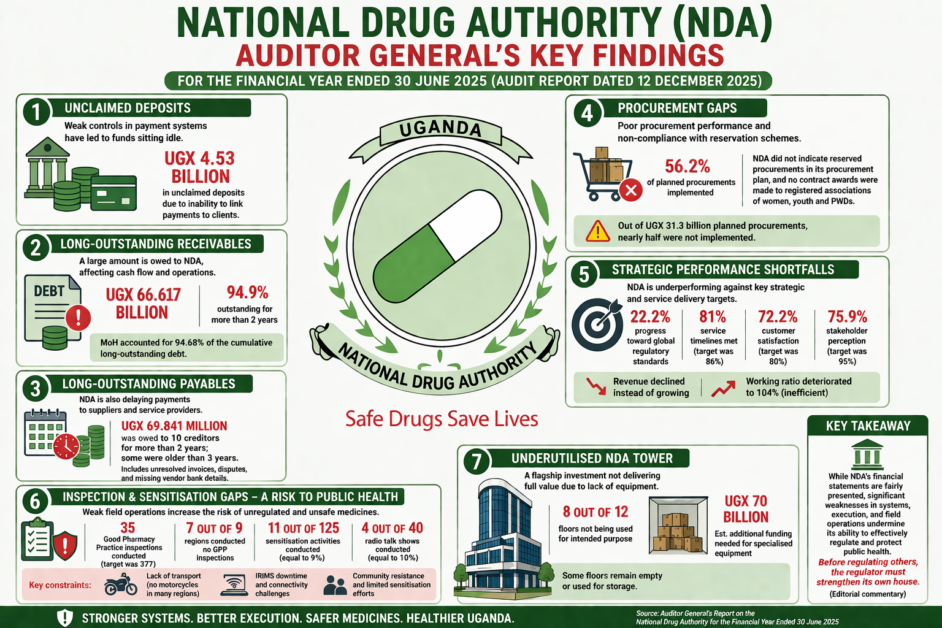
One of the most telling findings is the existence of UGX 4.53 billion in unclaimed deposits sitting in NDA’s accounts. These are funds paid by clients—drug shop operators and pharmaceutical players—but which cannot be matched to specific services or transactions. The reason is surprisingly basic: the absence of a system that assigns unique identifiers to payments.
In practical terms, money is coming in, but NDA does not always know who paid it or for what purpose. This is not merely an administrative lapse; it points to deeper weaknesses in financial controls, reconciliation processes, and system design. For a regulator that depends on licensing and compliance fees to function, such gaps undermine both efficiency and credibility.
At the same time, the Authority is grappling with the opposite problem—money it is owed but cannot collect. Receivables stand at a staggering UGX 66.6 billion, with nearly 95% outstanding for more than two years. Even more striking is that the bulk of this debt is owed by the Ministry of Health. The image that emerges is one of a regulator caught in a circular dependency within government, owed vast sums by the very system it is meant to support.
This combination of untraceable inflows and uncollected receivables creates a financial paradox: resources exist, but access to them is constrained.
A Regulator That Also Delays
The report does not spare NDA on the other side of the ledger. The Authority itself has outstanding payables, some stretching beyond three years. These include unresolved invoices, disputes with service providers, and cases where vendors lack proper documentation. While the amounts may not be as large as the receivables, the implication is clear—NDA is not consistently meeting its own obligations in a timely manner.
Procurement performance adds another layer to the picture. Only 56.2% of planned procurements were implemented during the financial year, leaving billions of shillings’ worth of projects unrealised. At the same time, the Authority failed to comply with a government directive requiring at least 15% of procurement to be reserved for women, youth, and persons with disabilities. Not a single contract met this requirement.
For an institution whose core mandate is to enforce compliance, these gaps carry a certain irony. They also raise legitimate questions about internal governance and planning discipline.
Strategy Meets Reality
Beyond finances and procurement, the Authority’s strategic performance tells its own story. Over the life of its strategic plan, NDA was underfunded by 18.3%, a shortfall that inevitably constrained implementation. But funding alone does not explain the outcomes.
Progress toward global regulatory standards—an important benchmark for drug safety—stood at just 22.2% against a target of full attainment. Service delivery metrics also fell short, with timelines missed, customer satisfaction below expectations, and stakeholder perception lagging significantly behind targets. Revenue, which was expected to grow, instead declined, while the working ratio rose to 104%, signalling inefficiency.
What emerges is an institution that knows where it wants to go, but is struggling to get there. Plans exist, frameworks are in place, but execution remains uneven.
The Real Test: Regulation in the Field
If the financial and strategic issues raise concerns, the operational realities on the ground are more alarming. This is where NDA’s mandate intersects directly with public health, and where gaps carry the greatest risk.
Inspection coverage, a core function of the Authority, fell dramatically short of expectations. Only 35 Good Pharmacy Practice inspections were conducted against a target of 377. In several regions, no inspections were carried out at all. Sensitisation efforts—critical for building compliance and public awareness—achieved less than 10% of planned targets.
These are not abstract metrics. They translate directly into reduced oversight of pharmacies and drug shops, increased risk of unregulated operations, and a higher likelihood of substandard or expired medicines reaching the public.
The reasons behind this underperformance are revealing. Inspectors in many regions lack basic transport, with some operating without motorcycles. Digital systems meant to support regulatory work are plagued by downtime and connectivity issues, slowing data entry, verification, and decision-making. In some areas, community resistance further complicates enforcement, a challenge exacerbated by limited sensitisation efforts.
In essence, the regulator’s reach is constrained not by policy but by capacity.
Infrastructure Without Utilisation
The story of the NDA Tower encapsulates another dimension of the challenge. Built as a flagship facility to expand laboratory capacity, the building currently has eight out of twelve floors not being used for their intended purpose. Some remain empty, while others have been repurposed for storage.
The explanation lies in the absence of specialised equipment, which requires substantial additional funding. It is a familiar narrative in public sector investment—capital expenditure outpacing operational readiness. Yet the result is a high-value asset that is not delivering its full potential, at a time when regulatory capacity is already under pressure.
A Regulator at a Crossroads
Taken together, the findings of the Auditor General paint a picture that is both sobering and instructive. The National Drug Authority is not failing in the conventional sense. It remains compliant with financial reporting standards and continues to carry out its mandate. But it is operating below its potential, constrained by systemic inefficiencies, resource gaps, and execution challenges.
For Dr. David Nahamya and the leadership of the Authority, the report is less a verdict than a moment of reckoning. It highlights the need to strengthen internal systems, improve financial discipline, align planning with execution, and invest in the frontline capacity that ultimately determines regulatory effectiveness.
There is a certain irony in a regulator being flagged for gaps in compliance, control, and performance. But there is also a clear opportunity. Because if any institution understands the value of standards, accountability, and continuous improvement, it should be the NDA.
The task now is to turn that understanding inward.
We reached out to NDA spokesperson Abiaz Rwamwiri on April 20 for comment. He acknowledged receipt, and a follow-up reminder was sent on April 23, but no response was received by the time of publication.