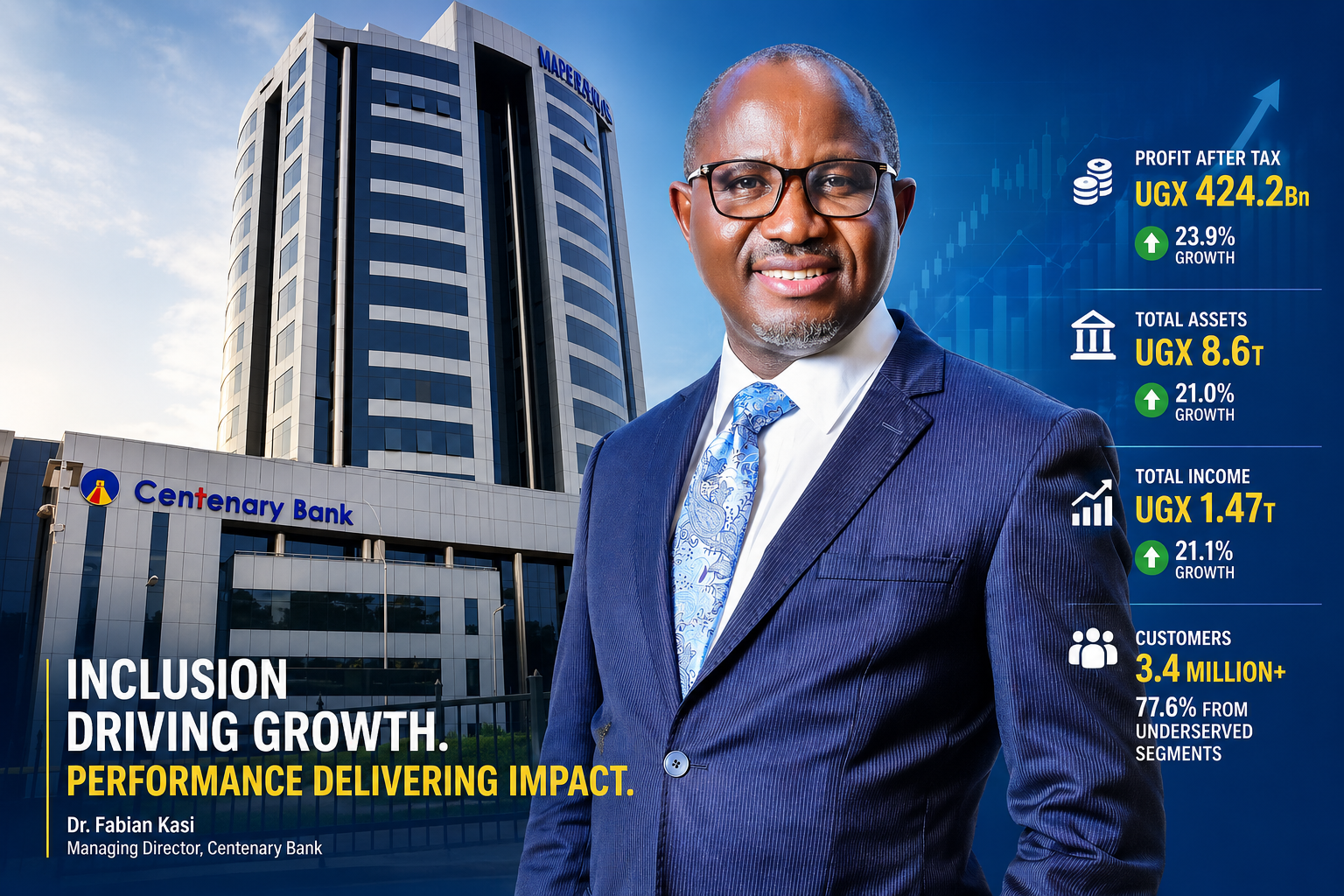
Centenary Bank’s 2025 results are not just a story of growth—they mark a pivotal moment, with the bank breaking new ground on profitability, balance sheet scale, and income generation, while proving that a model anchored on financial inclusion and ESG can deliver both impact and industry-leading financial performance.
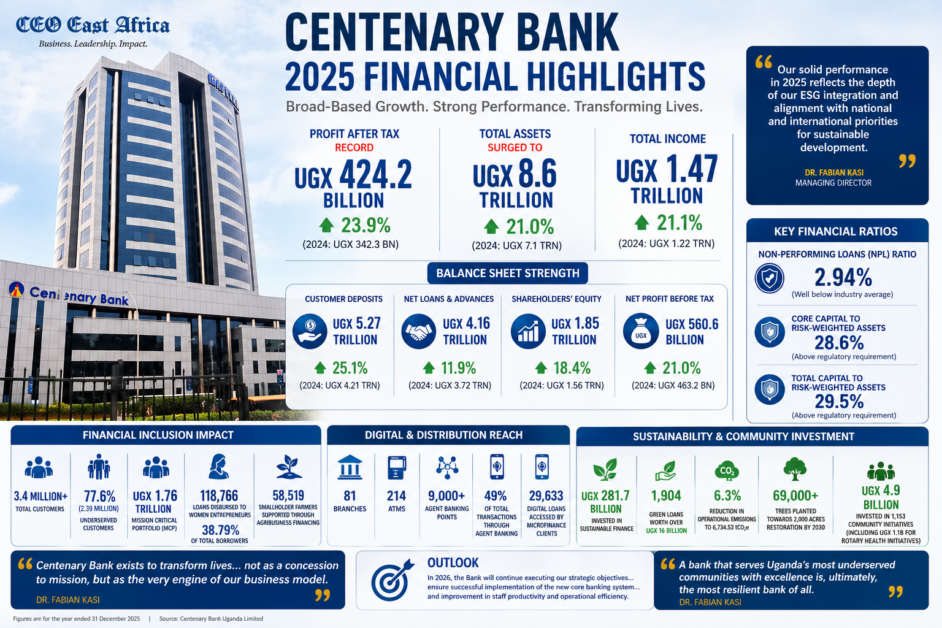
Centenary Bank Uganda has delivered a standout financial performance for the year ended December 2025, posting a profit after tax of UGX 424.2 billion, marking a 23.9% increase from UGX 342.3 billion in 2024.
The results cap a year of broad-based, double-digit growth across key financial indicators, reinforcing the bank’s position as one of Uganda’s most deeply embedded financial inclusion banks and propelling total assets to UGX 8.6 trillion, up 21.0% from UGX 7.1 trillion the previous year.
At the heart of this performance, according to Managing Director Dr. Fabian Kasi, is a deliberately structured business model anchored on inclusion, sustainability, and disciplined growth.
“Our solid performance in 2025 reflects the depth of our ESG integration and alignment with national and international priorities for sustainable development,” Kasi said, pointing to the bank’s growing emphasis on environmental, social, and governance principles as a central driver of both financial and social returns.
Broad-Based Growth Across the Balance Sheet
The bank’s balance sheet expansion was underpinned by strong growth in customer deposits, which rose by 25.1% from UGX 4.21 trillion in 2024 to UGX 5.27 trillion in 2025.
This surge in deposits significantly outpaced loan growth, strengthening liquidity and reinforcing the bank’s funding base.
“This steadfast performance is a reflection of the trust of our customers, partners and stakeholders, which we don’t take for granted,” Kasi noted.
Net loans and advances grew by 11.9% to UGX 4.16 trillion, up from UGX 3.72 trillion in 2024, with lending concentrated in what the bank describes as “mission critical portfolios,” particularly agriculture, MSMEs, and microfinance segments that directly support Uganda’s real economy.
“Our loan book expanded… dominated by mission-critical portfolios,” Kasi emphasised.
Shareholders’ equity also registered strong growth, increasing by 18.4% to UGX 1.85 trillion, further strengthening the bank’s capital base and positioning it for continued expansion.
Earnings Momentum Driven by Core Banking Activity
Total income rose to UGX 1.47 trillion in 2025 from UGX 1.22 trillion in 2024, reflecting growth across key income lines, including interest income from loans, investment securities, and fee-based revenue streams.
The bank’s net profit before tax reached UGX 560.6 billion, while disciplined cost management ensured that operating efficiency remained intact despite rising operational demands.
Kasi attributed the strong profitability not only to growth in income but also to prudent risk management.
“Profit after tax grew by 23.9%… supported by sound credit underwriting that kept NPLs ratio at 2.94%,” he said.
The relatively low non-performing loan ratio underscores Centenary’s conservative lending practices, even as it scales lending to segments traditionally considered higher risk, such as smallholder farmers and micro-entrepreneurs.
Inclusion as a Scalable Growth Engine
Centenary Bank’s performance continues to validate its long-held belief that financial inclusion is not a trade-off against profitability, but rather a core driver of sustainable growth.
“Centenary Bank exists to transform lives. For over four decades, we have served Uganda’s most underserved communities… not as a concession to mission, but as the very engine of our business model,” Kasi said.
By the close of 2025, the bank was serving over 3.4 million customers, with 77.6% of its customer base—approximately 2.39 million people—drawn from underserved segments including smallholder farmers, women, youth, refugees, and rural communities.
This focus has translated into scale and depth. The bank’s Mission Critical Portfolio (MCP) reached UGX 1.76 trillion, directly supporting more than 180,000 farmers, women, and rural enterprises through targeted financing initiatives.
Women entrepreneurs accounted for 118,766 loans disbursed during the year, representing 38.79% of total borrowers, while agribusiness financing supported 58,519 smallholder farmers despite persistent collateral constraints.
“We reached Ugandans where they live and work, and we did so responsibly and sustainably,” Kasi noted.
Deposits growth is also closely tied to this inclusion strategy, as millions of previously unbanked or underbanked individuals are brought into the formal financial system, contributing to a stable and diversified funding base.
Digital and Distribution Scale Driving Access
Centenary’s expansive distribution network continues to be a critical enabler of its growth. By the end of 2025, the bank operated 81 branches, 214 ATMs, and more than 9,000 agent banking points across the country.
Agent banking alone accounted for 49% of total transactions, significantly lowering the cost-to-serve while extending access to remote and rural communities.
Complementing physical infrastructure is the bank’s growing digital footprint, particularly in micro-lending. Of the 122,833 microfinance clients served during the year, 29,633 accessed digital loans, reflecting increasing adoption of technology-enabled financial services.
Financial literacy initiatives have also played a role in strengthening customer quality and engagement.
Through 58 structured sessions, the bank trained 33,341 individuals in financial management, helping to improve income resilience and reduce vulnerability to fraud.
Sustainability and ESG at the Core
Centenary’s 2025 results further highlight the integration of sustainability into its core business strategy. During the year, the bank deployed UGX 281.7 billion in sustainable finance toward green and social impact projects.
“This intentionality enabled the bank to directly invest Ushs 281.7 billion in sustainable finance toward green and social impact projects,” Kasi said.
Separately, the bank disbursed 1,904 green loans worth over UGX 16 billion across clean energy, water, sanitation, climate-smart agriculture and e-mobility, expanding access to sustainable infrastructure while reducing reliance on environmentally harmful alternatives.
Environmental stewardship efforts extended beyond financing. Operational emissions were reduced by 6.3% to 6,734.53 tCO₂e, driven by energy efficiency measures and the transition of 10 branches to solar power.
In addition, the bank planted over 69,000 trees as part of its long-term commitment to restore 2,000 acres of degraded land by 2030.
Community investment remained a priority, with UGX 4.9 billion deployed across 1,153 initiatives spanning health, education, and financial literacy.
Contributions to Rotary-related health initiatives alone exceeded UGX 1.1 billion in 2025.
“A resilient and empowered community equals a resilient and empowered bank,” the bank said.
Governance, Risk and Capital Strength
The bank’s governance framework was further strengthened through enhanced ESG risk integration, improved internal controls, and expanded whistleblower protections.
Centenary maintained strong capital adequacy ratios, with core capital to risk-weighted assets at 28.6% and total capital at 29.5%, well above regulatory requirements. This provides a solid buffer for future growth and risk absorption.
Staff diversity also remained robust, with women accounting for 49% of total employees and 30% of management, reflecting the bank’s commitment to inclusive leadership.
Outlook: Scaling Inclusion, Driving Efficiency
Looking ahead, Centenary Bank is focused on consolidating its gains while driving operational efficiency and technological transformation.
“In 2026, the Bank will continue executing our strategic objectives… ensure successful implementation of the new core banking system… and improvement in staff productivity and operational efficiency,” Kasi said.
The bank’s strategy is closely aligned with Uganda’s Ten-Fold Growth Agenda, with emphasis on expanding access to finance, supporting enterprise development, and boosting productivity in agriculture and SMEs.
Kasi remains confident that the bank’s model—anchored on inclusion, sustainability, and disciplined execution—will continue to deliver long-term value.
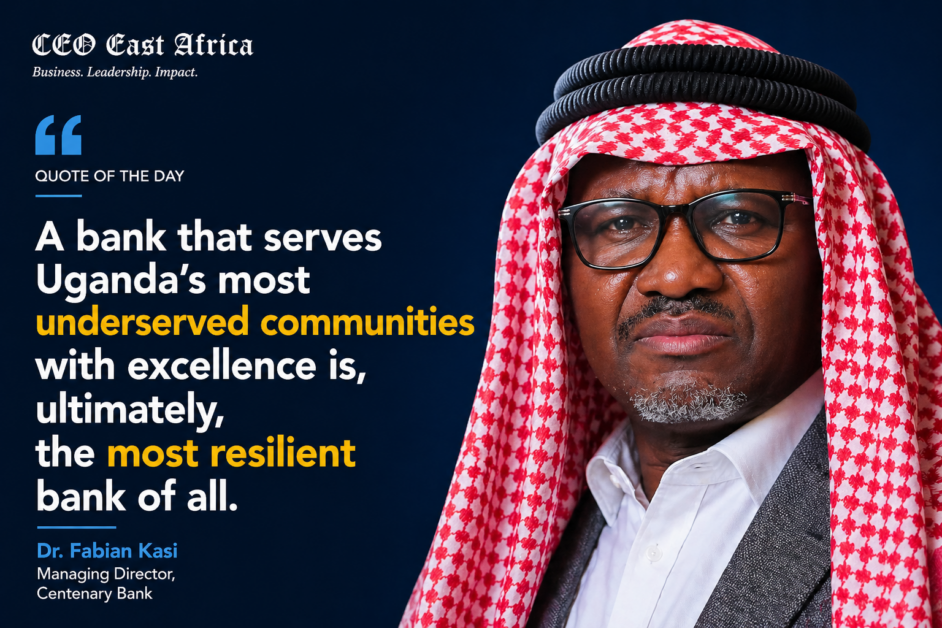
“A bank that serves Uganda’s most underserved communities with excellence is, ultimately, the most resilient bank of all,” he said.
That philosophy, now backed by strong profitability and sustained balance sheet expansion, positions Centenary Bank not just as a financial institution, but as a central player in Uganda’s economic transformation story.