Absa Bank Uganda’s 2025 results were not just strong—they were unexpectedly strong for the moment in which they were delivered.
In a year defined by leadership transition, shifting market dynamics, and underlying economic uncertainty, the bank did more than grow. It accelerated—posting one of its fastest expansions in the post-COVID period, with profit, deposits, and assets all rising at a pace that outstripped recent years.
A closer look at the trajectory makes this even clearer.
Across most key indicators, 2025 showed an improvement on both 2024 and 2023, although the pace of change varied by metric.
Across most key indicators, 2025 showed an improvement on both 2024 and 2023, although the pace of change varied by metric.
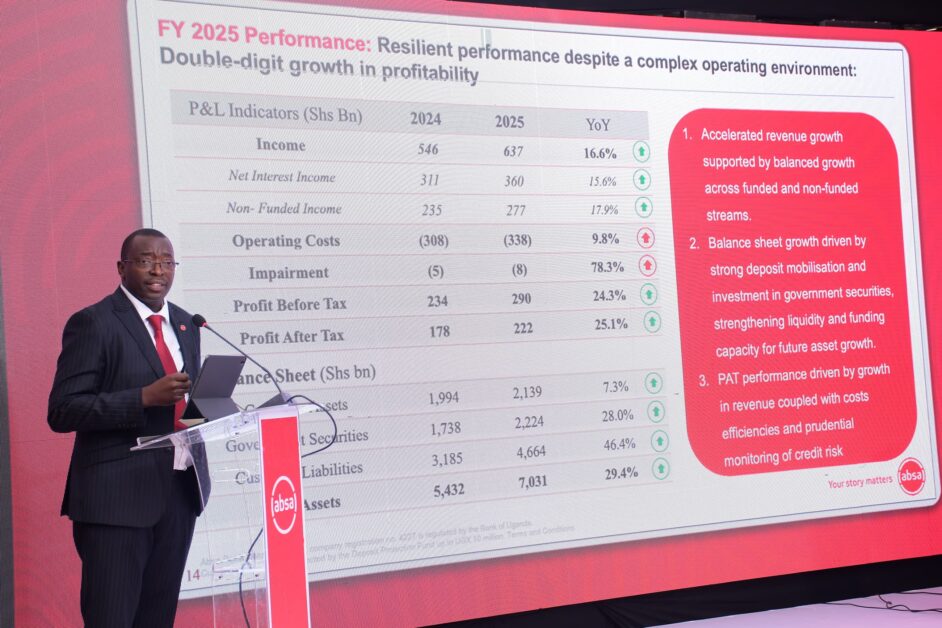
Revenue growth, which has remained consistently strong over the past three years, rose from UGX 472 billion in 2023 to UGX 546 billion in 2024 (+15.6%), and further to UGX 637 billion in 2025 (+16.6%), following a 15.1% increase in 2024.
Profit after tax grew from UGX 173 billion in 2022 to approximately UGX 178 billion in 2023 (~+3%), before accelerating to UGX 178 billion in 2024 (+22%), and rising further to UGX 222 billion in 2025 (+25.1%).
But the balance sheet tells an even more compelling story.
Total assets have expanded steadily over the past four years, rising from approximately UGX 4.43 trillion in 2022 to UGX 4.77 trillion in 2023 (+7.8%), then to UGX 5.43 trillion in 2024 (+19.1%), before accelerating sharply to UGX 7.03 trillion in 2025 (+29.4%), marking a clear and sustained scaling of the balance sheet.
Customer deposits followed a similarly upward, but more volatile trajectory—growing from roughly UGX 2.37 trillion in 2022 to UGX 2.75 trillion in 2023 (+16%), then to UGX 3.19 trillion in 2024 (+11.5%), before jumping significantly to UGX 4.66 trillion in 2025 (+46.4%).
Taken together, these numbers point to something more profound than incremental improvement.
2025 is not just better—it is structurally different. The bank is scaling at a pace not seen in the previous two years. But what makes these numbers particularly compelling is the context behind them.
This was the bank’s first full year under a new leadership configuration—with David Wandera stepping in as Managing Director, a new Board Chairman in Keith Kalyegira, and fresh additions across both the Board and Executive Committee. It is the kind of transition that often introduces hesitation, recalibration, and, at times, a temporary slowdown in execution.
Instead, Absa delivered momentum.
And it did so against a backdrop that was far from benign. Globally, policy shifts—including the ripple effects of U.S. directives on aid flows—introduced uncertainty across emerging markets. In Uganda, the impact was more immediate. The scaling down and closure of USAID-funded programmes disrupted a number of sectors, leading to job losses and putting pressure on household incomes and business cash flows—factors that typically have a direct bearing on loan performance across the banking sector.
At the same time, the country was entering a pre-election cycle, a period often associated with cautious lending, delayed investment decisions, and subdued private sector activity.
Yet, even within this environment, the bank’s performance pointed to something deeper than favourable conditions or cyclical uplift. It suggested clarity of strategy, discipline of execution, and a leadership team aligned on where—and how—to grow.
As Managing Director David Wandera framed it at the results presentation:
“Our performance is anchored in a refreshed strategy built on four pillars: placing the customer at the centre, strengthening our Pan-African reach, driving disciplined execution, and unlocking growth through innovation.”
The Strategy Behind the Surge
But what is really in those pillars?
The first pillar is customer at the centre—and its clearest expression in 2025 is the bank’s funding story.
Customer deposits surged by 46.4%, rising from UGX 3.19 trillion to UGX 4.66 trillion. That kind of growth is rarely accidental. It reflects a shift in behaviour—customers not just transacting with the bank, but choosing it as a primary financial partner. As Managing Director David Wandera explained:
“Growth in deposits is ultimately the customers choosing Absa as their long-term financial partner.”
This shift was supported by simplified customer journeys, faster onboarding, and a growing suite of digital channels that made access to banking more seamless.
The second pillar is strengthening Pan-African reach—a play on scale, capability, and long-term positioning.
While still unfolding, the pending acquisition of Standard Chartered’s retail and wealth business signals a bank that is not just growing organically, but expanding its footprint and deepening its relevance across customer segments. Combined with the broader Absa Group network, this positions the bank to serve clients across borders and increasingly complex financial needs.
The third pillar is disciplined execution—arguably the most critical in understanding the quality of the 2025 results.
In a year where deposits expanded rapidly, lending growth was intentionally more measured, at 7.3%. This reflects a conscious decision to prioritise asset quality and sector focus over aggressive expansion. As Managing Director David Wandera noted:
“We were very intentional about where and how we deployed capital, focusing on the productive sectors of the economy.”
That discipline is also evident in sector allocation, with a significant share of lending directed toward trade, agriculture, and manufacturing—segments that drive enterprise growth and employment.
At the same time, the Board maintained a firm stance on governance and risk. Board Chairman Keith Kalyegiraunderscored that growth was being pursued within clearly defined guardrails:
“Growth is achieved responsibly… maintaining strong oversight, reinforcing our risk management frameworks and upholding high standards of governance.”
The result is a balance sheet that is not only larger, but structurally stronger—supported by high liquidity and a cautious approach to credit risk.
The fourth pillar is innovation and new growth, most visible in the bank’s digital trajectory.
As customer behaviour continues to shift, Absa has leaned decisively into digital platforms—driving transaction volumes, expanding product offerings, and improving accessibility. As Managing Director David Wandera put it:
“Digital is no longer an alternative. It’s becoming the default.”
This shift is not just about convenience. It is about scale, efficiency, and the ability to serve a broader customer base without a corresponding increase in cost.
Taken together, these pillars reveal a strategy that is not only well-defined, but tightly executed.
They also explain why the 2025 results are not just strong—they are coherent. Growth in deposits, discipline in lending, expansion in digital channels, and improvements in efficiency are not isolated outcomes, but interconnected results of a strategy applied consistently across the organisation.
From Trust to Impact: How Absa Deployed UGX 4.66 Trillion
At the heart of Absa’s 2025 performance is a surge in customer deposits—one that was not just a function of market conditions, but the result of deliberate strategy execution and growing customer trust.
Deposits rose sharply by 46.4%, from UGX 3.19 trillion in 2024 to UGX 4.66 trillion in 2025, marking one of the most significant funding expansions in the sector. But beyond the headline number lies a more important story: why customers chose to place their money with the bank at such scale.
As Managing Director David Wandera observed: “Growth in deposits is ultimately the customers choosing Absa as their long-term financial partner.”
But where was this money deployed?
On the asset side, total loans and advances grew by 7.3%, from UGX 1.99 trillion in 2024 to UGX 2.14 trillion in 2025. Rather than aggressively expanding credit, the bank channelled lending into productive sectors of the economy.

As Managing Director David Wandera explained, the allocation was deliberate and impact-focused:
“40% of our loan book supports trade, manufacturing, and agriculture—sectors that drive enterprise growth and employ the largest part of our population. And that means job creation and value addition.”
“Close to 28% of our loan book supports individuals and households, enabling everyday financial resilience and participation in the economy.”
Based on a loan book of approximately UGX 2.14 trillion, this allocation translates into significant real-sector exposure. Trade accounts for the largest share at about UGX 640 billion, followed by agriculture at roughly UGX 360 billion, and manufacturing at approximately UGX 260 billion. Lending to individuals and households stands at around UGX 600 billion, supporting consumption and financial resilience, while the remaining UGX 275 billion is distributed across other sectors of the economy.
Together, trade, agriculture, and manufacturing account for over UGX 1.25 trillion of lending—clearly tilting the portfolio toward sectors that drive enterprise growth, job creation, and value addition.
This alignment between capital allocation and economic outcomes reflects a broader philosophy articulated by management. As Managing Director David Wandera noted:
“Performance is only meaningful if it reflects progress in people’s lives and in the real economy.”
At the same time, a significant portion of the deposit inflows was channelled into government securities, which increased from UGX 1.74 trillion in 2024 to approximately UGX 2.22 trillion in 2025 (+28%).
This dual allocation—measured lending alongside increased investment in government securities—resulted in a more liquid and resilient balance sheet.
The impact is visible in the loan-to-deposit ratio, which declined from 62.6% in 2024 to 45.9% in 2025—highlighting how funding growth significantly outpaced credit expansion.
Far from signalling under-lending, this reflects a disciplined approach to growth, particularly in a year marked by economic uncertainty and evolving risk dynamics.
Leadership in Motion, Execution Intact
2025 was marked by leadership transition across multiple levels—Board, Executive Committee, and senior management—typically introduces friction: slower decision-making, shifting priorities, and a period of internal recalibration.
Yet, the bank delivered one of its strongest performances in recent years.
One explanation lies in the strength of its internal alignment.
Related
 A Bill Like No Other: Sovereignty Protection Push Raises Economic, Legal, and Political Questions
The bank recorded an employee experience score of 78%, placing it above both regional and global benchmarks, alongside strong job satisfaction levels. These are not just internal metrics—they are indicators of an organisation where engagement, clarity, and execution discipline are already embedded, reducing the operational drag that often accompanies leadership change.
As Managing Director David Wandera emphasised: “Sustainable growth is only possible through our people. Our people are our strength.”
This internal cohesion proved critical in a year of transition.
Wandera himself was confirmed as Managing Director in May 2025, stepping into the role as part of a broader leadership refresh across the organisation. New appointments spanned key areas of the business, including Catherine Kijjagulwe as Head of Financial Markets, succeeding Wandera, ensuring continuity in a core revenue function.

At the same time, the bank elevated the role of technology and risk within its leadership structure. The Chief Information Officer, Philip Walera, was brought onto the Executive Committee, while the introduction of a Chief Information and Cyber Security Officer (CISO) role—currently held in an acting capacity by Francis Topacho—signalled a deliberate strengthening of the bank’s digital and risk architecture.
Further additions across the leadership bench reinforced this direction. The appointment of Moses Rutahigwa as Retail and Business Banking Director brought in regional experience in customer growth and transformation, while Henry Tumusiime’s appointment as Human Capital Director added depth in organisational development and cultural alignment—both critical as the bank scaled its operations .
At the governance level, the appointment of Keith Kalyegira as Board Chairman, alongside new non-executive directors Hassan Saleh and Gloria Byamugisha, strengthened oversight and strategic guidance during a period of change
The strength of the underlying culture—anchored in customer focus, accountability, and execution discipline—allowed the organisation to absorb these changes without losing momentum.
This was reinforced by a leadership approach that prioritised listening and alignment over rapid, top-down decision-making. As Wandera reflected:
“The quality of decisions improves significantly when we take time to listen—to customers, to our people and to the environment in which we operate.”
That approach appears to have ensured that new leadership did not disrupt execution, but rather integrated into an already functioning system, strengthening it further.
Ultimately, the 2025 results suggest that performance was not driven by individuals alone, but by an organisation where capability, culture, and leadership were sufficiently aligned to sustain execution—even through transition. And that may be one of the clearest indicators that the bank’s growth is not only strong, but structurally resilient.
Turning Growth into Profit: The Efficiency Story
Strong growth tells one part of the story. Efficiency tells the rest.
In 2025, Absa did not just grow—it converted growth into earnings at a faster rate.
Total income rose from UGX 546 billion in 2024 to UGX 637 billion in 2025, a 16.6% increase. Over the same period, profit after tax grew from UGX 178 billion to UGX 222 billion, representing a much stronger 25.1% increase
This 8.5 percentage point gap between revenue and profit growth signals a business that is improving its operating leverage—generating more profit from each additional shilling of income.
At the centre of this performance is cost discipline.
While the bank continued to invest in people, digital infrastructure, and operational capacity, cost growth remained contained relative to income growth. This is reflected in the improvement in the cost-to-income ratio, which declined from 56.4% in 2024 to 53.1% in 2025
As Chief Financial Officer Michael Segwaya explained: “The cost-to-income ratio… is a reflection that our revenues are growing faster than the costs.”
This matters because even small improvements in efficiency ratios can have a material impact on profitability at scale. For a bank generating over UGX 600 billion in income, each percentage point improvement in cost efficiency translates into billions of shillings in additional profit capacity.
Absa also maintained a disciplined approach to risk and balance sheet management.
The loan-to-deposit ratio declined sharply from 62.6% to 45.9%, reflecting strong funding growth and a more liquid position, while the liquidity ratio improved from 44.1% to 53.0%, strengthening the bank’s ability to absorb shocks and support future lending.

Credit quality remained broadly stable, with the loan loss rate at 0.4% (from 0.3%), while the coverage ratio improved to 54.9%, indicating prudent provisioning and strong risk buffers
Ultimately, these efficiency gains translated into stronger returns.
Return on equity rose from 21.9% in 2024 to 24.8% in 2025, demonstrating improved profit generation from shareholder capital
At the same time, the bank continued to invest for future growth.
Operating expenses increased in part due to deliberate investments in staff, technology, and digital platforms, ensuring that the bank builds capacity even as it improves efficiency. As Chief Financial Officer Michael Segwaya explained:
“We had to grow costs… to invest in our staff and in the technology that will serve us for the future.”
Impact at Scale: When Performance Meets Purpose
For Absa, the 2025 story does not end with growth, efficiency, or returns. It extends into how that performance translates into tangible outcomes for people, communities, and the broader economy.
This is where the bank’s philosophy—“Your Story Matters”—moves from brand positioning to measurable impact.
Across its environmental, social, and governance agenda, Absa’s approach is increasingly defined by scale, integration, and intentionality—embedding impact within its core operations rather than treating it as a standalone function.
On the environmental front, the bank continued to deploy capital toward clean energy and climate resilience. Through partnerships and financing structures, over UGX 20 billion was channelled via the Uganda Energy Credit Capitalisation Company (UECCC) to support off-grid solar deployment, expanding access to sustainable energy solutions
This was complemented by broader environmental initiatives, including the planting of over 1.28 million trees, surpassing the bank’s multi-year target ahead of schedule—an indication of both commitment and execution at scale
But it is on the social front that the reach becomes more visible.
Through its financial literacy programmes, Absa reached over 61,000 beneficiaries, equipping individuals with the knowledge to make informed financial decisions. At the same time, targeted interventions supported 335 women entrepreneurs in Kashari to start and grow businesses, while partnerships such as Aceli Africa enabled de-risked financing for youth- and women-led agricultural SMEs
These efforts are reinforced by the bank’s expanding physical and digital footprint.
The number of agency banking outlets grew to 2,691 agents, up from 1,861, extending access to financial services deeper into rural and underserved communities
Beyond financial inclusion, Absa’s impact is also reflected in its investment in human capital and community development.
Through the ReadytoWork programme, nearly 2,949 young people were equipped with work-readiness skills, while employee-led initiatives saw 643 colleagues contribute over 3,510 hours to community programmes. In parallel, the Absa KH3 7 Hills Run raised UGX 400 million, supporting over 11,000 girls to stay in school
Internally, this commitment to inclusion is mirrored in leadership representation, with 45% of leadership roles held by women—a signal that diversity and inclusion are embedded within the organisation itself
Taken together, these initiatives point to a model where sustainability is not peripheral, but integrated into the bank’s growth strategy.
The same balance sheet that is funding trade, agriculture, and manufacturing is also supporting clean energy, financial inclusion, youth empowerment, and community development.
This is what impact at scale looks like.
It is not defined by isolated programmes, but by the alignment of capital, capability, and intent—ensuring that growth in the bank translates into progress in the lives of the people it serves.
Entering the Next Phase from a Position of Strength
Having delivered strong growth, improved efficiency, and expanded its impact across the economy, Absa now enters its next phase with a balance sheet—and a strategy—firmly aligned for the future.
The operating environment is expected to remain dynamic, but increasingly opportunity-rich. Uganda’s economy is projected to accelerate further, supported by oil and gas developments, infrastructure investment, and expanding regional trade. For the banking sector, this signals a gradual shift from cautious positioning toward more selective, opportunity-driven growth.
For Absa, this transition is already underway.
The bank is positioning to expand its lending capacity, particularly as economic activity strengthens and demand for credit in key sectors such as trade, manufacturing, and energy begins to pick up. This is underpinned by a significantly strengthened funding base, with customer deposits now at UGX 4.66 trillion and a more liquid balance sheet capable of supporting future asset growth.

At the same time, Absa is continuing to deepen its digital leadership, building on strong momentum in payments and mobile banking. The focus remains on making banking faster, simpler, and more inclusive, while leveraging technology to scale efficiently across a growing and increasingly diverse customer base
Strategic expansion also remains a key priority. The pending acquisition of Standard Chartered’s retail and wealth business in Uganda is expected to further strengthen the bank’s position in high-value segments, broadening its customer base and enhancing its capabilities in both retail and wealth management.
Internally, the bank continues to invest in what has already proven to be a critical enabler of performance—its people and culture. The emphasis on building a winning, diverse, and execution-driven team is expected to remain central as the organisation scales and adapts to new opportunities.
Sustainability, too, is becoming more deeply embedded within the business. Beyond standalone initiatives, Absa is integrating environmental, social, and governance considerations into its core decision-making processes, ensuring that growth remains aligned with long-term impact and responsible banking principles.
As Managing Director David Wandera noted, the bank enters this next phase from a position of confidence:
“We enter this next phase from a position of strength, with a clear strategy, a strong balance sheet, and a team aligned to deliver sustainable growth.”
Taken together, these priorities point to a bank that is not simply building on past performance, but positioning itself deliberately for what comes next. The foundations are firmly in place—a stronger balance sheet, improved efficiency, a more diversified income base, and a clear strategic direction.
The opportunity now lies in scaling that foundation—deploying capital more assertively as conditions allow, deepening customer relationships, and continuing to translate growth into real economic impact.
If 2025 was a year of acceleration, then the years ahead may well be defined by expansion—executed with the same discipline that has come to define Absa’s recent performance.