To get back on track, Uganda needs to restore the healthy pre-2012 figures that averaged 7%. Short of that, East Africa’s third biggest economy risks failing the dream of a one East African currency by 2024.
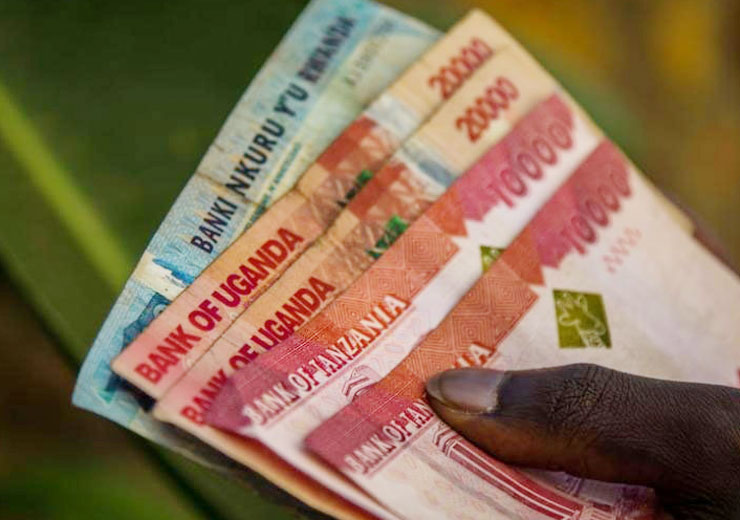
The East Africa Community member of Kenya, Uganda, Tanzania, Rwanda and Burundi aim at having a single currency in 2024. South Sudan will also lose its relatively valuable pound, melting Juba’s currency into the envisaged EA currency.
A key milestone was achieved on the 30th November 2013, when the East African Community (EAC) member states signed a protocol for the East African Monetary Union (EAMU) protocol. This therefore laid down the 10 year implementation road for convergence towards the monetary union and feasibly to a common currency in 2024.
This came at the back drop of Free Trade Area, a Customs Union, and a Common Market which when fully operational would allow for free movement of goods and services and factors of production such as labour and capital.
In fact, in 2017, the East African Community remained the main destination for Uganda exports, followed by European Union. This suggests that trade creation amongst trade partners has taken place.
The EAC countries have put in place macro convergence criteria to be met by each of the countries prior to entry into the monetary union set in the East African Convergence Criteria.
Macroeconomic convergence means the convergence by Partner States to low and stable levels of inflation, sustainable budget deficits, public and publicly guaranteed debt and current account balances. From 2021 onwards EAC countries will have to attain and maintain the primary convergence criteria.
The EAC Single currency will be introduced /adopted if at least three partner states meet the criteria for at least three consecutive years.
Varied performance is noted against performance and the main area of non-compliance relates to fiscal deficits that have risen substantially in last 5 years. None of the EAC countries meets yet the ceiling on fiscal deficit (including grants) of 3% of GDP.
The pace of growth of debt has been elevated in all countries. In Uganda debt has grown by an average of 30% per annum over the last 6 years and as such interest cost has grown substantially, to 18% of domestic revenue, which is way higher that the national threshold of 15%.
Recent lessons from debt crisis from the oldest economic bloc — the European Union — suggest that untamed fiscal deficits and debt accumulation can be a threat to regional integration. The narrowing fiscal space in EAC countries may dent the 2024 agenda. The prospects of natural resource extraction in medium term may increase the fiscal burden in the short term with expected moderation in the medium term.
On inflation, Burundi and South Sudan are in double and triple digits respectively. The other member countries attained a ceiling on headline inflation of 8%. Rwanda and Kenya for the year ending December 2017, headline inflation eased respectively to -0.2% and 4.4%. Uganda registered inflation under 5% attributed to prudent BoU interventions through its inflation targeting regime (demand management).
Inflation however, remains supply constraint-driven which requires fiscal policies to address. Additionally, all Central banks in the EAC states are currently implementing legal, regulatory and supervisory amendments in their national legal instruments to harmonise banking supervision and regulatory frameworks in the region.
All still below 50% in Net present value terms of Debt to GDP. However, in nominal terms, gross public debt of 50% of GDP, debt is rising with Kenya and Burundi above 55%, followed by Rwanda at 40.2%, Uganda at 38.6%, and Tanzania at 37.4%.
n terms of foreign exchange reserve cover of 4.5 months of imports, only Uganda and Kenya have adequate reserves. The high infrastructure related import however may increase vulnerability of the reserve cover in Uganda.
In terms of secondary criterion of convergence, EAC countries are required to pursue debt reduction initiatives to reduce both domestic and foreign debt. However, the recent debt strategy/framework expired and a new one is yet to be adopted.
Uganda’s current debt portfolio is 66% external and 34% domestic and is poised to keeping growing before narrowing in 2020. With the prospects of not realising a number of middle income targets by 2020, the heightened investment pressure will prevail.
This implies that fiscal adjustment as also seen in many other countries is going to be hard undertaking. Political sentiments often run high on national budgets in our part of the world as history has proven. In principle, debt accumulation is in part attributed to low tax collections, which is the case for Uganda. The next issue of this column will present taxation and whether Uganda can do better.
Additionally, Uganda’s growth has slowed and lowers than regional average and historical average of 7%. The EAC target is Maintenance of a high and sustainable growth rate of GDP>or=7%.