
The Financial Year 2019-20 (FY 2019-20) has been a bag of mixed fortunes. The first half of FY 2019-20 was smooth, and the Fund performed well beyond its targets, collections and member registration, exceeding set targets and the economy seemed well on the road to recovery. This was rudely interrupted by the outbreak of the Covid-19 pandemic towards the end of December 2019. The real impact materialised after March 2020, significantly changing the way businesses operate, with a devastating effect on the global economy.
Operating environment
In FY 2019-20, Uganda’s economy grew at 3.3% compared to the projected rate of 6% and prior year’s 5.5%. Inflation averaged 4.1% compared to 3.4% for the prior year. Other qualitative factors that characterised the economy during FY 2019-20 include; a relatively long wet season that favoured agricultural production and supply resulting in relatively low food prices, a strong shilling, and a stable interest rate regime.
However, Covid-19 slowed down the economy bringing it to a near total shut down in all sectors in the final quarter of the financial year.
NSSF Performance
The gross impact of Covid-19 was unprecedented, however, NSSF weathered this storm and performed beyond expectations, remaining on track to achieving the 10-year Strategy (Vision 2025).
During the FY 2019-20, the Fund registered good performance in the following key financial areas:
- Total income grew by 65% mainly on account of Fixed Income interest that increased by 20%;
- Cost Income Ratio was 10.8% compared to the budget of 13.4%, due to the efficiency in cost management;
- The Balance sheet size grew to UGX13.28 Trillion, 17% better than FY 2018-19 figure of UGX11.34 trillion;
- The accumulated members’ balance grew to UGX13.06 trillion compared to UGX11.14% trillion in the prior year.
Customer journey through digital innovation
Over the years, the Fund has registered tremendous business process improvements and high productivity fuelled by great innovations.
With respect to service delivery, the Fund’s digital journey is well underway. With our tried and tested Relationship Management model and improved compliance levels which stood at 55% against a target of 60%, the Fund has demonstrated that business can continue uninterrupted even during hard times. From the onboarding to the exit stage, members can now access services through various digital platforms such as the NSSFGO App, Web Chat, Social Media, Unstructured Supplementary Service Data (USSD), and Interactive Voice Response (IVR).
This year alone, 88% of our member transactions and interactions were hosted digitally. We are now fully utilising the e-Channels to collect members’ contributions. E-Collections’ usage has risen from an average of 40% in July 2012 to 100% as of 30 June 2020. This is demonstrated in the minimally interrupted collections figures during the Covid-19 lockdown.
Customer perspective
NSSF achieved an 88% rating in customer satisfaction compared to the 86% target. Our members are always considered the core of our existence, and we continue in striving to empower and meet their needs wherever they are.
The empowerment of Fund members is anchored on two fundamental pillars; their financial wellness and their ability to access our offerings in a convenient, quick, and safe manner. To facilitate this, we have broadened reach through the Financial Literacy agenda across the country. The Fund is committed to ensuring that these two pillars define the customer journey because digital is the future and financial literacy is the new wealth.
From the Benefits paid perspective, the Fund paid UGX496 Billion. Using online services during the lockdown period, we received a total of 83 benefits claims online. This concretises movement towards self -service for our members. Over 86% of all benefits paid were completed within 7 days and we are on course to achieve all payments of benefits within 24 hours by 2025.
Investment portfolio
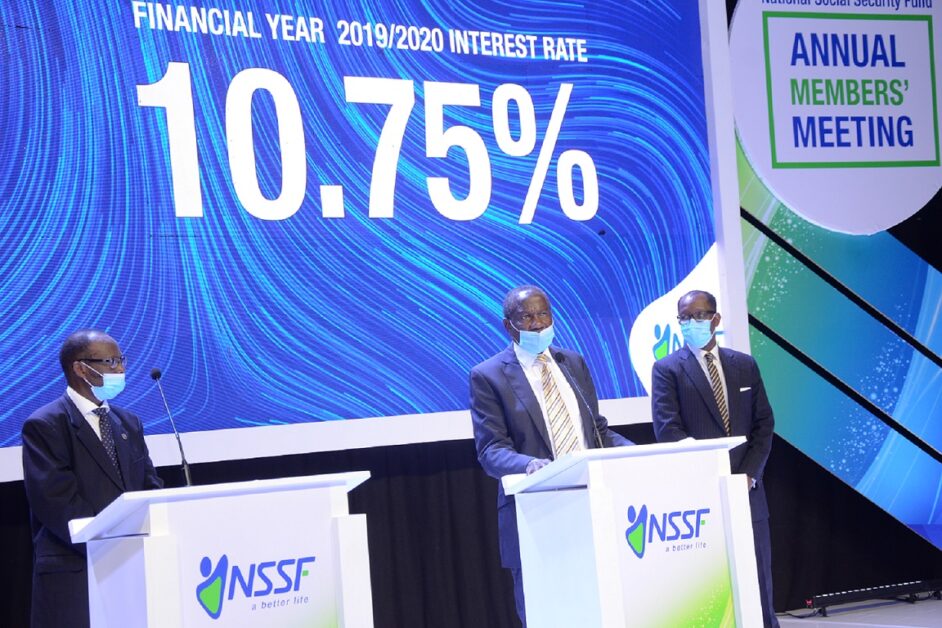
Interest to members’ Fund was 10.75% compared to the budget of 10.5%, resulting into UGX1.15 trillion credited to member accounts. Our investment portfolio is at UGX13.09 Trillion, with 77.25% in Fixed Income, 15.06% in Equities and 7.69% in Real Estate as compared to the Strategic Assets Allocation (SAA) of 70%, 22.5% and 7.5% respectively.

The Fund maintained an increased regional diversification into the Kenya, Tanzania and Rwanda markets helping to reduce the concentration into the Ugandan Stock Exchange which offers limited investment opportunities. We also unlocked the real estate developments with various housing units constructed and sold. The real estate projects undertaken this year include Phase I of Lubowa Housing Estate with 306 housing units on 33.2 acres and phase II of Pension Towers, an intelligent and modern commercial complex comprising of 3 towers of up to 32 floors.
 She Walks: Purposeful Strides, Scaling Hills in Heels—and Why Women’s Progress Matters for Africa’s Future
Impact of Covid-19 and stakeholder support
In March 2020, Uganda registered its first case of Covid-19 and the government came up with a number of containment measures to curb the spread of the virus in the country. These included among others, the closure of many businesses and restrictions on local and international travel. Uganda’s economic growth declined to 3.3% from the highly anticipated 6%.
The sectors that were affected most include: transport and aviation, tourism and hospitality, wholesale and retail trade, manufacturing and infrastructure, financial and agricultural sectors. This inevitably affected our business on both the investments and collections front. The Fund, being customer-centric, pioneered a mechanism for employers to defer payments until their cash flows stabilise, with many employers opting in with more than Ushs 69 Billion being deferred in collections.
The Fund also instituted all the Standard Operating Procedures as issued by the Ministry of Health and this included lockdown of our offices. However, due to the strong technological drive in the Fund’s strategy, our operations did not cease, and services were and are still accessible by all customers through various electronic channels.
The Fund remains cognisant of the changes and issues raised by Covid-19 in terms of economic trends and the general operating environment. However, it is important to note that steps have been taken to avert any challenges that may still unfold.
Outlook for the year ahead
In FY 2020-21, we shall continue working towards attaining our 10-year Corporate Strategy. We will focus on supporting our staff to serve our members ubiquitously; a work mode we had already launched prior to Covid-19.
The Fund is committed towards implementing all core internal projects with minimal or no shift in timelines, despite the Covid-19 disruption. The key projects are the Pension Administration System (PAS) aimed at improving the management of members’ funds through related innovations coming with this infrastructure.
For construction projects, Pension Towers, and Lubowa Housing Estate remain high priority to complete the scheduled milestones to avoid extra costs related to delays. We will look for diversification opportunities of the investment portfolio within Uganda and the East African Region specifically in both Fixed Income and Equity asset classes.
We will continue to create an enabling and exciting work atmosphere aimed at retaining and attracting talent to the Fund that will enable us to achieve our strategic goal and objectives.
For the past two years, the Fund has been pursuing the innovation agenda and in 2017, this was elevated as a long term strategy to drive the Fund business. I would say this has yielded results and is continuously being embedded in the organisational culture as demonstrated by the customer journey through digital innovation highlighted above.
Challenges that need to be noted
The Covid-19 pandemic and the lockdown in the last six months since March 2020 has affected economic activities globally. On the side of business, this has led to a reduction in members’ contributions during the period coming from two fronts; the deferment window and closure of some businesses.
The NSSF Amendment Bill currently at the floor of parliament remains a significant management challenge as it creates an uncertain direction the Fund has to take.
It has been a very challenging year for all of us, but we have delivered despite uncertainty in the current operating environment.
Richard Byarugaba is the Managing Director NSSF Uganda