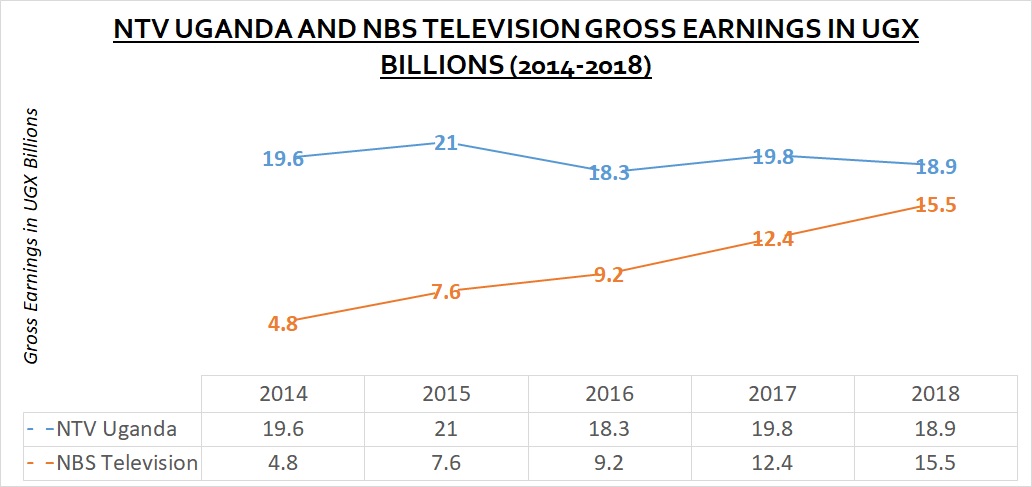
NTV Uganda, in the year ended December 2018 bagged UGX18.9 billion in gross revenue and made a net profit of UGX600 million, according to figures, this reporter has had exclusive access to.
NTV’s archrival, NBS Television, according to our investigation, on the other hand, for the year ended June 2019, made gross earnings of UGX15.5 billion, but unlike NTV, registered a UGX100 million loss.
Ordinarily the media honchos at NTV should be happy that they have their act together and they are giving their arch-rival a bloody nose where it hurts- share of wallet. But if you consider the fact that in 2014 NTV’s UGX19.6 billion revenue, was 4 times NBS Television’s UGX4.8 billion- a whole difference of UGX14.8 billion and five years later, a resurgent NBS has narrowed that gap to just UGX3.4 billion, then you begin to understand why there is or why there should be, if it isn’t there yet, a lot of unease in NTV’s corridors of power.
Twists and turns of television business in Uganda
The television business in Uganda has gone through a recurring and familiar trend.
For a long time, the state-owned UBC Television- then called Uganda Television (UTV) until the Uganda Broadcasting Corporation Act, 2004 merged UTV and Radio Uganda- and subsequently had UTV renamed to UBC, was the only television station in Uganda.
But by 2004, UBC TV’s hey days, had been cut short by WBS Television, owned by billionaire businessman Gordon Wavamunno of the Wavah Group. WBS TV, largely capitalised on UBC’s inefficiencies and quickly; successfully, ate off UBC’s monopoly, becoming the nation’s favourite, regardless of the fact that UBC had wider geographical coverage.
Sanyu TV, another private television that had earlier tried to unseat UBC TV suffered a quick death when its owners- the Katto Family, had their bank- International Credit Bank (ICB) closed in 1998, starving the young TV of cash.
However, WBS TV’s reign too did not last long as in 2007, Nation Media Group’s Africa Broadcasting Uganda Limited (ABUL), trading as NTV Uganda- hit the airwaves and by 2011 had grabbed 26% of the total national TV audience- and 38% of the more elite and economically active urban audiences- as per the Uganda All Media & Products Survey (UAMPS) done between October to December 2011, but released in January 2012 by media research firm, Ipsos.
So gripping was NTV’s hold on the market that according to the media survey, out of the top 20 TV programmes in the country, 18 programmes (90%) were on NTV. While it is true, that NTV had superior programming, reach and graphics, a large part of their winning team- be it sales, editorial and technical, had been poached from WBS TV and sharpened even further- leaving WBS TV gasping for breath.
The growth of NTV severely depressed WBS TV’s viewership share from 23% in 2010 to 8% at the end of 2011. WBS TV’s death was accelerated by the late 2009 launch of Bukedde TV- an all Luganda TV Station by the Vision Group and the 2010 launch of NBS Television – broadcasting in a mix of English and Luganda. Such was Bukedde’s profound impact that in 2 years alone- Bukedde had by end of 2012 grabbed 30% viewership share, and NTV had come down to 25%. Newcomers NBS TV were at 9% while WBS TV had been relegated to just 6% market share, according to Ipsos.
However, Bukedde TV continued its rise, due to its unconventional programming. By end of 2012- Bukedde had 7 out of Uganda’s top 20 popular programmes in the country and 13 of the top 20 in Kampala. The rest were NTV’s; NBS Television had none. So good was business for Bukedde that in 2016, they opened Bukedde TV 2 a 24-hour all entertainment channel that targets the youth and airs action movies, music mixes and select soap operas.
In 2015, businessman, Kin Kariisa acquired controlling stake in NBS Television rebranded it, refocussed both its programming and its audience targets. He poached quite a number of talent from the rival NTV and Vision Group exerting more pressure on the struggling WBS TV, but more importantly on NTV.
In December 2016, WBS TV would close due to combined pressure from the tax man and dwindling audiences and revenues, leaving the real TV battle between NTV Uganda and NBS Television on one hand, serving the elite ABC1 Classes, while Bukedde TV- essentially focusing on the C2 and D classes.
NTV feels the heat
The exit of WBS TV and the strong emergence of NBS and Bukedde, meant NTV now had not one, but two rivals to fend off. The emergency of a Luganda-only TV station especially, curved out an important niche of NTV’s audiences and a rebranded NBSTV that went for NTV’s ABC1 elite viewers became NTV’s new nightmare.
By the end of 2018, according to research firm Geopoll, NTV’s market viewership share had come down from 25% in 2011 to 18% while NBS improved to 11%.
Although Bukedde was dealing with shocks arising from the launch of two other Luganda stations- Delta TV in 2015 and the Buganda Kingdom owned BBS Telefayina launched in 2016, at 11%, they were still a power to reckon with.
Moreover, these two Luganda stations were also picking audiences and splitting NTV’s bread too. A Q4 2019 audience survey by Geopoll shows that at the end of 2019, NTV’s audiences further reduced to 11.6%, compared to NBS’ 10.21%- a very thin line.
Bukedde TV too has recovered, regaining 4 percentage points- from 11% at end of 2018 to 15.26% at the end of 2019.

But thankfully for NTV- Spark TV, a female-centric and largely urban Luganda TV station launched in December 2015 has quickly grown to the country’s number 4 biggest station by viewership share. According to the Geopoll, Spark TV audience share has grown from about 7% for much of 2018 and closed 2019 at 8.97%- just 1 point behind NBS and 2 points below NTV.
As a result of declining viewership numbers, NTV revenues too have come under pressure.
With audience leadership, NTV was always the money bags too. For example in 2014 and 2015, NTV grossed UGX19.6 billion and UGX21 billion respectively and registered a net profit of UGX3.1 billion and UGX3.3 billion. This could partly be attributed to a temporary windfall associated with the presidential elections of 2016.
But in 2016 gross earnings went down by 13% from UGX21 billion in 2015 to UGX18.3 billion in 2016, causing a loss of UGX200 million down from a profit of UGX3.3 billion the previous year. 2017 saw an 8.2 percent rise in gross revenue and a recovery from the losses, to a UGX600 million profit. In 2018, gross earnings tripped by 5% down to UGX18.9 billion, but profits remained at UGX600 million.
Overall, between 2014 and 2018, NTV’s gross earnings have literally stagnated- Compounded Annual Growth Rate for gross revenue was -1% while the CAGR for profit was -28%. Not good at all.
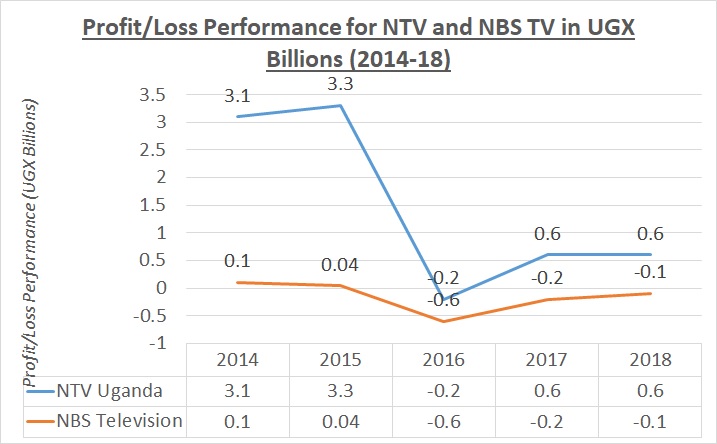
By comparison, NBS TV’s revenues have grown from UGX4.8 billion in 2014 to UGX15.5 billion in the year ending June 2019- on average, a 26% year on year increment. However, meaningful profit, still eludes NBS to date. In 2014 NBSTV profits were just UGX100 million, declining to UGX40 million in 2015. In 2016, 2017 and 2018, NBSTV posted a UGX600 million; UGX200 million and UGX100 million in losses respectively.
NTV’s Tony Glencross and NBS’ Kin Kariisa Speak out
In an email interview with this reporter, mid last year, Tony Glencross the Nation Media Group Uganda Managing Director, under whom NTV falls said that the measure for audiences is best told by the more realistic time slot share as opposed to overall market share.
 Inside the Balance Sheet: CFO Doreen Kyomugisha on Building Capital Strength and Financial Discipline at SanlamAllianz General Uganda
“Our focus at NMG has moved from overall market share to time slot market share and we monitor the audience and shares daily; program for program and time band for time band. We have deliberately chosen not to focus on any perceived challenger. We focus on our audiences, what they want, when they want it and how they want it. At the end of the day the audiences will choose how they use their time to consume media content. This strategy is applied across all our platforms, including radio, TV, Digital and Print,” he said.
Regarding NTV’s massive staff loss to rival companies, he said that NMG as a policy, does not “enter bidding wars for people” saying that “it’s not sustainable long term.”
“No personality is bigger than our products,” he said adding that: “Most of the top people in this industry including yourself, started out at NMG and then moved on. NMG is the best training ground for media practitioners and we will continue to grow the industry and that legacy, as the place to work if you want to work in Media.”
Regarding declining earnings, Glencross declined to comment directly saying: “I am not sure where you are getting your numbers, ABUL is not a listed company and so it does not publish its financial statements.”
Kin Kariisa, the CEO of Next Media Services, the parent company of NBS agrees with Glencross that time-slot analysis is the best way to analyse audiences- because viewers now have more choice- between 2-5 stations, making it difficult to tell the No.1 overall station.
“We have gone to a level of the US Tv market where they don’t rate which TV is number one; they rate which show is number one; who has the numbers at a particular time slot and that is the more credible kind or way of looking at things because every Tv station in the top 5 all have more less similar audiences but it depends who has which audience and at what time,” he says.
He also insists his station is ahead of all competition according to his in-house research, arguing that existing Geopoll and Ipsos research is not credible enough given its limitations in sampling and research methodologies.
“As far as we are concerned, of all the research we have looked at, the only time NTV could beat NBS TV is the 7 o’clock news bulletin, but only for 30 minutes- they have “Akawungeezi” we have “Amasengeje”,” he says.
He later shared with this reporter a research report done by a company called Research In-depth but also had an Ipsos logo on the cover page. When we asked by him by email- if the research had been done jointly with Ipsos, he did not respond.
However an investigation by this reporter shows that Research Indepth is headed by a Moses Mafabi a former Ipsos Senior Resaerch Executive, who also indicates on his LinkedIn profile that he is employed as a research Manager at Next Media Services. Due to this conflict of interest, we declined to publish the findings in the research- many of which placed most of Next Media Services’ media platforms on top of competition.
Why NBS Television is rising
On NBS’ rise from the bottom, Kariisa proudly says, NBS actually only started competing with NTV in 2015 because before that, NBS was all over and unfocussed. He says that in 2015, on the onset of digitalisation of the TV industry, he made a conscious decision to refocus NBS for the AB & C audiences. He also created two new TV brands- Sanyuka TV and Salam TV for the mass audiences and his goal is to have each of these channels leading in their respective market segments.
He says then an investment was made in getting the right people, the right technology and all this is backed by research so he is able to create the right content at the right time.
“When it comes to middle and upper class, for TV, people should look at NBS as their main channel. NBS is hinged on three things- current affairs, politics and live broadcasting,” he told this reporter, adding: “If anything happens or is happening, you should be able to say that the channel I should turn to is NBS because I know they will be having it; they will be neutral and they will be reliable.”
He also says that NBS TV’ competitive advantage over NTV lies in technology and quick decision making.
“In terms of picture, in terms of sound, presentation and delivery, graphics, we believe they don’t match us,” he says.
“Decision making is what they find hard on their team, not that the people who are there don’t know what they want, what to do, where as it will take us three hours to purchase a camera from Dubai to put it in the next flight to bring here, it takes them six months to write on paper, justifications, not that they don’t know what they want but the structure is harder than even government. So, there is no way they can compete with us, that one I know,” he boasts.
Kariisa is also not shy about people poaching saying that first, NBS TV went for competition’s production teams and thereafter their editorial teams. He however quickly adds that NBS does not only poach good people, but they also do training of their own as well as re-sharpen those they poach.
“We have developed our people, we train our people, the systems we have here are very robust, I too have done a lot of trainings, even if you brought CNN here, they can’t compete in this terrain of mine that I understand very well….no way,” he says.
This is the reason why, Kariisa also says he is not worried about losing his people to especially local competition.
“I have never gone home thinking that may be one of my big people might go to competition; they will never have the experience that we have here or the pay that we give them, so I cannot go home worried that tomorrow I will wake up and then Samson (Samson Kasumba) will go or Solomon (Solomon Sserwanja) will go; may be to BBC yes, but here in the market, no,” he brags.
So confident, he is of his cash chest (we believe) that he openly says: I can pick any one, any day.”
Kariisa, instead says he is more worried about social media platforms than local television stations.
“Our biggest worry are the big platforms- YouTube, Facebook. These don’t invest in content but they earn more money than the content providers. The future is really very abnormal; we don’t know how this things are going to turn out, but we are trying to strengthen ourselves to become great content providers. Content is key- we want to invest in our people, in the technology and create concepts and ideas that would be able to compete and be able to provide content that can run through all these platforms,” he says of the future of the industry.
He also denied that NBS is loss-making.
“So, you think we have gone to the Bank to borrow money to grow the company? NBS has financed all this,” he says, adding: “If we are loss making, could we be having a radio, could we be having Sanyuka with the state of the broad casting equipment, which no body has in this market? I have no singe loan; it is out of NBS that we are financing all this.”
“I can tell you that in two years, you will come here and we shall not be having this conversation because there won’t be any more competition,” he confidently says.