If the first four parts of this MadMen, Dreamers and Deal-Makers series were about the machine, how it was built from accidents, battered by economics, bruised by burnout, and handed to a new generation, this part is about something stranger.
What happens when the machine learns to think?
Not “think” like a creative director pacing in Kololo at 2 am, or a media buyer staring at a GRP spreadsheet. Think in code. In predictions. In prompts. When the tools you once used to execute your ideas start quietly suggesting ideas of their own.
For nearly four decades, Uganda’s advertising engine has been powered by people: pharmacists who escaped the counter, cricketers who answered phone calls, kids in flip-flops who thought “copywriting” meant copyright law.
Now, for the first time, those same people are sitting at desks where the brief can answer back.
This is the story of AI, automation, and the future adman, not as sci-fi fantasy, but as lived reality in the agencies of Kampala, Nairobi, and beyond.
It’s about the fear, the opportunity, and the uncomfortable question humming underneath every glowing screen: when machines can do almost everything, what is a human adman for?
From razor blades to algorithms
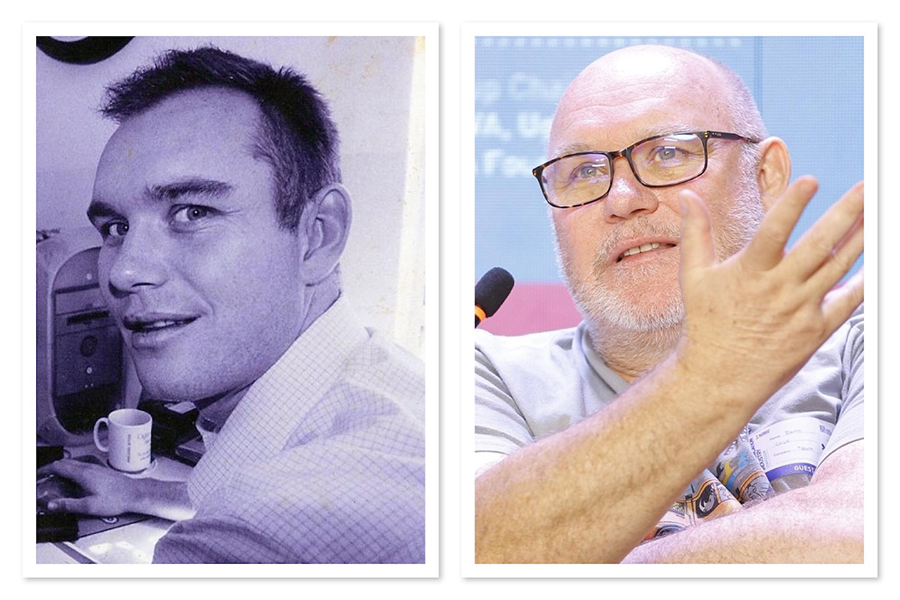
To feel the shock of this moment, start with someone like David Case.
He began in 1988 at MCL McCann, in a world where layouts were literally carved together. Illustrations were hand-drawn. Typesetting meant cutting letters from printed sheets.
Newspaper ads were glued, photographed, and converted to film. Billboards were hand-painted. “What a journey it has been!” he recalls.
Then 1997 arrived with a different kind of thunder. South African companies poured money into Uganda; Stanbic, Multichoice, MTN, Coca-Cola, Shoprite, SABMiller, and with them came digital production, modern print, and a real media marketplace.
Case calls it a “remarkable digital transformation.”
By 2010, Facebook and Google Ads had arrived and “democratized media buying.” A brand manager in Ntinda could place ads from a laptop instead of begging for slots from a single gatekeeper.
Now, Case says, we’re “entering the transformative era of AI resolution … a disruption that promises to be advantageous for those who master it,” and those who do will emerge as “visionary game changers.”
In one man’s lifetime, the industry has moved from razor blades to algorithms.
For Daniel Ligyalingi, co-founder of Maad Advertising, who entered the media in 1998, the early internet was still a rumour.
“Back then, the internet was limited and digital media almost non-existent,” he says. Yet he lived through every wave: print dominance, radio explosions, satellite TV, early websites, early dashboards.
Today, people like Case and Ligyalingi find themselves mentoring a generation that has never cut film, never waited for a newspaper proof, never placed an ad without a dashboard.
And that generation is now staring at something that feels like their own “1997 moment”, except faster, colder, and far less forgiving.
“We have maybe 12 months”
If you want to measure urgency inside boardrooms, listen to Peter Magona, Managing Director at TBWA Uganda.
“One big area is AI and automation,” he says. “It’s no longer something in the distant future; it’s already here, disrupting how we create, test, and deliver work. In fact, in some cases, clients actually have access to better AI tools than we do.”
Then he says what many leaders only imply: “We have to start from the assumption that the client is using AI … I believe we have maybe 12 months, max, to become truly fluent and competitive in how we integrate AI. Beyond that, if we haven’t figured it out, we risk being outpaced.”
This isn’t conference-stage drama. It’s a managing director looking at his own P&L and admitting that the tools are already in the client’s hands.
There are CMO dashboards in Kampala right now where scripts, headlines, and visual concepts are being generated and tested before agencies ever see the brief.
So Magona’s question isn’t “Will AI take our jobs?” It’s more surgical:
How does the industry make sure the work it brings to the table hasn’t already been chewed, watered down, or replicated by the client’s own AI?
His answer is attitude and skill, where teams should experiment by using AI for ideation, drafting, and strategic framing.
Personally, he sees AI as “integration, not replacement.” Two decades of experience, he argues, should make him better at prompts and judgment, not obsolete. “That human insight still matters … we’re not throwing away our expertise. We’re enhancing it.”
The ticking clock isn’t just about software. It’s about relevance.
The agency that became a tech company

Some shops didn’t wait for AI headlines to realise they were no longer just in “advertising.”
At Blu Flamingo, Seanice Kacungira watched social media turn from toy to infrastructure. She built one of East Africa’s earliest serious digital agencies, then kept moving. Today, she describes a business that sounds less like an agency and more like a lab.
She talks about a “data, creative, and tech” triangle where stories are “pieces of data put together in a poetic way that has emotion behind it.”
In her view, AI doesn’t arrive as a threat; it arrives as a workforce.
“We’re entering a future where AI agents will handle a significant part of execution,” she notes.
That means small, sharp human teams sitting on top of AI stacks; strategy, insight, culture, relationships, while machines churn through permutations, reports, and variations at inhuman speed.
The agency changes shape. Instead of a traffic manager herding 10 designers, you might have one or two sharp individuals who understand prompts, data, and culture, and can scale production across markets with AI as the execution arm.
In that world, titles like “junior artworker” begin to fade. New titles emerge: AI lead, automation strategist, creative technologist.
Blu Flamingo already behaves like a tech company that happens to love stories. In the next decade, many of Uganda’s agencies will either follow that path or find themselves competing against platforms that don’t care whether they exist.
When machines learned to buy media
If creativity is learning to live with AI, media is learning to live inside it.
For Rommel Jasi, Managing Director of Saladin Media and Chair of the Uganda Advertising Association, the shift is more than tools; it is a mindset.
“There’s been a clear shift from traditional to digital, and this hasn’t just called for new tools, it’s required a complete mindset transformation,” he says.
He describes an industry that can’t survive on one “big” TV spot and a rate card.
“We’re no longer in an era where you could spend weeks and a big budget crafting a single glorified 30- or 60-second TV ad and expect it to do all the work. Today, you’re expected to produce multiple iterations, across multiple formats, in real time. That demands agility.”
Behind that agility is automation. Programmatic platforms buy impressions at scale. Algorithms decide where and when ads run. Optimization engines pause underperforming creatives at 3:17 am, while everyone in Kampala sleeps.
Media planners have gone from booking spots to reading dashboards; from negotiating over coffee at Capital Shoppers to debugging pixel fires and attribution windows.
In that world, the value of a media agency can no longer be “we know the stations.” The machine knows the stations. The machine has the inventory.
The value shifts up: interpreting messy data in a market that is still poorly measured, designing human-centred strategies inside algorithmic systems, and protecting clients from wasting money on cheap but useless impressions.
The media adman of the future is not the person with the rate card. He’s the one who can sit in front of a client’s dashboard and translate chaos into clarity.
“Everyone needs to be a kick-ass prompt engineer”
Jeffrey Amani, founder of Zeus The Agency, treats change as raw material. He got a break designing a mascot called Tsavo; now he’s building an agency for a world where the mascot might be generated.
“One of the first things we did here at Zeus was introduce AI skilling initiatives,” he says. They started with fundamentals, what AI can actually do, then built training around one skill: prompt engineering.
“We believe everyone needs to be a kick-ass prompt engineer,” he says, not just creatives. It’s happening across departments.
The point isn’t that prompts are magic. It’s that the future adman isn’t only a storyteller; they are a systems whisperer. They must know how to talk to machines.
Amani refuses doomsday narratives. “AI is just another tool,” he argues.
 Ruparelia Group Wins Key Entebbe Land Case, Clearing Path for the New Mega Speke Resort and Convention Centre, Entebbe
People worried when Adobe arrived; those who adapted thrived. Same pattern. AI isn’t the enemy; the winners will be those who adopt quickly, leverage its strengths, and apply it skillfully.
That optimism echoes Case’s “visionary game changers” and Kacungira’s view that “we’ve been here before.” The technology changes. The pattern doesn’t.
Driven by technology, sustained by trust
For Adris Kamuli, who co-built Maad on second-hand laptops and stubborn faith, the future isn’t a choice between analog romance and AI.
“The future of advertising in Uganda will be driven by technology but sustained by trust and creativity,” he says. Tools like AI are reshaping how we create, analyse, and deliver, “but they are just enablers.” What matters is responsible, authentic use.
He goes straight to the fault lines: data privacy, truth in advertising, and AI transparency. “We’re already seeing deepfakes and manipulated content,” he warns, and without policies on data protection and ethics, risks will grow.
The machine will amplify whatever you feed it. If inputs are lazy, exploitative, or dishonest, AI will scale the damage.
So Kamuli’s prescription is simple and hard: client–agency trust must shift from transactional vendor relationships to genuine partnerships built on respect, shared goals, and long-term thinking.
Creativity remains a differentiator, but it must be powered by insight, data, and real understanding of evolving behaviour.
That is the future adman’s job description in one breath: fluent in AI, anchored in ethics, obsessed with data, comfortable with automation, and unable to outsource integrity.
When your idea can be watered down in seconds

Not everyone sees only opportunity. At TROI, Joshua Kamugabirwe lives in the uncomfortable middle.
“A client can now run your ideas through AI and water down two weeks of effort in seconds,” he says.
At the same time, clients demand data-driven recommendations while investing little in research, in a market that remains poorly measured. Agencies are asked to deliver AI-level insight on budgets that barely fund basic measurement.
Yet he doesn’t flinch from the upside. Used correctly, AI can find quick solutions, save time, and make smarter decisions. The future is balance: embrace efficiency, protect depth, creativity, and the human touch.
That’s the tension of the next decade: AI can trivialise your work, or give you back hours to deepen it. It can push clients to bypass you, or force you to raise your game. It can flatten everything into sameness, or free you to explore what machines don’t understand.
The difference won’t be the tool. It will be the posture.
What the future adman actually does all day
A day in the life of the future adman is no longer a linear march from brief to brainstorm to execution. It’s a dance, half-human, half-machine, where instinct and algorithm sharpen each other.
A creative may no longer start with a blank page and wait for inspiration. They may open AI tools beside the document, like a second brain humming in parallel. They may ask for thirty headline variations, not because they can’t think, but because volume gives them a palette to react to, refine, disagree with, and sculpt into something true to the brand.
They might use AI to build first-cut moodboards, then apply taste to elevate what’s strong and discard noise. They might simulate journeys, map predictable behaviour, then stress-test those predictions against real-world nuance and market intuition.
The job shifts from inventing in a vacuum to curating, editing, and steering. Machines generate possibilities; meaning remains human.
On the media side, the machine buys. Humans interpret. Teams plug campaigns into systems that optimise in microseconds, but their value lies in knowing which signals matter, especially in imperfect measurement environments. They design test-and-learn frameworks that machines can run at scale so campaigns evolve like living organisms.
Leadership changes, too. Magona talks about building systems so that only a small fraction of time is spent firefighting. Chaos isn’t heroic; it’s expensive. With systems, dashboards reveal problems early, enabling honest client conversations, protecting teams from unnecessary late-night panic, and reducing burnout that silently kills quality.
In this world, the future adman is less emergency responder and more architect, designing workflows so crises become rare. Their craft becomes structure. Their superpower becomes foresight.
Underneath runs a philosophy many share: learning never stops. Tools evolve faster than job descriptions, so nobody can hide behind “I’m just a copywriter” or “I’m only an art director.” You must be multi-skilled, cross-disciplinary, adaptable.
Kacungira frames it as “a world of patterns.” History doesn’t repeat; it follows patterns. AI is simply the newest wave in a long line of disruptions, and the only defence is continuous learning and personal mastery.
The most important skill isn’t expertise in one channel. It’s the ability to keep learning without losing yourself, to work with machines without becoming one; to wield AI without surrendering judgment, taste, intuition, and ethics.
The human moat
If AI can write a script, design a visual, plan a flight, and generate a report, what’s left?
More than you think. Culture is first. AI can remix, scrape, and mimic language, but it struggles to originate what hasn’t been named yet, the living nuances that sit in the gut.
AI can scrape Luganda expressions; it doesn’t know what it feels like when a boda guy twists your line into a new joke on Jinja Road, or when a silence in a village bar tells you a line landed wrong. Culture lives in moments machines don’t inhabit.
Ethics is second. AI will optimise for clicks on a deepfake if your KPI tells it to. It has no “should,” only “can.” In a future where manipulation is cheaper than ever, integrity becomes a moat. Trust is earned in choices: what you refuse to do, what you disclose, what you protect.
Relationships are third. AI can produce return on investment graphs; it can’t sit across from a CMO whose brand is under attack and calmly map a path through the storm.
It can’t manage boardroom politics, stakeholder fear, and reputational risk. Return on relationships matters alongside return on investment. In a world where everyone can access similar tools, character becomes the differentiator.
The future adman’s real advantage won’t be faster software. It will be a deeper sense of responsibility for what that software unleashes.
Systems, not miracles

Alemu Emuron’s line keeps stalking this series: “You don’t rise to the level of your ambition; you fall to the level of your systems.”
He’s talking about creatives who dream globally but don’t build the habits to match. He’s also talking about agencies that talk big while running on late payments, broken HR, and random training.
In the AI era, that becomes prophecy. You can dream of an agency where AI does grunt work, humans do deep think, clients pay on time, and staff don’t burn out.
But if your systems are still built for 2005, manual processes, opaque finances, abuse disguised as “feedback,” no training budget, that dream collapses the first time a client asks for a same-day AI-driven campaign in three languages.
The future adman’s job is no longer only to write great lines. It is to participate in building systems, financial, ethical, technological, that can carry those lines into the world without breaking people along the way.
Magona is doing it with project management and planning systems. Rommel with delegation structures and mental-health cover. Kacungira with AI-driven operating models. Amani with skilling and prompt academies.
These aren’t side projects. They are foundations.
Designing a machine worthy of its future drivers
Earlier in this series, we said Uganda’s advertising industry is like a battered Coaster assembled from borrowed parts, still somehow making its run-down Jinja Road.
AI and automation are not a new engine bolted onto that Coaster. They are a rewiring of the dashboard.
They can be cruel: exposing inefficiency, rewarding laziness with irrelevance, and allowing clients to chew through your ideas with a prompt.
They can also be generous: giving exhausted creatives their evenings back, letting small agencies pitch against big networks, enabling a young art director to train an image model on Kampala streets and sell that aesthetic to the world.
What they cannot be is neutral. The future adman faces three choices. The first is to fear the machine: refuse to learn it, mock it, pretend it’s a fad, and watch relevance decay one brief at a time.
The second is to worship the machine: treat AI as an oracle, let it decide everything, reduce yourself to a prompt operator, and watch your soul quietly exit the building.
The third is to design around the machine: learn it deeply, expose its limits, utilize its speed to buy time for depth, fight for ethics even when nobody is watching, build systems that protect people and amplify creativity, and teach clients that tools are cheap, but judgment isn’t.
Many of the leaders quoted here have already made their choice.
Technology will transform the industry. But trust, creativity, ethics, and systems will decide who survives, and what kind of industry Uganda becomes on the other side of the wave.
The battered Coaster is still on the road. But somewhere under its rusted body, the wiring is changing, lit not just by petrol fumes and late-night coffee, but by lines of code, streams of data, and invisible hands adjusting bids in the dark.
If the people driving it can match that invisible power with visible courage – ethical, creative, systemic – then AI and automation will not write them out of the story.
They will simply hand them a new pen.