
For decades, Uganda’s Chief Information Officers were largely viewed as custodians of servers, networks, data centres, and IT support desks — technical specialists expected to “keep the lights on” while strategic decisions were made elsewhere in the organisation.
But that era, Uganda’s emerging digital leadership class says, must now come to an end.
At the recently concluded CIO–CXO Digital Leadership Forum and 2026 CIO Conclave in Kampala, technology executives, banking transformation leaders, regulators and international digital strategists converged around a single, urgent message: Uganda’s digital economy ambitions can no longer be achieved if technology leadership remains trapped below the boardroom table.
Leading that charge was Nkurunungi Gideon, Executive Secretary of the CIO–CXO Digital Leadership Forum, who framed the issue not merely as a corporate governance concern, but as a national economic imperative.
“Every company should have an IT leader in their boardrooms,” Gideon declared, arguing that digital transformation can no longer be treated as an operational afterthought delegated to technical departments.
He warned that Uganda risks remaining a consumer rather than a creator of technology unless CIOs become central participants in shaping enterprise strategy, economic competitiveness and national transformation.
“For too long, the IT industry in Uganda has lacked a unified home,” Gideon said. “We are no longer just a collection of individuals; we are a fraternity.”
The gathering — attended by representatives from NITA-Uganda, NSSF, Bank of Uganda, financial institutions, telecoms, technology firms, universities and students — evolved into a national conversation about AI disruption, digital infrastructure, workforce transformation and the strategic future of Uganda itself.
At the heart of the discussions was a growing recognition that technology is no longer merely an operational support function. It is now deeply intertwined with revenue generation, customer experience, risk management, national productivity and enterprise survival.
And if technology has become strategic, many speakers argued, then the CIO must become strategic too.
“We want to be at the seat where decisions are being made,” said Peter Mukuru, Director of Business Technology at Uganda Development Bank. “But first, we must speak the language of the people already sitting there.”
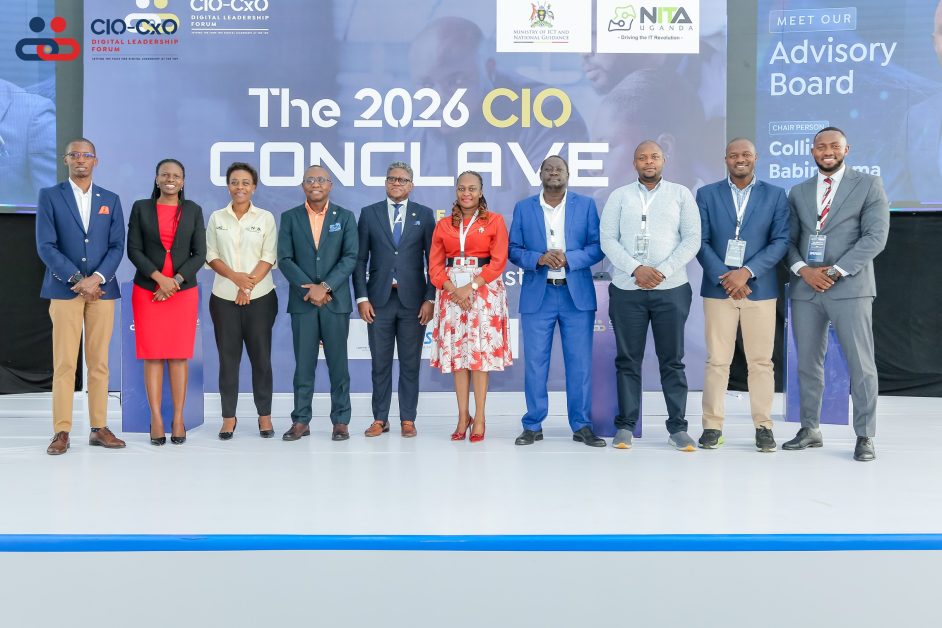
Technology leaders, regulators and digital transformation executives pose for a group photo during the 2026 CIO Conclave in Kampala, where speakers made a strong case for elevating CIOs from operational support roles into strategic boardroom leadership positions capable of shaping enterprise growth, innovation and Uganda’s digital economy future.
From Infrastructure Managers to Strategic Leaders
Throughout the two-day forum, one issue surfaced repeatedly: despite overseeing some of the most critical systems within organisations, CIOs are still frequently treated as technical managers rather than business leaders.
Jonathan Kayemba, CEO of Logos Cloud Edge Limited, described a long-standing imbalance where IT executives are often invited into boardrooms merely to report on infrastructure updates instead of shaping enterprise strategy.
“Good software doesn’t change the world; you need a seat at the table with the people who change the world,” Kayemba argued.
That frustration was echoed by multiple speakers who argued that digital transformation has fundamentally altered the role technology plays within modern institutions. Today, technology influences everything from operational efficiency and fraud detection to customer acquisition, market competitiveness and national economic growth.
Yet many boards, speakers argued, still evaluate IT departments primarily through cost centres, uptime statistics and procurement cycles.
Mukuru challenged delegates with a blunt but revealing question: Why is it almost never the CIO who ascends into the Managing Director or CEO role when leadership transitions occur?
His answer was equally direct. CIOs, he argued, have historically failed to translate technical initiatives into business language. Boards, Mukuru explained, are ultimately driven by five priorities: revenue growth, cost optimisation, risk management, customer impact and regulatory compliance.
If technology leaders cannot frame cybersecurity investments, AI deployments, digital platforms and infrastructure upgrades within those business outcomes, they will continue to remain operational rather than strategic leaders.
“The modern Chief Information Officer must fully complete the transition from technical expert to strategic business executive,” said Collin Babirukamu, Executive Director of Information Technology at Bank of Uganda.
He urged CIOs to abandon infrastructure-centric thinking and instead align technology initiatives directly with organisational goals such as efficiency, revenue growth, customer trust and operational resilience.
“You are not just managing IT,” he said. “You are managing trust, driving growth, and building the infrastructure of a better Uganda.”
The Rise of the “Value-Driven CIO”
That argument was reinforced by Fred Percy Kisa, Senior Manager Transformation at NSSF, who delivered one of the forum’s clearest frameworks for redefining technology leadership.
For years, Kisa argued, IT departments have measured success through operational metrics such as uptime percentages, patch compliance, server migrations and ticket resolution rates. But executive boards are increasingly asking different questions: how much revenue technology generated, how much it cost, how much customer friction it removed, and how much organisational risk it reduced.
“The ultimate job of the CIO is not merely to build systems,” Kisa said. “It is to remove friction from the human experience, thereby accelerating business growth.”
Using NSSF as a case study, Kisa illustrated how digital transformation creates business and social value simultaneously. Previously, members in rural Uganda often spent hours travelling to Kampala to access services physically. Digital systems dramatically reduced that burden, eliminating travel costs, shortening waiting times and improving trust in the institution.
The lesson for CIOs was clear: technology must no longer be reported as infrastructure expenditure. It must be communicated as enterprise value creation.
Uganda’s Digital Economy Ambitions
Underlying the boardroom debate was a broader national concern: Uganda’s digital economy race is intensifying at a time when the country still faces major workforce and coordination gaps.
One of the forum’s most significant announcements was the launch of the National IT Talent Registry — described by organisers not as a simple graduate database, but as “national infrastructure” designed to power Uganda’s digital future.
The registry seeks to capture certifications, skills, project portfolios and competencies, and make them visible to CIOs and employers nationwide.
According to Janey Rachel Nakato, CTO at Pearl Bank Uganda, Uganda currently produces thousands of graduates annually while still struggling to fill critical technology roles locally.
To address that gap, the forum unveiled a ten-year National Tech Skills Talent Program aimed at building a globally competitive workforce through certifications, hackathons, mentorship, employer partnerships and innovation ecosystems.
The long-term target is ambitious: to position Uganda as one of Africa’s leading digital outsourcing destinations with more than 200,000 verifiable ICT professionals by 2035.
“We want founders and creators, not just job seekers,” Nakato said. “We are moving from being users of technology to being builders of technology.”

Students and young technology enthusiasts pose for a group photo at the National ICT Innovation Hub during the 2026 CIO Conclave, where digital leaders challenged Uganda’s next generation to move beyond being consumers of technology and become builders, innovators and future boardroom leaders in the country’s rapidly evolving digital economy.
The rise of Artificial Intelligence also loomed heavily over the discussions.
International technology veteran and CCIE-certified engineer Eman Conde described AI as “the great equaliser,” capable of allowing talented young Africans to compete globally regardless of geography.
“With the right skills, a young person in Kampala can compete with anyone in the world,” he said.
He also announced a series of commitments, including efforts to lower certification costs for Ugandan students, support for Cisco networking academies, mentorship pipelines, and a $10 million infrastructure commitment toward data centres and digital ecosystems in Uganda.
But despite the optimism around AI, speakers consistently warned against reckless adoption.
“AI is not perfect,” Conde cautioned. “CIOs must guide adoption with accountability, ethics, and a commitment to continuous improvement.”
Julian Rweju, Director of E-Government Services at NITA-Uganda, argued that infrastructure alone is meaningless without the human talent capable of operating, securing and evolving it.
“We have built the infrastructure,” she said. “Now we need the talent to make it work.”
A Defining Leadership Transition
Perhaps the forum’s most important takeaway was that Uganda’s digital transformation debate is no longer fundamentally about technology. It is about leadership.
For years, CIOs were expected to maintain systems quietly in the background while strategic conversations occurred elsewhere. But as AI, cybersecurity, digital finance, automation and platform economies increasingly define competitiveness, that separation is becoming unsustainable.
Uganda’s technology leaders are now arguing that the CIO must move from the basement server room to the executive boardroom — not as a technical support function, but as a strategic architect of institutional and national transformation.
And as the country races to position itself within Africa’s rapidly evolving digital economy, the success or failure of that transition may determine whether Uganda becomes merely a consumer of global technology — or one of the continent’s next digital builders.