

By Muhereza Kyamutetera
East Africa’s CEOs are entering 2026 with confidence—but also with growing unease. Across Kenya, Uganda, Tanzania, Rwanda, Mauritius, and Zambia, business leaders are upbeat about growth prospects, supported by improving market conditions, expanding intra-African trade, and resilient economic fundamentals. Yet, beneath this optimism lies a critical question: are they moving fast enough to stay competitive in an AI-driven world?
The findings from PwC’s 29th Global CEO Survey – East Africa Perspective suggest they may not be. While 60% of CEOs express confidence in their company’s growth over the next three years, more than half admit they are concerned about the pace of transformation within their organisations. The result is a growing gap between ambition and execution—one that could define the region’s competitiveness in the years ahead.
The Good: Growth Confidence and Regional Momentum Hold Firm
At a macro level, the story remains compelling. East Africa continues to stand out as one of the fastest-growing regions on the continent, with 79% of CEOs expecting improvements in local market conditions.
This optimism is grounded in tangible economic shifts. Intra-African trade is accelerating rapidly, with East Africa’s trade with the rest of the continent growing by 42.9%, underlining a structural shift toward regional integration. Kenya, Uganda, and Tanzania remain the region’s top investment destinations, reflecting continued investor confidence in core markets.
“Trade within East Africa grew to USD 4.6 billion, up 24.5%, and accounts for 12.1% of EAC trade. This momentum isn’t just a number; it’s a clear sign of a region actively redefining its economic ties. And it shows that deeper cross-border collaboration isn’t just a choice, it’s a necessity, remarked Zainab Salome Msimbe, Country Senior Partner, PwC Tanzania in the commentary on the report.
Beyond trade, innovation is already contributing meaningfully to revenue growth. An overwhelming 85% of CEOs report generating income from new products and services over the past three years, with many attributing between 10% and 50% of revenue to these innovations.
This combination of economic resilience, expanding markets, and emerging innovation signals a region with strong growth fundamentals. But it is only one side of the story.
The Bad: AI Adoption Is Real — But Shallow
While CEOs widely acknowledge the transformative potential of artificial intelligence, actual adoption remains limited in depth and scope.
Only 10% of East African CEOs report using AI to inform strategic decision-making, even as 27% say AI has already contributed to revenue growth and 24% report cost reductions.
The gap becomes even more pronounced when organisational readiness is brought into focus. While a strong majority—70% of CEOs—believe their technology environments are already AI-ready, this confidence is not matched by execution. Only 41% have developed a clear roadmap to guide AI implementation, and an even smaller proportion, just 26%, feel that their current level of investment is sufficient to achieve their AI ambitions.
This disconnect highlights a critical issue: AI is being adopted tactically rather than strategically.
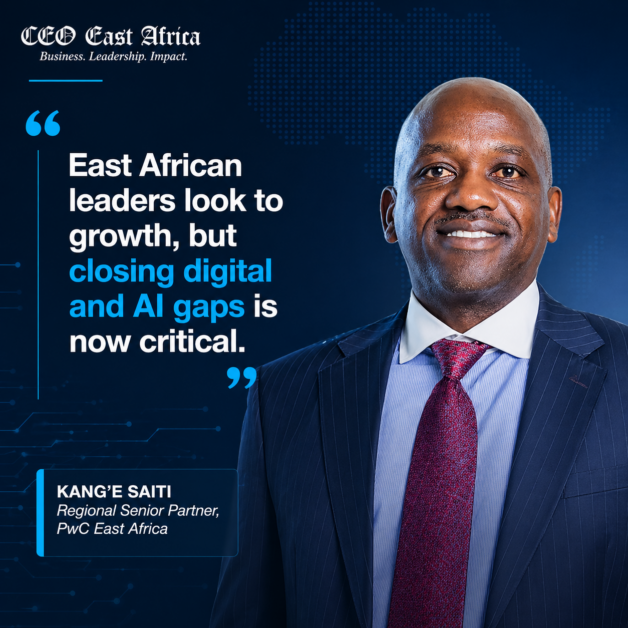
“East African leaders look to growth, but closing digital and AI gaps is now critical,” Kang’e Saiti, Regional Senior Partner, PwC East Africa, notes.
In effect, many organisations are experimenting with AI at the edges—customer engagement, support services, and operational efficiencies—but have yet to embed it at the core of decision-making and strategy.
The Worrying: Execution Gaps and Leadership Readiness
The most concerning findings lie in execution capability and leadership preparedness.
A significant 47% of CEOs acknowledge that their technology functions are not performing at the level required to support their ambitions. Meanwhile, 58% report that their primary AI tools do not have access to all relevant organisational data, limiting their effectiveness.
At the leadership level, the picture is equally troubling. Only 41% of CEOs believe their C-suite is adequately prepared to respond to disruption, raising concerns about leadership readiness in an increasingly volatile environment. At the same time, 34% report having faced stakeholder trust concerns over the past year, particularly around issues such as AI, data privacy, and transparency. Compounding this is a deeper sense of urgency, with 55% of CEOs acknowledging that they are worried their organisations are not transforming fast enough to keep pace with the speed of technological change.
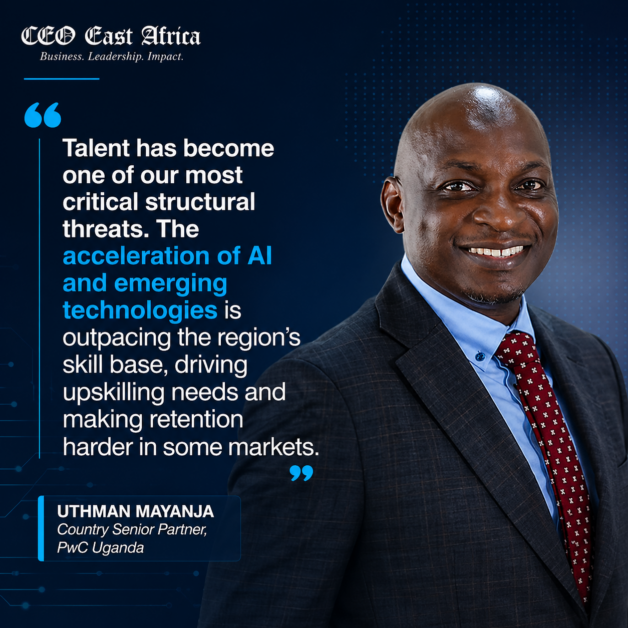
“Talent has become one of our most critical structural threats. The acceleration of AI and emerging technologies is outpacing the region’s skill base, driving upskilling needs and making retention harder in some markets,” Uthman Mayanja, Country Senior Partner, PwC Uganda, notes.
These findings point to a deeper structural issue: the challenge is no longer awareness, but capability.
Compounding this is how CEOs spend their time. On average 50% of CEOs’ time is focused on short-term issues and only 15% is dedicated to long-term strategy
This imbalance limits the ability of leaders to anticipate and shape future disruptions, reinforcing the execution gap.
The Structural Shift: Workforce, Risk, and Investment Tensions
Beyond technology, CEOs are navigating a fundamental reshaping of the workforce and operating environment.
Nearly half (46%) expect AI to reduce junior roles over the next three years, signalling a structural shift in how organisations are designed.
At the same time, talent availability has emerged as the top threat, cited by 32% of CEOs, followed by technological disruption (27%) and cyber risks (26%).
Despite these mounting pressures, investment appetite across the region remains notably subdued. Only 9% of CEOs indicate a willingness to make substantial investments, while more than half have refrained from increasing investment levels over the past year. A further 26% report that they are actively less inclined to invest, underscoring a cautious, risk-averse stance even in the face of clear transformation needs.
This caution is largely shaped by persistent geopolitical uncertainty, which continues to weigh heavily on boardroom decision-making and long-term capital commitments. Yet, even as leaders hold back on bold investment moves, the broader economic landscape is shifting in ways that demand the opposite—greater agility, deeper collaboration, and more strategic reinvention across borders.
“Intra-Africa trade is no longer just about growth — it’s about reinvention. With the AfCFTA and EAC strengthening regional supply chains, leaders must rethink tax, transfer pricing and operating models to compete across borders,” remarked Frobisher Mugambwa, Head of Tax and Legal Services, PwC Rwanda.
The Opportunity: Reinvention Through Partnerships and New Domains
Despite these challenges, the report highlights a clear path forward—one rooted in reinvention and collaboration. East African CEOs are increasingly looking beyond traditional sector boundaries, with 49% having already entered new industries and 93% generating revenue from these cross-sector ventures. Strategic partnerships are emerging as a key lever, particularly with technology firms, as companies seek to accelerate transformation and access new capabilities.
This shift reflects a broader redefinition of how and where value is created. No longer confined to traditional industries, growth is increasingly being driven by convergence—where sectors overlap, capabilities combine, and new domains emerge.
“The US$7.1 trillion in global revenue shifts unfolded in 2025 isn’t about markets moving—it’s about new cross-sector domains emerging. East African CEOs will win by partnering boldly, not protecting the past,” Anthony Leung Shing, PwC Mauritius, advises.
At a broader level, these dynamics are being reinforced by structural changes across the global and regional economy. Rapid mobile money adoption, continued investment in digital infrastructure, and deepening regional trade integration are unlocking new value pools that could reach up to $4 trillion in Africa by 2035. At the same time, capital is increasingly flowing toward African markets, with countries such as Nigeria, Zambia, and Madagascar rising alongside traditional regional leaders as key investment destinations.
These shifts are not just abstract trends—they are already playing out in real economies, where reforms, sector growth, and renewed investor confidence are beginning to take hold.
The Bottom Line: A Defining Leadership Moment
The message from the survey is clear: East Africa’s CEOs are not lacking in confidence—they are grappling with execution.
The region stands at a pivotal moment where growth opportunities are abundant, but the pace of transformation will determine who captures them. AI, innovation, and regional integration are reshaping the competitive landscape, demanding faster, bolder, and more coordinated leadership action.
The risk is not that CEOs fail to see the future. It is that they move too slowly to meet it.
In the age of AI, the gap between confidence and capability is no longer a strategic inconvenience—it is a defining leadership challenge.