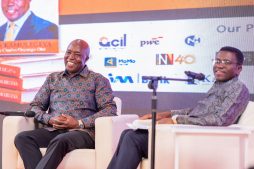
On Saturday, December 16, 2023, in what many within Uganda’s banking circles saw as a rare — and unusually public — endorsement and apparent promotion announcement of the chief executive of the country’s largest bank, Patrick Mweheire — then the East Africa Regional Chief Executive of Standard Bank Group, Africa’s largest bank by assets and the parent company of Stanbic Bank Uganda — openly praised Anne Juuko in an interview with the Daily Monitor, describing her leadership at Stanbic Bank Uganda as “exceptional” and suggesting she was destined for even bigger responsibilities within the Group.
In the December 2023 interview, Patrick Mweheire was unequivocal in his praise for Anne Juuko’s leadership, publicly crediting her for steering Stanbic Bank Uganda through one of the most difficult periods in modern banking history.
“We are very proud of the exceptional job she has done—leading the business to record-breaking numbers, through what was a challenging period,” Mweheire told the Daily Monitor, adding that Juuko had “led and continues to lead the team well in building our franchise, keeping us relevant in the market.”
He went even further, signalling what appeared to be a clear promotion pathway within the Group:
“We would love to keep and see her take on even bigger responsibilities within the Group… the next logical step after here would be a regional management role where she can partner with me and support more countries as I do.”
That unusually direct praise mattered because it came not from a distant commentator, but from one of Anne Juuko’s most senior bosses within Standard Bank Group. It was also consistent with what the bank’s own public reports, financial results and later appointment statements would say about her: that she had led through crisis, delivered record performance and was ready for a broader regional mandate.
However, for seasoned corporate observers, the moment felt unusual.
Chief executive exits and promotions at major banks are typically communicated through carefully crafted corporate statements, internal memos, or regulatory disclosures — not casually embedded inside a newspaper interview.
At the time, the interview was interpreted as an elegant public signalling of succession and promotion — a graceful transition for one of Uganda’s most visible banking executives. Soon after, Anne Juuko would indeed move into a regional role as Regional Head, East Africa for Global Markets at Standard Bank Group, overseeing operations across several African markets.
But little did the public know that, according to what is now a disputed and publicly leaked internal board resolution, just days before that glowing newspaper interview — on December 9, 2023 — the Stanbic Bank Uganda board, on which Patrick Mweheire himself sat alongside other senior directors, had allegedly convened a closed-door meeting and resolved to end Anne Juuko’s tenure as chief executive.
The reasons cited in the document were serious: concerns around the bank’s control environment, operational-risk incidents, governance disagreements, alleged market-share erosion, and tensions with Group leadership.
When CEO East Africa Magazine approached Stanbic Bank Uganda regarding the authenticity of the document, the bank declined to formally confirm or deny it. In the absence of Stanbic’s confirmation, it remains difficult to independently verify whether the versions currently circulating publicly can be fully relied upon.
The two-page document seen by CEO East Africa Magazine purports to have been sourced from the Uganda Registration Services Bureau (URSB), where company filings and board resolutions are ordinarily lodged as part of statutory corporate governance requirements.
The leak itself consists of two separate — and strikingly contradictory — board documents.

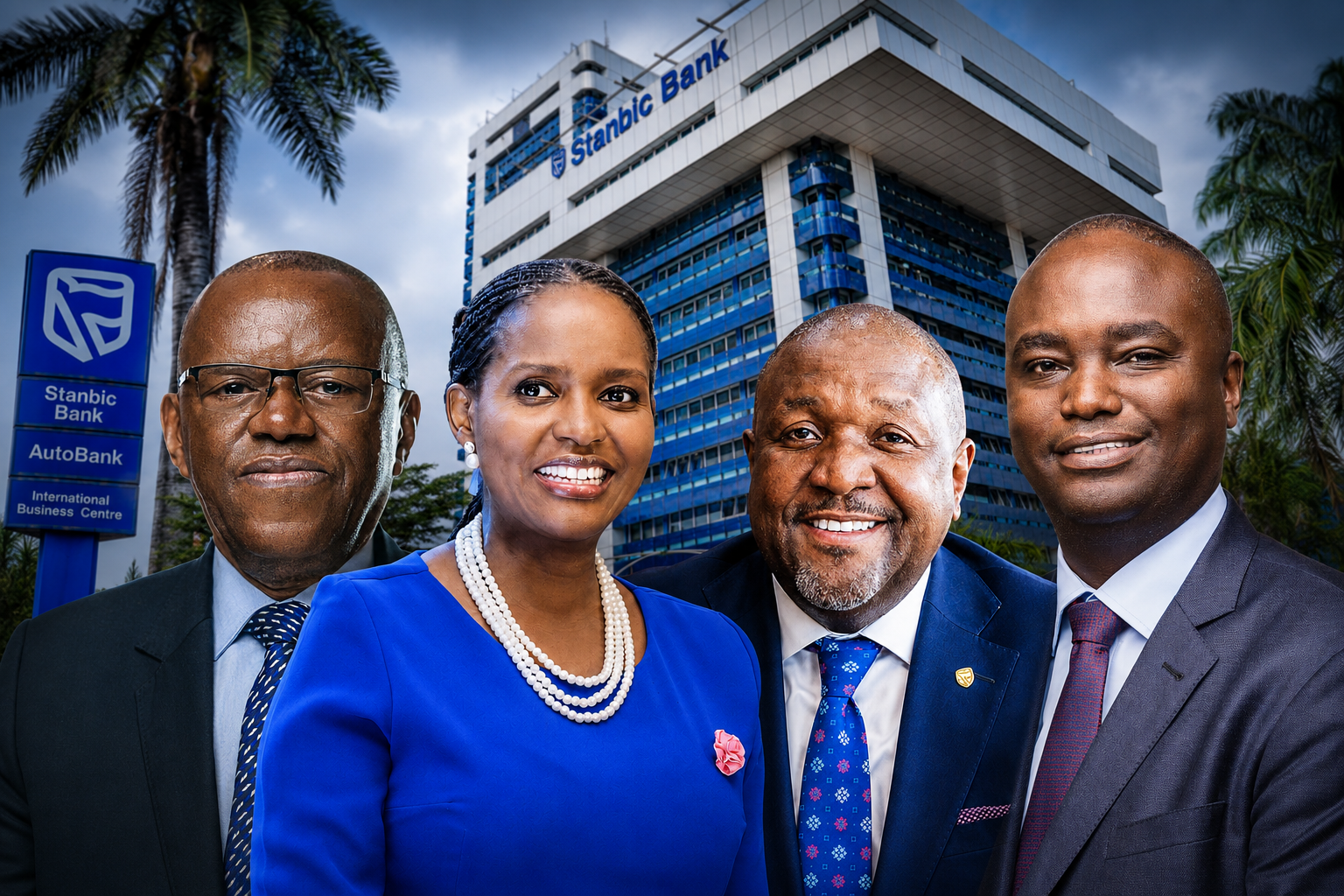
The first page, allegedly dated December 9, 2023, is the explosive resolution purportedly signed by Board Chairperson Damoni Kitabire and directors including Patrick Mweheire, Eva G. Kavuma, Elizabeth K. Ntege, Josepha T. Ndamira, Kim Kamarebe and Kenneth Ogwang. In that document, the board purportedly resolves to end Anne Juuko’s tenure as Chief Executive on grounds ranging from a “distressed control environment” and operational-risk losses to alleged market-share erosion and failure to implement board directives.
The second page — a letter dated May 9, 2024 and bearing a URSB receipt stamp dated May 17, 2024 — presents an entirely different narrative. Rather than referring to dismissal or failure to meet expectations, it formally states that Anne Juuko would cease serving as Chief Executive and Executive Director effective March 31, 2024 “following the completion of her three-year tenure and re-assignment as Regional Head, Global Markets, Standard Bank Group.” The same document expresses the board’s “gratitude” to the outgoing chief executive for her service to the bank.
When CEO East Africa Magazine formally sought clarification from URSB regarding the two documents, the bureau issued a response that deepened the mystery even further.
In its written clarification, URSB confirmed that it does indeed have on record the May 2024 board resolution relating to executive director changes — including Anne Juuko’s cessation as CEO following completion of her tenure and reassignment within Standard Bank Group.
Crucially, however, the bureau stated that it “does not have on record the separate resolution allegedly dated 9th December 2023 purporting to terminate Ms Anne Juuko’s tenure for the reasons stated therein.”
URSB further clarified that the alleged December 2023 resolution “does not correspond with any filing currently held by the Bureau” and that it could only confirm documents formally lodged within its official records.
That contradiction now sits at the centre of what is shaping into one of the most sensitive corporate governance controversies to hit Uganda’s banking sector in recent years.
Yet perhaps even more intriguing than the existence of the disputed board resolution itself is the timing — and manner — of its re-emergence into the public domain.
If the December 2023 document was never formally filed with URSB, how did it enter circulation? Who had access to it? Was it an internal working resolution that never matured into a formal statutory filing? Was it superseded by later board decisions? Or was it deliberately leaked outside formal corporate governance channels for reasons unrelated to regulatory disclosure?
The document has resurfaced at a moment when Anne Juuko is understood to be among the frontrunners for the position of Director General of the East African Development Bank (EADB), with sources indicating that the EADB board is now considering the final stages of the recruitment process.
According to multiple sources familiar with the matter, the same document had earlier been quietly circulated to executive recruiters and decision-makers involved in the EADB search process in what some insiders now believe was an attempt to derail her candidacy.
Yet despite the allegations contained in the resolution, sources say subsequent due diligence and background reviews involving Standard Bank Group, Stanbic Bank Uganda and the Bank of Uganda did not establish direct personal culpability by Anne Juuko on several of the issues raised.
Now, with the EADB recruitment process reportedly nearing conclusion, the resurfacing of the document is raising fresh questions: Who is leaking it? Why now? And who stands to benefit if Anne Juuko’s candidacy collapses at the final hurdle?
But beyond the leaked resolution itself lies a deeper and more complicated story — one involving boardroom tensions, competing power centres inside the Standard Bank ecosystem, executive succession politics, and the difficult balancing act of navigating leadership within one of Africa’s largest banking groups.
If the allegations surrounding the leak are accurate, the episode would expose the darker underside of executive succession battles inside large African corporates: where leadership transitions do not always end when an executive leaves office, and where influence, reputation management and institutional networks can continue shaping careers long after the boardroom doors close.
But before examining the motives behind the leak — and the powerful interests that may stand behind it — it is important to first interrogate the central question at the heart of this controversy:
Did Anne Juuko’s actual performance as Chief Executive of Stanbic Bank Uganda justify the severity of the allegations contained in the leaked board resolution?
The Public Record Tells a Different Story
Anne Juuko assumed leadership of Stanbic Bank Uganda in March 2020 just as the Covid-19 pandemic triggered one of the most disruptive economic shocks in modern banking history. Uganda’s economy slowed sharply as lockdowns disrupted business activity, weakened household incomes, strained supply chains and forced banks into widespread loan restructuring amid rising uncertainty and heightened credit risk.
Yet despite operating through that environment, Stanbic Bank Uganda remained Uganda’s largest and most profitable banking institution throughout her tenure.
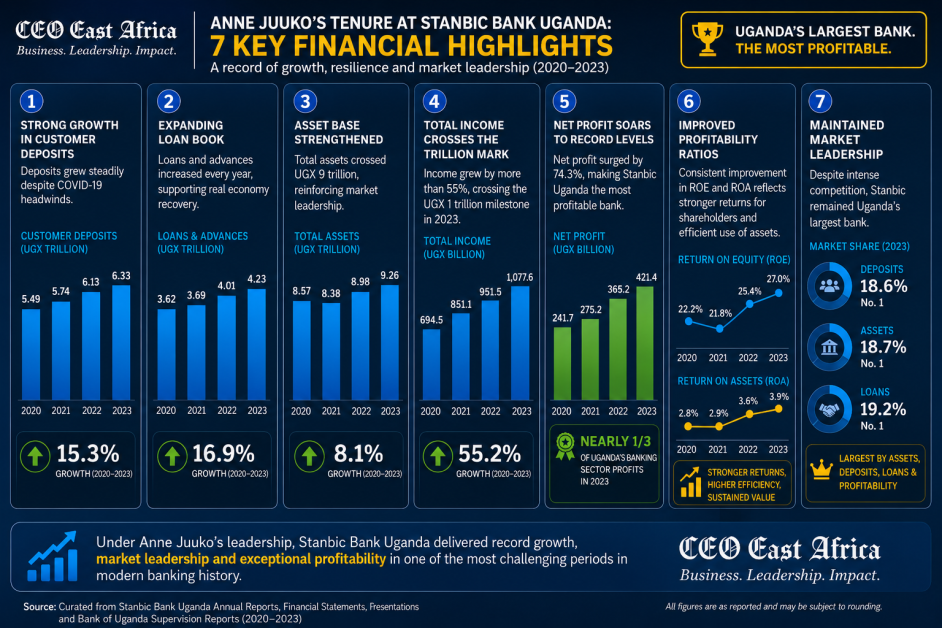
Between 2020 and 2023, customer deposits grew from approximately UGX5.49 trillion to UGX6.33 trillion, while the bank’s loan book expanded from UGX3.62 trillion to UGX4.23 trillion. Total assets rose from UGX8.57 trillion to UGX9.26 trillion.
More significantly, total income crossed the trillion-shilling mark, growing from UGX694.5 billion in 2020 to UGX1.08 trillion by 2023.
Profitability was even more striking.
Net profit increased from UGX241.7 billion in 2020 to UGX421.4 billion by 2023 — growth of more than 74 per cent in just three years. By 2023, Stanbic alone accounted for nearly one-third of Uganda’s entire banking sector profits, maintaining its position as the country’s largest bank by assets, deposits and lending.
More importantly, the bank’s audited disclosures during the same period do not describe an institution in a governance crisis or operational breakdown.
In its 2022 Annual Report, Stanbic’s Board of Directors stated that the financial statements gave “a true and fair view” of the bank’s affairs and confirmed that the institution remained a going concern. The Board Audit Committee similarly reported that there had been “no material breakdowns in internal control,” no reportable irregularities identified by external auditors, and no significant disagreements between management, internal audit and compliance functions.
The committee further stated that it was satisfied with the effectiveness of the bank’s internal controls, governance structures, risk management systems and financial reporting processes.
PwC, the bank’s external auditors, simultaneously issued clean audit opinions affirming that Stanbic’s financial statements fairly represented the institution’s financial position in accordance with IFRS and Ugandan banking law.
These were not personal representations by Anne Juuko. They were formal, audited, board-approved institutional disclosures signed off through established governance and regulatory processes.
At the holding-company level, Stanbic Uganda Holdings’ annual reports during the same period consistently portrayed an institution pursuing expansion, diversification and strategic transformation rather than institutional distress. The Group highlighted progress in digital transformation, platform banking, sustainability initiatives, regional positioning and non-bank subsidiaries spanning securities brokerage, fintech, SME incubation and real estate.
Even the board’s own public commentary appeared fundamentally at odds with the tone of the leaked resolution.
In the 2021 Annual Report, then-Chairman Japheth Katto praised Stanbic for delivering “commendable results,” demonstrating “market leadership,” and successfully executing its diversification strategy despite the pandemic. In the 2023 Stanbic Uganda Holdings report, Board Chairman Damoni Kitabire similarly described the institution as sustaining strong growth momentum while successfully executing its strategic priorities.
Those are not the public disclosures of a board signalling executive collapse or institutional dysfunction.
The market-share issue cited in the leaked resolution also appears more nuanced than the document suggests.
It is true that Stanbic’s relative dominance moderated modestly between 2021 and 2023 as competitors such as Equity Bank, Absa, DTB and Housing Finance Bank expanded aggressively from smaller bases. Stanbic’s deposits market share declined from roughly 20.4 per cent in 2020 to about 18.6 per cent by 2023, while asset market share softened from 22.1 per cent to 18.7 per cent.
But the bank itself was not shrinking.
Stanbic continued growing in absolute terms across every major balance-sheet category. What changed was the pace at which competitors were growing relative to the market leader in an increasingly competitive banking environment.
Industry analysts note that large incumbent banks globally often experience slower percentage growth than smaller challengers during recovery cycles because scale itself becomes a limiting factor.
That broader context matters when assessing allegations of “market-share erosion” during a period in which Stanbic remained Uganda’s largest banking franchise by a considerable margin.
The contradiction becomes even sharper when viewed against Anne Juuko’s subsequent trajectory within Standard Bank Group itself.
After leaving the Stanbic Uganda chief executive role, Juuko was not exited from the Group. Instead, she was elevated into a regional leadership position as Regional Head, East Africa for Global Markets, overseeing operations across Uganda, Kenya, Tanzania, DR Congo, South Sudan, Malawi and Zambia.
That appointment — alongside the Group’s subsequent internal recognition of her work in sovereign transactions, regional strategy and revenue diversification — creates a difficult institutional contradiction.
If her leadership record had genuinely been viewed internally as severe enough to justify removal on the grounds outlined in the leaked resolution, why did Standard Bank Group subsequently entrust her with broader regional responsibilities across multiple African markets?
One of Stanbic’s Most Consequential Leaders
The March 25, 2024 FY2023 Financial Results Presentation — the final major results presentation delivered during Anne Juuko’s tenure — further complicates the narrative contained in the leaked resolution.
Far beyond profitability, the presentation portrayed an institution that, by its own internal scorecards, believed it was strengthening operationally, culturally and strategically.
Customer deposits grew from UGX4.7 trillion in 2019 to UGX6.3 trillion in 2023, while gross loans and advances expanded from UGX2.85 trillion to UGX4.37 trillion over the same period.
Internally, several workforce and institutional indicators also improved materially.
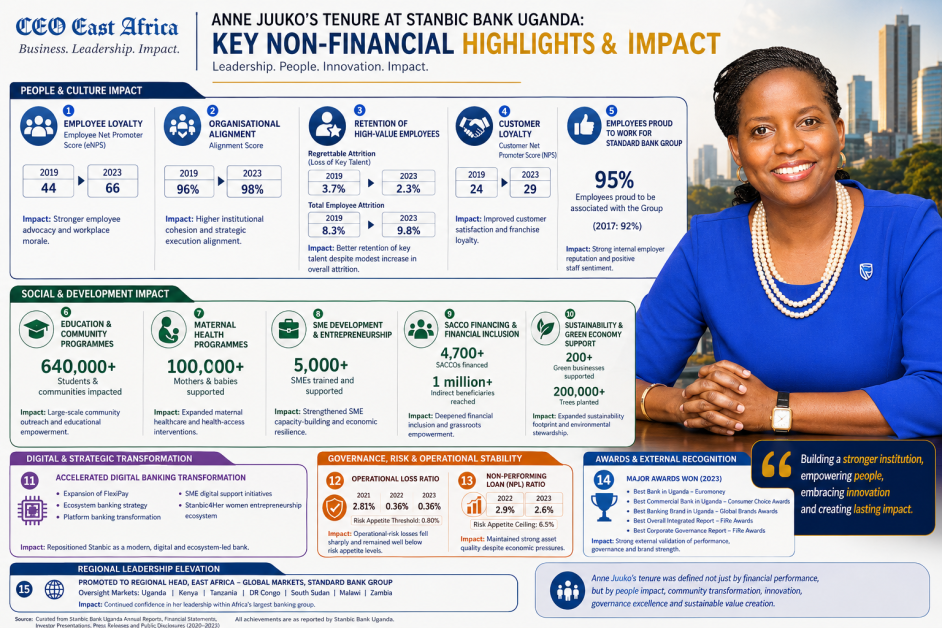
Employee Net Promoter Score — a measure of employee loyalty and workplace advocacy — rose from 44 in 2019 to 66 by 2023, while organisational alignment improved from 96 per cent to 98 per cent. Although overall employee attrition increased modestly from 8.3 per cent to 9.8 per cent, the bank’s regrettable attrition rate — which measures the loss of strategically important and high-performing employees — declined from 3.7 per cent to 2.3 per cent.
Customer Net Promoter Score also rose from 24 in 2019 to 29 in 2023.
Operational risk metrics presented during the same FY2023 briefing similarly appear inconsistent with the image of prolonged institutional distress described in the leaked resolution.
Stanbic reported that its operational loss ratio fell sharply from 2.81 per cent in 2021 to just 0.36 per cent in both 2022 and 2023 — well below the bank’s internal risk appetite threshold of 0.80 per cent.
The non-performing loan ratio improved from 2.9 per cent to 2.6 per cent during the same period, remaining comfortably below the bank’s stated risk appetite ceiling of 6.5 per cent.
Externally, the institution continued receiving major industry recognition. In 2023 alone, Stanbic was recognised as Best Bank in Uganda by Euromoney, Best Commercial Bank in Uganda by Consumer Choice Awards, Best Banking Brand in Uganda by Global Brands Awards, and winner of multiple FiRe Awards including Best Overall Integrated Report and Best Corporate Governance Report.
Internally, the bank reported that 95 per cent of employees were proud to be associated with Standard Bank Group and would recommend it as a good place to work.
Many of these metrics and institutional achievements were presented publicly just weeks after the board had allegedly resolved to remove Anne Juuko over concerns relating to governance weaknesses and operational failures.
Beyond the balance sheet, Juuko’s tenure also coincided with a broader repositioning of Stanbic as a development-oriented ecosystem player rather than merely a commercial bank.
Under her leadership, the bank expanded SACCO financing and community banking programmes, accelerated women entrepreneurship financing through Stanbic4Her, deepened digital transformation through platforms such as FlexiPay, and significantly expanded its footprint in sustainability, youth empowerment and social-impact initiatives.
According to the FY2023 presentation, Stanbic’s programmes impacted more than 640,000 students and communities through education initiatives, supported over 100,000 mothers and babies through maternal health interventions, trained more than 5,000 SMEs, financed over 4,700 SACCOs reaching more than one million beneficiaries, and supported more than 200 green businesses while planting over 200,000 trees.
Taken together, the audited disclosures, financial performance, governance statements, institutional metrics and subsequent regional elevation inside Standard Bank Group present a picture that sits uneasily beside the severity of the allegations contained in the leaked resolution.
That tension is precisely why the document’s repeated resurfacing — particularly during the final stages of the EADB recruitment process — has generated such intense scrutiny within banking and governance circles.
By the time the document re-emerged publicly, Anne Juuko had already undergone an extensive recruitment and due diligence process for the EADB Director General role. Multiple sources familiar with the process say she emerged among the strongest candidates in the field, with her candidacy strengthened by her regional banking experience, institutional transformation track record and leadership profile.
Sources familiar with the process say the same leaked document had earlier circulated privately among recruiters and decision-makers involved in the search process. Yet despite the seriousness of the allegations, subsequent reviews reportedly involving Standard Bank Group, Stanbic Bank Uganda and Bank of Uganda did not establish direct personal culpability by Juuko on several of the issues raised.
That, in turn, raises a broader question that extends beyond Anne Juuko herself.
If the leaked document reflected a settled institutional consensus regarding executive failure, why did regulators, recruiters and Standard Bank Group itself continue treating her as a credible candidate for increasingly senior leadership responsibilities?
The answer may ultimately lie less in pure performance metrics and more in the opaque realities of executive succession politics inside large corporates — where boardroom tensions, institutional rivalries and reputational battles can continue long after an executive leaves office.
The official URSB record points to tenure completion and regional reassignment. The bank’s audited disclosures point to sustained profitability, institutional stability and strategic growth. Standard Bank Group’s own actions point to continued confidence in Juuko’s leadership capabilities.
Against that backdrop, the repeated resurfacing of an unfiled and deeply damaging internal document increasingly appears less like routine governance disclosure and more like a high-stakes reputational struggle playing out at the intersection of corporate power, executive succession and regional influence.