
Uganda’s UGAFODE Microfinance Limited (MDI) has reported a year of strong balance sheet expansion in 2025, with lending, deposits, and total assets all posting double-digit growth—signalling an institution in full-scale growth mode, deepening its footprint across Uganda’s financial landscape.
Customer deposits—arguably the lifeblood of any deposit-taking institution—registered particularly strong growth, rising by 20% to UGX 66.31 billion in 2025, up from UGX 55.36 billion in 2024. This expansion in deposits not only reflects growing customer confidence in UGAFODE’s brand but also provides the critical funding base that powers lending, balance sheet growth, and overall financial intermediation.
Strong Growth in Lending, Deposits and Assets
Anchored on this stronger deposit base, UGAFODE accelerated its lending activities, with loans and advances increasing to UGX 136.10 billion, up from UGX 108.08 billion, representing a 26% surge. This sharp rise underscores a deliberate push to deepen credit access, particularly among micro, small, and underserved segments that form the core of the institution’s market.
Despite this strong growth in the loan portfolio, asset quality improved, with the Portfolio at Risk (PAR) declining from 3.34% in 2024 to 3.1% in 2025. This reflects the effectiveness of UGAFODE’s credit risk management practices, including enhanced underwriting standards, close portfolio monitoring, and strengthened recovery efforts. The improvement in PAR indicates that the institution has been able to scale lending in a prudent manner while maintaining the quality and sustainability of its loan book.
The combined effect of deposit mobilisation and credit expansion was a 17% growth in total assets, which climbed to UGX 173.20 billion from UGX 148.30 billion the previous year. This balance sheet expansion highlights an institution scaling rapidly within Uganda’s Tier III financial ecosystem, strengthening its role as a bridge between informal finance and mainstream banking.
Despite Growth, Profitability Declines
The strong expansion in lending translated into higher earnings, with total income rising to UGX 54.58 billion in 2025, up from UGX 50.91 billion in 2024, as the larger loan book generated more interest revenue. This reflects the natural cycle of growth—where increased credit extension drives top-line expansion and reinforces the institution’s revenue base.
However, this growth in income was more than offset by a sharp rise in costs associated with funding, scaling operations, and managing credit risk. In addition, profitability was significantly impacted by tax-related adjustments—specifically unpaid stamp duty arrears and tax ledger reconciliations amounting to UGX 2.12 billion. As a result, net profit after tax declined to UGX 4.65 billion, down from UGX 5.85 billion, representing a 21% drop despite the stronger revenue performance.
Related
 Chandan Singh Takes Over as Bank of Baroda Managing Director after Strong Growth under Shashi Dhar
Operating expenses rose to UGX 29.78 billion from UGX 27.66 billion, largely driven by these tax adjustments, alongside continued investments in branch expansion, digital infrastructure, and service delivery capabilities to support UGAFODE’s growing customer base.
A Tier III Institution Expanding Its Reach
UGAFODE’s performance reflects an institution in transition, both structurally and strategically. Originally founded in 1994 as a development NGO, it evolved into a regulated Microfinance Deposit-Taking Institution (MDI) in 2011 and now operates under a Tier III license from the Bank of Uganda—allowing it to mobilise deposits and extend credit while bridging the gap between informal finance and commercial banking.
Management frames 2025 as “a year of strategic growth and deepened social impact”, driven by expanded access to financial services for underserved groups, including refugees and women-led enterprises.
This growth has been underpinned by investments in digital channels, agency banking, and the digitisation of Village Savings and Loan Associations, alongside product expansion into areas such as bancassurance.
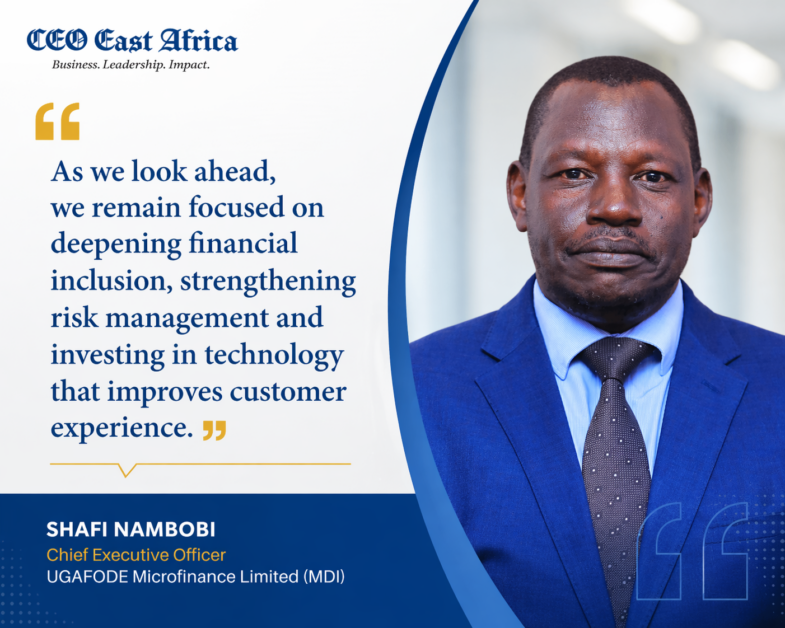
Chief Executive Officer Shafi Nambobi signals that this is a deliberate phase of investment, noting:
“As we look ahead, we remain focused on deepening financial inclusion, strengthening risk management and investing in technology that improves customer experience.”
With a clean audit opinion affirming financial soundness, UGAFODE’s trajectory points to a calculated trade-off—prioritising scale, inclusion, and long-term sustainability over immediate profitability.