


As Uganda celebrates International Women’s Day 2026, Agnes Mbabazi’s success story of building Agrifarm Uganda, an agro-input business, is one of the stories featured in “She Powers Uganda’s Economy — A dfcu Story Series,” a flagship storytelling initiative by dfcu Bank that spotlights outstanding female entrepreneurs banking with the institution.
Through this series, CEO East Africa Magazine will profile six successful businesswomen throughout the month of March, with Agnes Mbabazi among the entrepreneurs featured. The series highlights their entrepreneurial journeys, measurable economic and social impact, while reinforcing dfcu’s leadership in inclusive and sustainable economic growth through the Women in Business programme, dfcu Rising Woman, the GROW Project, dfcu MTN AWE and the dfcu Foundation.
For 19 years, Agnes Mbabazi built her name in the corporate world, rising through multinational agribusiness with discipline, technical mastery and executive grit. But when she finally stepped away to build her own company, Agrifarm Uganda, it was dfcu Bank’s belief, flexibility and timely support that helped transform a long-held side hustle into a serious agribusiness serving farmers across Uganda.
Today, Agrifarm Uganda Limited imports and distributes agro-chemicals, seeds, fertilisers and essential farm inputs including pumps, irrigation systems, greenhouses and water solutions. The company also supports the sector through agribusiness development services, consultancy for start-up agribusinesses and capacity building in modern agricultural technologies.
The Genesis
There is a moment in every entrepreneur’s journey when vision collides with reality.
For Agnes Mbabazi, that moment did not come when she registered Agrifarm Uganda in 2007.
It came years later, after nearly two decades in the corporate world, when she chose to walk away from executive comfort and place her future in a business she had kept alive quietly, patiently and at great personal cost.
By then, she had already built an impressive career in agriculture. Fresh from university, she joined Balton Uganda and entered one of the most technically demanding corners of the industry, floriculture. It was not an easy beginning.
She had not trained as an agriculture specialist, yet her day to day responsibilities required her to answer complex questions on pests, diseases, irrigation, crop nutrition and greenhouse systems.
Within three months, she was ready to quit.
“I almost gave up on my job,” she recalls. “I went to my boss and told him, ‘I need to leave this job. I don’t think I’m going to continue.’”
But instead of losing her, the company invested in her. She was sent to Kenya for practical training on flower farms, an opportunity that changed the course of her professional life.
When she returned, she was promoted, and the learning only deepened from there. Later, she trained in Israel, travelled widely for agricultural exhibitions and professional exposure, and eventually studied horticulture formally.
What had begun as an overwhelming assignment became a lifelong calling.
“From then on, I knew this was my space,” she says. “This is what I have done all my life.”
Over 19 years, Mbabazi rose through the ranks, serving in senior leadership across multinational agribusiness operations. She worked at Balton Uganda for 15 years, climbing from junior roles to become one of the company’s top agriculture executives.
She later joined a Chinese agrochemical firm at the startup stage and served as country director, helping build the business from scratch in Uganda before eventually returning to Balton as head of agriculture.
She had the title, the reputation, the influence and the lifestyle that come with corporate success. Fuel was paid for. Medical bills were covered. The company car was there. Airtime was never a concern. Executive life had become normal.
But even then, Mbabazi understood something many professionals ignore for too long. Employment, however rewarding, is not forever.
“Whether you like it or not, you will either quit willingly, they will throw you out, or you will retire,” she says. “So I knew that one day I had to build something of my own.”
That is why, long before she fully stepped into entrepreneurship, she had registered Agrifarm Uganda with her brother. At the time, it was less a full operating business than a strategic seed, a backup plan for the future she knew would eventually come.
Because of conflict of interest concerns, she could not directly manage the company while serving in senior corporate roles. Her brother helped run it while a small team handled day to day activities.
Then tragedy struck.
Her brother died in 2012.
Suddenly, the question was no longer how to grow the company. It was whether to shut it down entirely.
For Mbabazi, the easier option might have been to close it. At that point, she was still earning well in corporate life. Agrifarm was not growing meaningfully. The emotional blow of losing her brother was heavy. The business had become fragile.
But she kept it alive.
“The hardest decision was whether to close the business or let it continue,” she says. “I had a vision. I knew one day I would go solo.”
So she instructed her team to do the bare minimum needed to keep the company breathing. Pay rent, keep the licenses active, maintain the supplier relationship and do not let the name disappear.
At times, she personally sent money from her salary just to keep operations going.
“Sometimes I would pay salary from my own earnings just to keep the business alive,” she says. “I kept it as my safe haven.”
That safe haven became her landing ground in 2019 when she finally left corporate life for good.
The transition was far from glamorous.
Leaving a top executive role meant losing more than a paycheck. It meant adjusting to a completely different way of living.
There was no company medical cover anymore. No automatic airtime. No executive package cushioning everyday life. And yet she refused to retreat.
She took a short break, recalibrated, and committed herself to building Agrifarm Uganda into a real business.
Her Turning Point

In some ways, she was starting from strength. She knew the sector intimately. She knew suppliers, farmers, regulators and major clients.
Her reputation had already been built over years of disciplined corporate work. But in another sense, she was starting with almost nothing. The company was still small. Capital was limited. Growth required a leap.
And that leap would soon depend on one institution, dfcu Bank.
As Agrifarm began bidding for bigger opportunities, Mbabazi quickly ran into one of the hardest truths about entrepreneurship in Uganda. It is not enough to be capable. You must also be financially credible enough to compete.
Large institutional and government tenders required bid securities and performance guarantees. Without them, even the best proposal would go nowhere.
At the time, Agrifarm was banking with dfcu, but the company was still modest in size. Its account history did not necessarily reflect the scale of business it was trying to pursue.
Still, Mbabazi walked into the bank and made her case.
“I explained myself almost like I was in an interview,” she says. “I told them I had been in corporate life, I had experience, I understood the business, and this is what I wanted to build.”
Rather than dismiss her because the company was still small, dfcu listened. The bank looked beyond the immediate account balance and saw the person, the track record, the credibility and the business potential behind the numbers.
It related Mbabazi’s personal journey to Agrifarm’s future and chose to support her.
“What dfcu did for us was to hold our hand,” she says. “They gave us the support we needed at a time when we did not even have the money on the account. They saw the potential.”
That support made it possible for Agrifarm to secure the instruments it needed to compete for large contracts.
It opened the door to the company’s first major deal, a transaction that would become the business’s real breakthrough.
“Our biggest deal ever came because dfcu gave us the support,” Mbabazi says.
That first big opportunity was strengthened further by supplier trust.
A Norwegian company extended credit, allowing Agrifarm to deliver a large government order worth just under one million dollars and settle payment later.
For Mbabazi, that combination of supplier confidence and bank backing was transformative. It meant she could start scaling without immediately collapsing under the weight of capital constraints.
From there, the relationship with dfcu bank deepened.
The bank provided overdraft support and, over time, became more than just a place where the business kept its money. It became a growth partner.
Mbabazi says one of the most valuable things dfcu offered was flexibility, the ability to understand a growing woman-led business and respond with speed and trust.
“These days it is as easy as you can imagine,” she says. “I just send an email and whatever I need is handled instantly.”
But for her, the value of dfcu goes beyond credit facilities and securities.
She speaks passionately about the bank’s investment in women entrepreneurs, not only through financial products, but through platforms, visibility, training and networking opportunities that help legitimize and elevate women in business.
“There is much more than money,” she says. “They have given us platforms to speak. They invite us to high level events. You network, you learn, and sometimes you leave with much more than money. You leave a better entrepreneur.”
In one instance, she recalls a customer who had seen her at a dfcu event and immediately associated that visibility with credibility.
“For him it meant authenticity,” she says.
That is the kind of intangible value many growing businesses underestimate. In a country where trust and reputation drive deals as much as paperwork does, the validation of a respected institution can change how the market sees you.

Shooting for growth
With financial support and new momentum, Agrifarm began to evolve from survival mode into structured growth.
Mbabazi moved quickly to install systems, compliance systems, tax systems, accounting systems and operational discipline. This too came from her corporate background.
“We started building systems from day one, because we had no option,” she says. “If you want to do government business, you must be compliant. You must be reliable. Systems help you become reliable.”
She describes Agrifarm today as, in many ways, a scaled reflection of the discipline she learned in multinational agribusiness. The financial rigor, process culture, supplier management and accountability structures she observed for years are now embedded in her own company.
Today, Agrifarm Uganda imports and distributes fertilizers, improved seeds and crop protection products sourced from countries including Germany, Norway, Argentina and Kenya.

But Mbabazi has built the company to be more than a distributor of inputs. It is also a knowledge platform.That evolution became especially clear during and after COVID 19.
While the pandemic disrupted many businesses, it also revealed an urgent gap in Uganda’s agriculture sector. Farmers did not just need products.
They needed technical guidance, problem solving and trusted advisory support. As an essential sector player, Mbabazi travelled, visited farms, advised growers and discovered how deep the knowledge deficit really was.
“There is a huge knowledge gap in agriculture, from the smallholder farmer to the commercial farmer,” she says. “Farmers are willing to pay for technical advice, but many do not know where to go.”
That insight helped define Agrifarm’s broader mission. The company now combines input supply with farmer training, technical support and market linkage facilitation.
Through the Development Response to Displacement Impacts Project (DRDIP), with the Office of the Prime Minister, GOAL and Mastercard Foundation, it has worked in refugee hosting districts and vulnerable communities, reaching smallholder farmers, women, youth and people with disabilities.
In the past three years alone, the company says it has reached more than 100,000 smallholder farmers across over 40 districts in Uganda. It operates with a team of 24 full time staff and, depending on project scale, can engage between 100 and 200 additional field workers, many drawn from local and refugee communities.
For Mbabazi, this is the most meaningful dimension of her work.
“The most impactful part of my journey has been working in refugee communities,” she says. “When you go back and people show you that you have actually changed their lives, that is the most satisfying thing.”
Her impact now extends well beyond Agrifarm. She serves as Chairperson of CropLife Uganda, the apex body representing manufacturers and importers of agricultural inputs.
She also sits on the Agricultural Chemicals Board under the Ministry of Agriculture, helping shape policy, regulation and standards in the sector.
These positions reflect the breadth of her influence, but they also underscore the scale of her reinvention. She is no longer simply a former corporate executive running a business. She is now one of the women helping shape Uganda’s agricultural future.
And still, she keeps learning.
“For me, studying never ends,” she says.
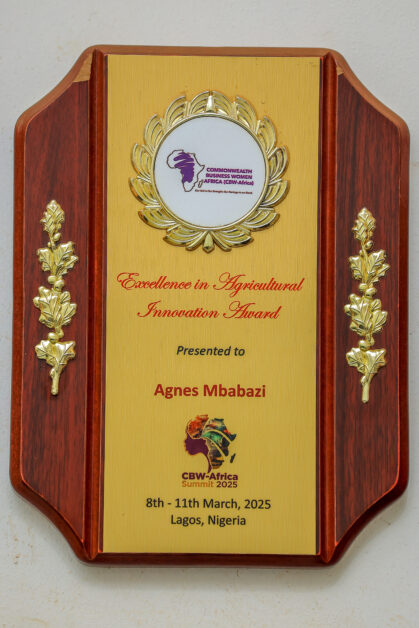
Her academic and professional path includes an MBA in Strategic Management and Marketing from Makerere University, a Bachelor of Science in Management Science from Kyambogo University, postgraduate horticulture training in Israel and specialized studies in agribusiness production, water and nutrient management, floriculture and value addition.
Yet perhaps the most powerful part of her story is not the titles, the awards or the rapid growth of Agrifarm.
What made the difference was not only courage, but support. In her telling, dfcu Bank was central to that next chapter.
The business that began as a side hustle in 2007 is now a force in Uganda’s agribusiness sector, with ambitions reaching beyond Kampala and into northern Uganda, Masaka and even the eastern Democratic Republic of Congo.
Mbabazi is already planning new branches closer to farming communities and studying regional demand from Congolese buyers who come into Uganda looking for genuine agricultural inputs.
Her message to women entrepreneurs is as firm as it is hopeful.
“Women need to get out of their comfort zone,” she says. “The world today is no longer entertaining sympathy votes. Everybody is focusing on women. Let us take this as an opportunity to thrive.”
She urges women to seek mentorship, use the financial products designed for them, enter rooms that build value, take risks and stop shrinking themselves.
“Do not fear to expand,” she says. “Go out there and make it as big as you can ever be.”
In many ways, that sentence could also serve as the summary of her own life.
And when the time came to cross into entrepreneurship, dfcu Bank helped make sure that bridge held.
dfcu Women development initiatives
That philosophy has shaped dfcu’s approach to women entrepreneurship for nearly two decades.
In 2007, the bank launched the Women in Business programme — the first structured banking proposition for women entrepreneurs in Uganda. It was built around a simple premise: women-led enterprises are viable, and financing must reflect that reality.
Facilities are deliberately structured to align with business cash flow patterns. Collateral frameworks are reviewed with care, and pricing is kept competitive, and where appropriate, preferential.
But capital alone is not enough.
Through dfcu Rising Woman, the bank strengthens governance, financial discipline and market readiness.
Women entrepreneurs gain mentorship, refine business models and build networks that extend far beyond access to credit.
The dfcu Women Business Advisory Centre provides tailored advisory support, ensuring women entrepreneurs receive structured guidance as they transition from survival to scale.
Through dfcu MTN AWE, the bank promotes digital inclusion, enabling women entrepreneurs to transact efficiently while building the financial visibility that supports future financing.
The dfcu Foundation reinforces this ecosystem through enterprise development and capacity-building programmes designed to strengthen management and governance practices.
And when the Government introduced the GROW Project, dfcu was selected as one of the implementing financial institutions, a reflection of trust in the bank’s governance standards and operational discipline, and a recognition of its experience in supporting women-led enterprises.
Taken together, these efforts reflect a deliberate position: the gap between foundation and success can be narrowed when finance, knowledge and networks move in alignment.








Follow