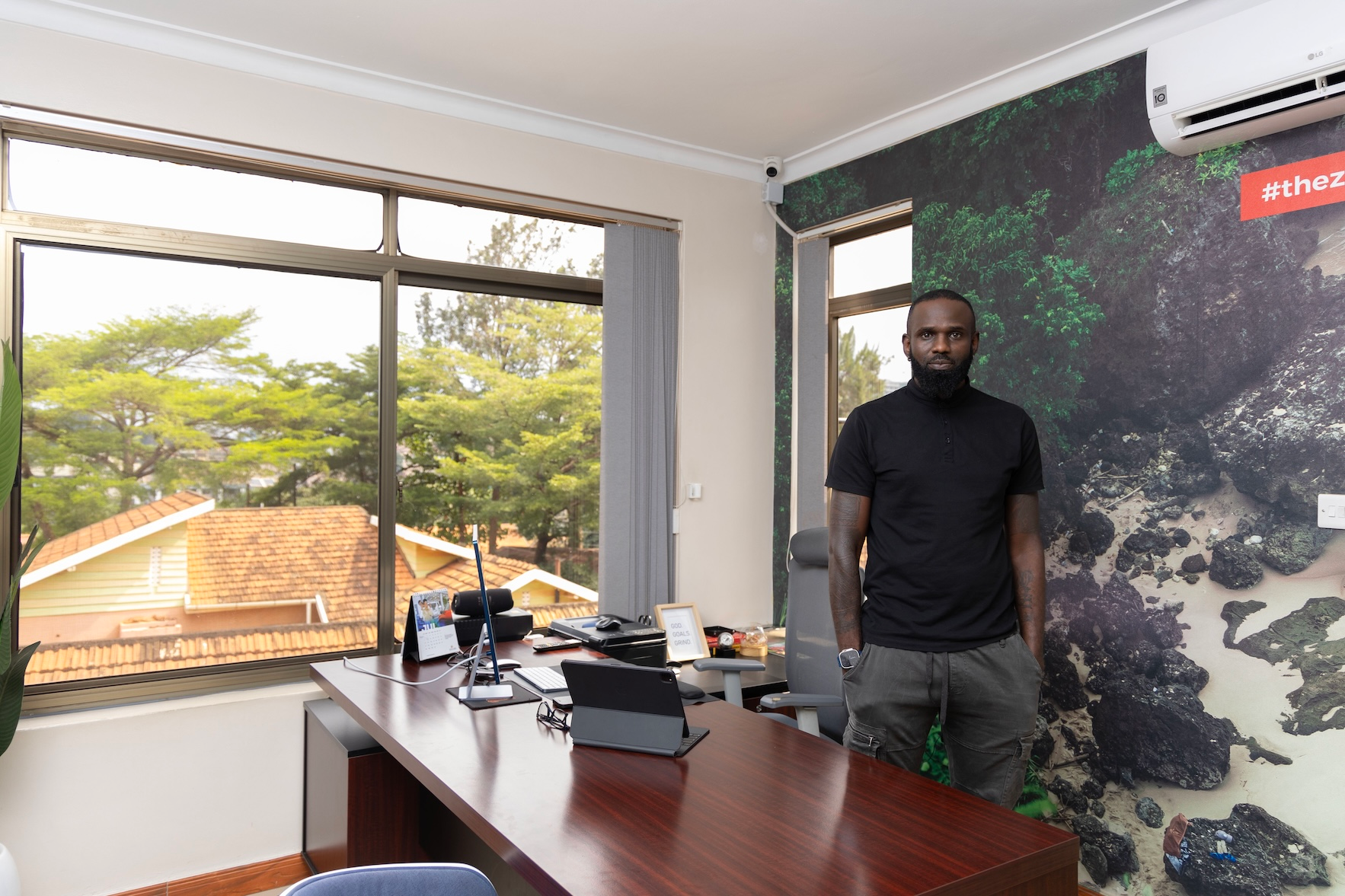
Candid and compelling, Amani unpacks the philosophy behind #TheZeusWay—a relentless commitment to speed, quality, and consistency—and reflects on what it takes to lead Gen Z creatives, earn client trust, and stay sane in a high-pressure, fast-turnaround industry. He also doesn’t shy away from calling out client-agency dynamics, Uganda’s work ethic culture, and the myths surrounding Gen Z entitlement and success.
Part of our MadMen of Uganda feature series, this interview is a powerful reminder that today’s new-age agency leaders are not just designers or strategists—they’re builders, mentors, and bold challengers of convention.
Curiously, on many of your platforms—from LinkedIn to personal branding—you go by Jeffrey (HalfmanHalfamazing) Amani. It’s bold. It’s memorable. What’s the origin of that moniker, and what does it say about how you see yourself—not just as a creative, but as a person?
Yeah, so it’s a name I picked up way back when I was playing basketball in high school—back in Kent. At the time, basketball was really hot, and there was this show called And1 in the US. It had these characters—guys picked straight from the neighbourhoods in New York and other places—really good streetballers. They would go to different hoods and challenge the best local players. It was almost like the Globetrotters, but more raw and real. The whole thing was about promoting sneakers, basketball culture, and swagger.
One of the standout players on that show was called Half Man, Half Amazing. And I loved him—just the way he played, his energy. I was also playing ball then, so the name really resonated with me. I picked it up, and it stuck. Guys started calling me that on the court. It’s followed me ever since. I mean, it’s not a bad name, right?
No, I mean—it actually carries a bit of mystery, just the way it sounds. It gets people curious, wondering, “What’s this about?”
Yeah, yeah—and it actually makes for a great conversation starter. I think in almost every online meeting I’ve attended, someone always asks, “Who’s Half Man, Half Amazing?” It’s a good icebreaker.
So, how’s the agency world treating you these days?
Man, dude—this thing is hectic. No one warned me about the other side of it. It’s cutthroat. There are so many moving parts, and you can’t take your eyes off it for even a minute.
It’s a solid way to spend the early years of your career. Would you say it shaped how you see the business today?
Yes, definitely. But in my opinion, it’s not something you do forever. It’s a young man’s game, you get? It takes a lot of energy to keep up. And from what I’ve seen—even with other guys—as you grow older, you start to feel it. At some point, there has to be an exit plan.
There’s so much changing in the industry. A lot of decisions—especially on the client side—are being made in isolation. The truth is, it’s a buyer’s market, and clients wear the pants. Unless we push back together, agencies will always be price takers, not partners. Clients are thinking for themselves, by themselves. Agencies are struggling just to get a foot in the boardroom and have a say in decisions that directly affect them.
Look, clients are making decisions that benefit them—which is okay—but if you say agencies are your partners on the brand growth journey, then it’s only fair to consult them when making choices that could impact the relationship. Take what’s happening now: many clients are setting up internal teams—mini-agencies or creative departments. But in doing that, they’re moving away from their core focus, which is delivering their product or service—not running agency workflows.
Sure, internal teams sound like a smart move, but if you don’t understand how agency operations really work—how briefs are processed, how creative is turned around, how resources are allocated—you end up in uncharted territory. And that’s where issues start. By simply consulting agencies, you might find better ways to achieve your goals without spreading yourself thin or compromising on quality. So yeah, these conversations are long overdue.
Let’s start at the beginning—could you tell us a bit about yourself and your journey into the creative space?
My name’s Jeff Amani. I am Kenyan. First and foremost, I’m a creative, long before I’m a businessman. I identify as an adman through and through. I’ve spent years honing my skills in the creative space, and that’s really where my heart is.
Outside of work, I’m a serious petrolhead. I love cars—anything with a combustion engine excites me. Driving is therapeutic for me; I enjoy long drives just to clear my head. I’m also a biker, and an outdoor enthusiast—I love camping, being in nature, just unplugging from everything. Most weekends, you’ll probably find me on a motorcycle, decompressing from the madness.
I’m also a stickler for detail—obsessed with quality. I’m a workaholic, proudly so. And above all, I’m a proud father to two amazing girls.
Great—let’s talk about your journey into the industry. I don’t know how it is in Kenya, but in Uganda, many of us grew up thinking we’d become lawyers, doctors, priests, or nuns—advertising wasn’t really seen as a career path. So how did you end up in this game? So first of all, I was actually on track to study law, that was the path I was taking. My parents, especially my dad, had different expectations for me. Advertising or art as a career just didn’t make sense to them at the time.
But I veered off and decided to pursue something in the creative space. I got into Art school and studied Fine Art & advertising. The way I entered the mainstream advertising world, though, was through a national competition in Kenya, the IAAF mascot design contest. I created three mascot designs, gave two of them to friends at school, and we all submitted.

Just before the winners were announced, I got a call from someone, whom I later found out was one of the judges and also owned an agency. He’d seen my work and offered me a job, even before I knew the results. I went to meet him, and he gave me a position at his agency.
It was only later, around January, when I officially started, that he told me to dress up nicely one day, as we were attending an event. That’s when I found out I’d actually won the competition. My mascot design had come out on top.
And that’s how I found myself in advertising.
So, how was the experience for you? What was it like stepping into the world of mainstream advertising for the first time?
When I started out in advertising, I was pretty much thrown into the deep end. Unlike most creatives who might begin with small gigs, maybe doing posters or basic design work, I walked straight into a mainstream advertising agency where serious, high-level work was going on. There were creatives, PR people, and client service teams; it was the full agency setup. I honestly didn’t know what hit me. There was so much jargon, marketing speak, and advertising lingo that I had no clue what half of it meant. It felt like being caught in a whirlwind.
Now, I don’t know how it was in Uganda at the time, but in Kenya, advertising was seen as this glamorous industry. It had this ‘cool kids only’ energy, tattoos, earrings, and rebellious fashion. So there I was, a young, naive guy who just knew how to draw well, suddenly surrounded by all of this.
The good thing is, the person who hired me, the judge from the IAAF mascot competition, really took me under his wing. He didn’t make me sit with everyone else; he sat me directly opposite him at his desk. I had my little computer, and he’d look at my screen, give me feedback in real time, and walk me through things. My first tasks were illustrations; I’d sketch on paper, scan them, then rework them digitally. Gradually, he started giving me more real jobs.
That period was a crash course in agency life. I also got to work with some really brilliant creatives at the agency, guys who were miles ahead, and I learned a lot just by being around them.
But something else happened during that time that changed everything for me. The mascot I’d submitted to the IAAF competition? I named it Tsavo, after one of Kenya’s largest and most famous national parks, Tsavo East and Tsavo West. It was an elephant mascot, so I thought the name fit.
Well, when I won the competition, the Kenya Wildlife Service reached out. Apparently, naming the mascot Tsavo had drawn a lot of international attention to the park. People were curious, asking, “What is Tsavo?” That curiosity translated into increased interest and traffic to the park.
As a thank you, they offered me an all-expenses-paid trip to visit the park. While I was there, I met the top management, and they offered me their account. They said, “You’re a designer, can you work with us?” So, without even fully understanding how agency business worked, I suddenly had my first client.
This is where my business acumen started kicking in. I didn’t try to do everything myself. I approached the same senior creatives at the agency I was working for and said, “I’ve got work. I’ll pay you, can you help me deliver on these briefs?” They agreed, and I began acting as the go-between, managing the client relationship, reviewing the work, and learning the ropes. I got to understand how creative processes, client servicing, and production really worked, just by being in the middle of it.
Eventually, I had to register a company so that I could get proper contracts. That’s how I formed my first agency, Mosaic Concepts. I registered the company, submitted the paperwork, and we started getting real jobs. I even hired a small team, designers, copywriters, set up a second office, and continued working at the main agency full-time.
So yeah, that’s how I got into the industry. It was intense, but it gave me both my creative start and an early window into the business side of advertising.
So you were already running a full agency on the side? That’s interesting.
Yeah, yeah, I was running a full-on gig, a proper agency on the side, though it was purely focused on creative. We weren’t offering anything beyond that, no media buying, no PR, just solid creative work. And we actually picked up a few big clients who kept us going for a while.
But even with that running, I was still fully committed to my job at the main agency. I never missed a day. That’s one of the things I really learned, discipline and consistency, no matter what else is happening on the side.
Wait—so did your employers ever find out you were running your own agency… and just let it slide?
Yeah, they actually did find out, once. I had a campaign they wanted to pitch out, and the agency I was working for at the time was one of the participants. I wasn’t directly involved in the pitch, but during the presentation, someone from the client side casually mentioned, “Oh, we already work with someone from your team.” And just like that, the cat was out of the bag.
But to be honest, I was a solid employee. I never missed a day of work, and I was consistently delivering results. I think because of that, the management didn’t see any reason to make a fuss. They just let it slide. So I kept going, balancing both roles.
Okay, so how did the journey into Uganda happen? What brought you here?
Ah, that’s a pretty interesting one. So while I was still working at the agency in Kenya, I decided to set up a personal website, mostly out of curiosity. I wanted to learn how to build one, and once I did, I started using it to showcase my work. Every time I did something I was proud of, I’d upload it.
Then one day in 2013, around August or September, I got an email from the then Managing Director of a local agency here in Uganda at the time. He said he’d come across my website, liked my work, and was interested in bringing me on board to help stabilise their creative department, as Head of Studio.
At first, I honestly thought it was a scam or just someone joking. I didn’t respond for a few weeks. But he kept following up. Eventually, I replied, and he sent me more info, the agency’s website, their portfolio, and the accounts they handled. Once I reviewed it, I thought, “Okay, this might actually be something.”
We agreed I would come in for a one-month trial, just a reconnaissance trip to get a feel for the market and the agency. It was a big decision because I was leaving quite a bit behind: I had my network, my own agency was thriving, and I was well-rooted in my full-time role.
But I came to Uganda for that month… and by the time I was leaving, I was convinced. I knew I wanted to come back. And that’s how I ended up here.
So what happened to Mosaic? Did you shut it down completely, or just step away and move on?
Yeah, it was tough, honestly. I didn’t really think through the long-term complexities of my being in Uganda while Mosaic was still running in Kenya. I was excited about the new opportunity, the challenge, the change, so I just went for it.
At the time, I had someone acting as a sort of GM running Mosaic while I worked at the agency. So when I moved to Uganda, I told him to continue running things; it was business as usual, just that I was now based in Uganda.
But things got complicated. Because I was physically absent, this gentleman started telling our clients that I had left the company entirely and that he was now in charge. He then went ahead and introduced a new company, his own, and told clients Mosaic had essentially been handed over to him, but he preferred to operate under a different name.
So yeah… it got messy. Some clients believed him and transitioned over. Others eventually came back when they figured out what had happened. But in the end, things fizzled out. It was one of those hard lessons, in many ways. But we are now in Kenya again, as House of Zeus. Back like we never left.
Well… creatives really do find creative ways—don’t they?
Let me tell you, it’s crazy what people can do, especially when money is involved. It really changes things. And this guy wasn’t just anyone; he was a close friend, a confidant. Someone I trusted completely. I let him handle the finances while I focused on managing client relationships and creative direction.
Eventually, Mosaic started to fizzle out. A few clients did come back once they realised what had really happened, and we continued working with them for a while. But by then, I had gotten so busy in Uganda that I just couldn’t sustain Mosaic anymore. So yeah, we eventually had to close it down.
Alright, let’s talk about your arrival and experience working in Uganda. What shocked you? How did the advertising ecosystem here compare to what you were used to in Kenya at the time? Were there things you expected or didn’t expect that stood out?
Okay, so to be fair to Uganda, the advertising market here wasn’t too far off from Kenya; if anything, it was more or less at par in terms of creative potential and industry structure. The key difference really lies in the size and strength of the economy. Kenya simply has more clients with higher purchasing power, think of brands like Safaricom, Airtel, Britam Kenya, and the big banks. The private sector is robust, and you have a wider pool of clients who can comfortably pay solid retainers.
That said, what really stood out to me, what truly shocked me, was the work ethic. There was a noticeably more laid-back, laissez-faire approach to work here. People were more relaxed, less urgent. I remember when I first arrived, during my very first month, I’d be at my desk by 7:00 a.m., and the first person wouldn’t walk in until 9:00 or 9:30. In fact, the only person I’d find already at work was the MD. Everyone else would stroll in late—some even at 10:00 a.m.—which was unheard of for me. Back in Kenya, I was used to being at the office by 6:30 or 7:00, and by 10:00, I’d have already gone through a few briefs.
Then came the lunch culture. We’d head out around 12:45, and wouldn’t be back until 2:30 or even 3:00 p.m. And it was normal. No one was in a rush. Then by 4:30, people were checking out—not going home, but heading to a kafunda to hang out. It took me a while to adjust and understand that this was more of a cultural and societal rhythm than just an individual work habit.
Now, I’m not saying there’s anything wrong with it—it’s simply how things are done here. But for me, the challenge was that this pace often clashed with the demands of advertising. Agencies are under pressure to deliver work fast, sometimes even “yesterday”—and that kind of urgency doesn’t always align with a laid-back approach. There has to be a certain level of pace and discipline to meet those demands.
Interestingly, someone once joked that the reason Kenyans are always on the go while Ugandans are more relaxed is food availability. In Kenya, if you don’t hustle, you starve—food is expensive, and life is fast-paced. But in Uganda, food is abundant. There’s always something to eat, even if you’re not working, which probably influences how people engage with work and pressure. It’s an amusing theory, but it kind of makes sense when you think about it.
Yeah, exactly. I mean, in Kenya, if you don’t work for even two days, you’ll probably go hungry. There’s a certain pressure to keep moving, to hustle, because the cost of living doesn’t allow you to slow down.
Absolutely, you’ll starve. Food in Kenya is expensive, and it’s not as abundant as it is here in Uganda. We actually import a significant portion of our food. Kenya has only two main breadbasket regions, and even those don’t produce enough to meet the country’s needs. So the cost of food is high. Rent and the general cost of living are also steep. You’re constantly under pressure to hustle just to stay afloat.
And then there’s the mindset—I’ll never forget what my boss once told me: “The position you’re holding right now? There are a thousand people out there who want it, and many of them are hungrier and faster than you.” So you had to earn your place every day. You had to show up, stay sharp, and perform. It was that competitive.
The issue of work ethic in Uganda is quite unique and, in many ways, warrants deeper study. Compared to other markets, our approach to work seems to operate in its own league—why that is, I’m not sure. But beyond individual behaviour, did you also observe similar cultural differences in how suppliers approach their responsibilities?
More importantly, how would you compare the way clients in Uganda value the role and contribution of agencies, versus what you experienced in Kenya? Does this difference influence how clients engage with agencies—whether they see you as a strategic partner, how they compensate you, or how much they involve you in key decisions? Were there any striking contrasts?
Yes, absolutely, there are real differences. And as you rightly said, someone really needs to study the Ugandan work ethic, because it has a ripple effect across many sectors—not just within agencies but also on the client side. One of the biggest things I noticed is that, unless things have gone terribly wrong, there’s often a lack of urgency.
If the client’s organisation doesn’t have strong internal systems—structures for productivity, accountability, and timelines—you’ll find that even the clients adopt a laid-back approach. That affects agencies directly. A disorganised client breeds a disorganised agency. You end up in situations where briefs are delayed unnecessarily, and then suddenly there’s a last-minute panic. A client who’s been sitting on a brief for weeks will come in under pressure from their superiors and expect you to deliver overnight.
This puts the agency in a tight spot, expected to work miracles in a few hours, and when the quality drops, it’s the agency’s name on the line. It creates a cycle of rushed work, compromised output, and sometimes reputational damage.
That said, I’ve also worked with well-structured clients here, and the difference is clear. For example, when I joined, MTN was one of the clients I worked on, and they had solid systems. Everything moved with a certain rhythm—because the organisation demanded it. They had structures, they tracked output, and you could feel the accountability on both sides.
In contrast, some locally-owned or family-run businesses often lack that level of discipline. You see it in how they run their internal operations and in how they deal with partners. That difference in structure directly impacts how they value, engage, and hold their agencies accountable.
In Kenya, because of the competitive culture and sheer pressure to deliver, both clients and agencies operate with much more rigour. Clients keep agencies honest—they brief clearly, on time, and with thorough follow-through. You don’t often have that “last-minute panic” culture, at least that’s my experience.
I’ve also worked with agencies and clients in other parts of Africa and other continents. And in those ecosystems, where both sides have structure and discipline, you find a better balance. Agencies don’t always have to play scapegoat when something fails.
That said, I’ve seen progress in Uganda. The exposure and upskilling happening across the board, on both the agency and client sides, is starting to shift things.
One other trend I noticed is how many agency people transition into client roles here. That’s been interesting. Someone who’s worked in an agency and then moves into a client role often brings that mindset and process orientation with them. That crossover can change how briefs are written, how timelines are respected, and how collaboration happens.
Yeah, I remember when I was working actively in agency life, there was this running joke that clients who were former agency people were sometimes the hardest to work with.
Yeah, that’s 100% true. I totally agree. We’ve also had our fair share of those. I don’t know what it is exactly—maybe it’s that sense of, “Now it’s my turn to flex.” It’s like they come in with something to prove, or they overcompensate because they know how the agency side works.
Right. So with all those differences in perspective, work culture, and work ethic, did that lead to any early friction on your part? Did you find yourself clashing with people before figuring out how to adapt and navigate the environment?
Yeah, it definitely did. There was quite a bit of friction in the beginning. On one hand, it ruffled a few feathers—some people didn’t like the pace I was bringing in, or the fact that I was outproducing them. It probably felt like I was disrupting the status quo. But honestly, that didn’t bother me too much.
What worked in my favour was that it made me stand out. One thing I realised quickly is that, regardless of the environment or culture, clients still value reliability. They want someone who gets the job done. And so do agency leaders. At the time, the management at the agency I was in appreciated that consistency. Even the creative director saw the value.
So I started getting the big briefs. And beyond just the work, that exposure really helped shape me. I came in primarily as a creative head, but I found myself in boardroom meetings—listening in on strategic conversations with clients. That level of immersion accelerated my learning curve.
Ultimately, my work ethic and results gave me an edge—and helped grow me not just as a creative, but as a more holistic advertising professional.
Before we leave that point, I’ve spoken to several agency leaders, and one recurring theme is a growing frustration with many Gen Z employees. They tend to focus only on what’s strictly within their job description and often seem hesitant to go beyond that.
So, from your experience, what advice would you give to young creatives—or young professionals more generally—about what it really means to show up, to go the extra mile, and to stand out when opportunity presents itself?
That’s a big one—we could honestly do an entirely separate interview on just that subject. I’m very passionate about it, and I’ll tell you why: I’m going through it right now. It’s something I’m experiencing firsthand as an agency owner, and frankly, it’s painful.
I have to recruit talent, and the bulk of the talent pool coming up is Gen Z. And with that comes a mindset that’s often misaligned with the realities of work. I deal with what—pardon my language—I can only describe as frustrating levels of entitlement or naivety.
Here’s my principle: hard work has no shortcuts. If I want to climb Mount Rwenzori, I have to train, prepare, and do the actual climb. Someone might say, “But you can just hire a chopper and land at the summit.” Sure—but where are you getting the money for that shortcut? Even that shortcut demands that you’ve worked. That’s the irony. So yes, the only real formula for success is this: you have to put in your 10,000 hours. You must become a master at something. There’s no bypassing that process.
Now, what makes it harder today is this utopian warp that Gen Z seems to be caught in—a false sense of reality heavily influenced by social media. They’re seeing instant gratification, curated success stories, influencers flaunting lavish lifestyles—jets, yachts, luxury cars—but none of the hard work behind it is ever shown. All they see is the destination, never the journey.
I’ve interviewed candidates who come in with barely a portfolio—maybe two logos, at most—and when I ask for their salary expectations, they casually say, “10 million a month.” So I ask, “Where is that figure coming from? What is the value that backs it up?” And they respond, “Well, I went to school. I give you my time.” That’s not how value is created or measured. The sense of entitlement is astonishing.
If you ask me, it’s a lost generation if they don’t wake up, at least in terms of how they perceive work, growth, and the real path to success. Many are in denial of the fact that success is built, not wished into existence. And ironically, some are already suffering from it.
I had one guy tell me, “I need to quit this job. It’s messing up my mental health. I need a sabbatical.” And I said to him, “You’re worried about mental health now? Try being jobless for a month. Let’s talk about your mental health then.” That’s when reality begins to sink in.
Most of the younger generation working in Kampala seems to have a fallback. Many have close relatives nearby—an auntie in Ntinda, an uncle in Makindye, or parents just a taxi ride away. So even when finances are tight, they’re unlikely to go hungry or homeless. There’s always someone to bail them out with a meal or a place to stay. This kind of social safety net is undoubtedly a blessing, but unlike the generations before them—who often had no one to fall back on and had to figure things out on their own—it may also dull the urgency to hustle. Would you agree that this kind of cushioning contributes to the more laid-back work ethic we see in parts of the Ugandan workforce?
There’s actually a theory about this—one that I really believe in. It says: “Tough times create strong men, strong men create easy times, easy times create weak men.” And I think that’s exactly what we’re seeing.
Look at our parents’ generation. They went through real hardship—blood, sweat, and tears. They worked their fingers to the bone just to survive. And naturally, they didn’t want us to go through the same struggles. So what did they do? They made life a bit more comfortable for us.
Now, for our generation, sure, we still experience some struggles. We went to school without shoes, wore hand-me-downs, and sometimes went hungry. But it was character-building. Yet look at how we’re raising our children now—it’s feather-touch parenting. These kids don’t know struggle. They cry, and we buy them a PlayStation. We take them to elite schools with lunch buffets and printed menus. They grow up in environments where everything is provided.
And it goes even further. Parents are now bribing people just to get their children jobs. So imagine the mindset of a kid who’s had everything handed to them. They graduate from high school, and the reward is… a car? That’s real. A friend of mine in Kenya was telling me how his brother bought his son a car just for completing high school. That child hasn’t earned anything, but is already being rewarded with astronomical gifts for doing the basics of life.
This kind of upbringing creates entitlement. A lot of the Gen Zs I encounter feel incredibly entitled. I had a guy walk up to me and say he deserved 25% equity in my company because he’d worked there for a year. I was like—are you serious? Do you have any idea how much sweat, risk, capital, and sacrifice it takes to build something from the ground up?
It’s frustrating. This is what happens when you remove struggle from the equation—they start expecting outcomes they haven’t earned.
We’ve talked about working with young talent—Gen Zs—who often seem like they’re from another planet. Yet, they’re the ones available to hire, especially since many of the older professionals have moved on or are fewer in number.
Have you, personally or as a business, developed any strategies, coping mechanisms, or “hacks” to effectively manage and work with this unique generation? How have you adapted to their distinct ways and needs?
Yeah, so we definitely have some things in place, especially around employee welfare, to help us manage this generation. One of the first steps we took was onboarding a counsellor—someone dedicated to mental health support.
There are other benefits we provide as well, like meals and medical coverage, but the counselling service was brought in specifically because mental health issues kept coming up, especially among the Gen Z folks. These young people often struggle with coping and mental fortitude. Unlike previous generations who endured real hardships, this generation has grown up in a softer environment—things handed to them on a platter. Because of that, they’re more prone to mental health challenges, stress, anxiety, and sometimes breakdowns.
We see situations where a guy doesn’t come to work, and when you ask why, they say they had a panic attack. When you probe further, you realise the panic is often because they’re overwhelmed—scared to come to work knowing they’ve wasted time on TikTok and social media, and the work has piled up. They feel paralysed and panicked by the sheer volume of tasks waiting for them.
It’s a big challenge. No matter how many times I stand on tables shouting, “Use your time wisely,” change doesn’t happen overnight. So having the counsellor is crucial—they guide, coach, and help these young people develop better habits around time management, stress control, and organisation.
We also run periodic talks, bringing in experts to discuss practical life skills—money management being a big one. Many of these young people don’t know how to manage finances. We pay very early in the month, around the 20th or 25th, but by the 5th, some employees have already gone through their pay, asking for advances or borrowing from colleagues. This financial instability is a huge stress factor because their salary is often swallowed up by debts and urgent expenses, leaving them little relief.
To help, we partnered with a fintech company operating an app that lets employees discreetly access salary advances without going through HR or finance directly. This privacy reduces stigma around borrowing money. We only get a monthly invoice showing total advances, but employees can manage their own requests. The counsellor monitors frequent users, and if someone repeatedly needs advances, we hold group or individual counselling sessions to tackle the root problems.
The biggest issue I see is that these young people lack structure and life skills. They’ve grown up in a kind of utopian social media world that only amplifies the highlights, not the toil and hard work behind success. They expect instant gratification and quick wins.
We see this clearly around payday: employees suddenly splurge on phones, shoes, and clothes. Some even stop eating the very buffet meals we provide—meals they themselves chose and praised as the best they’ve had—opting instead to order from cafés or delivery for about a week or so, until their money runs out.
It’s almost paradoxical—they have access to good benefits but choose other options that only add to their financial stress.
So managing this generation means balancing empathy with accountability. We can’t solve it in a day. It takes constant training, coaching, and mental health support. It’s an ongoing process for the whole company.
Let’s shift focus now to your transition from the Metropolitan Republic to founding Zeus. Can you walk us through how that journey unfolded? How did you get here?
Man, do you want me to go deeper? Alright, so here’s the story. From the very beginning of my career—right after my experience with the IAAF competition and Mosaic—I knew one thing: I wanted to own my own agency one day. I wanted to run my own thing. But honestly, I was scared.
By the time I had transitioned to Uganda, I was torn—do I go back to Kenya and revive Mosaic, or do I build something here? There had even been attempts to set something up in Uganda. I teamed up with a few guys, and we started an agency. We landed a couple of clients, but there wasn’t enough commitment, so that fizzled out. I was hesitant and fearful of leaving the comfort of what I had.
Then something happened at Metro, and I had to leave prematurely, a story for another day over a single malt whiskey bottle. The exit was a blessing in disguise because that moment forced me to realise I had no option but to stand on my own two feet. When I left, I got offers from other agencies, but the pay was far below what I was earning. This was around 2020, at the start of COVID. Suddenly, I found myself out of a job during a global crisis.
It was tough. I went through depression. I was isolated, stuck at home alone, surrounded by rumours and gossip about why I left Metro. As a human being, it hit me hard. It almost broke me.
But I had a few key people who spoke reason to me—my lawyer, two clients, and my mom. I remember my mom asking me, “Have they chopped off your hands? No. Is your brain still intact? Yes. Do you still have a network? Absolutely.” She told me to get up, dust myself off, and start something new.
Luckily, I had already registered Zeus, though it was dormant. When everything fell apart with Metro, I dusted off Zeus and got to work. I had a couple of clients lined up, so I started working from home during the lockdown—my dining room became my command centre, the living room a workspace. A few people I had managed to employ sat there with me, and we made it work.
It wasn’t the launch I dreamed of, but sometimes life pushes you into uncomfortable situations that make you realise what you truly need to do. I guess that’s how it all began.
When you’re pushed off a cliff, there’s no option but to figure out how to organise your fall. So, what were your fears and hopes at that time? And how many of those fears and hopes have come to pass, even as you’re still a work in progress?
I’d say the fear was huge. Honestly, I was petrified—terrified of the unknown. With Mosaic, at least I had a fallback; I still had the other agency job to lean on. But this was a different ball game. This was the real deal. There was no safety net anymore. No Metro to go back to and draw a salary from if things didn’t work out.
The fear of failure was constant—the uncertainty of tomorrow, not knowing where the next paycheck would come from. Plus, I’d already built a certain life here, so the fear of losing that stability was real. Being in a foreign country, trying to succeed on my own—it was intimidating.
I also had other options in my mind. If this didn’t work, I could always return to Kenya, reinvent myself, maybe revive Mosaic. Or even move to the Netherlands—some friends there had offered opportunities. But every one of those options came with its own fears and doubts, and I had to face all of that day by day.
Thank God for my support system—family, friends—and the incredible clients who continued to believe in me. After I left Metro, many clients reached out, asking where I was, what I was doing, and how they could support me. That helped a lot. We started getting invited to pitch, secured small jobs here and there, and gradually began to showcase what we could do.
 Modernising General Insurance: SanlamAllianz CEO Ruth Namuli on Building Uganda’s Insurance Powerhouse with Trust, Innovation, and Scale
From those small beginnings, we built a steady business and contracts. It’s been a journey, but those first moments of belief and support were crucial.
Okay, I’ve been asking some startups about this—often, the biggest fear is not landing any business. But sometimes, landing that first big client can become the biggest challenge, especially when the expectations are high and the stakes are significant.
Did you experience something similar with your first major account? How did you navigate those early days, and what kept you motivated when the pressure was on?
That’s a great question. When I started, one of the promises I made to myself was to operate strictly by the book. No shortcuts. I was determined to have all my paperwork in order—with URA, NSSF, and all the regulatory bodies—because I knew that if I wanted to attract big accounts, I had to be fully compliant.
I had a mentor and a lawyer who kept emphasising this point. They said, “Make sure your paperwork is clean, or you won’t get tax clearance certificates, and you won’t win those big clients.” So right from the start, I hired someone to handle our finances.
Unfortunately, the first guy I got was a complete quack. Within six months, we already had notices for assessments and penalties. We were flagged by the agency, and nothing was being filed properly. Once I realised what was going on, I immediately started looking for a competent accountant.
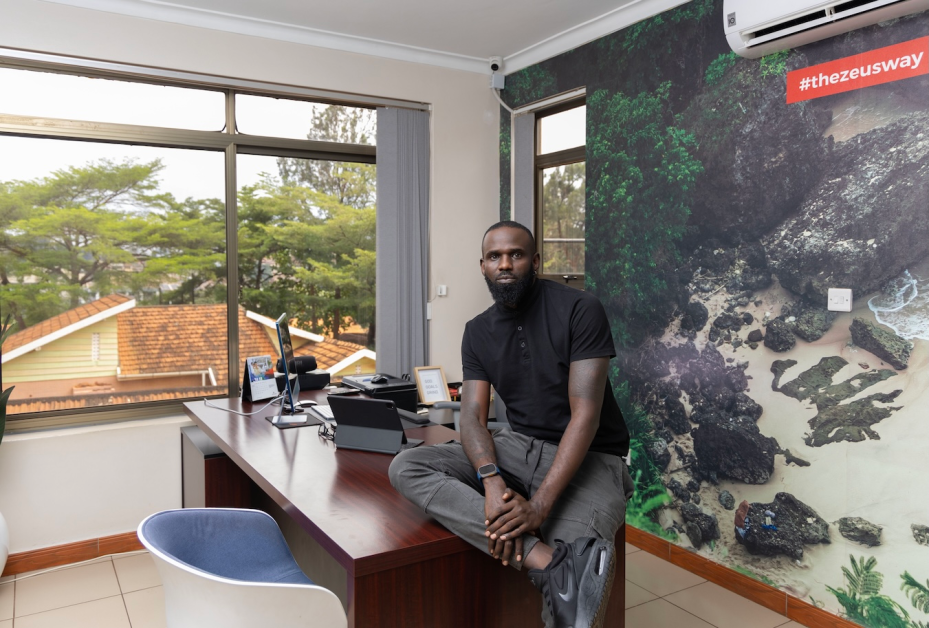
By God’s grace, I found an exceptional finance resource who is still our finance director today. When I met her, I handed over all our messy paperwork. She cleaned everything up, met with URA, negotiated payment plans for the fines, and started putting proper systems in place. Later, she brought on another fantastic accountant to manage admin and support finance, and these two women have played a huge role in the Zeus growth story. They built the structures and the discipline that we badly needed and still use today. Even now, when my finance director calls, I panic a little—they are that strict and that approach has really helped stabilise us.
So my advice to anyone starting a business is this: get your finances in order from day one. Don’t fall for the temptation to cut corners. The money will come, but you have to have your books clean and your compliance tight. Because now, thanks to those two incredible women, we can easily apply for tax clearance certificates, get any government document we need, and maintain good standing with all regulators.
Jeffrey, I understand you wear both hats—as a creative and a strategist. How do you balance these two roles? And if you had to prioritise, which do you think is the most important aspect for a consulting firm like yours: the creative side or the strategic side?
That’s a great question. So, how do I balance creativity and strategy? Well, first, I started as a creative. I spent many years perfecting that craft and really making sure I was good at it. I remember back before I came to Uganda, there was always this debate in creative circles—creatives versus strategists. I used to argue, “Since when does strategy tell creative what to do?” Looking back, I realise how ignorant that was.
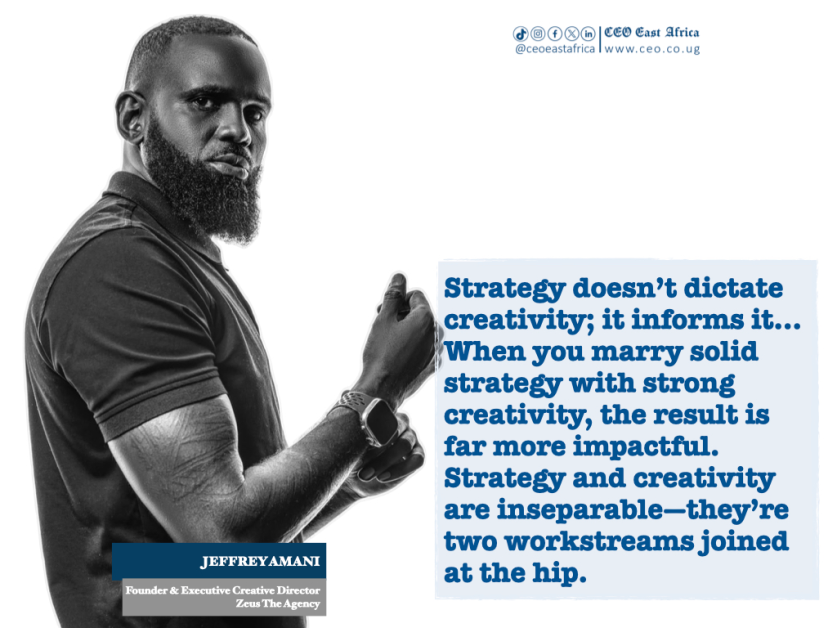
Strategy doesn’t dictate creativity; it informs it. Creative work is just beautiful pictures and ideas, but what gives those ideas meaning and power is strategy—the insight and understanding behind them. When you marry solid strategy with strong creativity, the result is far more impactful.
For me, strategy and creativity are inseparable—they’re two workstreams joined at the hip. You can’t have great creativity without a strong strategy. And the only way to demonstrate good strategy is through compelling creative execution. It’s a symbiotic relationship that will always exist.
Now, to your second question—if I had to choose one over the other? Honestly, neither is greater. Clients today expect agencies to bring both heavy strategic thinking and exceptional creativity. Creative work alone can’t stand on its own anymore.
When Zeus was just starting, we would sometimes produce amazing creative work but miss the mark on strategy. That pushed me to dive deeper into strategy. At Metro, we had strategists from South Africa and talented local strategists. But when I launched Zeus, I couldn’t afford to hire a big strategy team, so I had to roll up my sleeves.
I enrolled in courses, attended classes, watched countless videos about building strategy, and read extensively to learn how to leverage strategy effectively to empower our creative output. That’s how I grew into a strategist and creative hybrid.
So to me, both are critically important. Neither stands well alone, but combined, they’re unstoppable.
Back when I worked in agencies, there was something I found quite strange, but that eventually evolved. There was this idea that creatives didn’t engage directly with clients—instead, client service teams handled all client interactions, often leading to long, complicated approval processes that could drag on for weeks.
Today, the industry is fast and furious. Sometimes turnaround happens within 12 hours. So, in this new environment, if someone came to you and asked, like in those Chinese movies, “Master, what does it take to be a great adman?”—what skills and attitudes would you advise them to bring to the workplace?
That’s a great question. In today’s fast-paced, “fast and furious” environment, my advice is simple: be an all-rounder.
This ties back to the earlier discussion about strategy versus creativity. What makes someone truly powerful—and frankly, dangerous—in this industry is the ability to both think strategically and execute effectively.
If you master those two skills and combine them with softer skills like a strong work ethic, good presentation, punctuality, keeping your word, and being trustworthy, you become untouchable.
I tell my team all the time: what makes you marketable today is not being one-dimensional. This applies across all disciplines in advertising—and beyond. You can’t just be a great community manager, for example. Yes, be the best community manager you can be, but also bring strategic thinking to the table.
What the world—and every client—is desperately looking for are problem solvers. And not just any problem solvers, but those who can diagnose the problem, propose the strategy, and then execute it flawlessly.
Someone who can do all that is invaluable. It’s hard to push someone like that out of the room, because they deliver the results that matter—they think, and they execute.
Okay, you can’t hide it—your success speaks for itself. Within just a few years, you’ve earned the trust of some major brands and the respect of the industry here, which is remarkable, especially considering most startups don’t even make it to their second birthday in this market.
On those long rides and reflective moments, have you been able to pinpoint the key factors—beyond luck and divine favour—that have driven your success so far? What would you say are the main ingredients that have helped you build and sustain Zeus?
That’s a really good question. One thing I’m very clear about is that our success didn’t happen by accident—it was by design. Of course, there was some luck and divine favour, but most of it was how we positioned ourselves in the market.
When I started Zeus, I had to figure out how to position the agency. I studied the market and looked at how our competitors positioned themselves. The big question I had to answer was: How do I disrupt? How do I compete with the giants? I had to find my own path and figure out where Zeus would fit and how to draw attention.
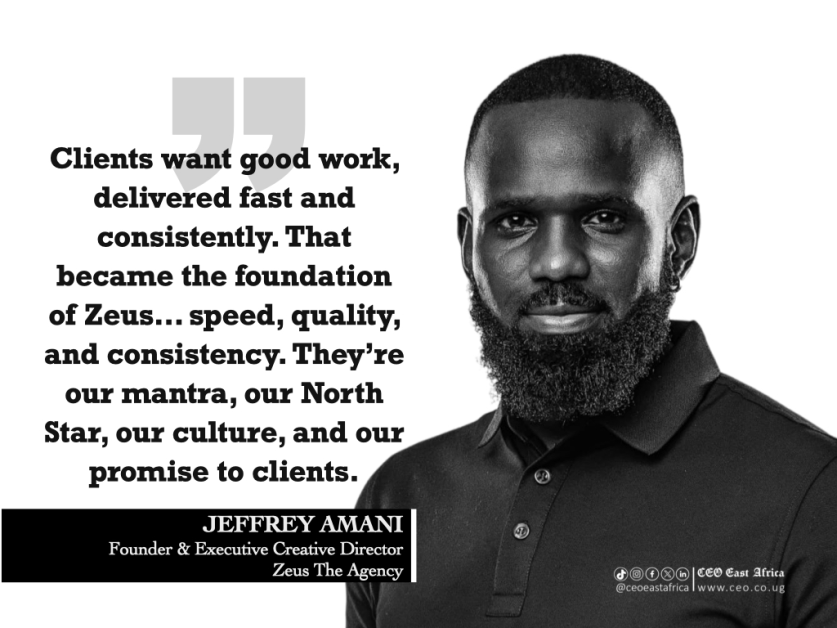
Drawing on my experience as Creative Director at my previous job and my interactions with clients, I identified three core needs in the market: clients want good work, delivered fast and consistently. That became the foundation of Zeus.
I drafted our organisation’s strategy that had several pillars, but eventually we narrowed it down to these three: speed, quality, and consistency. If you come to our office—what we call Mount Olympus—you’ll see these three words everywhere. They’re our mantra, our North Star, our culture, and our promise to clients: to deliver quality work with speed, always.
These principles are deeply ingrained. Every new team member goes through rigorous recruitment and testing to ensure they can produce great work fast and consistently. Consistency builds trust. If you keep showing up with quality and reliability, people start to see you as dependable. It’s a psychological thing—like in a marriage: if you show up differently every day, your partner won’t trust you. But if you show up every day with the same commitment, that trust grows.
That trust matters a lot. There have been times when we couldn’t deliver a brief on time, but because we had built strong trust with clients, they gave us extensions. They believed in us.
I’m obsessed with these three pillars because I believe they are the reason for our rapid growth. Early on, clients would switch from other agencies to us because of how we delivered. I remember a campaign where the client gave another agency three months to deliver, but they kept giving excuses. Within four days of working with us, we had a full strategy and creative rollout, and the client never went back.
Besides these pillars, we add empathy. I don’t see clients as just logos or accounts. I think about the people—brand managers, account managers—who are working with us. I make their ambitions, their challenges, their dreams, my problems.
When we start working with clients, I ask them what they want out of the job. Their eyes light up when they talk about their goals—whether it’s to become a marketing director, a brand manager, or even the MD. My response is always: How can I help you get there?
When clients see that we’re invested in their success, they’re clear about their expectations: “I need you to make me look good.” Because internally, they have stakeholders to manage, performance appraisals to ace, and careers to build. When they succeed, they remember who helped them—and they bring us along.
That’s crucial because agencies rarely get to sit in boardrooms where contracts and big decisions happen. We need loyal advocates inside client organisations. We build those advocates by aligning ourselves with their ambitions.
That changes how we approach every brief. It’s not just a task—it’s about helping someone become an MD. That mindset makes our work more enjoyable, the relationships stronger, and keeps us in the boardroom longer.
As an agency manager and business owner, do you have an internal philosophy or set of standards—whether formal or informal—that guides how you work with clients? For example, are there specific criteria you use to decide whether to take on or retain a client? Conversely, do you have standards below which you would consider ending a client relationship?
Similar to how you hold your team to the standards of speed, quality, and consistency, do you have expectations or non-negotiables when it comes to working with clients, especially as the key decision-maker?
Yes, absolutely, having a clear internal philosophy or set of standards is vital. Without it, you risk confusion, misalignment, and wasted energy. Early on, we took the time to define exactly who our core clients are—those we want to work with and where we believe we can add the most value as an agency. This wasn’t a random decision; it was based on careful research and reflection about the market, our strengths, and where we could truly make an impact.
Now, this philosophy might not always be formally documented in a single place, but it’s absolutely something I carry into every conversation with prospective clients—whether consciously or subconsciously. It guides the way we evaluate whether a partnership makes sense or not. There are always red flags and warning signs that tell you a client might not be the right fit.
To be honest, there are plenty of time-wasters in the market. We’ve seen clients who love the idea of having an agency—they enjoy the prestige or the image—but don’t want to fully support the partnership. That can show up in different ways: they might delay payments, expect disproportionate value without proper remuneration, or micromanage and misuse agency resources in ways that undermine the relationship.
We’ve had to make some tough calls and let go of clients who simply wouldn’t conform to a healthy, mutually respectful agency-client dynamic. That’s never easy, especially in a competitive market, but it’s necessary to preserve our focus, integrity, and sustainability.
Having these standards and boundaries has saved us countless headaches and frustrations. It allows us to be focused and surgical in how we prospect and build our client portfolio. We know exactly what kind of clients we want, how we want to engage with them, and who we should say no to. This clarity means we spend our time and energy on partnerships that truly align with our values and business goals.
Ultimately, this approach not only protects us but also builds trust with clients who respect and value a transparent, professional, and accountable relationship. It’s one of the cornerstones of how Zeus has grown so quickly and sustainably.
Okay, and when you talk about speed, consistency, and high quality—those are intense commitments to uphold, especially under pressure. Considering you’re working with human beings who each have their own agendas and expectations, how do you, as a leader, cultivate an organisational culture that keeps your team highly motivated?
How do you identify and support those who might be struggling, making sure they get the “glucose or water” they need to perform at their best? In other words, how do you keep this machine running smoothly, practically around the clock?
Yeah, you’re absolutely right—those three principles—speed, quality, and consistency—are demanding standards. To master speed means being the fastest; to obsess over quality means every piece of work leaving your desk is the best it can be. And consistency is not just a one-off effort—it’s a habit, a culture you have to nurture daily, monitor rigorously, and never let slip.
At Zeus, we don’t just talk about these values—we live them. They’re plastered all over the agency walls, in every meeting, every client sign-off, every internal conversation. Culture doesn’t survive if it’s ignored. It dies when it stops being a constant dialogue, so we’re very deliberate in keeping these principles front and centre.
When you bring new people into the agency, you’re inviting individuals with their own backgrounds, habits, biases, and past experiences. Naturally, that transition isn’t always smooth. Some people fail to adapt and assimilate into the Zeus culture. We put a lot of effort into training, exposure, and coaching—extending grace to help people grow. But we also have clear boundaries. If someone resists change or refuses to align with our values, we’re not afraid to let them go.
Because culture is fragile, it can be eroded quickly by even one person who refuses to play by the rules. Human nature tends to make people want to impose their own ways on others—some come in and say, “Back at my last job, we did it differently.” That’s fine, but here at Zeus, this is how we do things. If they can’t accept that, we part ways.
We’ve even had to let go of senior team members who were actively undermining our culture, pulling the team in the wrong direction. That was tough. For a while, I had to carry the weight of their actions. But I believe that protecting the culture is paramount.
I remind my team—and myself—that I started from a dining room. I’m not afraid to do it all over again. I’ve learned so much, figured out the shortcuts and “cheat codes” to success. If someone’s not pulling their weight despite all efforts, it’s better to cut them loose quickly.
But beyond internal challenges, the broader industry landscape is tough. In Uganda, there are very few institutions truly training the next generation of advertising talent. Yes, there are tertiary institutions and advertising schools, but if you examine their curricula, you’ll see they skim the surface and are often outdated and impractical.
That leaves agencies with the heavy burden of taking raw talent and polishing them into professionals. And here’s the catch: after we invest time, resources, and energy into training these individuals—instilling discipline, work ethic, speed, and quality—another agency comes along, offers a higher salary, and poaches them. It’s frustrating and demoralising.
Just recently, I had to have a conversation with a rival agency’s CEO because their HR was actively recruiting from our team. Their pitch was that their agency is a “nicer place to work,” less demanding—“not a slave ship.” It was crude, and frankly, an insult to the productivity we demand here at Zeus.
We don’t compete that way. We’re not afraid to lose people who don’t fit our culture. But I’m deeply grateful that most of our core team has embraced the Zeus way. Their belief transforms how they think, how they live, and how they grow.
Because we take care of our people, it’s not just a slogan—I truly believe I take care of the people who take care of the business. Show me you’re committed, willing to push yourself, live our values, and deliver results, and I’ll make sure you’re taken care of. That means better pay, continuous development, and an environment where you can thrive.
This approach has been foundational to our rapid growth and the strong, loyal culture we’ve built.
Okay, I’m curious—what inspired the name Zeus? I know Zeus is a heroic god and leader, which feels fitting.
As a creative director and now as a business owner, you’re like an army commander, leading your team through intense moments, especially during pitches. But inevitably, there are times when things don’t go as planned—you lose a pitch or a client.
From your personal experience and industry insight, how do you rally your team after setbacks? How do you motivate and mobilise them to get back on their feet and ready to tackle the next challenge, knowing there’s always another hurdle just around the corner?
Yeah, absolutely. Pitching is the lifeblood of every agency—it’s how you bring in business, test your mettle, and see how strong you are against your peers. We’ve had quite a few successes, which I attribute to the team’s drive and our obsession with those three pillars I mentioned earlier: speed, quality, and consistency.
Now, about the name Zeus—you’re right, Zeus is the god of gods in Greek mythology, the god of thunder. When we were registering the company, I submitted several names to the registrar, but most were taken or too abstract. I went back to naming conventions I’d studied in school—principles about simplicity, memorability, and meaning.
I thought: if I’m launching an agency late in a market crowded with competitors who’ve been here for a minute, I need a name that commands attention, one that scares the competition and sparks conversation. Coincidentally, I had a high-performance computer I’d built and called Zeus because it was lightning fast. That stuck with me.
The name is simple, short—just four letters—and packed with symbolism. It’s powerful and memorable. When USB approved it, I knew we’d found something special. Since then, the name Zeus has opened doors and sparked curiosity. Whenever I say it, people ask questions, and that’s our chance to pitch who we are. It’s been a tremendous asset.
Nowadays, some people even call me Zeus—especially with the beard and all! It’s become a part of our identity.
As for motivating the team through wins and losses, having been around the block, I’ve learned how pitches impact morale. Before every pitch, we do dry runs. After those rehearsals, I tell my team, “It doesn’t matter what happens from here on. We don’t lose, we learn. We’ve put our best ideas forward. If the client doesn’t pick us, it’s not because our work was weak—it could be budget constraints, internal politics, or they may have already made a decision.”
I prepare them mentally to accept either outcome. This mindset makes taking an ‘L’ easier to handle. I’ve seen teams come out of losing pitches and still high-five, saying, “That was a good experience; we learned a lot.”
This attitude is crucial because I’ve seen agencies where repeated losses demoralise the team, killing the drive to pitch again. That stagnation hurts growth.
Every year, we set a mantra. This year it’s: “Take everything, leave nothing on the table.” We approach every pitch like we’re going to win because pitching isn’t just about winning the business—it’s a learning process.
In fact, we don’t just say it—we live it. At the start of this year, I did a whole presentation to the team and told them: “This is the mantra for this year—take everything and leave nothing on the table.” It’s plastered everywhere in the office as a daily reminder of our commitment and ambition.
Through pitching, you learn the industry and category, understand what works and what doesn’t, and sharpen your thinking. It also builds team spirit—brainstorming together, collaborating across departments, and sharing ideas. For many team members, especially those new to pitching, it’s a valuable experience just to see the process in action.
So for us, pitching is always welcome. We never go in expecting to lose—we go to win and to learn.
That’s interesting. As a business leader and industry veteran, are there concerns or worries that weigh on your mind about the future?
For example, do you see challenges around talent development—are agencies grooming enough talent, or are they losing people to other industries? Are there practices within agencies or client organisations that you feel are problematic?
What about issues like cutthroat pricing or other fundamental trends? Are there risks or challenges that, if left unaddressed, could potentially harm the industry in the coming years?
Yeah, there’s a lot that worries me. Actually, I wrote a whole list to the Chair of the Uganda Advertising Association, detailing many of these grievances. I even wrote an article on LinkedIn addressing some of these concerns.
The first and most critical issue is talent. As an industry, we’re not grooming enough talent. We need to be more selfish about building our own ecosystem—a pool where we nurture future creative directors, strategists, and other key roles.
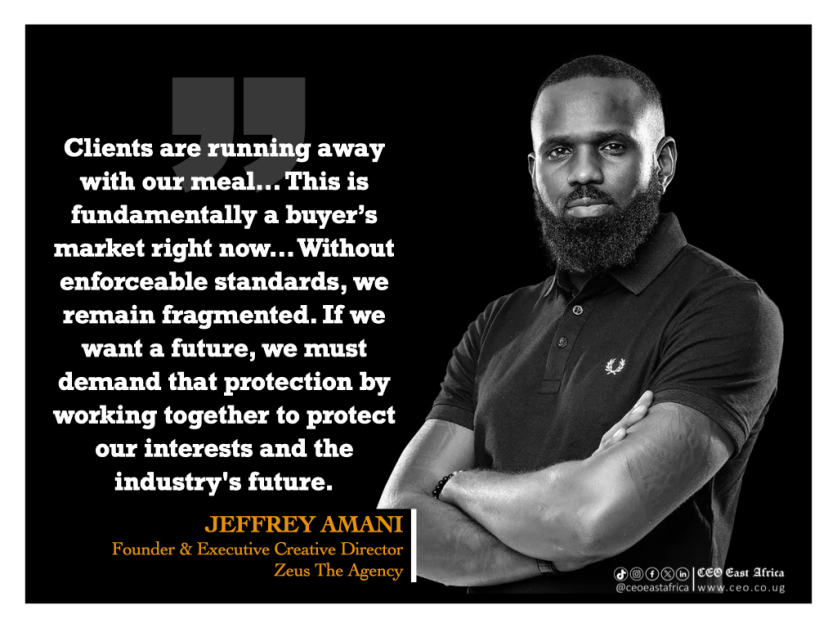
Second, clients are running away with our meal—they’re taking food out of our mouths. This is fundamentally a buyer’s market right now. Clients dictate terms: how much they pay, when they pay, when and how they brief us, who pitches, and so on. Agencies feel exposed because there’s no strong protection from any abuse. Without standardised pricing frameworks or collective bargaining power, clients dictate terms freely.
The best analogy I have is that all agencies are like vendors selling tomatoes in a market. Instead of setting a fair price, the buyer walks in and says, “I’ll pay you 10,000.” You say no, and the next vendor accepts 5,000. This undercutting drives prices dangerously low.
To me, we are not doing enough to protect ourselves as agencies. Standardize. For example, some clients gross huge revenues, and yet they pay their agency peanuts, despite the agency being a critical contributor to their growth.
Imagine if there were laws—policies pushed through private sector & government ministries—that mandated companies to support the local creative economy by contracting local agencies and adhering to tiered payment structures based on their size and revenue. This would create standards that agencies could rely on. If a client offered less than the mandated amount, agencies like Zeus could refuse, avoiding desperate underpricing that hurts the entire industry.
Right now, it’s the wild west. Business depends heavily on connections—“I know the procurement officer, so I get the account”—and rampant undercutting. Agencies find out what others quoted and slash prices further just to win. This fragmentation and lack of unity destroy the industry. Without enforceable standards, we remain fragmented. If we want a future, we must demand that protection by working together to collectively protect our interests and the future of the industry. I say this not as an outsider but as someone in the trenches who can see the risk we face as an industry. If we don’t regulate ourselves, we will keep losing ground. We must act fast and strategically, engage all stakeholders, even when it feels uncomfortable.
Without collective action, clients set the rules, pitting agencies against each other to drive prices lower and lower. The cycle continues until no one on either side profits, and the quality of work suffers.
What the industry desperately needs are policies and frameworks to ensure long-term sustainability, so the creative sector remains strong for decades to come. If things continue as they are, I fear for the future of agencies and the health of the industry overall.
Yeah, and you’re right—100%. If you read my LinkedIn article, I discussed pitch fees extensively. It’s only fair to have a standard pitch fee for any client. Pitching is often abused—agencies spend weeks preparing detailed proposals without compensation because many clients run “procurement” exercises where they’ve already made their decision. They just crowdsource ideas.
I’ve seen it many times: agencies present great concepts in the boardroom while clients aren’t even paying attention, then say “we’ll get back to you,” and later execute those ideas without credit. This is where standardised pitch fees could play a role. If every agency demanded a baseline payment to participate, clients would be forced to value the work rather than exploit it. It would force them to evaluate whether pitching is necessary or if their relationships with agencies are broken.
I liken the agency-client relationship to a marriage—you don’t divorce your spouse because they burnt dinner. You communicate and work things out through quarterly reviews, addressing issues and fixing them. Only when the relationship fails completely do you consider “divorce”—or pitching. And if you do pitch, the pitch fee should be non-negotiable.
Since you started running the business side early on, what hard truths have you encountered while managing an ad agency? Are there specific challenges or pressures that have taken a personal toll on you?
And especially during those early years of building the agency, there must have been moments of intense pressure—times when missing a day or taking a break due to stress wasn’t an option because others depended on you.
How do you maintain your sanity and keep showing up every day with focus and determination?
Okay, so regarding some of the hard truths that have really shaken me—and this is something that still shows up regularly—first and foremost, no one is coming to save you. You’re on your own, especially as a single owner-operator like me. I don’t have affiliations with any agency bodies or a godfather agency I can lean on for financial or technical support. The buck stops with me. That reality has been tough, and sometimes it really beats me down. But I didn’t start this to give up, so I dust myself off and keep moving.
One lesson I’ve learned is: when you don’t know what to do, do what you know to do. For me, that means getting out of bed and coming to the office—even if I don’t have all the answers. Showing up, taking charge of the situation despite uncertainty, has done tremendous things for me. The key is not to stop or remain stagnant, but to keep moving forward. Even when things are toughest, even when the agency is struggling, I show up.
Another hard truth is that the taxman doesn’t care. Honestly, the regulatory environment is a huge challenge. Regulators often don’t understand how money moves in this industry. It’s very different from FMCG or retail. We work on post-sale invoices, and I’ve told the Uganda Advertising Association chair that we need to have a meeting with URA.
The E-tax system, while the best thing they’ve done recently, also creates issues. For example, when we generate many invoices in a month, URA expects payment by the 15th of the next month, regardless of whether we’ve been paid by our clients. If we haven’t received that money, penalties and interest start accruing. It feels like I’m being asked to pay myself! It would be fair if the system also penalised the clients who owe us money. If the agency is fined for late payment, the debtor client should be fined as well. That’s a no-brainer.
This year, especially, my phone has been ringing non-stop from different tax officers demanding payment. We had agency notices every week early this year. We pay immediately, but the next notice comes right after. It cripples the business. A conversation to understand how we work would go a long way.
We don’t have the luxury of a cash stash. Most of the money that flows through the agency is what I initially invested, plus additional funds I continue to put in. This is not sustainable. It’s hard to run a business when the regulator is inflexible and seemingly indifferent to whether the business thrives or not. We have a good tax payment history, yet we’re treated like we might run away with money.
Finally, the industry itself is unregulated and unprofessional. Anyone can wake up and set up an agency, quote any price, and pay salaries at will. Big agencies have an unfair advantage because they can poach talent at will. That creates a wild, wild west environment.
All these issues weigh on me daily. I wake up asking myself, “What is this?” and try to navigate these ongoing challenges.
Okay, that’s interesting. As we wrap up, here’s a final question for you: When the story of Zeus is told, say 10 or 20 years from now, how would you want that story to be told?
And looking ahead, how do you envision the evolution of your agency? Of course, you may not have full control over that future, but I’m sure there are aspirations and ideals you hold—things you hope will be said or achieved.
How do those long-term visions influence the way you operate today? And how would you want your role and contribution to be remembered in that story?
When it comes to the future of Zeus and our vision, we’re passionate about what we do, and our goal is to spread that passion across the region. We’ve already set up operations in Kenya and Tanzania, replicating what we’re doing here in Uganda. The response in both countries has been positive, and we’re focused on growing that footprint.
Our vision is to become one of the big, most respected players in the region. Of course, there’s the commercial side, but equally important is our social impact agenda. We want to provide a platform where creatives and agency professionals who are passionate about brands and how they show up can have an opportunity to showcase their talents, practice their craft, and earn a decent living while doing so.
That’s been the underlying reason for setting this up. I’m a creative first, and I understand the plight of creatives—how this career has long been looked down upon as something for those “lost” or “not serious” about life. Thankfully, those perceptions are changing, but the need for strong, supportive advertising agencies remains.
I’m in this game to ensure that there’s a platform for those eager and hungry creatives. A place where they can thrive and make a good living while doing what they love. I’m a product of agencies that provided me with that opportunity. Those platforms helped shape my life. Because of them, I’ve been able to live well, take care of my family, and build a career I’m proud of.
Now, I want to pay that legacy forward. I want people to say, “Jeff came in and changed my life.” It’s not about how big the business got, but about the lives impacted—people who learned from me, whose lives improved because they had a space to grow and be supported.
This idea comes from a lesson my mentor once shared: the true impact of anyone isn’t measured by buildings built or money earned, but by how many lives they touched by giving their best, by “emptying yourself and letting others drink from your cup.”
That is the legacy I want. Already, I see changes—people coming to Zeus not knowing their right hand from their left, and now becoming productive members of society, supporting their families, raising healthier kids. That human impact—that’s my fulfilment. It’s not just about money. The money helps, sure, but it’s the people we uplift that truly matter.
And maybe just as a final question, out of curiosity—considering the expenses and challenges you’ve faced building your business, and now as a business owner observing the issues with the current talent pool and the state of education for our children—how do you see the future of work evolving?
What opportunities and skill sets do you believe will be essential going forward? And how does this shape the way you are preparing your own children, in terms of the education you want for them and any concerns you might have about their future?
Obviously, a lot is changing—there’s AI, and this new wave of technology that’s transforming how work gets done. One of the first things we did here at Zeus was introduce AI skilling initiatives, starting with the basics: understanding AI’s power and learning how to leverage it effectively.
For example, one of our current training modules is on prompt engineering—teaching everyone how to become better prompt engineers. This is happening across departments because we believe everyone needs to be a kick-ass prompt engineer. We’re constantly observing trends and adapting to make sure we remain the agency of the future, never left behind by these shifts, but rather ready to assimilate and adopt where needed.
This perspective also shapes how I view the future for my kids. I don’t buy into the fearmongering about AI “taking jobs.” I tell my team the same thing: AI is just another tool. Think back to when Adobe introduced Photoshop and the whole Adobe Suite—before that, it was CorelDRAW. People worried then, too, saying that if you don’t know Adobe, you’ll be out of work. But those who adapted thrived.
It’s the same with AI. It’s not the enemy—it’s a tool. The winners will be those who quickly adopt it, understand how to leverage its strengths, and apply it skillfully. Remember, AI can’t think for itself; it relies on us feeding it the right inputs.
So, having open conversations like this with the team helps calm nerves and shows how everyone can position themselves to be creatives, agency resources, and admins of the future.
I’m speaking because I care about this industry. I want agencies in Uganda to thrive for the next twenty years, not collapse under short-term deals and undercutting. These are not complaints, they’re survival strategies. If we organise, protect each other, and set real standards, we will build an industry worth handing to the next generation.