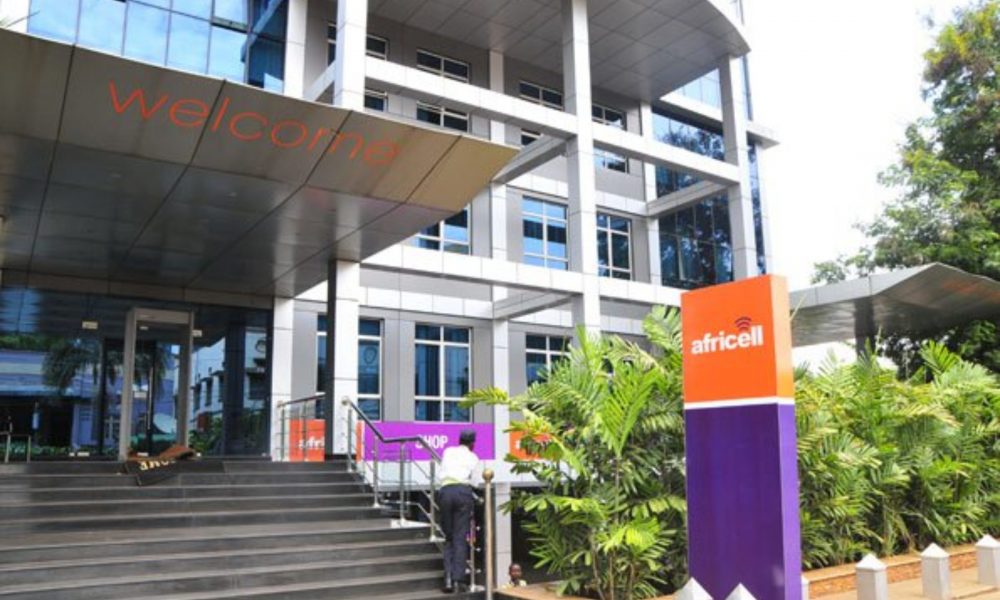
Over the last month, the market was awash with talk that Eaton Towers and ATC Uganda, the two biggest operators of cell towers in Uganda, had switched off telecom operator, Africell Uganda over unpaid bills. That it took the intervention of the regulator, Uganda Communications Commission (UCC) to have them restored temporarily.
We reached out to UCC’s Executive Director, Eng. Godfrey Mutabazi who referred us to Mr. Ibrahim Bbossa the Head Public and International Relations at UCC.
Bbossa, however declined to comment saying that the matter beforehand was sensitive.
Mark Turyamureba, the ATC Uganda, Head of Legal/Regulatory Affairs in a phone call to this reporter said his company, had not switched Africell off, to the best of his knowledge.
Jim Burns, the Eaton Towers, Deputy Managing Director, did not respond to our email, calls and messages to his phone for over 3 weeks.
When we asked Africell’s Spokesperson, Edgar Karamagi about this turn of events, he said the company was aware of the “existence of business obligations with service providers but all processes are moving on smoothly.”
“I am not aware of any switching off as per your claim,” he said, adding: “All our engagements with tower companies and other service providers, are premised on well stipulated agreements which touch on all issues including but not limited to payments. As a company we value our service providers and extended stakeholder community to ensure we are act in accordance to our agreed roles. In brief, we honor our obligations to all our stakeholders without exception. This has been the trend and it is not about to stop.”
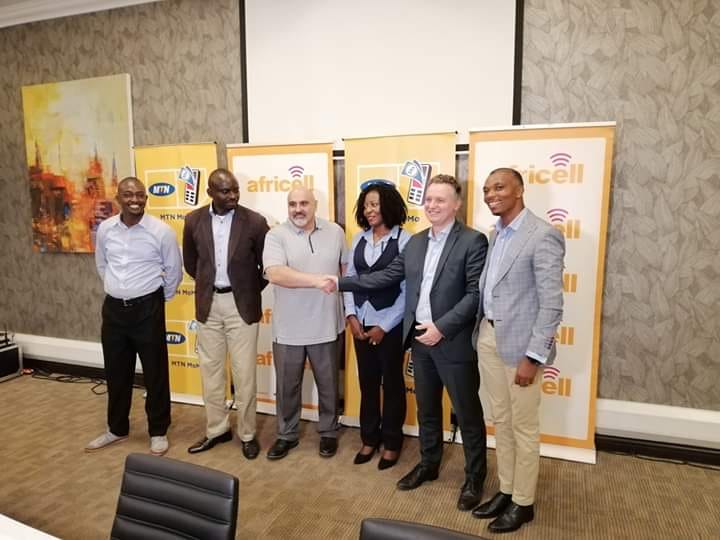
COOPERATING TO COMPETE: Africell CEO Ziad Daoud (in t-shirt), shakes hands with MTN Uganda CEO, Wim Vanhelleputte on August 6th, 2019 at the joint announcement that Africell would begin distributing its airtime through MTN’s Mobile Money, over and above its shops. Africell, it appears is getting innovative so as to stay afloat at minimal costs.
Mr. Karamagi went on to say, without divulging how much these obligations were, that: “To allay your fears, the telecom business is a high capex investment business, therefore such amounts can’t run us out of town,” he said.
However, when we put it to him that according to audited financials to which CEO East Africa had gained exclusive access, Africell was heavily indebted and by end of 2018, its current liabilities reached the tune of UGX258.3 billion- more than twice their total turnover in 2018, wondering if indeed Africell was in position to pay these debts, Karamagi responded as thus:
“No comment on the figures although I do question your source. We take exception to remind you of your obligation to publish with responsibility,” he said.
One step front, two steps back
Africell Holdings, mid-2014 acquired then Orange Uganda at an undisclosed sum, amidst analyst questions on what bag of tricks Africell had up its sleeve, given that Orange, part of a bigger and more experience Orange Group had failed to meaningfully penetrate the Airtel and MTN duopoly.
At the time Orange quit, they were faced with UGX771.8 billion in accumulated losses and with almost no significant market share gains to show for it.
It appears, the timing of Africell’s entry was just wrong- at the time of Africell’s entry, Airtel, part of the Bharti-Airtel, the giant out-of-India operator, had just successfully pulled off a merger and acquisition of Warid Telecom creating a much stronger No.2 market player.
As a result of the merger, Airtel would nearly double its revenue from UGX367.7 billion in 2012, to UGX505 billion in 2013 and UGX722 billion in 2014. This put Airtel, well within a fighting chance, against market-leader MTN which as at end of 2014 had a gross turnover of UGX1.27 trillion.
A much stronger Airtel, meant that Africell, had two market giants to fight against.
ALSO READ: Airtel posts UGX338bn in 2018 profit; makes more profit than MTN for 3 years in a row https://www.ceo.co.ug/exclusive-airtel-posts-ugx338-bn-in-2018-profit-makes-more-profit-than-mtn-for-3-years-in-a-row/
 After 29 Years in Court, Government Ordered to Pay UGX 512.9 Million in Kamuli Land Dispute
As at end of 2014, Africell’s total turnover was a meagre UGX121.3 billion- 10 times less than MTN’s revenue market share and about 5 times that of Airtel. This was a David with one stone, versus not just one Goliath, but two Goliaths. That left the question on everybody’s head: How exactly did Africell plan to change the game? What move were they going to pull in that market that MTN and Airtel could not replicate?
2015 was the year that Africell too their first hard lesson in the market. Amidst tough talking and supported by heavy market spending- Africell only managed to grow their turnover by 6.1% from UGX121.3 billion to UGX129billion. But due to the big spending, losses increased by UGX94.4 billion that year, from UGX171.5 billion in 2014 to UGX266 billion- a one-step front, two steps back scenario.
UGX121 billion in turnover would infact be the furthest they ever reached in turnover- what followed would three years of consecutive revenue decline. In 2016, revenue declined to UGX126.6 billion, then to UGX113.6bn in 2017, settling at UGX108.8 billion- altogether a reduction of 16%.
Put another way, this was UGX12.5 billion less than the revenue that they inherited from Orange Uganda. As if this was not bad enough, this lackluster performance came in with another cost- more accumulated losses; UGX171.5bn in 2014, UGX266 billion in 2015, UGX172 billion in 2016, UGX66.5 billion in 2017 and UGX72.2 billion in 2018.
Altogether, since Africell entered the Ugandan market, they have amassed UGX748.2 billion in accumulated losses- perhaps a testimony to market analyst fears that by trying to put up a fight against 2 market giants, huge competitors, each of whose turnover is more than 10 times Africell’s- MTN in 2018 turned over UGX1.55 trillion and netted UGX219.5 billion while Airtel turned over UGX1.21 trillion and netted UGX338 billion, Africell would only succeed in hurting itself.
We asked Edgar Karamagi and new CEO, Ziad Daoud if Africell had any fighting chance against Airtel and MTN who are backed by bigger group entities that are themselves bigger than Africell Holdings – Africell’s mother group, but Africell instead chose to sidestep the question by expressing reservations on the authenticity of our figures.
How much further can Africell go?
To understand the futility of Africell’s fight, you need to understand that while Africell’s turnover between 2015 and 2018 reduced by 16%, that of MTN, the market leader increased by 16% from UGX1.33 trillion to UGX1.55 trillion.
That of Airtel leaped by 43% from UGX846.2 billion to UGX1.21 trillion.
But Africell, won’t give up as yet. In July 2019, it was reported by Reuters that Africell Holdings had in May 2019 secured a $100 million (UGX365.4 billion) credit line from the Overseas Private Investment Corporation (OPIC), the U.S. government’s private investment fund.
Reuters quoted Ziad Dalloul, Africell’s founder, CEO and Group Chairman saying that the money would be used to fund infrastructure investments for their operations in Uganda, Democratic Republic of Congo, Gambia and Sierra Leone.
He also said it would help the firm expand fintech services, such as mobile payments, micro-insurance and micro-finance.
But given the size of the problem at hand, it appears, that even if the entire $100 million was to be spent on Uganda alone, it may be just enough to fix the debts with a few billions left to patch, a minute portion of the UGX1.52 trillion in accumulated losses.
Eaton may or may not have switched them off, but sooner than later debts, losses and a tough market will.
One step front, two steps behind: Can Africell survive an onslaught from MTN and Airtel, amidst declining sales, heavy losses and deep indebtedness?