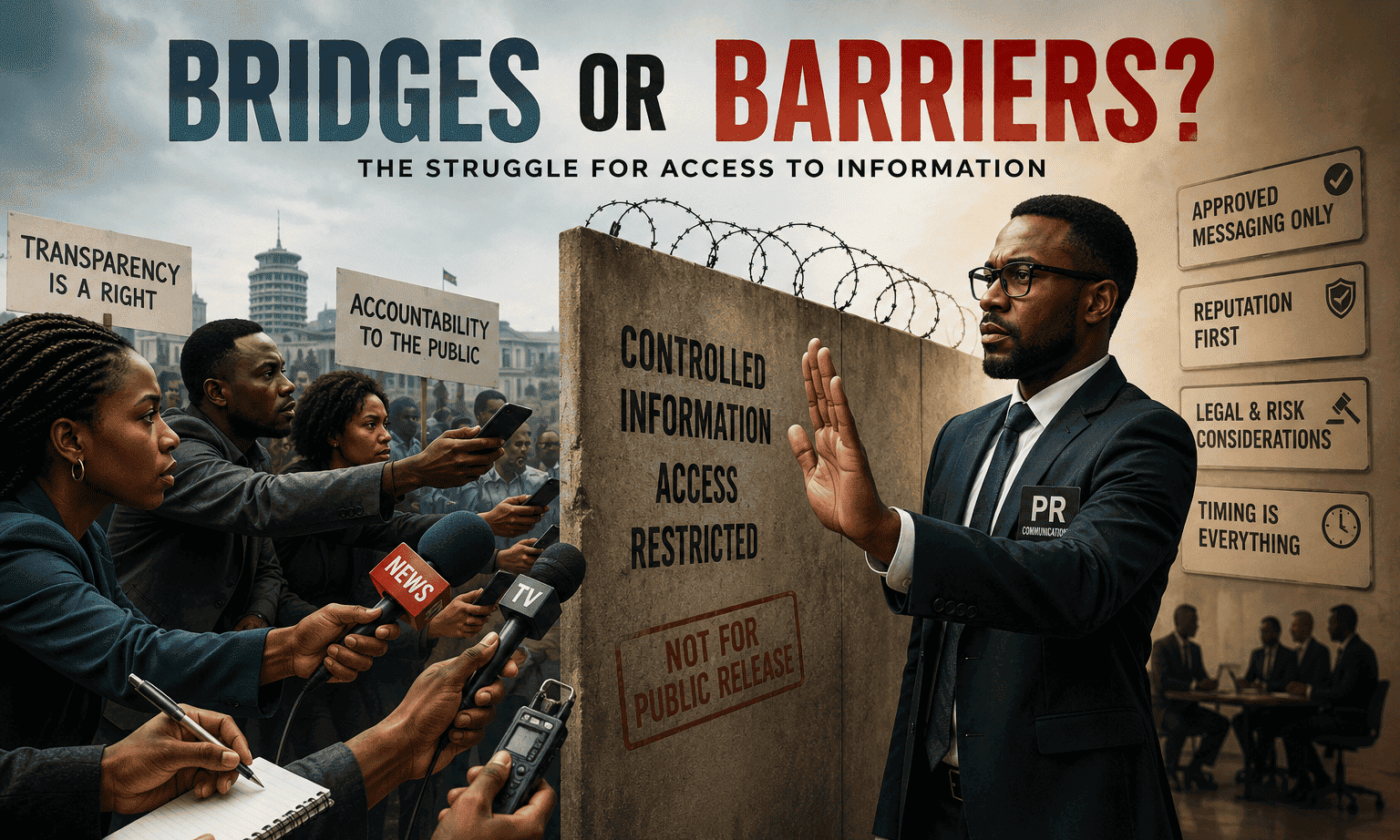
For years, PR practitioners were seen or at least thought of as the bridge between organisations and the public, facilitating access, clarifying issues, and connecting journalists to information. But in today’s high-risk communication environment, many journalists argue that PR officers have become more protective, cautious, and controlling of information than ever before. From delayed responses and tightly managed interviews to concerns over reputation, legal exposure, and social media backlash, the relationship between journalists and communicators is increasingly strained. So, are PR professionals simply managing institutional risk, or are they becoming barriers to public accountability and transparency?
From university, the fundamentals of public relations are clear: to facilitate communication, manage risks, correct misguided perceptions, and support branding and marketing for an organisation.
So why is it that lately, communication officers have turned from facilitators into gatekeepers of information? Why do they make securing a CEO interview so difficult that one feels as though they are fighting for dear life? Why is a request for a profile met with, “That does not serve our publicity needs at the moment?”
Are PRs biased?
Should everything be about what the PR practitioner wants to say? What happened to being a conduit of information?
While it is understood that journalists may sometimes seek information that could undermine an organisation’s integrity, the roadblocks can at times become too much.
However, Charles Mpagi Mwanguhya, who has been on both sides of the coin, quickly reminds us: “If communications people know something that may place the organisation in a poor light, they may avoid disclosing it.”
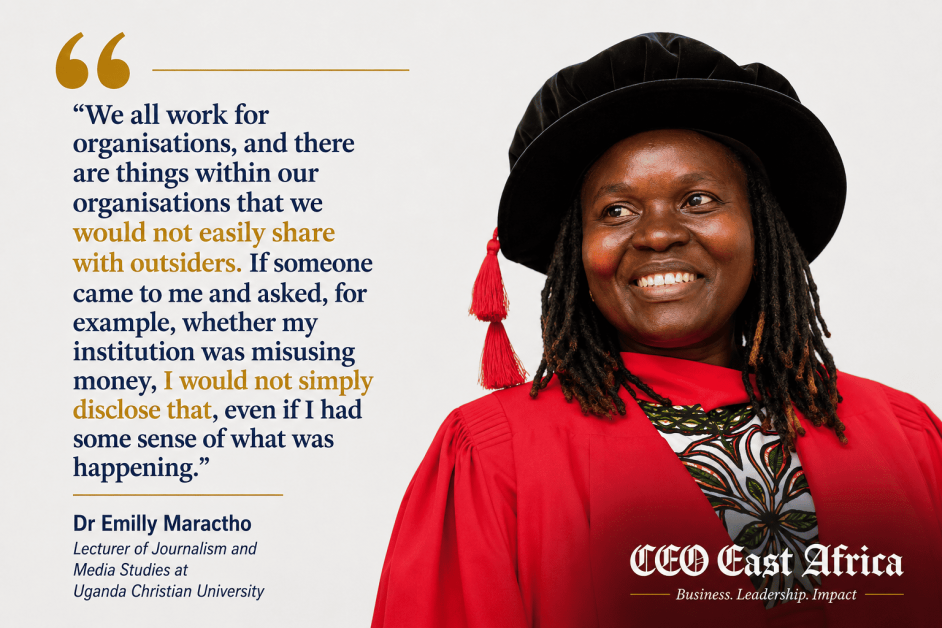
Dr Emilly Maractho, a lecturer of Journalism and Media Studies at Uganda Christian University, adds that it is their role to protect the brand they work for, and sometimes that means withholding certain pieces of information from journalists.
“We all work for organisations, and there are things within our organisations that we would not easily share with outsiders. If someone came to me and asked, for example, whether my institution was misusing money, I would not simply disclose that, even if I had some sense of what was happening,” she says.
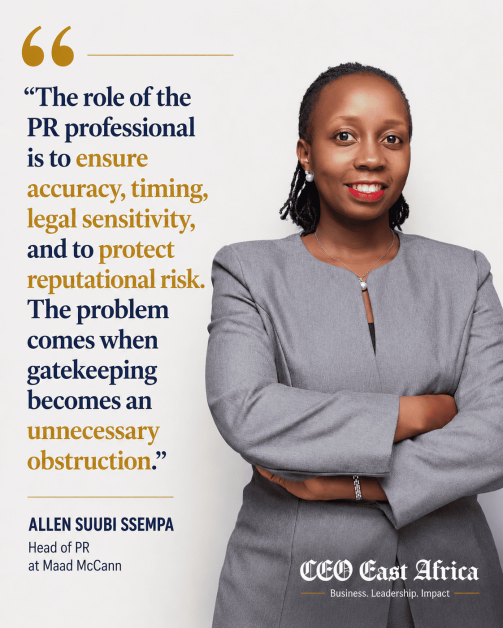
Allen Suubi Ssempa, a public and international relations expert and Head of PR at Maad McCann, clearly explains the role of a PR person.
It is to enable accurate, timely and responsible storytelling. “We’re the bridge between the organisation and the media, making sure journalists get what they need while also ensuring the information shared is correct, contextualised, and aligned with the organisation’s reality. We coordinate media relations with strategy,” she says.
Dr Maractho adds that someone who is communications-minded is different from someone who is journalism-minded. They are pursuing different objectives. “One is looking to expose; the other is looking to uplift and promote what the organisation is doing,” she says.
When Access Becomes a Battle
Paul Busharizi, a seasoned journalist, says he has encountered situations where access to sources or information was deliberately delayed or denied, especially when covering finance ministries, regulators, or large corporations.
“When you send questions, you are told that they are ‘being worked on’ until your deadline passes. Then, when responses come, they are often tightly curated. The result is that reporting becomes thinner or shifts into analysis rather than direct reporting. It can also unintentionally fuel speculation because information gaps get filled by inference.”
In the case of Mwanguhya, he, alongside Angelo Izama, was among the first journalists in Uganda to test the Access to Information Act of 2005. They went to court seeking access to production-sharing agreements for oil exploration in western Uganda, in the Albertine Graben.
“We were blocked. The government argued that the agreements contained anti-disclosure clauses,” he says.
The two journalists doubled down, saying this was a public resource and Ugandans had a right to know what had been signed on their behalf.
Then, even when the agreements were tabled in Parliament, they were quickly withdrawn, and even MPs struggled to access them, including through the parliamentary library.
“At the time, Uganda had just announced commercially viable petroleum discoveries. We believed the law should be tested properly. If agreements were being signed on behalf of citizens, citizens had a right to know what was in them,” he says.
More than 20 years later, he believes some of the transparency now present in the oil sector is partly the result of those early efforts.
Looking back, he says that the fight both closed and opened doors. Nonetheless, the character and quality of the journalist also shape which doors open or close.
“I did it from a genuine place, not for favour or recognition. My intention mattered more than how some interpreted it. It was important to prove that the law actually worked, that people could use it to access public information. Those who understood that appreciated it. Those who did not, simply did not,” Mwanguhya says.
Protecting the Brand or Blocking the Public?
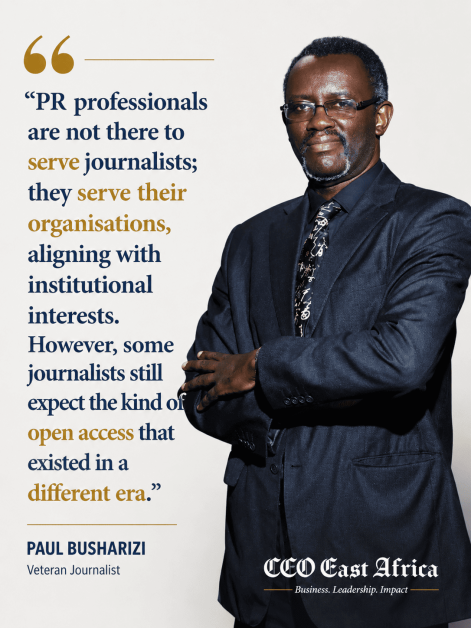
Busharizi says the claim that PR officers have become barriers rather than bridges is partly fair, but it misses the point, as there is a mismatch of expectations on both sides.
“PR professionals are not there to serve journalists; they serve their organisations, aligning with institutional interests. However, some journalists still expect the kind of open access that existed in a different era,” he says.
Ssempa also says that while the perception is not entirely wrong, it is often misunderstood. She says that good PR professionals gatekeep, but ideally for the right reasons. “It is to ensure accuracy, timing, legal sensitivity, and to protect reputational risk. The problem comes when gatekeeping becomes an unnecessary obstruction,” she says.
The pressures that push PR professionals to restrict or tightly control information are significant, ranging from investor scrutiny and regulatory compliance to performance expectations.
Then there is the reputational dimension, as social media amplifies everything instantly. “Under those conditions, PR teams default to caution: controlled messaging, delayed responses, and carefully managed access,” Busharizi says.
In all this, Ssempa says that management always requests her to say less in order to minimise risk, and she must agree.
“I can only share information with the protection of my organisation’s reputation in mind, and I’ll restrict it to manage that risk,” she says.
Is the protection too much?
Agreeably, there are instances when protecting an organisation’s image crosses the line into obstructing the public’s right to know. Such instances include when information that is clearly in the public interest is withheld or excessively delayed. For example, financial performance, regulatory breaches, or the use of public funds. “At that point, PR stops protecting reputation and starts undermining accountability, which is problematic, particularly in emerging markets where transparency is still evolving,” Busharizi says.
That said, there are situations where limiting or delaying access to a source is not only justified but necessary. In many cases, organisations may still be verifying information internally or waiting for approval before issuing an official press release. During crises, facts often evolve rapidly, making premature communication risky and potentially misleading. There are also instances where legal or regulatory implications restrict what can immediately be disclosed to the public. Similarly, organisations may choose to delay access when a spokesperson has not yet been fully briefed or aligned on the matter at hand, to avoid contradictory messaging or factual inaccuracies.
“The key factors are accuracy and risk management. Delaying access is, in most cases, responsible information management,” Ssempa says.
So Mwanguhya says it is not fair to criticise PR practitioners as barriers, as journalists must be finders of information, educators, and communicators. “They cannot expect someone else to do the job for them. A PR person is not supposed to take away your story. If a PR person gives you nonsense, report their comment as their position, but the story remains yours,” he says.
Why Some Journalists Frustrate PR Teams
But journalists can also be a pain, as some only care about their deadlines, which are sometimes unrealistic, as opposed to an organisation’s hierarchy of information sharing and internal processes.
Ssempa says some also ignore context in favour of sensational angles that stand to damage the reputation of the organisation.
“There is also repeated disregard for agreed boundaries; calling our executives or other peers for information we’re trying to delay to disseminate,” she says.
How Social Media and Reputation Risks Changed PR Forever
Busharizi says the relationship between a PR practitioner and a journalist has shifted quite fundamentally. In the past, PR officers mainly opened doors — you called, they connected you to the technical people, and you did your job. “Today, PR is less about access and more about control,” he says.
That change has been driven by the 24/7 news cycle, the rise of social media, and heightened reputational risk. “Organisations now operate in an environment where a single misstatement can spiral into a crisis, so they have tightened how information flows out,” he clarifies.
Mwanguhya adds that back then, organisations trusted journalists more. Today, they have many more avenues to communicate, but they also have many more issues they want to manage.
The other issue is the ability of journalists to build credible sources so that by the time they approach the PR person, they already have their facts in order.
“We have progressively made the mistake of going to the PR person as the first source of information. As a PR person, I will immediately assess how much you know. Are you knowledgeable, or are you just looking for a quote to build a superficial ‘he said, she said’ story? Once they realise your information is weak or ungrounded, they become guarded and may simply leave you where you are. If they realise you know a great deal, then they may try to manage you by sharing just enough information to secure an outcome favourable to them,” he says. That said, a journalist must first build strong independent sources.
Changes in relevance
It should also be noted that PR offices have grown in importance within some organisations, thus becoming part of shaping or processing that information. That is not to say some are not still sidelined and simply given information to relay. For these, the response tends to be reactive.
“For the empowered PRs, they defend the organisations that employ them, and sometimes want to sell the organisation’s version of events without actually providing meaningful information. They promote what suits them but may be slow to respond to legitimate media enquiries,” he says.
This is where gatekeeping is rife. While that is understandable, it may sometimes backfire because they may not even have the right information themselves. That is in instances where they do not understand the perspective from which the journalist is enquiring.
Then there is the layered process of getting approval or information from senior management. That often takes time and can be deeply frustrating for journalists.
Technological advancement also adds to the gatekeeping because today, almost everyone can publish directly. That could be the chief executive, the finance officer, a departmental manager, or an institution itself. “That, in some ways, reduces the role of the PR or communications person,” Mwanguhya says.
Take the White House, for example. If you are the spokesperson for a chief executive such as Donald Trump, who is constantly posting his own views online, often changing position rapidly, then even the gatekeeping role becomes weakened. Journalists can simply monitor his social media feed because those posts themselves become official sources of information.
Why Organisations Are Tightening Control of Information
Information access is shaped by many factors. For instance, today one can call you on the phone and start asking questions. You may not know where they are or who else is listening. Even when you meet people physically, they may record you without your knowledge. That alone can make people guarded.
“Therefore, the way we use technology today has made people more cautious. They censor themselves because of that,” Dr Maractho shares.
Then there are the economic interests, as well as the ethos of the institution the PR professional works for. If you work for an organisation that does not want certain matters to be public, you are likely to stay within those limits.
On the social side, the PR professional must assess how people wish to be perceived publicly. That matters more today because information can spread far beyond its original context.
“Imagine being the PR person who says something unfortunate about your organisation. That could damage your chances of securing similar work elsewhere,” she says.
Bottom line, the way people handled information in the past has changed. Everyone now believes they can control some form of information and decide how it is shared.
“In the past, PR professionals depended on journalists for favourable coverage. Now organisations employ influencers, brand ambassadors, and company sites to tell their stories directly,” Dr Maractho says.
Why Journalists Must Rethink Their Approach
While the narrative is that the PR person has become a gatekeeper, journalists cannot always cry foul play. Dr Maractho reminds us that a good journalist is trained to go beyond official sources.
“If there is a scandal in an organisation, are you really going to rely only on the CEO’s statement? Of course not. You would speak to ordinary staff members, affected people, and others who know what is happening,” she laughs.
There will always be ways for a journalist to obtain relevant information beyond the official line. Since time immemorial, people have found ways to obtain information. Therefore, journalists need to get their hands dirty, digging up information.
While direct access to sources has reduced, Busharizi agrees that journalism is adapting. “The best reporters now triangulate — using data, insider knowledge, market signals, and official responses. If anything, this environment rewards more analytical and rigorous journalism. Those who rely solely on access struggle; those who dig deeper still produce strong work,” he says.
For the journalist who is unlucky to be denied the CEO’s interview, it is unfortunate. It could be that the organisation does not trust the media company or has a bad relationship with it. However, when good publicity is thrown in the bin, you do not have to throw away your story. In these isolated cases, she advises that the journalist find out who else in the organisation has influence and could help secure access.
“That is where people skills come in. Journalism also requires interpersonal skills — the ability to get people to talk to you, listen to you, and engage with you. Engagement is important. If one avenue fails, try another. My principle is always that there must be another way,” Dr Maractho says.
“Likewise, if you are a communications person, you should have the personality to treat people respectfully. Even when saying no, you should do so courteously and professionally.”
There is also the issue of how the journalist pitches their story. Mwanguhya says if PR practitioners sense that they may not control the narrative, they become cautious.
“But sometimes, it is sheer incompetence where a communications person is unwilling to make an extra effort. That happens,” he says.
Why Government and Private Sector PR Behave Differently
That said, it is important to understand that some organisations are naturally closed and inward-looking, while others actively seek media attention. Some want to dominate media space, while others prefer to stay quiet.
Additionally, distinguish between the public sector and the private sector, because they often behave differently.
Take a public institution such as the Ministry of Health, where you may find a large public screen with real-time updates, health incidents, and ongoing developments across the country.
“In such an instance, should the journalist misconstrue the information, the ministry’s PR team would be justified in getting angry with the journalist,” Mwanguhya says.
On the private sector side, organisations tend to be more guarded, guided and constrained by company policy and commercial interests.
“Therefore, even when approached for their CEO’s profile, there could be several underlying questions. One of them could be whether they want the exposure at the moment,” he says.
There is also the tension between formality and informality in business. Some organisations are highly structured and transparent. Others operate in ways that make them sensitive to scrutiny. “That can determine whether you secure the profile or not,” he says.
Where Reputation Management Crosses into Obstruction
Obstruction happens daily. It is when people go out of their way to ensure information does not get out. It can involve intimidating people or warning them not to say certain things.
On the other hand, legitimate management of information is based on a need-to-know principle.
“Information is not automatically for everyone at all times. While some information can be accessed by all, some is for specific groups. As such, implications are depending on what is being shared,” Dr Maractho says.
That is why even laws such as Freedom of Information or Access to Information legislation contain exemptions. Information relating to national security or the military, for instance, often follows separate procedures.
“Even if you accidentally came across sensitive information through a relative who works in an office, you would not simply publish it because you overheard it. There are always decision points: what to share, with whom, where, and how,” she says.
The Politics of Access and Institutional Power
Power is a very interesting thing, and it surely affects the relationship between institutions and journalists. Sometimes people do not even realise they have power until a situation arises. A journalist may or may not have power, depending on the context.
How organisations define and exercise power differs greatly. If you are speaking about Parliament, that is one situation, because it is an institution deeply tied to power. If you are speaking about a school, the power may lie mainly with the head teacher.
So, it depends entirely on the institution. “Power dynamics may affect how journalists access information and how easily they can reach key individuals. But they do not necessarily prevent journalists from asking questions,” Dr Maractho says.
When Media Errors Fuel Distrust
There have been complaints that journalists sometimes misquote or misrepresent people. Some PR professionals may at times use that as an excuse not to share information with journalists.
“We do occasionally see apologies where media outlets admit they got something wrong. But those cases are not constant or universal. They should not become a blanket justification for excessive control,” she says.
There are also opportunities for correction. Dr Maractho always advises her students, especially when the story is not adversarial, to share relevant quotations or factual sections with the interviewee for accuracy. “If you quote someone extensively, it is only fair to verify. Ask whether you have captured their words correctly, particularly if you did not record the conversation or if you are unsure,” she says.
However, there are times when you would not go back to the source, especially if doing so might allow them to reshape the angle of the story after already giving you the facts. The journalist’s duty is to ensure accuracy and fairness, not to surrender editorial independence.
There are also times when journalists choose headlines or angles that distort the overall story. For instance, there have been headlines that promise one thing while the actual article says something quite different. That can be problematic.
“Even so, errors/mistakes should not be reasons for tighter control of information,” she says.
Can Journalists and PR Professionals Rebuild Trust?
Ssempa reminds journalists that PRs do not exist to spin rather than clarify, that delays do not always mean disguising facts, and that access cannot always be immediate regardless of internal realities.
“In truth, most PR professionals are trying to protect both the story and the source, not distort it,” she clarifies.
For a healthy relationship between PR practitioners and journalists, it calls for mutual respect and an understanding that both sides are professionals.
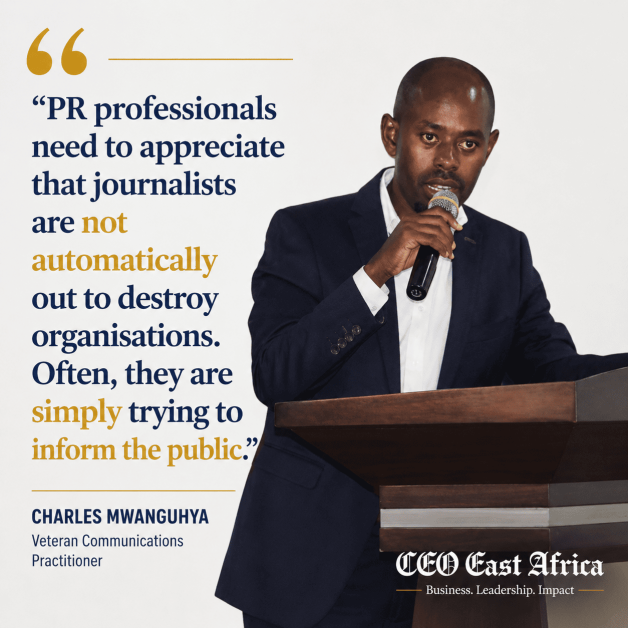
PR professionals need to appreciate that journalists are not automatically out to destroy organisations. “Often, they are simply trying to inform the public,” Mwanguhya says.
At the same time, journalists must recognise that excitement over a story can lead to unnecessary damage. “When you are younger, you may be driven by the thrill of seeing your byline. You do not always think about consequences. Later, you look back and ask: Should we really have published that? Was I fair? Should I have done more work before going to print or going on air? Always ask the question, ‘So what?’”
PRs must appreciate that credibility is a long-term asset, and journalists must earn trust through accuracy and depth. “Where those two meet, you get a relationship that serves both institutions and the public,” he says.