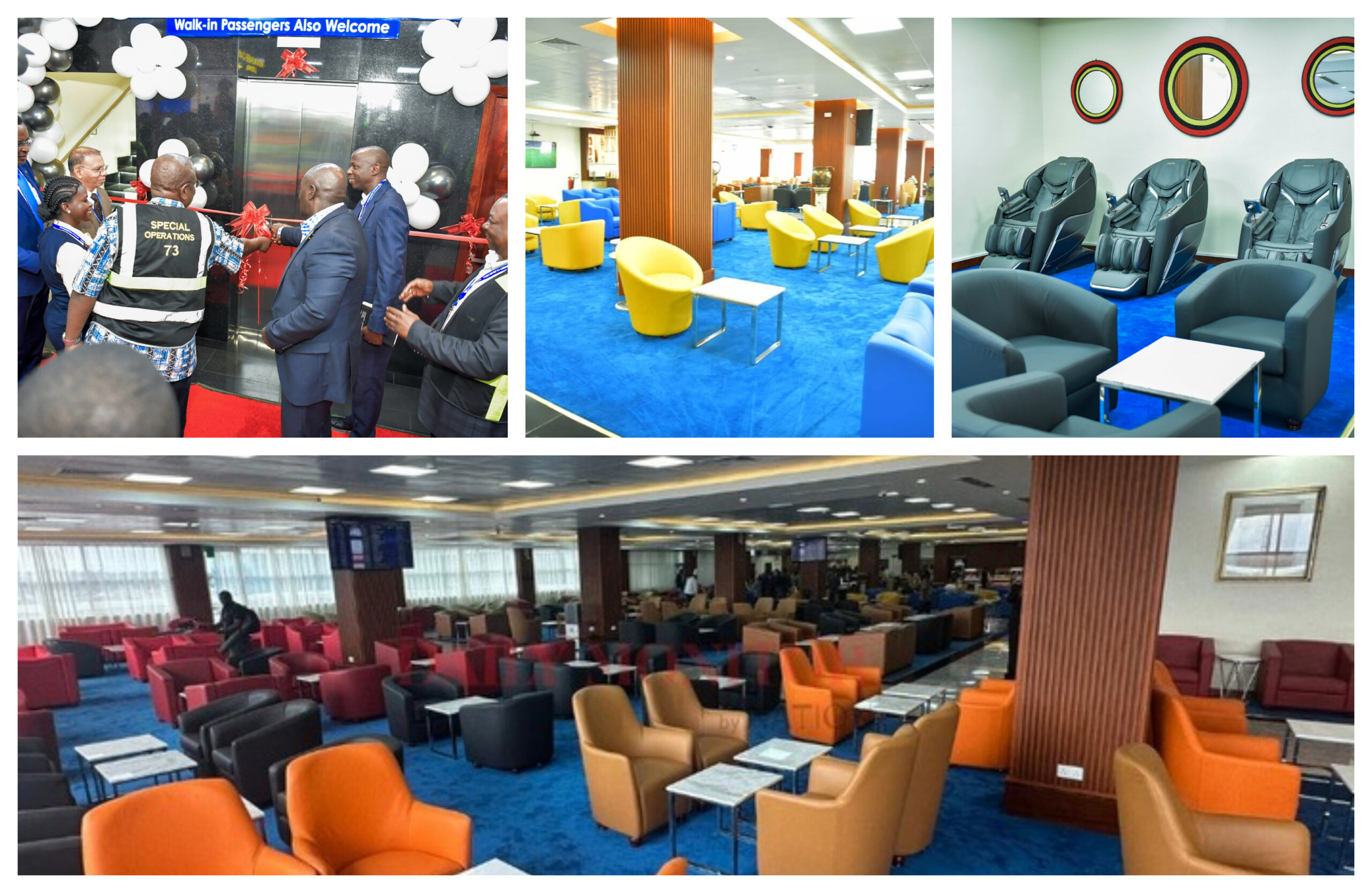
In pictures, Uganda Civil Aviation Authority (UCAA) had promised a grand plan and a blend of class for a VIP Lounge that truly speaks to the beauty that Uganda is.
But what was delivered yesterday is a contrast and a broken promise.
And for delivering what some have called low-budget work for billions of shillings, UCAA is facing pushback.
On Friday, UCAA unveiled the newly refurbished Karibuni Lounge at Entebbe International Airport, but critics did not wait for the chairs to warm.
A wave of comments was quick to describe the facility as “bland,” “tasteless,” and “unworthy” of the country’s main gateway.
The Karibuni Lounge, located within the arrivals and departures section, is part of the airport’s broader strategy to improve passenger experience and handle increasing traffic.
However, what was meant to be a show of luxury and national pride has instead triggered widespread criticism, especially from architects, creatives, and public figures who say the design lacks creativity and ambition.
The lounge is operated by Jamani Investments Group, which has run airport services at Entebbe for over three decades.
According to the company’s website, the Karibuni Lounge is marketed as a premium space offering a “relaxing and pampering atmosphere” with gourmet food, beverages, and professional service.
But many have dismissed that description as far from reality.
Social media platform X (formerly Twitter) has been awash with comments from Ugandans who expressed disappointment over the lounge’s aesthetics, finishing, and overall quality.
BBC Africa podcast host Allan Kasujja was among the first to voice concern, describing the refurbishment as “embarrassingly bad.”
“Something about Ugandan workmanship and lack of sophistication,” Kasujja posted. “Bland. Tasteless. Perfunctory. Unambitious. Complete lack of creativity.”
Interior designer Alex Ponton described the lounge as a missed opportunity for Uganda to project a polished image to the world.
“There is enough talent in Uganda to make this lounge unique and memorable—a VIP lounge proudly made in Uganda that competes with the ones in Dubai and Qatar. Yes, it was possible,” he said. “Instead, this lounge will be remembered for poor taste and incompetence.”
Ponton added that design is not always a matter of cost but of vision and imagination, both of which he said were lacking in the final output.
Veteran journalist Timothy Kalyegira attributed the poor execution to a culture of mediocrity, arguing that loyalty, rather than merit, now determines key public decisions.
“This was to be expected,” Kalyegira posted. “Loyalty to power at the top is now the most important ‘CV’ one can possess. But also, the society, beyond politics, is a generally lax, unambitious, and unimaginative one.”
“There is something truly not right with people in the decision-making process,” said financial analyst Alex Kakande. “Well-educated, well-traveled, but still stuck in the old ways. Zero imagination, even with what appears to be an unlimited budget.”
Others pointed to Uganda’s thriving furniture and interior design industry as evidence that the poor finish could have been avoided.
“Those people don’t know the Modern Living showroom in Muyenga?” questioned political activist Anthony Natif. “One of East Africa’s best contemporary furniture companies is right there… and they serve us that stuff in the VIP section of the national airport?”
Lawyer John Musiime challenged what he described as blanket criticism, noting that several well-designed spaces exist within the country.
“I am a traveler and I have seen some beautiful lounges in Uganda,” he said. “I’ll be sharing examples soon, starting with the beautiful homeland of my fathers, Kabale.”
Minister of Works and Transport, Gen Katumba Wamala, recently announced that a new terminal building—reportedly a multi-billion shilling investment—is nearing completion as part of efforts to modernize Entebbe Airport.
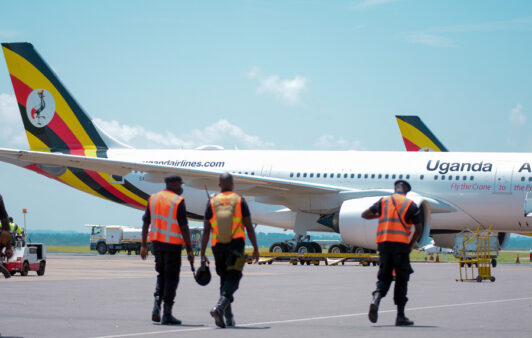
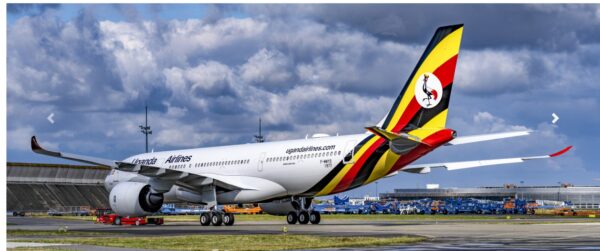
The airport is also preparing to handle a new double-decker aircraft, while additional infrastructure upgrades are underway.
However, the Karibuni Lounge controversy has now cast a shadow over these developments, prompting questions about design standards, procurement practices, and the image Uganda presents to international visitors.
“There are many truly wonderful spaces in Uganda to draw inspiration from,” said veteran journalist Angelo Izama. “Creative experimentation with art, craft, and materials is dynamic, if mostly found in private rather than public spaces. This is probably the result of the procurement curse.”
As the debate continues to dominate public discourse, the UCAA has yet to issue a formal response to the growing criticism.
Audit concerns
But beyond the poorly delivered lounge are old age problems, some of which have been highlighted in audit reports.
For instance, in a report for the year ended June 2024, the Auditor General spotlighted UCAA’s leadership under Director General Fred Bamwesigye, which is grappling with a string of financial and operational challenges.
 Could Museveni’s Election as EAC Chair Renew Push for Accelerated East African Integration?
The report cites rising debt, revenue collection inefficiencies, procurement irregularities, and delayed infrastructure projects—developments that could affect the Authority’s ability to deliver on its aviation oversight and development mandate.
One of the central findings of the audit is the Authority’s growing debt burden.
As of June 2024, UCAA’s total borrowing stood at UGX 723.63 billion, an increase from UGX 636.9 billion the previous year.
Much of this debt arises from an on-lending agreement between government and UCAA for the expansion of Entebbe International Airport, financed by China EXIM Bank.
While government has continued to meet its external repayment obligations, the Auditor General noted that UCAA has not reimbursed the government for these payments, as stipulated under the terms of the agreement.
The audit raises concerns over the sustainability of this arrangement, particularly as the anticipated financial returns from the expanded airport infrastructure have not fully materialized.
This debt pressure, coupled with a significant drop in net income attributed to rising operational costs, has constrained UCAA’s financial flexibility.
Revenue collection was another key area of concern. The audit identified rental income shortfalls of UGX 2.6 billion, largely from tenants at the New Cargo Terminal Building at Entebbe International Airport.
Despite the Chief Government Valuer approving a rental rate of $15 per square meter, two ground handling firms have continued paying only $7 per square meter.
As of June 2024, this discrepancy had resulted in an unpaid balance of $1.389 million—equivalent to about UGX 5.2 billion.
Compounding this issue, several government institutions occupying UCAA premises have outstanding rental arrears amounting to UGX 2.678 billion.
The Authority has also been unable to recover UGX 58.043 billion owed by the Ministry of Foreign Affairs, inherited from the United Nations peacekeeping mission (MONUSCO).
The Auditor General faulted the Authority for not formalising tenancy agreements or memoranda of understanding with the institutions concerned, making enforcement of payments difficult.
On procurement, the report flagged irregularities in contract management.
Contracts worth UGX 2.24 billion were executed without valid bid securities, a breach of procurement standards that exposes the Authority to performance risk.
Delays in contract execution further impacted projects valued at UGX 11.08 billion, with reasons ranging from delayed advance payments to land disputes and shipping challenges.
In addition, UGX 73.37 billion worth of procurement activities were not properly documented in the government’s electronic procurement platform (eGP), with missing bid opening records, contracts, and Solicitor General approvals cited.
The Auditor General expressed concern over these documentation gaps, particularly given the scale of public expenditure involved.
Project implementation across the Authority was found to be well below target.
Of 44 activities reviewed, valued at UGX 52.5 billion, only one activity, worth UGX 0.35 billion was fully implemented.
Activities worth UGX 33.53 billion were partially implemented, while those totalling UGX 18.62 billion had not been implemented at all.
Delayed projects included the Passenger Terminal Building expansion, which was 85 percent complete by the audit date. Other projects—such as the Unified Security System (60% complete), the Aviation Training Centre (delayed due to land acquisition issues), and the planned Control Tower Complex (still under design procurement)—were behind schedule.
The Auditor General attributed the delays to funding shortfalls and protracted procurement and planning processes.
The audit also highlighted weaknesses in car parking revenue management at Entebbe International Airport.
Over 654 transactions worth UGX 1.3 million were found to have irregular receipt numbers, while 15,539 transactions worth UGX 31.6 million lacked payment references.
Additionally, more than 54,000 transactions had no recorded vehicle registration numbers, undermining traceability. The report noted that UGX 68.6 million had been irregularly spent at source using IOUs prior to being banked.
In response to the audit, UCAA management acknowledged the challenges and indicated that corrective measures are underway.
These include strengthening contract enforcement, upgrading procurement documentation procedures, improving revenue controls, and engaging stakeholders to clear outstanding arrears.
The Auditor General has called on UCAA to fast-track tenancy formalization, enhance procurement compliance, complete delayed projects, and improve internal controls—especially around parking and non-aeronautical revenue streams.
As the Authority seeks to position Uganda as a regional aviation hub, the audit findings underline the importance of financial discipline, project execution, and institutional reform. Going forward, the focus will remain on how UCAA, under Fred Bamwesigye’s stewardship, implements the recommendations to restore operational and financial confidence in one of Uganda’s most strategically important parastatals.