Uganda’s petroleum sector has recorded a major milestone with new assessments showing a rise in recoverable oil resources from 1.4 billion to 1.65 billion barrels.
The announcement was made by Ernest Rubondo, Executive Director of the Petroleum Authority of Uganda (PAU), during a media engagement on the progress of Uganda’s oil and gas sector.
Rubondo said the increase follows updated evaluations of existing oil and gas discoveries in the Albertine Graben, made possible by an enhanced and expanded data portfolio covering the discovery and development areas.
He explained that PAU’s review of technical data submitted by licensed oil companies, evaluated using internationally recognised standards, enabled the more accurate estimation of Uganda’s petroleum resource endowment.
The result positions the country with a stronger and more refined understanding of its petroleum potential just as it prepares for its first-ever production phase.
A strengthened resource base as projects enter final stretch
The upward revision arrives at a defining moment for Uganda, with its flagship projects—Tilenga, Kingfisher and the East African Crude Oil Pipeline (EACOP)—now in advanced stages of completion.
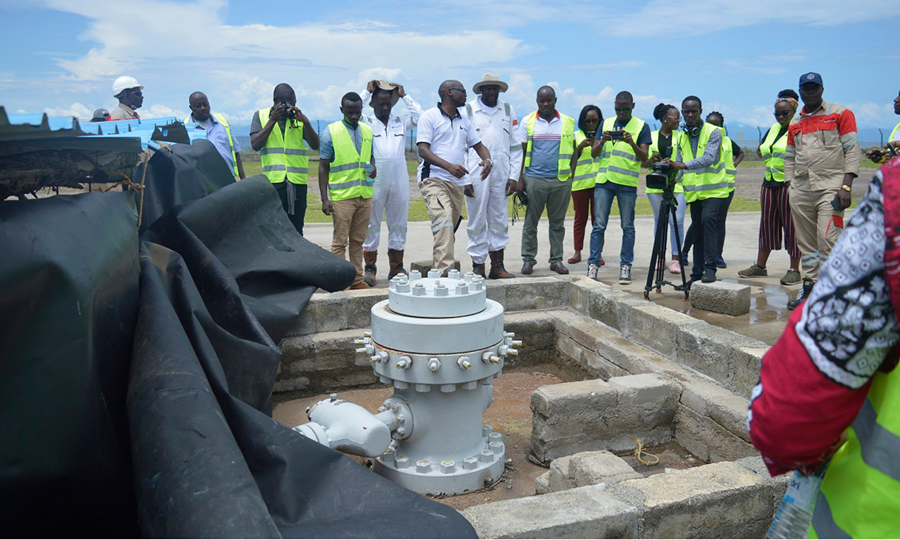
Rubondo confirmed that all 19 wells required for First Oil under the Kingfisher Development Project have been drilled, marking a significant operational milestone.
The Tilenga Project, another major upstream development, is 97% complete, with 164 of the planned 170 wells already drilled.
Progress on the EACOP is similarly substantial. All pipeline segments needed for the 1,443-kilometre route have been delivered, and more than 1,000 kilometres have already been welded, keeping the project firmly on schedule.
Overall project progress currently stands at 60% for Tilenga, 74% for Kingfisher, and 75% for EACOP.
Rubondo noted that these advances underscore Uganda’s readiness to achieve First Oil in the second half of 2026, supported by an even more robust resource base than previously estimated.
Refinery project and infrastructure reinforced by revised estimates
The increased resource estimate also strengthens the strategic case for the Uganda Refinery Project, which is progressing steadily following the signing of the Implementation Agreement in March 2025.
Work is ongoing on finalising the design, conducting pre-commissioning studies, securing project financing, and operationalising the newly incorporated Refinery Company.
 Modernising General Insurance: SanlamAllianz CEO Ruth Namuli on Building Uganda’s Insurance Powerhouse with Trust, Innovation, and Scale
To support the management and utilisation of the expanding resource base, PAU has invested in world-class data infrastructure.
The National Petroleum Data Centre now hosts over 60 terabytes of electronic data alongside thousands of physical samples.
The planned Real-Time Monitoring Centre will further enhance oversight by enabling continuous monitoring of drilling, production and transportation operations, improving transparency, efficiency and safety across the sector.
Environmental, social and local content gains
Rubondo emphasised that Uganda’s oil and gas projects remain among the least carbon-intensive globally, designed to deliver net biodiversity gains.
Social initiatives tied to sector development have resulted in significant community benefits, including the completion of 475 modern houses for Project-Affected Persons and the strengthening of schools, health centres, water systems and other local infrastructure benefiting nearly 20,000 households.
National content participation also continues to expand. Of the $7 billion in approved contracts to date, $2.2 billion has been awarded to Ugandan companies.
Nearly 20,000 Ugandans are directly employed across the sector, while over 180,000 jobs have been created indirectly.
Ugandans hold 64% of management roles, 85% of technical roles, and 99% of support positions.
Over 14,000 Ugandans have received vocational and technical training, and more than 40 joint ventures have facilitated substantial technology transfer into the domestic market.
A larger resource, a critical moment
The confirmation that Uganda now holds 1.65 billion barrels of recoverable oil significantly strengthens the country’s petroleum outlook.
It enhances the long-term viability of major projects already underway, reinforces sector confidence as the country approaches First Oil, and positions Uganda as an emerging petroleum producer with a clearer, larger and more commercially attractive resource base.