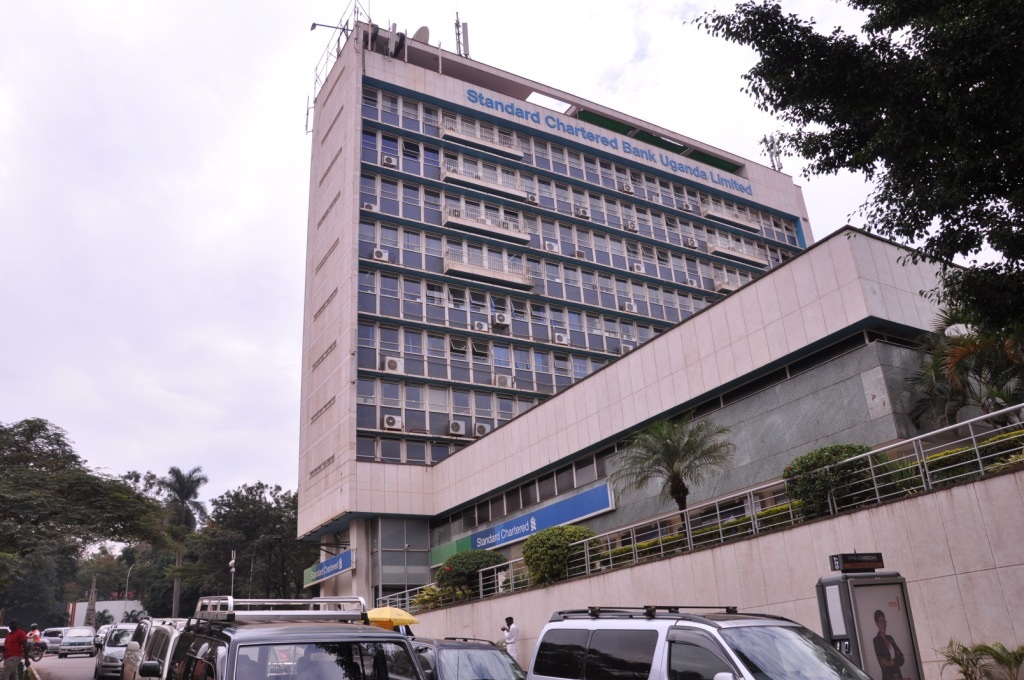
There was no change at the very top in Uganda’s banking sector, as Stanbic Bank Uganda maintained its position as the country’s biggest commercial bank, followed by Centenary Bank. But third place got a new entrant, with Standard Chartered edging out Absa Bank.
Absa Bank Uganda, a subsidiary of South Africa’s Absa Group, slipped to fourth place after being overtaken by Standard Chartered Uganda, part of the London-listed Standard Chartered PLC. Absa’s assets increased by 3.5 per cent to Shs3.5 trillion in the twelve months to the end of 2020, but this was not enough to stave off StanChart’s stronger jump.
Read More: List: the largest banks in Uganda by assets in 2020
StanChart’s assets increased to Shs3.8tn, rising 21.5 per cent — a growth rate only eclipsed by Stanbic, Centenary, Equity Bank, and Finance Trust. The growth was due to an increase of Shs280.5bn in cash and balances with the central bank, a 37.2 per cent rise in cash and balances due from parent and group companies to Shs827.9bn, and a 19.6 per cent jump in investment securities to Shs820.5bn.
At Absa, asset growth was driven by an increase in investment securities, from Shs769.2bn in 2019 to Shs1.1tn at the end of last year. Loans and advances to other banks rose 90.4 per cent to Shs183.5bn, while derivative financial instruments — financial contracts whose value is determined by the performance of an underlying asset, pool of assets, or a benchmark — jumped by Shs27.5bn to Shs40.1bn.
Total assets at Uganda’s 23 commercial banks grew by 16 per cent in 2020 to Shs37.9 trillion. The top four banks hold 53.9 per cent of the industry’s total assets; the seven biggest banks own 74.3 per cent of total assets.
Stanbic’s Shs8.5tn in assets represents just over a quarter of the industry’s asset base; indeed, the bank’s share of total assets increased from 20.5 per cent to 22.7 per cent in 2020. Its assets rose 28.9 per cent from 2019, largely reflecting an increase in trading account assets and net loans and advances to customers. Similarly, Centenary’s asset growth, to a total of Shs4.5tn, was due to rises in trading securities, loans and advances to customers, and cash and balances with other banks.
Cushioning the blow of bad loans
Loans, especially those made to customers, usually make up the largest share of commercial bank assets. Lending is, after all, the main business of commercial banks. As such, it is notable that lending growth was not a significant contributor to asset growth at a large bank like StanChart or, in the case of Absa, that the more active lending stream was to other banks.
Loans to customers declined at the two banks, although this was hardly a unique phenomenon. The two were among the seven banks that reported a decline in loans and advances to customers at the end of the year compared to the previous period.
The shrinking in loans and advances to customers at four of the seven banks was even more significant given that they recorded strong growth in 2019. Loans fell 11.4 per cent at Ecobank after growing by 23.9 per cent in 2019, while Tropical Bank reported a 3.3 per cent slide down from a rise of 40.2 per cent the previous year.
Overall, after excluding [the six] banks whose data from 2018 we did not have, the stock of loans to customers at the end of 2020 rose 10.8 per cent, down from 11.4 per cent in 2019. The total value of assets at the same 17 banks rose 18.1 per cent, up from 13.4 per cent in 2019.
 Ruparelia Group Wins Key Entebbe Land Case, Clearing Path for the New Mega Speke Resort and Convention Centre, Entebbe
The biggest factor at play in the fall of credit extended to customers at the seven banks was the quality of the loan assets. Absa, Housing Finance, Ecobank, and NCBA all significantly raised their loan-loss provisions and, in addition to Tropical Bank, reported big jumps in their non-performing loans.
The two developments were not restricted to just those banks, however; the Covid-19 pandemic disrupted business activity, making it difficult for many borrowers to meet their loan obligations.
In addition to being riskier, lending to customers was less profitable. As part of its efforts to stimulate growth, the central bank reduced its policy lending rate to historical lows in 2020 and pressured lenders to cut their interest rates. The net-interest margin of Uganda’s lenders, a measure of the return on average interest earning assets, fell to its lowest — 10.24 — in ten years, according to Bank of Uganda data.
Trading and investment securities cushion blow
The increase in trading and investment securities suggests that banks were more willing to lend to the government — a relatively risk-free undertaking — as they retreated from customers with a higher chance of defaulting.
In addition to the big banks mentioned earlier, some lenders with the highest asset growth rates in 2020 mainly grew their resource base with trading account assets and investment securities; debt securities issued by the government, essentially. This was the case at Housing Finance and Bank of Baroda, which raised their assets by 21.5 per cent and 14 per cent, respectively.
Still, traditional loans featured significantly in raising the value of some banks. An increase in loans and advances to customers drove the increase in assets at lenders such as Equity Bank, Finance Trust, Exim Bank, and Dfcu.
Only four banks reported a decline in total assets. These were KCB Bank with a 23.6 per cent fall, Orient Bank and a drop of 9.8 per cent, Guaranty Trust posted a dip of 2.5 per cent, and Tropical Bank where assets were down by 1.8 per cent from the previous year.
At KCB, the drop was due to a decline in cash and balances with Bank of Uganda. Orient Bank, on the other hand, was influenced by a fall in loans and advances to customers, and balances with other banks, and cash and balances with the central bank.