For over 23 years, Sadolin Paints Uganda had been the exclusive manufacturer and distributor of paint under the Sadolin trademark by virtue of a trademark licence with Akzo Nobel Coatings International B.V. the Dutch owners of the Sadolin brand.
The contract was renewed on the 1st of May 2015 till December 2019. Under the agreement, Akzo Nobel was entitled to royalty fees equivalent to 2% of net sales.
However, according to documents seen by CEO East Africa Magazine, around 2016, Akzo Nobel hinted that it planned to increase royalty fees to 5% after 2019 and also rebrand from Sadolin to Dulux- their largest global brand that already had good presence in South Africa.
Sadolin Uganda and their shareholders, who had a franchise to run Kenya, Tanzania, Rwanda, Burundi, South Sudan, Ethiopia, Eastern Democratic Republic of Congo, Somalia and Djibouti were not happy about the rumblings by Akzo Nobel.
There were also other complaints like- Akzo Nobel failing to meet their end of the bargain in especially marketing support.
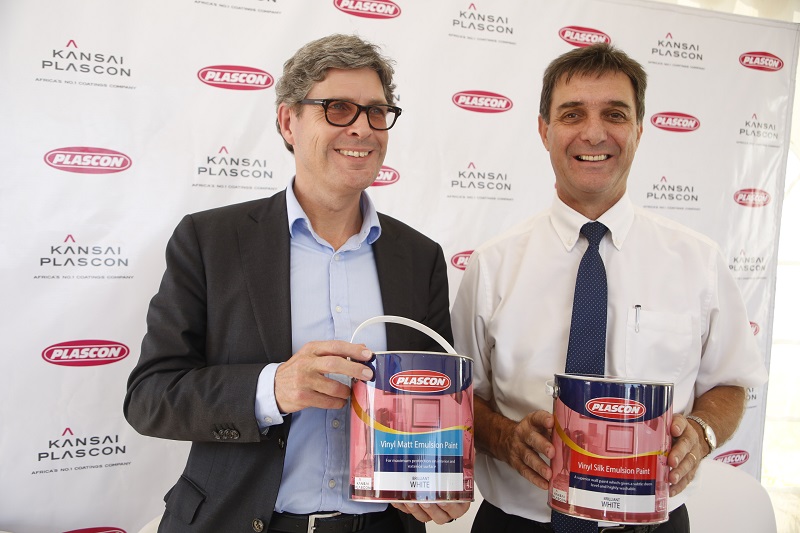
Then an opportunity came if form of Kansai Plascon- the out-of-Japan paint manufacturer and one of the global top 10 giants- just like Akzo Nobel. Kansai Plascon, as they are largely known- had been in South Africa for some time and was kin on expanding northwards.
To Kansai Plascon, a partnership with Sadolin Uganda owners, who also had operations in Kenya under Sadolin Paints East Africa Limited (SPEAL) and Sadolin (Tanzania) Ltd with ongoing export business to Rwanda, Burundi, South Sudan, Ethiopia, Eastern Democratic Republic of Congo, Somalia and Djibouti was God-sent.
A deal was struck for Kansai Plascon East Africa Proprietary Limited (KPEA) to acquire 100% of Shalvik Investments Limited- registered in Guernsey that owned 85% of Sadolin Paints (Uganda) Limited and 80% of Sadolin Paints (Tanzania) Limited respectively. Along with acquisition of other minority shareholders KPEA, on 1st August 2017, secured 92.5% of Plascon Uganda and 90% of Sadolin Paints (Tanzania) Ltd. The two were immediately renamed Kansai Plascon Uganda Ltd and Kansai Plascon Tanzania Ltd (Respectively).
KPEA also acquired 85% of Sadolin Paints (EA) Ltd and renamed it Kansai Plascon (Kenya) Ltd. The company in its 2017 report said it hoped to acquire all the remaining shares so as to acquire a 100% controlling stake in the Group.
According to their 2018 Annual Report, Kansai Plascon agreed to pay USD40.8 mn for the three companies’ current assets, USD46m for non-current assets like plants, vehicles and buildings as well as USD83.1 mn as goodwill. Less theliabilities and cash acquired, the final price came to USD$126 mn (UGX452.5 bn).
All payments were made in cash!
The specific amounts for the Uganda acquisition is not mentioned in the report, but according to the East Africa Venture Capital Association (EAVCA) and KPMG Private Equity Sector Survey of East Africa for the period 2017 to 2018, the Ugandan operation being the biggest of the three- was cashed out for an irresistible USD88 mn (UGX316 bn).
But Akzo Nobel had gotten wind of the deal in its infancy stages and had moved to on 31st January, 2017 to serve Sadolin a 12 months’ notice to terminate the contract. However on getting knowledge that KansaiPlascon had completed the takeover deal with Sadolin and that they were in advanced stages of ditching Sadolin branded paints even before the expiry of the notice period and were to launch their own Plascon paints brand, Akzo on 2nd June 2017- served Sadolin a 15 day notice to terminate the Trademark Licence Agreement.
Meantime, Akzo Nobel had hatched a master stroke up their sleeves- they were planning, following the termination to use their production facilities in South Africa and Zambia- which operate under the Dulux brand to manufacture and reintroduce into Uganda, Sadolin paint. Their bet, was hedged on the fact that Sadolin as a brand certainly had higher awareness and trust levels, that they would, working with some staff poached from the former Sadolin Uganda, use to penetrate the very same distribution networks that Sadolin Uganda had cultivated and hopefully crowd out Plascon who would no doubt need a little bit more time to gain traction in the market.
You cannot approach Sadolin’s former distribution network- Court Tells Akzo Nobel
Somehow, Kansai Plascon managed to learn of this Akzo Nobel plan and went to work- putting their money, literary where their mouth was.
According to their 2018 Annual Report, Kansai Plascon reported spending another USD5.3 mn (UGX19 bn) on various consultants to complete the deal but also smoothen their landing and hit the ground running.
In Uganda, Kansai Plascon hired TBWA Uganda one of the best advertising agencies to handle their market launch. They also hired Corporate Image Limited, a brand and reputation agency to manage both the awareness needs but also any potential image and reputation issues.
On the legal front they hired M/s Muwema & Mugerwa Advocates & Solicitors – a law firm known for their hard-hitting and unconventional approach to the law.
Fred Muwema, the firm’s founding and Managing Partner holds over 20 years of extensive experience in Commercial legal practice and litigation. He has handled numerous commercial transactions on mergers and business acquisitions, receiverships, legal audits, company formations and restructures for business ranging from banking, manufacturing and mining etc.
He is also known for handling some of Uganda’s major disputes in areas of trade, tax, telecom, broadcasting sector, banking, intellectual property and constitutional law and he didn’t disappoint.
Muwema advised Kansai Plascon to sue Akzo Nobel in the commercial court for seeking to unjustly enrich themselves by taking advantage of and grabbing Sadolin’s market profile and customer base, once the company ceased trading under the Sadolin brand.
He subsequently dragged Akzo Nobel to court for “actively and aggressively approaching former Sadolin Uganda’s (now Kansai Plascon Uganda) customers who have been grown over time, to switch allegiance and continue buying Sadolin products under a new arrangement.”

In the case, Miscellaneous Cause No 163 of 2017, Muwema successfully argued that Sadolin Uganda (now Kansai Plascon) had “invested a lot of effort and resources in promoting Sadolin as the number one paint brand in Uganda with little help from Akzo Nobel” and that it was “therefore unfair for Akzo Nobel to take benefit of Kansai Plascon’ customers without compensating it.”
On 07th July 2017, court granted a 3 months injunction against Akzo Nobel, up to 11th October 2017 upon which the two parties would enter into arbitration proceedings.
“An interim measure of protection doth issue restraining the respondent (Akzo Nobel), its agents, assigns or licensees from: Directly or indirectly soliciting and or selling any Sadolin paint products to the distribution network or customer base developed by the applicant in Uganda under the trademark license agreement of 1st May 2015, between the applicant and the respondent pending a hearing and determination of the arbitration proceedings,” reads an extract from the ruling by the commercial court registrar.
With this injunction Kansai Plascon had secured a very important window and did not waste any single minute of it.
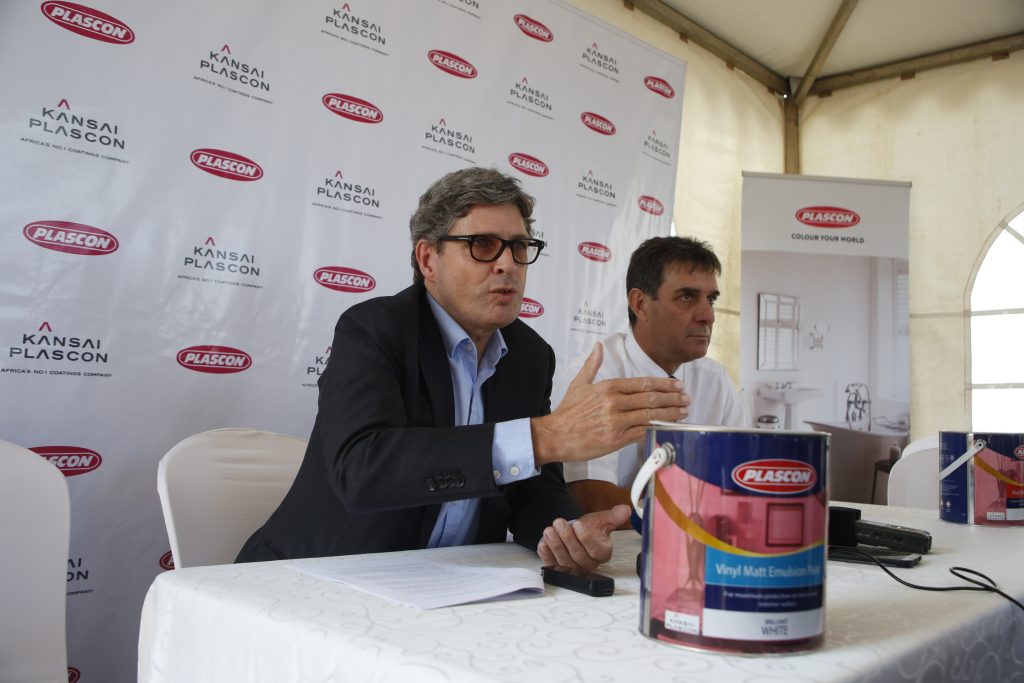
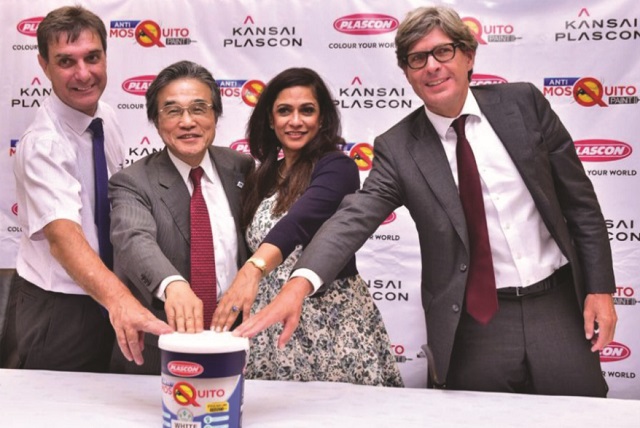
After closing the acquisition deal on 1st August 2017, two days later on 3rd August 2017, Kansai organised a press conference at their Namanve factory to announce the acquisition of the former Sadolin Paints Uganda and the rebranding to Kansai Plascon. A few days later they would roll over a nationwide radio, outdoor, online and TV campaign to announce the new brand name.
Sadolin is now Plascon, they told the market. They would also roll over a trade campaign that rewarded several distributors, painters and house owners.
According to audited results for Kansai Plascon Uganda that CEO East Africa has had access to, the company in 2017 alone increased their cost of advertising by 59.1% from UGX4.9bn in 2016 to UGX7.8bn.
How Kansai Plascon managed to stay a step ahead of Akzo Nobel remains a mystery but a clue could lie in the a one, Mr Wim Bramer a senior executive who worked for Akzo Nobel for 11 years as Director International Business Development based in London- but but was involved in branding, distribution footprint, exports, licensing, joint ventures and acquisitions in Europe, Middle East, Africa, Central Asia, Far East and South America.
Related
 Beyond the Low-Hanging Fruit: The Grit, Capital, and Vision Required to Industrialise Rural Uganda
Mr Bramer had left Akzo Nobel and joined Kansai Plascon as the Managing Director for East Africa in January 2016.
Akzo Nobel revises plan, relaunches under Regal Paints
Paint companies- like all other construction supplies manufacturers, use the same distribution channels- hardware outlets and duukas. So it is not uncommon to find one hardware shop, stocking products, in this case, paint from over 15 paint makers.
So, thwarted by Kansai Plascon’s legal manoeuvre, Akzo Nobel, decided they would instead pick an existing company to manufacture and distribute their Sadolin brand. An existing company would after all already be using the same distribution channels as any other paint maker. With this strategy, they could still ride on the popularity of their Sadolin name.
Akso Nobel couldn’t find a better partner than Crown Paints East Africa, to manufacture and sell their Sadolin paint in East Africa.
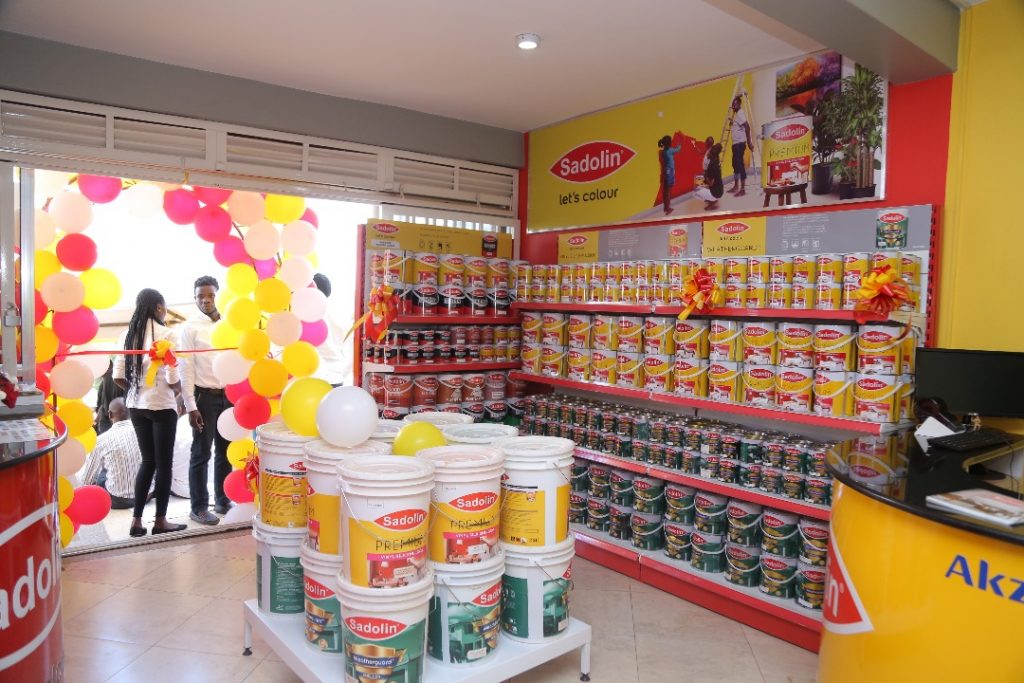
The company had been operating in East Africa since in 1958 and in Uganda since 2006- under Regal Painnts- a company they own 100%. In Kenya, Crown Paints is said to be a market with an annual turnover of about KShs7.4bn (UGX260.4bn) in 2017 and is the only paint company listed in the Nairobi Securities Exchange. The Company also has presence in the three major East African markets- Kenya, Uganda and Tanzania.
In Uganda, Regal Paints, is among the top 10 paint brands with an already established distribution network across the country.
However, Crown Paints was a little bit cash strapped to fund the quick regional rollout of Sadolin products, but Akzo Nobel, desperate to make this deal work, had to lend an equivalent of KShs136,380,000 (UGX4.9 billion) to Crown Paints Tanzania Limited and KShs41,616,000 (UGX1.5bn) to Crown Paints Rwanda Limited as working capital- all because then needed to keep the Sadolin brand alive and present in every corner of the region.
With the deal, done and dusted, on September 28, 2017, Johann Smidt and Deon Nieuwoudt the Managing Director and Africa Executive respectively, at South Africa’s ICI Dulux Pty Ltd- a subsidiary of Akzo Nobel and Rakesh Rao the Crown Paints East Africa Group CEO put up a powerful relaunch of Sadolin at Kampala’s Sheraton Hotel, complete, with pomp and sabre-rattling.
Johann, according to The Independent, a weekly news magazine in Kampala, said that Akzo Nobel was putting up their own UGX10bn plant at Regal Paints’ Kampala Industrial and Business Park, Namanve compound to produce Sadolin Paint for local and regional markets.
“Our Sadolin plant in the KIBP now under construction will be the primary site for manufacturing and distribution of Sadolin,” he told stakeholders and the media.
Rakesh Rao, on his part said that the partnership signalled a strong statement on Akzo Nobel‘s investments and continuity of the Sadolin brand in Uganda and the region.
“Sadolin brand has been a household name for many years,” he said, adding that the firm would sell its own Regal Paint products besides Sadolin Paints in the market.
Sadolin strategy yet to bear fruits
But how much of this Akzo Nobel/Sadolin strategy has succeeded?
To track how and if the Akzo Nobel/Sadolin strategy has succeeded in disrupting Kansai Plascon, we looked for Regal Paints’s financials to gauge the performance of the business before and after the October 2017 Sadolin partnership.
According to the financials for Regal Paints that CEO East Africa Magazine has had access to, between 2015 and 2016, Regal Paints’ sales turnover declined by a minor 2% from UGX15.1 bn in 2015 to UGX14.8bn in 2016. However, even with the declining sales, Regal Paints managed to reduce their losses from UGX1.1bn in 2015 to UGX500mn in 2016.
But in 2017, Regal Paints turnover, rebounded by 14.86% from UGX14.8bn to UGX17bn- perhaps partly driven by the Sadolin portfolio. Regal Paints even declared a UGX100 mn profit that year.
2018 would have been the year when Sadolin’s full impact would be felt- but Regal Paints’ turnover, only grew by 8.82% to UGX18.5bn. The company also registered losses of UGX2.9 bn.
However, thanks to what is believed to be an Akzo Nobel’s investment and increased stock in the market, Regal Paints’ assets, doubled from UGX3.2bn in 2017 to UGX7.1bn- particularly, the value of plant and machinery grew from UGX2.6bn to UGX6.3bn a sign that perhaps Akzo Nobel was delivering on their investments into Regal Paints’ operations so as to fortify them against a raging Kansai Plascon.
Kansai Plascon progresses, largely unharmed
For Kansai Plascon Uganda, it appears they have maintained their previous growth levels with little or no visible impact as a result of Sadolin’s re-entry into the market.
According to their audited books, sales turnover for Kansai Plascon (then Sadolin Uganda) in 2016, grew by 3.9% from UGX146.6bn in 2015 to UGX152.3bn in 2016. That year, profits, grew by 60.8% from UGX16.6bn in 2015 to UGX26.7bn.
In 2017, Kansai Plascon grew slightly faster that in 2016- turnover improved by 4.6% from UGX152.5bn to UGX159.3bn. However the cost transiting from Sadolin to Plascon, took a toll on profitability.
According to information available to us, in 2017 total operating expenses nearly doubled, growing by 92.3% from UGX5.2bn in 2016 to UGX10bn in 2017. This was largely driven by a 59.1% rise in the cost of advertising from UGX4.9bn to UGX7.8bn. Administration expenses also shot up by 112.5% from UGX4.8bn to UGX10.2bn.
Consequently, 2017 saw a 69% dip in profitability to UGX8.3bn, from UGX16.6bn.
In 2018, turnover further grew by 4.7%, reaching UGX166.8bn. However, expenses remained high- operating costs, although they eased down by 15% to UGX8.5bn, driven by a 28.2% reduction in the advertising bill to UGX5.6bn, administration costs further went up by 10.5% from UGX10.2bn to UGX11.4bn.
But the company still remained profitable- although there was a slight 3.6% reduction in profit to UGX8bn compared to the previous year.
Two years down the road, all odds seem to be in favour of Kansai Plascon; it remains to be seen how 2019 will pan out- but it is less likely that Akzo Nobel (Sadolin/Regal Paints) can cover up the huge gap between itself and its archival.