In Uganda’s manufacturing landscape, where few family businesses live to see a second generation, the story of Crest Foam is a rare and remarkable show of resilience, reinvention, and a powerful mother-daughter partnership.
Crest Foam sits on the eastern edge of Kampala, nestled between other factories and warehouses in the Ntinda Industrial Area.
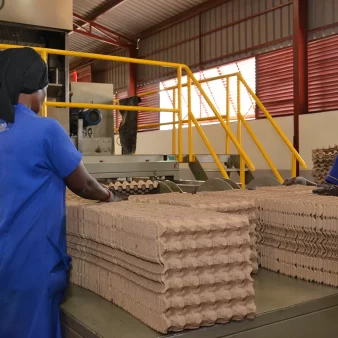
It is a quiet giant that hums to life every morning with rolls of flexible foam gliding down production lines.
And for every mattress produced, another Ugandan family, somewhere across the country, gets to sleep on a product born from one family’s resilience.
But behind the rise of this empire is an emotional, gripping story.
It is a story of love, loss, faith, and power, led by two formidable women – mother and daughter.
It is the story of Petua Kateeba, the heroine who stepped up from the shadows of grief to take on a business in danger of collapse.
On October 9, 1987, a symbolic date, the machines roared to life with their first production run.
Three years later, Crest Foam had risen to become Uganda’s second-largest mattress manufacturer.
But then, tragedy struck. On May 29, 1992, Joseph Kateeba passed away, leaving behind a fledgling company, a mountain of debt, and a young widow staring at an uncertain future.
Where others might have folded, Petua Kateeba made the brave and unconventional decision to take the reins.
With no formal business background and a company burdened by loans and foreign supplier debts, she became the Managing Director of Crest Foam in June 1992.
“I was afraid,” she admitted to African Business Stories Podcast host Akaego Okoye, “but my conscience told me God is there.”
That faith, and her sheer determination, guided her through uncharted waters.
She negotiated with the East African Development Bank to restructure the debt and reassured skeptical foreign suppliers to keep doing business with the company.
They agreed. And with that, Petua embarked on a nearly two-decade journey of growth.
It was a quiet, steady expansion of the Crest Foam brand more than tenfold.
But like many family businesses, Crest Foam faced a pivotal challenge: succession.
Joseline, the couple’s daughter, was thriving thousands of miles away.
After graduating with a Mathematics and Statistics degree from the University of Warwick, Joseline earned a Master’s in Management from Cambridge and an MBA from Harvard Business School – credentials few Ugandan executives could match.
Her first formal work was with Bain & Company, one of the world’s top consulting firms, and later held senior leadership roles at Cummins Inc, a global power systems giant.
Joseline worked across continents where she crafted strategies, running due diligence, and rubbing shoulders with boardroom heavyweights.
Then came the call.
“My mother began asking me to return as early as 2011,” she recalls in a PwC interview where she featured in a 2021 East Africa Family
Business Survey report.
“She wanted to begin stepping back, but also needed someone she trusted to carry the vision forward. It wasn’t an easy decision – I had a life and a career I had built from scratch. But I felt a responsibility to support her and protect what our family had built,” she adds
But something was missing.
“Sitting in those boardrooms,” she recalls, “I realised I could continue having a successful career — but I would never feel complete if I didn’t give back to the family. I had to make a real difference at home.”
Still, when her mother asked her to return, she hesitated.

Finding purpose in another heir’s story
But the turning point came during a 2013 joint venture project in Kenya, when Joseline met Vijay Gidoomal, the Managing Director of Car & General.
Listening to Vijay’s story of inheriting and growing his family business, Joseline saw a mirror.
“I thought to myself, I need to do something great like this … I wanted to be Vijay one day, telling my own story of growth and transformation,” she said.
In that moment, the corporate high-flyer became a successor-in-waiting.
And later that year, she called her mother with the words Petua had longed to hear: “Your girl is coming home.”
In 2014, Joseline joined the business. By February 2015, she was the Managing Director.
But the transition wasn’t seamless.
Although her mother had invited her back, Petua hadn’t fully let go.
Joseline was made General Manager—but placed in a separate office, while Petua remained in the Managing Director’s seat.
“It was confusing,” Joseline recalls. “Everyone knew my mum was the decision maker. I couldn’t make the impact I needed.”
Then came the bloodless coup.
 Modernising General Insurance: SanlamAllianz CEO Ruth Namuli on Building Uganda’s Insurance Powerhouse with Trust, Innovation, and Scale
“I staged it,” she says, half-joking, half-serious.
“I told her assistant that by February 1, 2015, I was moving into the Managing Director’s office and she was moving out.”
Symbolism mattered. Joseline had printed new business cards and, more importantly, made it clear: the new era had begun.
“It wasn’t about the office. It was about the clarity of leadership. I needed to sit in the decision-maker’s chair—for the business and our people to move forward.”
It was a jarring transition. The global corporate structures she was accustomed to were worlds apart from the informal, family-run dynamics at Crest Foam.
Several senior staff, including relatives, had been with the business for over 25 years.
Change, even necessary change, was greeted with what she tactfully describes as “polite reluctance.”
“When I came in and started to implement things, I was accused of being impatient,” she recalls.
Joseline’s first move was to professionalise governance. She revitalised the board, leaning on the guidance of a respected former development finance executive as chairman.
With quiet determination, she earned her mother’s buy-in to roll out new standards of accountability and transparency.
“Governance had to evolve. We couldn’t rely on informal decision-making if we wanted to scale.”
Internally, she tackled another challenge: modernising manufacturing.
Drawing on her background in world-class manufacturing systems at Cummins, Joseline introduced lean manufacturing processes to eliminate inefficiencies.
Her team mapped workflows, identified bottlenecks, and streamlined operations.
The results were stunning. Within five years, Crest Foam had doubled its production capacity, slashing waste and cutting lead times. Innovation followed.
During the early waves of Covid-19, Crest Foam teamed up with Nice House of Plastics to launch face shields – a new product line born from necessity.
“We empowered the team to design a solution, and they delivered. That is the kind of culture we are building – resilient, agile, and driven by excellence.”
Yet through all the change, the company’s core values – family, integrity, quality – remained intact.
“Professionalising doesn’t mean losing your soul,” she reflects.
“It’s about protecting what matters while evolving to meet the future.”
Her leadership is part of a larger story of intergenerational female leadership – one rarely told in the African industry.

Building on the family legacy
A daughter stepping into the shoes of her mother, not just to preserve the legacy but to build on it, is no small feat.
Joseline pays homage to her mother’s strength: “My mother laid a foundation of excellence. I’m standing on her shoulders.”
Since 2015, under Joseline’s leadership, Crest Foam has continued to modernise and expand.
It now designs, produces, and supplies a wide range of foam products – from standard to high-density mattresses, orthopedic options, and even specialty pillows – catering to different households, hotels, and institutions.
Their plant has a production capacity of 500 mattresses daily, meeting both domestic and regional demand, while plans are underway to set up a new plant in Namanve Industrial Park, broaden product offerings, and diversify into real estate.
Lessons for family-run businesses
Joseline is focused on formalising operations, making data-driven decisions, and preparing the business for competitive regional and global growth.
She’s also committed to financial discipline, advising family-owned businesses to keep clean records, build trust with stakeholders, and position themselves for external investment.
“Uganda is still seen as a high-risk market. Capital is expensive. If your business isn’t ready, you won’t access it,” she says.
Today, Joseline sits on the boards of Uganda Manufacturers Association, NCBA Bank Uganda, Biyinzika Poultry International, and serves on the advisory board of Total Uganda.
But she remains grounded in the day-to-day realities of Crest Foam – constantly reviewing strategy, mentoring staff, and pushing for smarter growth.
Looking ahead
Joseline is optimistic. She believes in the promise of Buy Uganda, Build Uganda, and sees family businesses as a vital part of that movement.
“If you support a family business, you are directly supporting local families and local economic growth.”
Her advice to fellow next-generation leaders is simple but profound: bring something of value, prepare relentlessly, and don’t shy away from hard conversations. And to founder generations?
“Start early. Give your children exposure to the business, and let them make mistakes. That’s how leaders grow.”
Crest Foam’s journey is far from over. But under Joseline Kateeba’s leadership, it’s no longer just a family business. It’s a family institution, with its eyes set firmly on the future.