
A new chapter has opened in Uganda’s insurance story. It’s one defined by ambition, scale, and a bold reimagining of what financial security can mean for millions of Ugandans.
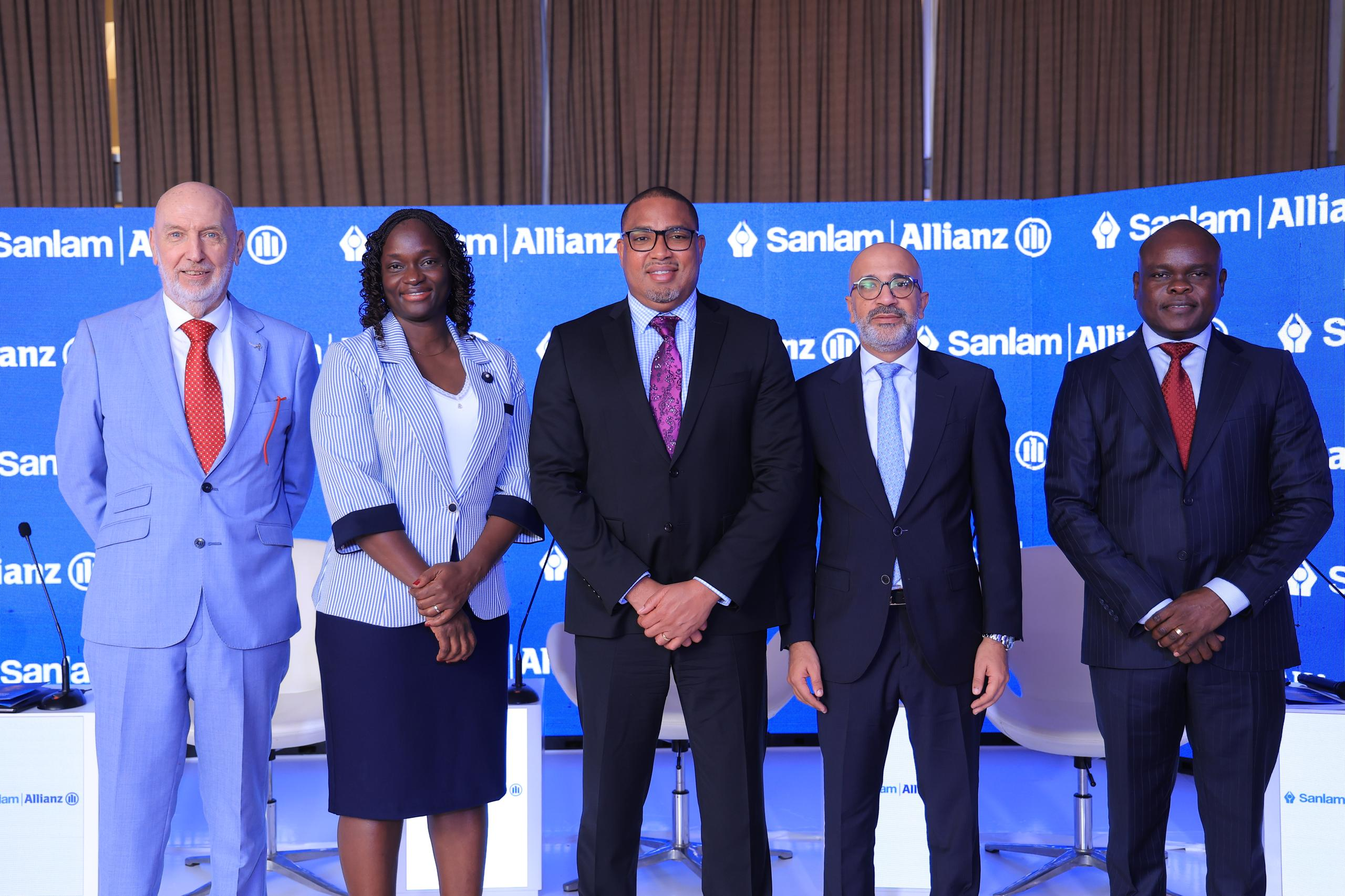
At the Kampala Serena Hotel, beneath the warm lights and quiet hum of optimism, the SanlamAllianz brand was officially launched to the Ugandan market.
It is a name that fuses two global insurance giants, Sanlam and Allianz, into a single entity determined to reshape Africa’s insurance story.
The event marked the local unveiling of Sanlam Allianz Africa (SanlamAllianz), the continent’s largest non-banking financial services group.
Formed in September 2023 as a joint venture between South Africa’s Sanlam Group and Germany’s Allianz SE, the partnership now spans 26 countries, carrying an enterprise value approaching $2 billion.
In Uganda, the launch of SanlamAllianz signals not just a change of name, but the beginning of an era.
The company steps into the market with the weight of history behind it; over two centuries of collective experience, and the promise of innovation and inclusion at its core.
At its unveiling at the Kampala Serena Hotel, the message was unmistakable: this is not just a rebrand, but the creation of a continental powerhouse built for dominance.
Together, the two insurance titans are betting big on Uganda’s growing economy and its rapidly evolving financial services landscape.
The power of two legacies
At the launch, Ruth Namuli, the CEO of SanlamAllianz General Insurance, and Gary Corbit, the CEO of SanlamAllianz Life Insurance, reflected on what this union truly represents.
Together, they painted a picture of the convergence of strength and depth.
In his remarks, Corbit highlighted the strength of the merger, noting that a combination of Sanlam’s deep continental expertise and robust footprint with Allianz’s global scale, financial strength, and legacy creates an African powerhouse.
“We are bringing together over 200 years of collective experience to Uganda, and we are here to set a new, higher benchmark for innovation and customer value,” he said.
He noted that this merger is well-timed, aligning with the momentum within Uganda’s insurance industry.
Corbit also emphasized that the company’s combined capabilities position it to play a defining role in shaping this growth and driving greater inclusion across the market.
“The country’s insurance sector demonstrated resilience in 2024, achieving a solid 10% growth in Gross Written Premiums (GWP) against a supportive macroeconomic backdrop of 6.1% GDP growth. We also see a maturing market, particularly in life insurance, which grew at a healthy rate of nearly 15%,” he added.
Under the SanlamAllianz brand, customers in Uganda will continue to enjoy all existing benefits of their policies with the added assurance of a stronger global backing.
The company will continue to invest in digital solutions and innovative products tailored to the evolving needs of Ugandans.
Namuli, whose optimism was palpable, said the merger represents a reinvention of what insurance can mean for Ugandans: more accessible, inclusive, and responsive.
She noted that the union is creating a platform to meet the evolving insurance needs of individuals, SMEs, corporates, and institutions across Uganda.
“We promise greater financial inclusion with innovative solutions for underserved segments of the population and sector growth through investing in local talent, technology, and partnerships,” Namuli said.
SanlamAllianz promises to deliver improved digital experiences, localized products, and innovative solutions tailored to Uganda’s diverse and evolving economy.
A regulator’s blessing
The merger has the full backing of the Insurance Regulatory Authority (IRA), which has, for over two years now, nudged insurers to think about acquisitions and mergers to build a more resilient and consolidated industry.
Ibrahim Kaddunabbi Lubega, the IRA CEO, said this consolidation marks a transformative moment for an industry that has long struggled with fragmentation.
He described the partnership as one that “blends global expertise with local strength,” with the potential to enhance the industry’s capacity, expand access, and boost innovation in customer protection.
Uganda’s insurance sector remains too segmented. Thus, the merger offers the sector gains capable of changing that narrative with both the financial muscle and the technological backbone to reach new customers and modernize the insurance experience.
A new market leader emerges
With the ink now dry, SanlamAllianz Uganda has risen to the top of the country’s insurance pyramid.
The merger has given birth to a powerhouse that reshapes the industry’s competitive balance.
For the first time, Uganda has a homegrown insurance powerhouse that combines global scale, deep local roots, and financial muscle.
 Could Museveni’s Election as EAC Chair Renew Push for Accelerated East African Integration?
The most recent figures from the Insurance Regulatory Authority’s (IRA) Quarter 2, 2025 Market Report reveal the full scale of SanlamAllianz’s dominance.
In the non-life segment, Sanlam General wrote UGX 69.4 billion in Gross Written Premiums (GWP), capturing a 12.1% market share from 6,520 policies.
Jubilee Allianz, now part of the same entity, contributed UGX 51.4 billion, representing a 9% share from 10,038 policies.
Together, the merged company commands an impressive 21.1 percent share of Uganda’s non-life market, with combined premiums totaling UGX 120.8 billion as of mid-2025.
This consolidation officially positions SanlamAllianz within reach of Old Mutual, which maintains a slim lead with a market share of 21.5% and gross written premiums of UGX 123.3 billion.
Beyond premiums, the merger creates an insurer with unmatched financial depth.
According to the IRA’s 2024 Annual Insurance Market Report, Jubilee Allianz held UGX 110.8 billion in total assets and UGX 33 billion in investments in the non-life segment, while Sanlam General reported UGX 173 billion in total assets and UGX 103.4 billion in investments.
Sanlam Life reported UGX 86.4 billion in assets and UGX 55.2 billion in investments for the non-life segment.
The merged entity commands a combined asset base of UGX 370.2 billion and an investment portfolio totaling UGX 191.6 billion, underscoring its financial depth and dominant balance sheet position in Uganda’s insurance industry.
With this balance sheet, SanlamAllianz can absorb large corporate and infrastructure risks, negotiate favorable reinsurance terms, and invest heavily in digital transformation.
It also provides the flexibility to expand into underserved sectors, such as agriculture, SMEs, and health microinsurance, that require high initial investment but promise long-term returns.
Profitability and investment returns
The merger brings together two entities with contrasting but complementary financial profiles.
Sanlam General ended 2024 with UGX 20.22 billion in profit before tax (and UGX 14.16 billion after tax), while Jubilee Allianz recorded a loss before tax of UGX 12.65 billion and a loss after tax of UGX 10.66 billion, largely due to integration and rebranding costs.
Investment income further strengthens this footing. In 2024, Sanlam General generated UGX 11.36 billion in investment returns, while Jubilee Allianz brought in UGX 3.31 billion, for a combined UGX 14.67 billion.
Sanlam Life made UGX 5 billion in investment return, and UGX 4 billion in profit after tax.
These figures rank SanlamAllianz among Uganda’s top three insurers by investment performance.
It is a testament to prudent asset management and balanced portfolio allocation across government securities, corporate bonds, and real estate.
While the merger is largely concentrated in the non-life segment, Sanlam Life Insurance Uganda, operating under the same umbrella, continues to strengthen the group’s overall footprint.
As of the second quarter of 2025, Sanlam Life had written UGX 38.4 billion in premiums, securing a 9.6 percent market share.
Major consolidation
This consolidation of balance sheet power positions SanlamAllianz as a financial fortress capable of absorbing risk, underwriting large corporate accounts, and funding long-term expansion.
It also bolsters the sector’s overall capital adequacy and stability at a time when the industry is facing heightened competition, rising claims, and regulatory pressure to meet solvency thresholds.
SanlamAllianz plans to unify its operations and invest heavily in digital infrastructure to make insurance simpler, faster, and more inclusive.
The company also intends to equip brokers and agents with better tools and insights, creating a stronger network for customer engagement and policy delivery.
Globally, the insurance industry is undergoing a similar transformation.
The 2024 Annual Insurance Industry Market Report points to a worldwide shift toward sustainability, digital integration, and regulatory convergence.
Global premiums are projected to rise by 3.3% in 2025, driven by the resurgence of life insurance and growing demand for health, liability, and cyber insurance.
SanlamAllianz’s strategy aligns seamlessly with these trends, positioning it not just as a national leader but a player with continental influence.
For a market long hindered by fragmentation and low awareness, SanlamAllianz stands as a symbol of possibility, a reminder that with the right partnerships, the business of protecting lives can itself become a catalyst for prosperity.
