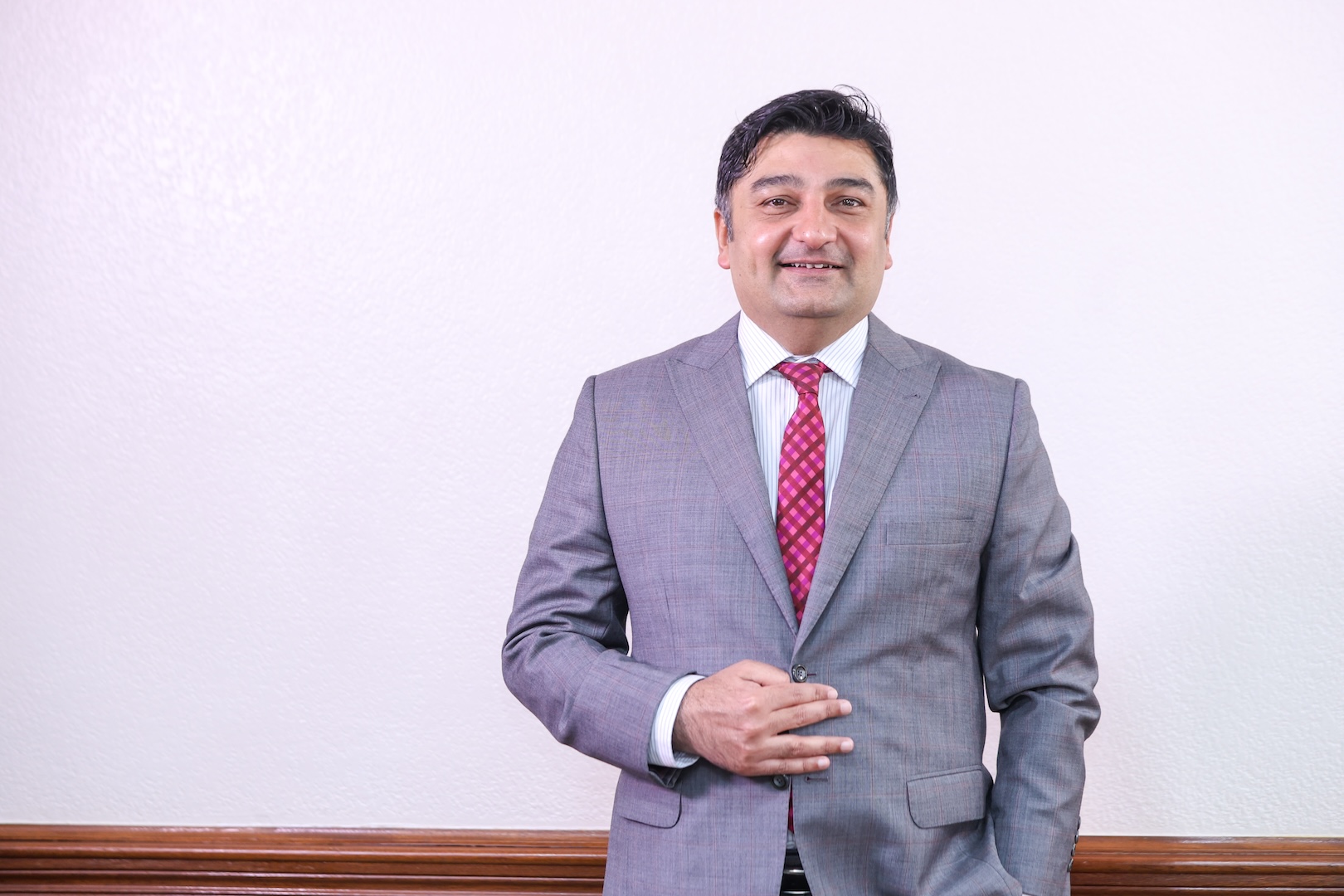
Ahead of a historic milestone for Uganda’s health and education sectors, The CEO Magazine sat down with Aga Khan University Hospital CEO Rashid Khalani. Last week, Kampala hosted the inauguration of the Aga Khan University Centre and the ground-breaking ceremony for the upcoming Aga Khan University Teaching Hospital in Nakawa – projects set to transform medical training and healthcare delivery in the country.
In an exclusive conversation, Rashid Khalani shared insights on the vision, impact, and opportunities these developments will bring.
What are the most pressing health challenges facing Africa today?
There are three interlinked challenges. First is human capacity. The World Health Organisation recommends roughly one doctor per 1,000 people. With Uganda’s population at about 45 million, that implies some 45,000 doctors; today the country has about 8,000 qualified doctors and not all are in clinical practice. Some work as administrators or in private ventures, leaving the country far below the standard.
Second is the urban–rural divide. 70–90% of our population lives outside major cities, yet most facilities, specialists and equipment remain concentrated in urban centres like Kampala which for example, has about 5 million people-roughly 10-15% of Uganda’s population-but it hosts the bulk of the country’s healthcare resources. This leaves the vast rural population underserved.
Third is the shortage of specialists such as oncologists, cardiologists, neurosurgeons and other super-specialists at a time when non-communicable diseases are rising like cancer, diabetes, and hypertension. Even among the few specialists available, most remain in urban areas.

Beyond workforce gaps, Africa’s limited local manufacturing of medicines, reagents and equipment makes us vulnerable to supply shocks and currency volatility. COVID-19 showed that painfully. Finally, there is a challenge that presents more as an opportunity. There is a need for greater collaboration between the public and private sectors. No single entity, government, private hospitals, faith-based organisations, or teaching institutions can solve these issues alone. We need joint efforts in training doctors, nurses, and allied health professionals, expanding rural services, and delivering care more equitably.
How is Aga Khan University Hospital tackling these challenges?
We focus on three main pillars. One is through quality of care. At Aga Khan University and Aga Khan University Hospital, we maintain an uncompromising commitment to quality. We want patients to have full confidence that they will receive world-class care.
Second is through training. As a university hospital, we do not just treat patients, we also prepare the next generation of doctors, nurses, and other health professionals. Building local human capacity is central to our mission.
Lastly is through research. Africa has not invested enough in generating its own medical knowledge. Most drugs are developed and tested on populations elsewhere, yet genetics differ significantly across regions and populations. What works effectively in a Caucasian population may not work the same way in East Africa. Without local research, we simply do not know.
COVID-19 made this painfully clear. When the pandemic struck, Africa largely waited for vaccines developed and manufactured in the Global North. There was anxiety about when, or if, we would receive them. We did not contribute significantly to the science or the manufacturing. That must change and while no single institution can do it alone, as a hospital, we intend to be an active contributor.
How is Aga Khan University Hospital expanding specialist training while keeping services affordable?
High-quality healthcare cannot be “cheap” because quality care comes at a cost. Just as you would not expect to buy a quality car or shoes at a very low price, good healthcare requires investment. Skilled doctors could earn very good salaries abroad. If we want to retain them here, we must provide fair salaries, proper equipment, and the tools to practice quality medicine. Otherwise, the brain drain will continue.
However, that does not mean the vulnerable should be left behind. At Aga Khan University Hospital, we run access programs to ensure inclusivity. For patients, we spend $3–3.5 million annually on a Patient Welfare Program, which supports those who cannot afford advanced treatments, often at little or no cost. Nearly 70% of our medical college students receive some form of financial assistance, whether merit scholarships or needs-based support. If you qualify on merit but cannot afford tuition, we will not turn you away.
When we talk about specialist training, in Nairobi, for example, although we are a private institution and receive no government support, we have launched 15 clinical fellowship programs, providing advanced training for doctors who have already completed their residency. These programs focus on critical sub-specialities such as interventional cardiology, medical oncology, haematology, neurology, infectious diseases, gastroenterology, pediatric neurology, pediatric gastroenterology, and critical care, among others.
The goal is simply to train more sub-specialists. Initially, many of them may serve at Aga Khan University Hospital, but over time, the numbers will grow beyond our institution. These doctors will move into public hospitals, private practices, and eventually into rural areas, gradually expanding access to specialised care across the country.
Of course, medical education is not a quick fix. You cannot change the landscape in two years. It takes decades of training to build a critical mass of skilled doctors who can serve the population effectively. Quality training requires patient volumes and case diversity. To illustrate, if you had to undergo surgery, would you choose a doctor who has performed two operations or one who has performed two thousand? Naturally, you would choose the latter, because experience builds confidence and competence. That is exactly why growing patient volumes and clinical exposure are vital for producing excellent specialists.
 Kenya's High Court Clears Path for KSh 300 Billion Asahi–Diageo Deal Despite Ongoing Distribution Dispute
This is the path Aga Khan University Hospital is pursuing, steadily building human capacity, bridging the urban-rural gap, and training specialists who will ultimately strengthen healthcare systems far beyond our walls.
The digital transformation is reshaping healthcare. How is AKUH leveraging technology to improve patient outcomes?
In 2022, we invested $12 million to implement a comprehensive Electronic Health Record (EHR) system in Nairobi. Today virtually all physician, nursing and patient documentation is digital. Clinicians capture notes via voice tools directly into patient charts, and the EHR enables secure integration with other platforms.
We are building on this foundation. Within months, we intend to roll out AI-assisted radiology, which will further enhance diagnostic accuracy and efficiency.
Because we are a university hospital, this transformation does not just improve patient care today; it also shapes the doctors and nurses of tomorrow. Our students are trained on the same digital platforms. They are not learning medicine with pen and paper, but with the latest technology. This ensures that when they graduate, they are not only skilled clinicians but also technologically fluent, ready to deliver care in a modern, digital-first healthcare environment.
Research is a cornerstone of health. How is Aga Khan University using research to anticipate and respond to emerging threats?
We made a deliberate decision to invest in research. Since launching our Clinical Research Unit (CRU) five years ago, we have run 17 clinical trials in partnership with global pharma, testing therapies in African populations.
This is important because much of the world’s medical research is done on populations in Europe or North America. Without local studies, we cannot fully understand how effective or safe these therapies are for Africans. By building this research capacity, we are helping to close that gap and also inspiring young African doctors who access them in libraries worldwide.
Aga Khan University faculty already publish in leading global journals, and our goal is to grow this footprint so that Africa is not just a recipient of global science but an active contributor, shaping solutions for both regional and global health challenges.
Access in rural areas remains a major barrier. How is AKUH bridging the urban–rural divide as Uganda pursues universal health coverage?
Infrastructure alone is not the answer, but human capacity is. A skilled clinician in a modest clinic is worth far more than an empty, impressive hospital. That is why our strategy is to expand outreach centres. These smaller, cost-efficient facilities bring essential and specialist services closer to communities, including outside major urban areas.
You should not need to travel to a tertiary hospital for dialysis, a neurology consultation, or pediatric care. Increasingly, we are decentralising these services to outreach centres, making quality care more accessible and reducing the burden on central hospitals.
This is how we balance quality, affordability, and accessibility—through financial support programs, education, and expanding care closer to where people live.
Looking ahead, what is your ten-year vision for Aga Khan University Hospital’s impact in Uganda and East Africa?
First, we must build trust in our own healthcare systems, and that trust comes from delivering consistently high-quality clinical outcomes. At Aga Khan University Hospital, we were the first hospital in Sub-Saharan Africa to receive Joint Commission International (JCI) accreditation– the gold standard in global healthcare quality- back in 2013. We pursued that certification to assure our patients that the care they receive here is on par with what they would get in North America. That commitment to world-class quality will remain central to our mission.
Second is education, which I have spoken about extensively. By training the next generation of doctors, nurses, and specialists, we are not only strengthening Aga Khan institutions but also building long-term capacity for the entire region.
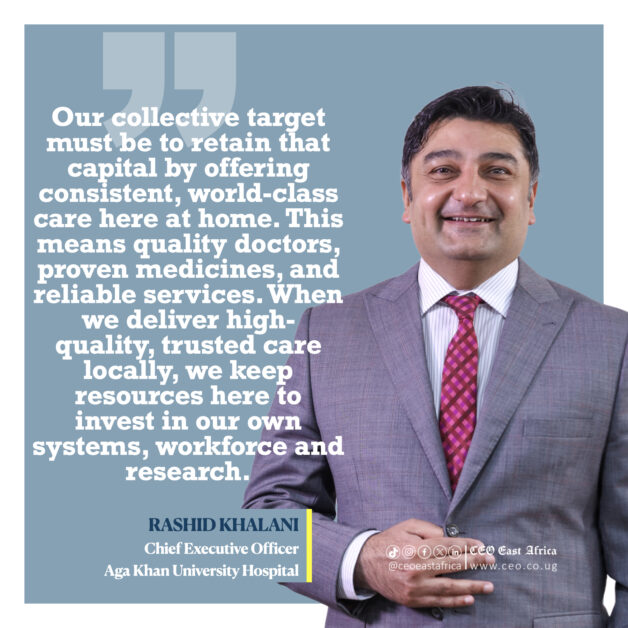
Lastly, a key focus for the next decade is to stop the billions of dollars leaving our continent due to the high number of patients travelling abroad for care. Our collective target must be to retain that capital by offering consistent, world-class care here at home. This means quality doctors, proven medicines, and reliable services. When we deliver high-quality, trusted care locally, we keep resources here to invest in our own systems, workforce and research.