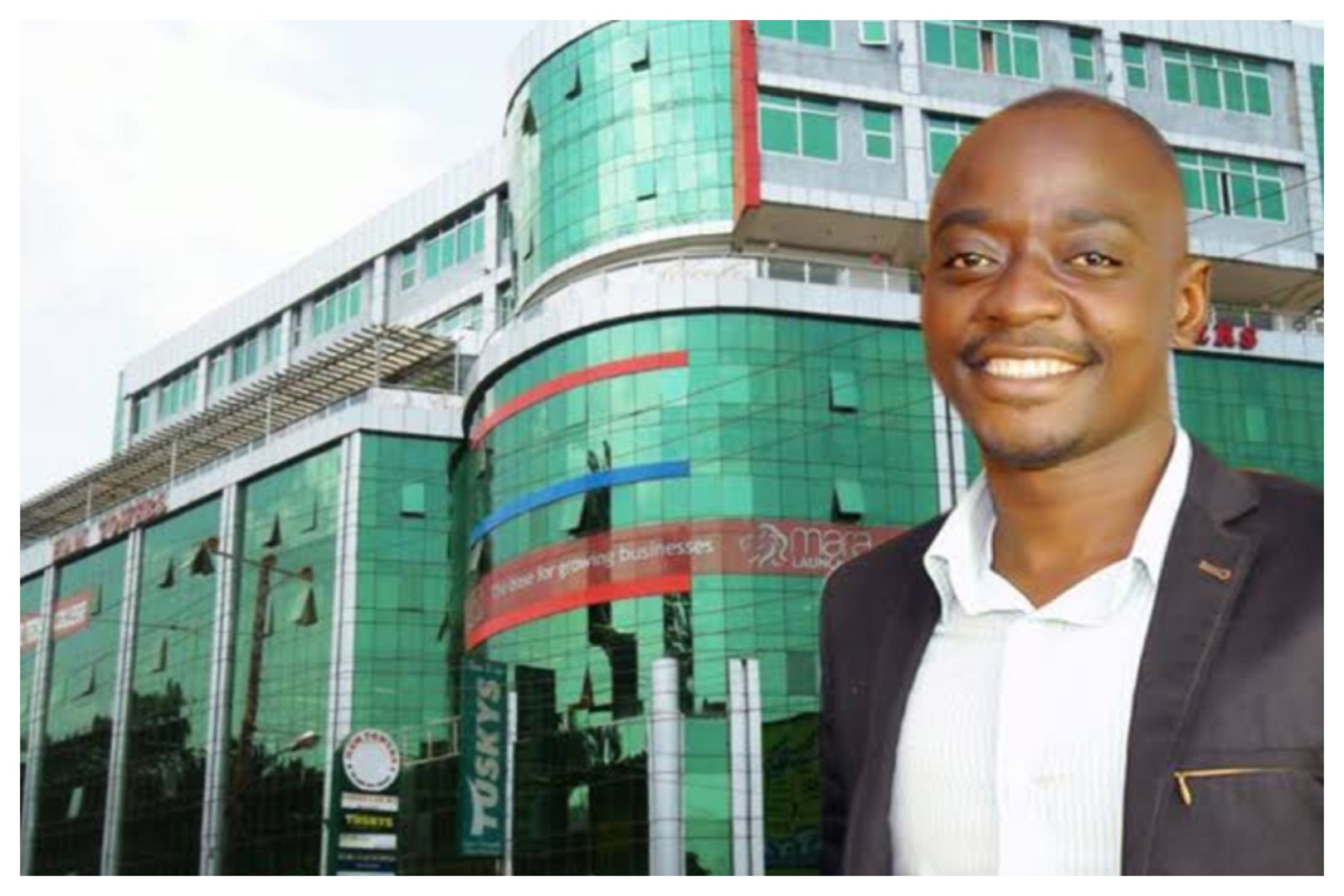
The Hamis Kiggundu vs. Diamond Trust Bank (DTB) case took almost everyone by surprise. Everybody who knows the maverick businessman, the proprietor of Ham Enterprises and Kiggs International, knows that he and DTB have had a long cordial and reciprocal working relationship. It is a public secret that DTB has been at the centre of the businessman’s growth. In fact the bank was also a tenant at most of the businessman’s buildings as well.
So mutual, that even when the businessman in October 2017, needed a USD10 million facility, and DTB Uganda could only lend him a maximum of USD5.5 million due to regulatory limits, DTB Uganda was able to rope in DTB Kenya – for a USD4.5 million top-up facility.
The businessman in his confidential April 11th 2019 letter to the DTB Uganda Managing Director also confesses to this warm relationship.
“We have had a banking relationship with DTB for almost 10 years and have had access to several funding (sic) which we have serviced satisfactorily,” wrote the businessman, to the bank’s Managing Director, Mr Varghese Thambi.
So, at what point did this nearly decade-old relationship, go so south to the extent that the businessman started accusing the bank of ‘stealing’ from him an alleged UGX120 billion, among a litany of other accusations?
For three weeks now, CEO East Africa Magazine, has conducted a painstaking investigation and has pieced together a timeline to Hamis ambitions and money troubles and how it got to a point where he had to cut off the hands that fed him- the banks.
How it all started: Did Hamis Kiggundu perhaps expand too fast?
From what we know and according to his book, Success and Failure based on reason and reality, Hamis, commonly known as Ham, started with some reasonable capital from his fairly wealthy parents and started trading in commodities and imported merchandise. Like most businessmen in Kampala, he sought to diversify but also ground his wealth, by investing in big-ticket real estate.
One of his very first flagship properties was the expansive Ham Towers (LRV 3716 FOLIO 10), located on Plot 923, Block 9, Makerere Hill Road. Being strategically located, just next to Makerere University, the building quickly filled up with tenants. A combination of the building’s strategic location and the good cashflows that came from the steady stream of tenants, made Ham more attractive to banks. With enhanced capacity to borrow, his real estate ambitions grew too.
In early 2015, with the help of President Museveni’s directive, he secured approvals to redevelop the 13-acre stadium in downtown Kampala- a project he said would increase the sports facility’s sitting capacity to 35,000, from 30,000 but also would have other commercial developments- all at a reported cost of USD49 million.
To finance this, he would on 23rd October 2017, use his Ham Towers to secure some USD6.5 million from DTB Uganda. He also borrowed an extra USD4.5 million from DTB Kenya- against his mega-mansion in Kawuku (FRV 1533 Folio 3) located on Plots 36-38, Victoria Crescent II Kyadondo and Land at Kawuku, Ggaba (Block 248 Plot 328) on the shores of Lake Victoria. But USD10 million was just a fraction of what he needed for the project. The businessman also acquired an extra facility of about UGX5 billion from Orient Bank.

The Nakivubo project kicked off in earnest and amidst so much fanfare, starting with several commercial retail units, named Ham Shopping Grounds, built around the to-be-developed stadium. These much-sought-after Nakivubo shops would shore up his rental income from Ham Towers, that was beginning to falter, largely because Tusky’s Supermarket, his anchor tenant, was facing its financial challenges. This was accelerated by road construction works on the Wandegeya-Nakulabye Road, that also shaved off nearly all the car parking, originally designed for the supermarket, starving Ham Towers of footfall (the number of people entering a shop or shopping area in a given time). This would have disastrous consequences on both the ability of tenants to pay their rent. As night follows day, as Ham Towers- literally the businessman’s goose that laid the golden egg went into limbo, the businessman’s troubles started piling up- just around the time the money borrowed for the Nakivubo stadium project was running out and he needed more.
Ham was in a difficult position- he needed cash flow to service the DTB Uganda and DTB Kenya loans, but he also needed more money to quickly finish up the now-stalled Nakivubo project. Luckily enough, by this time, the shops on the partially finished Ham Shopping Grounds had been taken up by tenants, giving him some relief- but just enough to service his loans with DTB Uganda and DTB Kenya. But pressure was mounting on him from various stakeholders, especially sports fans and politicians, to finish the stadium project. This was early 2019.
DTB loans go bad; Ham turns to Absa for rescue
Ham more than twice tried to apply to DTB to add him more money- but the bank declined as his exposure was beyond regulatory limits. Orient Bank too turned him down as his loans were already going bad. This is when he decided to go to Absa Bank Uganda. He at this time probably hoped, a bigger bank would give him perhaps all the money he needed to finish his project. Using the Nakivubo land titles i.e. Plot 258, Folio 23 Nakivubo Place and Plot 2 Folio 5 Nakivubo Close, he on 04th April 2019, secured a USD 7 million loan from Absa- but on condition that all rental income from the Nakivubo project, be paid into Absa.
But with the commercial troubles at Ham Towers, him diverting all rental income from Nakivubo to Absa, meant that his repayments in Orient Bank and DTB Uganda and DTB Kenya would go delinquent. But Ham had another plan. He, on 11th April 2019, wrote to DTB Uganda, asking them for permission to sell off Ham Towers, so he could be able to pay off DTB Uganda and DTB Kenya.
“In 2016 and 2017, Ham Towers was significantly affected by road expansion works which reduced the human traffic on the building and subsequently affected the rentals. Ham Tower’s anchor tenant-Tuskys Mattress significantly reduced its space by over a half and we have been struggling to reach the original projections of rentals. Since 2017 to date we have been supporting DTBU’s repayment shortfalls using rentals from our new project in Nakivubo as we source for buyers to close this debt obligations and focus on Nakivubo and to ensure that our loan doesn’t become NPL in the process which would affect us and the Bank,” Ham wrote to DTB.
In the letter, he further told DTB Uganda that the ability to support Ham Tower’s debt has been significantly reduced due to constraints on the cash flows of Nakivubo which are now ring-fenced to support Nakivubo’ s main financiers i.e. DTB Kenya and other financiers who supported completing of commercial complex as well as funding the construction of the main stadium arena.
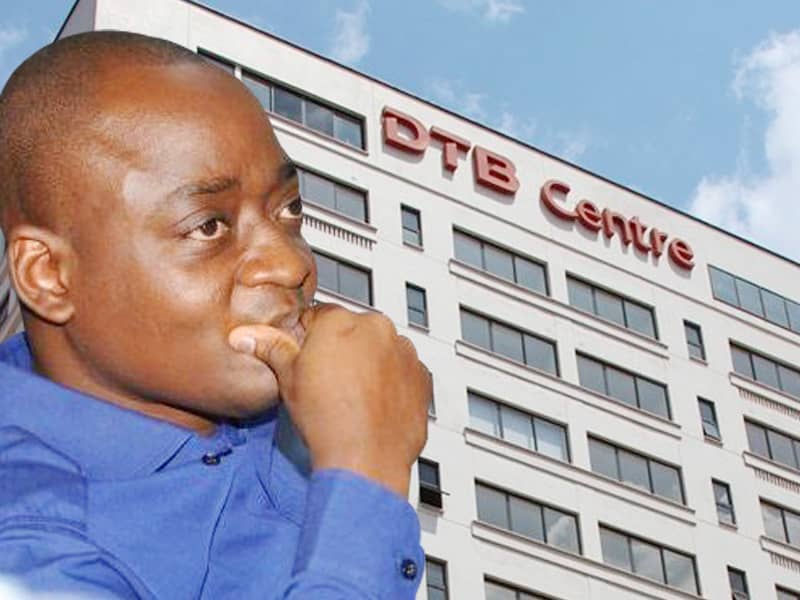
In the letter he asked for both DTB Uganda’s clemency as he looked for buyers of the property, but also asked for a further discount on the loan facility so that once the buyers for Ham Towers were secured, he could pay of the loan in one go.
But DTB Uganda largely declined to give him the discount but allowed him to continue searching for buyers of the building.
With both Orient Bank and DTB loans going delinquent, and with mounting pressure to finish the Nakivubo project, the businessman re-approached Absa for a possibility of them buying off all his loans in DTB Uganda, DTB Kenya and Orient Bank Uganda and compounding them into one facility held at Absa. Absa, in a letter dated 16th April 2019, and another term sheet and offer dated 30th April 2019 offered to arrange a facility of USD 17 million to the businessman as equity release to finance the applicant’s expansion projects. The USD17 million would be syndicated between Absa Uganda and Absa South Africa.
With Absa giving him some greenlight, the businessman started engaging Orient Bank and DTB Uganda asking for several discounts with assurances that he intended to pay them off, sooner than later.
But just as Absa Bank was about to release the USD17 million, it appears someone in the Uganda Credit Committee, tipped off Absa South Africa about Ham’s indebtedness as well as the political risk associated with the Nakivubo Project. According to a source within Absa- someone told South Africa that much as the Nakivubo project looked commercially attractive, given that the stadium- actually called Nakivubo War Memorial Stadium was built on public land with significant historic value- had immense political risk to it. That it would be difficult for the bank to sell it, should Ham default.
With this in hindsight- Absa declined to release the much-needed USD17 million- marking the beginning of Ham’s third wave of financial troubles. It should be remembered, that in anticipation of the larger Absa funding, he had whetted the appetite of his creditors- DTB and Orient, and we understand some money lenders as well, who were all warming up to a repayment.
By this time, with almost all Nakivubo rental collections going to Absa- both DTB loans as well as the Orient Bank loans were getting more in the red.
According to sources close to Ham and knowledgeable about the matter and his businesses, besides declining incomes from Ham Towers and Absa’s reluctance to disburse the USD17 million facility, Ham’s troubles were exacerbated by the fact that instead of investing the borrowed money into the more commercially viable and cashflow rich Nakivubo projects, he instead sunk the money into a big real estate housing project on the Entebbe Expressway called Ham Palm Villas. But even then, he did not sink in enough investment into this project as well and as a result, both the Entebbe Expressway project and the Nakivubo projects both remained incomplete, holding money that he very badly wanted.
It is therefore not surprising that by this time, Ham had also defaulted on the USD7 million facility at Absa, leading Absa to issue him with a default notice on the USD 7 million.
Ham cuts off the hand that fed and feeds him―sues the banks
A frustrated and now desperate Ham, on December 11th 2019 sued Absa, for refusing to lend to him the promised USD17 million- probably one of his worst decisions, as he would find out sooner than later.

In Civil Suit No.943 Of 2019 (Ham Enterprises (U) Ltd Vs. Absa Bank Uganda Limited) he dragged Absa for refusing to lend him money promised to him in their various letters of 16th April 2019, 30th April 2019 and 9th May 2019. Ham further argued that the bank was in possession of his titles and had even extended to him a contract that he had signed. That contrary to the agreement, Absa did not disburse the USD 17 million yet he had already made financial commitments to contractors, suppliers and had mobilized equipment based on the above expectation. That as a result, he had made losses.
He first asked the court to grant him a temporary injunction against Absa moving to sell the Nakivubo project that he had pledged as collateral for the first USD7 million facility, as court disposed of the USD17 million suit. At this point he also told court that he disputed the USD6,831,399 that Absa was claiming from him.
In their defence, Absa which was represented by K&K Advocates, denied ever making a binding commitment to extend a loan of USD 17 million and said that the mentioned offer letters, created no binding legal relationship between them and Ham. The bank said the letters, were meant to commence a process where both parties would formalize the relationship by signing agreements. Absa reiterated that the only known loan was the USD 7 million extended to Ham in April 2019, which facility Ham had also defaulted on to the tune of USD 6,831,399 as of 20th November 2019, and that requisite notices had been issued. Absa also denied ever signing both the loan offer agreement and the mortgage deed as claimed by Ham.
Delivering her ruling on December 11th 2019, Commercial Court Ag. Registrar, Lillian Bucyana said that Ham’s application had some legal matters to be decided by the court based on their own merits. The Registrar also accepted to grant Ham an injunction against Absa foreclosing on Ham’s Nakivubo project, but the businessman needed to deposit 30% of the sum in question.
“I will grant a conditional order of temporary injunction in the following terms: applicant deposits in court 30% of the amount claimed by the respondent. Thus 30% of USD 6,831,399 be deposited with court with 45 days from this date. The temporary injunction shall be in force subject to fulfilment of the 1st condition for a period of 90 days, but time may be extended if sufficient cause is shown,” ruled the Commercial Court Registrar.
 Aga Khan Fund Exits Troubled Nation Media Group After 66 Years, Sells Controlling Stake to Tanzanian Billionaire
Although the injunction looked like a win, for a cash-starved and debt-ridden Ham, this was a pyrrhic victory – a kind of win that inflicts such a devastating toll on the victor that it is tantamount to defeat.
In the meantime, DTB Bank Uganda and DTB Kenya were closing in too. On 19th November 2019, DTB Kenya issued Ham a default notice saying that his loan was in default by more than 30 days and as at 15th November, 2019 he owed the bank USD 4,014,444 or else the bank would sell his home in Kawuku.
“Notice is hereby given to you as mortgagor that you should pay to us or the Mortgagee within forty-five (45) working days from the date of this Notice, the whole of the principal sum with interest due to the said mortgagee as at the 15th November, 2019 being US$ 4,014,444 plus such further interest as shall accrue up to the date of repayment at the contractual default rate and such professional charges as shall have accrued and that unless the said amount due shall be paid, it is the intention of the said mortgagee to sell the mortgaged properties by public auction or private treaty,” wrote DTB Kenya.

On the same day, DTB Uganda also wrote demanding that Ham pay USD6,974,600 (United States Dollars Six Million Nine Hundred Seventy-Four Thousand Six Hundred only) plus interest or else the bank would sell off Ham Towers within 45 days.
Unable to raise the USD 2,049,420, being 30% of USD6,831,399 owed to Absa and hard-pressed by DTB Uganda and DTB Kenya, Ham decided to buy some time with Absa Bank by entering into a consent judgement that among others included an agreement not to further pursue the USD17 million suit against the bank.
According to the consent judgement reached on 21st January 2020, Ham agreed to withdraw and abandon any claims made against Absa. He also agreed to pay the bank, the sum of USD 6,831,399.88 in full and final settlement of the suit and all related claims. This would be paid in equal monthly instalments of USD 126, 000 commencing on 10th February 2020 until full settlement.
Ham would also resume banking all his rental income from his Nakivubo buildings as had been done before the 10th of July 2019.
“In the event that the plaintiff (Ham) fails to pay any part of the sums agreed upon, the defendant (Absa) shall be at liberty to immediately proceed with execution of the judgment against the Plaintiff and / or the Guarantor to recover the sums owing from the Plaintiff,” further read the consent judgement.
Plot gets ugly as Ham turns tables on DTB, accuses them of theft
Whereas peace had been reached with Absa, the 45 days’ notice given by DTB Uganda and DTB Kenya had elapsed and the two banks were closing in on Ham. Without enough money to hold them at bay, Ham attempted to buy time by making various offers to pay off the banks, provided they gave him sizeable discounts. But the banks would have none of this and told him off, saying that he had not honoured prior promises to settle.
With time running against him, and no cash in sight, the Ham, decided to pull off the mother of all gambles from his bag of tricks and manoeuvres. If it paid off, he would be largely a free man and if it failed, he would be a dead man.
In March 2020, probably on the advice of his lawyers, he decided to drag DTB Uganda and DTB to Kenya to court.
First of all, he sought court’s intervention to declare that since DTB Kenya was not licensed as a financial institution under the Financial Institutions Act of Uganda, then the lending contract between him and DTB Kenya was illegal and invalid. This would make DTB Kenya’s USD 4,014,444 claim on Ham to disappear overnight. In another reckless claim, his lawyers also argued that by DTB Uganda accepting to play agent to DTB Kenya in the above alleged illegal transaction, and for accepting to be party to an allegedly illegal loan syndication, it too should lose its claim to the USD USD6,974,600 that Ham owed it. With the two loans declared illegal, the banks were then supposed to return all his land titles.
But in perhaps one of the most frivolous claims of all times, Ham also alleged that DTB Uganda and DTB Kenya had over time deducted, without the knowledge of the businessman, a total of UGX 34,295,951,553/= and USD 23, 467, 670.61- altogether equivalent to UGX 120 billion.
But if these claims by Ham sounded surprising and perhaps frightening to the financial services industry, the judgement delivered by Justice Henry Peter Adonyo on 07th October was more terrifying.
Court ruled that syndication of the lending between DTB Kenya and DTB Uganda was aimed at dodging licensing from the central bank and therefore illegal. Court also ruled that it was wrong for DTB Kenya to appoint DTB Uganda as its agent in the lending transaction to Ham, without the consent of the BoU.
Consequently, the court declared the lending transactions illegal and invalid for violating of the Financial Institutions Act. Court then proceeded to declare Ham’s debts as settled by law as well as released all the mortgaged property. It also ordered the banks to refund the sums of UGX 34,295,951,553/= and USD 23, 467, 670.61 that the businessman alleged was unlawfully deducted from his accounts by the banks.
But Ham’s win was again short-lived. DTB did not waste time in letting the whole world know they were dissatisfied with the ruling and they would appeal.

“DTB, in consultation with its legal advisers, has filed a notice of appeal against the judgement of Justice Henry Peter Adonyo. We look forward to the expeditious resolution of the matter in the Court of Appeal and are confident that the case will be determined on its merits. We wish to assure all our stakeholders that we remain in good standing and our operations continue uninterrupted,” DTB said in an immediate media statement.
Given the urgency of the matter, on the 13th of October 2020, the Principal Judge, Hon. Justice Dr Flavian Zeija, ordered for an interim order for stay of execution as DTB appealed and the court determined the merits of the main application for the stay of execution.
Ham’s temporary win against DTB backfires as banking industry rises up in arms
While Ham could and should have anticipated an appeal from by DTB, he must not have been prepared for the burst of reactions from the financial services as well as legal industry, the first of which was fired by the Uganda Bankers Association (UBA).
In a statement issued on 8th October 2020, a day after the ruling, UBA, said the judgment had “sent shockwaves across the entire industry and related stakeholders” and said the judgement put up UGX5.7 trillion of syndicated loans portfolio seated with the Ugandan financial services industry at risk. UBA also said that “the wide-sweeping nature & sheer weight of shockwaves would have a severe impact on international lending and by extension on Uganda as an investment destination.
They also said the judgement would send a wrong message to, especially other borrowers with foul intentions that would now anchor their default on this judgement whose implication was declaring syndication illegal.
The Chief Executives of all the 35 member institutions of Uganda Bankers Association that includes all the Tier I Commercial Banks, the Development Banks and Tier II & Ill (Micro Finance & Deposit-taking Institutions) supervised by Bank of Uganda resolved to join Diamond Trust Bank (Uganda) Limited as an interested party in its appeal against the ruling.

The bankers’ association also said it would join Diamond Trust Bank (Uganda Limited) to file for a stay of execution of the court orders as well as call upon the Central Bank to pronounce itself on the matter. They also resolved to call upon the Executive Arm of Uganda Government through the Minister for Finance, Planning & Economic Development and the Attorney General to pronounce themselves on this matter, since they were the accountable officers for local and foreign syndicated facilities contracted by Government.
Over and above a statement from Ministry of Finance and other statements by several financial lawyers, the Bank of Uganda Governor on Professor Emmanuel Tumusiime Mutebile, also weighed in, poking more holes in the now-infamous ruling. He unequivocally affirmed that foreign financial institutions that do not use locally-raised deposits to lend to Ugandan entities do not require the authorisation of the central bank to be able to lend locally.
“Bank of Uganda does not regulate extension of loans/credit or the financing of commercial transactions that are funded using funds obtained from foreign banks that do not take deposits from the public in Uganda,” Mutebile said in the 4-page statement.
The Governor went on to clarify that the central bank did not regulate extension of loans/credit or the financing of commercial transactions that are funded “using funds owned privately by individuals, corporates, private equity funds local or foreign” as well as “using funds of members of small member-based collective savings or lending organizations that do not advertise themselves as safe-keepers of money or solicit for funds from the public in Uganda.”
Similarly, the central bank said, lenders that use funds from International, regional or local Development Finance Institutions, multilateral or bilateral Development Institutions do not require central bank authorisation to be able to lend to Ugandan entities even if such funds are advanced and administered directly by these institutions or through financial institutions in Uganda.
On the issue of agency banking, Mutebile also said, that: “international and regional development organizations, foreign banks and other lenders both local and foreign who may choose to appoint any entity or person to act as their agent in Uganda under general contract law do not require approval from BoU.”
“Such agencies do not fall within regulated agency under the FIA, 2004 and do not require a BoU license,” Mutebile said.
With DTB and UBA expected to lodge their appeal anytime (if they haven’t already), the clock is ticking on Ham. But again, Ham is Ham- who knows what else he has in store from his bag of many surprises?