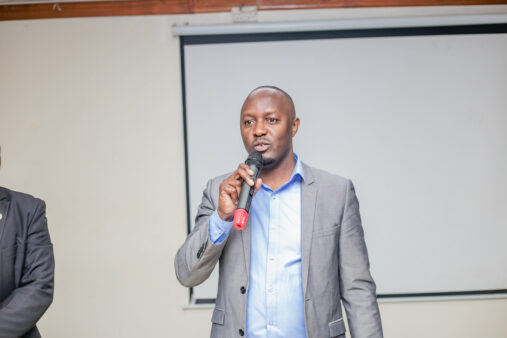
Appointed in June 2020, Peter Ssenyange is the Chief Financial Officer at Pearl Bank (formerly PostBank Uganda Limited), and is part of the leadership team that is transforming the bank into a value driver in the Ugandan economy.
Under his leadership, the bank has achieved sustainability certification, won the Sustainability Award, and he was named CFO of the Year for his role in redefining sustainable finance and corporate governance in Uganda at the CFO Awards 2025, an initiative launched by Deloitte Uganda and ACCA Uganda.
The awards highlight the critical role played by finance professionals in driving financial stewardship, strategic decision-making, and sustainable growth within their organisations.
Peter wields over 19 years’ experience in the finance sector in both banking and consulting within the finance sector.
He was previously the Chief Finance Officer at United Bank of Africa (UBA), where he was part of the team that turned around the bank’s 8-year loss-making streak.
He has also worked for Stanbic Bank Uganda Limited and Standard Bank Malawi, where he held several senior finance roles.
A fellow of the Association of Chartered Certified Accountants (ACCA) and member of the Institute of certified public accountants of Uganda (ICPAU), Peter is a strong advocate for integrated thinking in all corporate decision-making as well as business leadership development for accountants. He is also a proud alumnus of the CEO apprenticeship program and the CFO Academy at MAT Abacus.
His leadership extends to managing finance teams, fostering an environment of excellence and collaboration toward achieving sustainable business goals.
In recognition of his efforts, he was also awarded the inaugural Leadership Award at the 2023 ACCA Uganda CFO Awards. He was also 1st runner-up for the CFO of the year award in the same year. In the 2024 edition, he won the governance & compliance award.
In this in-depth conversation, CEO East Africa Magazine’s Paul Murungi, sits down with Peter, recently recognised as one of the region’s leading CFOs, to unpack the personal journey and professional philosophy behind the accolade, the spark that first drew him into finance, and how his sense of purpose has evolved with experience.
He breaks down the new reality of the modern CFO, his pivotal mentors, defining moments, and challenges that moulded his integrity, resilience, and values.
The discussion turns to legacy: the culture he hopes to embed, the institutional values he wants to outlast him, and how he balances short-term performance with long-term sustainability and financial inclusion.
On a personal level, Peter reveals how he stays grounded amid the pressures of leadership, what centres him, and why mentorship is core to his style, and he’s passionate about guiding young finance professionals to think beyond profit.

Peter, congratulations on this well-deserved recognition. When you look at the journey that brought you here, what does this award represent to you personally — not just as a professional milestone, but as a reflection of your purpose and journey in the world of finance?
I think receiving the two CFO accolades is what I can call the highlight of my career and one of the highest professional milestones I can receive, especially for a global body to recognise me as CFO of the year. Deloitte and ACCA are very reputable names, not just in Uganda but across the world.
It counts for all the years of holding up high professional standards. Participating in the award process, which most people don’t see the back end of, is a very rigorous process, and it does stretch you and also asks very internal questions.
Quite often, we see other CFOs doing great things out there, and some are recognised in different aspects. At a personal level, it was very important that the work I had done at Pearl Bank was recognised.
Five years ago, we said we would change this bank, and at that time, it was a daunting task. It was a vindication that, actually, the work we’ve done here has been recognised as well.
What first inspired you to pursue finance? Was it curiosity, necessity, or a belief that numbers could be used to create change? How has that motivation evolved over the years?
My mother introduced me to ACCA and accounting in a casual conversation over a dinner table in my Senior 4. I remember she actually brought me a brochure and said, You can do this after. We were talking about careers..
I had a head that could do sciences, and I also had the ability to do arts. But I think at that time, what I didn’t know much about from a self-awareness perspective was the passion; You can do something, but if there’s no passion there, then there would be no motivation.
I remember that I didn’t think much about it. Went to A-level, did what I did, and moved on to pursue ACCA.
But then, in the end, I think one thing that has not changed, although to some it has evolved over the years, is that I could see the potential of what accounting can do for business. I could see that this was the language of business.
Before my late father passed on, he ran a small medical business. One time, he asked me as I was doing my ACCA. ‘If I read your [ACCA] books, can I understand the concepts so that I can run my business well?’
We were actually discussing a technical topic that had happened in his business, and here was a professor, a veterinary surgeon, discussing a cash flow issue in his business and how he had overtraded.
Now, being an academician, the concept I was explaining to him was based on an argument over the way he had handled cash flow in a certain space of his business.
I was explaining to him the concept of overtrading, which is essentially that you use all your little cash and put it in the business, and you don’t have anything left.
So he came back after a few weeks and confirmed that he was overtrading. Now that was before I even became a professional accountant, but I could tell that was happening.
Now, the ability to translate a finance principle, you don’t have to go to school; it’s simply a language of business, and that need has not changed over the years, but the way that need is met has evolved over the years.
Because every business person wants to know, How am I doing? And the only thing that tells you how you’re doing is your numbers.
But then you need an interpreter of those numbers to bring them into context of strategy, the environment, even things like your competition, which is closely linked to your sustainability as a business.
Were you moved to do ACCA from the inspiration of your mother, who seems to have had so much impact on you while joining the world of finance?
My mom is a social worker who also did a small course in family law. But I mean, what do mothers do in the home? Nurture!
They are like the human resource person in the home. So you eventually discuss your career with them over time.
So, for me, doing ACCA was actually a career discussion. No wonder when I enrolled for it, it wasn’t that much of a surprise. It was definitely a journey!
My father was not quite happy, per se, that I wasn’t a scientist, but he was open-minded enough because he later researched it.
He went and inquired from one of his tenants who happened to work for PriceWaterhouseCoopers (PwC).
The PwC gentleman convinced him that if his son were pursuing accounting, he would be very successful!
How do you view finance today compared to what you saw in school?
By then, I was just enjoying the numbers and, of course, making my contribution to my father’s business. But can I tell you something? The irony is, I don’t love accounting as a business subject, but I love it as a language of business.
Just like you study a discipline, there are also many disciplines in accounting.
The ones that always got my attention were in the advisory capacity. In the early days, I noticed that the British businessman doesn’t sit down for any meeting unless they have a solicitor or lawyer and an accountant on the side.
And when you go through any company documentation over the years, what does an accountant do?
He takes your performance, interprets it and tells you how you’re doing, and actually advises you on what to do next.
Now, that advice can come from a regulatory standpoint, with a common example of managing taxes. But that advice can also come from a business strategy perspective for a CEO with a vision.
But as you move to that vision as a CEO, how do you know whether you’re doing well or not? How do you know whether you’re wasting a lot of your energy on something?
So for me, studying a practical professional accountancy curriculum designed in consultation with business leaders was very applicable in the working environment.
As a finance leader, what changes is having to contextualise as you go through the different work channels. For instance, the finance guy I was in Stanbic Bank is very different from how I was in UBA, and very different from how I operate at Pearl Bank. However, the technical aspects don’t change.
Today, you have managing directors who are accountants, so they are easier to deal with in a sense, but there are also many who are not, and still, they need your services.
But actually, accountants are some of the best business advisors you can have around, and sometimes it means protecting the business against itself.
The role of the CFO has changed dramatically — from managing ledgers to shaping corporate vision. How has that evolution challenged and inspired you personally at PostBank?
When I came to Postbank five years ago, the initial problems that were presented to me could be solved competently by my technical acumen. I just didn’t view it like that because, at the same time, there was also a need for business acumen.
We had to make a decision on how we were going to compete. One of the pivotal decisions we made was to move to a fully-fledged commercial bank, which formed part of the vision of the shareholders.
Now, as the CFO, you need to have a bit of business acumen to understand the ‘why’ behind the decisions that are being taken, and also actively participate in the process.
If you choose to close down Pearl Bank today, you’ll be surprised by how many stakeholders will oppose that decision because there’s a clear value creation story associated with the bank that matters deeply to Ugandans as they pursue prosperity in their daily lives. Articulating that to decision makers is now a CFO’s role.
The CFO now is required to be able to tell a value creation story of the organisation from start to finish through the eyes of stakeholders, not just shareholders.
For instance, what do you do with over 1,200 staff who gainfully get employment here? What do you do for nearly 300 vendors? What do you do with a shareholder who also wants you to have a socio-economic impact through the fourth National Development Plan (NDP-IV)?
What do you do with a regulator who is very interested in protecting customer deposits?
You’d better get it right because your value creation story must cover all that. One of the privileges I’ve had in the last five years is to tell the value creation story. A lot of that is shared through our annual integrated financial report.
Looking back, are there particular moments, mentors, or even failures that most shaped your approach to leadership, integrity, and resilience?
In my earlier days, I observed a lot from my mentors, as I still do. Before I became a professional accountant working in the private sector, I prayed to God and I asked him to show me how big companies are run.
I didn’t mind where God placed me, but all I cared about was that I wanted to work under very good people. When I joined Stanbic Bank, I saw how a well-run institution is structured, and the finance team was at the centre of that transformation.
I saw and learnt a lot about how they shaped the company’s leadership and winning philosophy, being deliberate, organising teams, command and control. Those were my first steps in leadership from there.
I vividly remember a young CFO who came from the Standard Bank Group headquarters in South Africa. He was very unhappy when he addressed the finance team.
I was new then, so I didn’t have any context about what made him unhappy. But he cast a vision and told us how we were going to operate the bank in that period of time. That is when I first learned about the power of a vision.
That young CFO didn’t last long because at the time, the group was buying other businesses across the continent. He moved on to anchor the Nigerian business but he left a massive cultural shift in how we worked as a team.
The group sent another CFO who was not exactly like his predecessor, but who had the same mission and was loyal to that same vision.
So I started to learn that in leadership, your job is really to create disciples. They may operate differently, but they are still on the same vision. And today it shaped a lot of us!
There are many CFOs who were groomed from that team, and it shaped their leadership philosophy around culture and changing things.
Funny enough, most of those lessons never made sense until I became CFO myself.
Now remember, when you cast a vision before a team, it is between you, God, hard work, and keeping your word.
When I arrived at Pearl Bank in 2020, they were advertising the 2020 financial reporting awards. I cut out the advert and I pinned it in my office, and told my team, if we’re to achieve our targets, someone out there will tell us that we’ve done a good job. Not ourselves!
At that time, Pearl Bank was going through a difficult time and the finance team was not excluded from this.. But I knew that for a team that had somehow lost morale, you have to cast a vision, but also be willing to walk by vision. That’s where integrity comes in, and then you must run the race with resilience.
I’m glad that four or five years down the line, we have achieved what we had set out to do.
We’ve been recognised in several forums and we have learnt a lot as well. In the final analysis,I am pleased to see how we have grown as individuals and how we have advocated for Pearl Bank through our work.
One of the moments for me, from my earlier mentors, was creating a winning culture. Winning as a person because I wanted everyone who was serving under me to win.
The organisation must win, and your team must win, and, as an individual, you must grow.
Legacy is an overused word, but in your own words, what does it mean to you? What kind of institution, culture, or values do you hope to leave behind at PostBank?
Over the last five years, we’ve made a lot of changes as an institution. I don’t want that agility and winning attitude to change. So if you’re to ask me, what kind of institution do I want to leave behind?
I want an institution that is very good at governance but also plugged in with its important stakeholders in Uganda. When asked, who is driving the development of Uganda? Pearl Bank must be mentioned there.
But on a personal level, and for the other staff who work at Pearl Bank, they should believe that they are able to grow in this place. We pride ourselves on nurturing emerging talent, and a person’s career shouldn’t come to a stop! You must grow.
None of that can work without a winning culture. Our values of passion, integrity, innovation and people must hold. A group of Ugandans believed that they could change an institution, and those changes made a mark on Ugandans. That’s what legacy means to me.
You’ve led PostBank’s transformation during turbulent times. How have you balanced the short-term demands of growth with the long-term goal of building a sustainable, inclusive financial system?
The beauty of Pearl Bank’s transformation was that it was deliberate. The shareholders of the bank wanted that change, and they appointed an MD and a board for that purpose. The intent at a governance level was clear from the start.We also had a lot of help from external stakeholders who believed in what we were trying to do.
Regulation changed, and we needed capital, but we knew in the long run, we wanted to run a very agile, technologically-driven organisation that catered to customers’ needs in the Ugandan context. That required that we make investments in three aspects: people, governance and technology. A lot of our spending and balance sheet investments have driven that.
Our journey to where we want to be in the Ugandan financial landscape is still in its infancy when we put it in perspective, but the building blocks positioning our customer offerings are in place and we can only get better at fostering prosperity for Ugandans.
To grow our deposits has been led largely by changes in technology, our loan book has been driven by our focus on customer needs, governance and also specific sectors in the economy. Those two things have given us legitimacy with our shareholders, hence entrusting us with the profits to reinvest and meet regulatory requirements.
So we’ve been intentional about growth every year and positioning the business right.
One of the things we did at the outset was to focus on performance at an individual level.
We changed the performance philosophy of the bank, and our ability to respond to local needs drove the numbers.
For instance, in 2020, we had a profit after tax of UGX 10 billion, and in four years, we had moved to UGX 35.4 billion in profit after tax. Our total revenue moved from UGX 119 billion to UGX 250 billion.
You were recognised for excellence in both sustainability and financial stewardship. What values and principles guided those twin successes — and how do you ensure they don’t drift apart?
The theme that ACCA and Deloitte are trying to achieve is to focus on a well-rounded CFO. They’re looking for business, technical, value and leadership acumen.
Those four things I can speculate guided the judges. With respect to sustainability and financial stewardship, we at Pearl Bank decided to pursue a unique journey by being profitable through sustainability. As we engage our stakeholders, they have certain things they want us to do; our impact on the people, economy and the environment.
So we’ve aligned with our overall performance philosophy through our sustainability goals. In between, we deploy brutal management execution and being accountable. So my nomination on the sustainability aspect and the recognition of my work when the bank was certified could have hopefully moved the judges.
On a personal level, how do you stay grounded amid the pressures of leadership and public expectation? What anchors you when the noise gets loud?
There will always be pressure related to responsibilities and leadership. One could say it’s a privilege because you have high expectations in that role. But when the noise gets loud, it does help a lot to bring God in there.
But when I really want to have downtime away from it, I watch a lot of Test Rugby and Test Cricket. Those two help a lot, but I have also found that coming home to a happy family helps drown out the noise.
Going home and listening to my daughter just conversing with me and my wife is also a very good outlet.
Generally, I think the pressures of leadership and public expectation are just to remind me why I’m here to serve, and that’s my philosophy! If I don’t remember that, I may let down those who entrusted me with the seat.
If you enter a situation knowing that it is pressurised and it will remain pressurised even after you’ve left, you don’t try to switch off the pressure. Your goal is to deliver within that pressure.
Mentorship seems to be a strong part of your leadership style. How are you empowering younger finance professionals to think about legacy — not just profit — in their own careers?
I think this is one of my happy areas when I come to this job. Not because you have to prepare someone for your seat, but when I look at a young professional coming through, I also look at all the mistakes I made.
I made a vow to myself many years ago that I would not manage a young professional or a subordinate the way I was managed. I think you need to tell someone what their journey is, what it takes, and they have to make a choice!
But typically, what a young professional would need is to explain to them what their mandate is. There is a lot of entitlement these days, and I will not say it was not there during my time.
It’s one thing to aspire to be the next MD, but the question is, are you willing to do the work? Are you willing even to identify what that work is? And also, do you know that there are so few MDs? If you don’t become an MD, then what?
But there are things you can control. You can control how good you are today in whatever role that is.
We are empowering young finance people with sponsored training sessions in the CFOAcademy. I also do a lot of management talks, but I centre them around the person, that your professional journey doesn’t start working until you work, and that’s how you link legacy and profit.
The money only comes after you’re obsessed with your legacy or the impact you’re creating in the team. It is your impact in the team that then drives your career rise, and therefore your profitability. So those two are inseparable.
We’ve seen young finance professionals get better at what they do from our training, and we’ve had an alumnus from Pearl Bank who is a CFO of another financial institution. She’s moved on!
We’ve had a former manager who went to pursue a tax career in oil and gas.
Now again, it came from a lot of asking, Is this the best you can be? And over time, the person grows, and as they grow, they pull up other people.
As a mentor, I get a more broad-based talent pool and also create others across the industry.
Let’s talk about young CFOs who aspire to make an impact but struggle to find meaning beyond results. What advice would you give them about building institutions that reflect their values?
You know, if you’re looking at impact beyond the results, you have to look at that institution’s value creation story.
The numbers will come, but what is a value creation story? And then articulating that story over and over again.
Now, with respect to building an institution, you cannot build it alone. So you have to engage with a lot of resilience with your colleagues and the MD. But the starting point is, does your institution have value that it brings to society?
What is it? Are you part of it? Or do you know what that is? You have to articulate that and will create impact eventually.
When you eventually step away from your role, how would you like people — your colleagues, your community, your family — to remember your impact?
That’s a hard one because I’m just a finance guy who looks at a challenge and chooses to face it head-on, and I gave it my best shot.
So I think eventually, it’s hard to know what people remember and what they don’t. At the core of all that I don’t want to let down people who gave me the mandate to work.
That matters a lot because when you’re sent into a role, you must make a difference, and that difference comes from personal reflection, and saying, I gave it my best!

Tribunal Backs URA in UGX 10.2 Billion Century Bottling Tax Fight