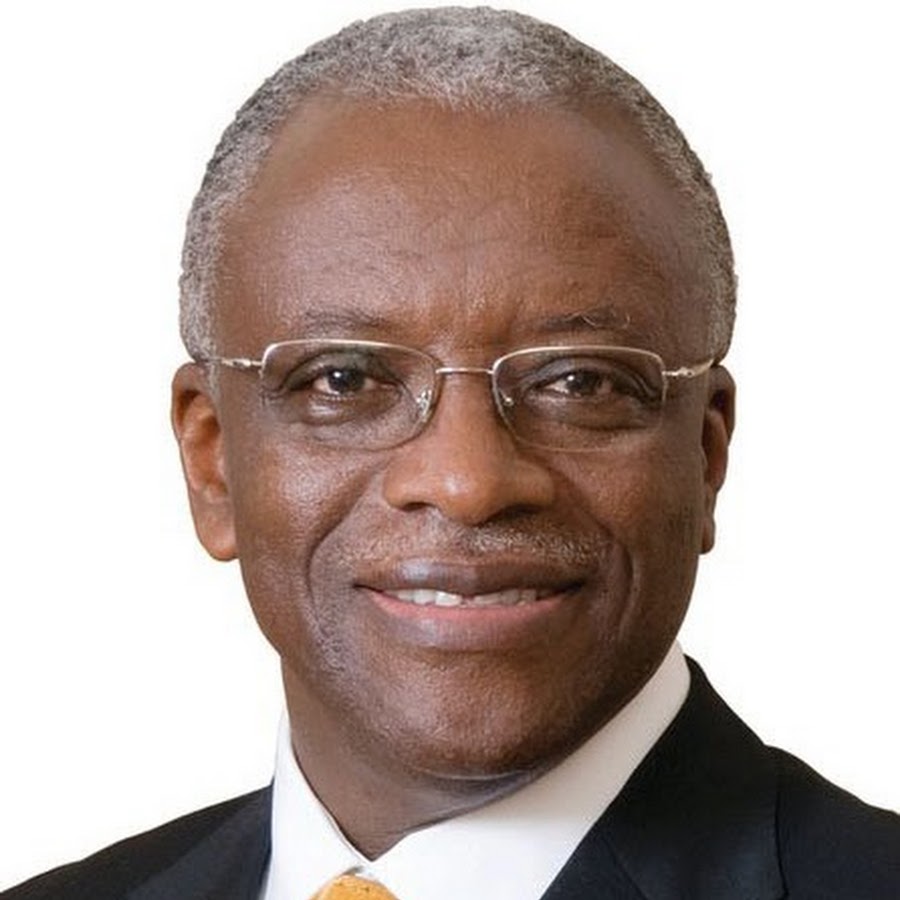

If the March 2016 Presidential Elections were held this month and John Patrick Amama Mbabazi was standing for president, 44.54%, of Ugandans would vote him, an online poll by The CEO Magazine has shown.
Five Hundred Forty One (541) respondents aged above 17 years participated in the online poll, conducted by the magazine between 17th June 2015 to June 24, 2015. The poll was conducted via Survey Monkey one of the best online survey tools, according to analysts. SurveyMonkey uses some of the most advanced technology for Internet security and data integrity. By default, Survey Monkey allows only one response per computer or voting device. It also uses the Secure Sockets Layer (SSL) and Transport Layer Security (TLS) technology to protect communications by using both server authentication and data encryption. This ensures that user data in transit is safe, secure, and available only to intended recipients.
The poll was based on how the respondents would rate 4 of the main potential contenders drawn from 2 of the country’s strongest parties i.e National Resistance Movement (NRM) and Forum for Democratic Change (FDC).
The selected likely aspirants are: Yoweri Kaguta Museveni and John Patrick Amama-Mbabazi for NRM on one hand as well as Kizza Besigye and Gregory Mugisha Muntu from FDC. The two parties are Uganda’s largest parties as measured by the 2011 presidential election where the two combined, garnered 94.4% of the counted polls.
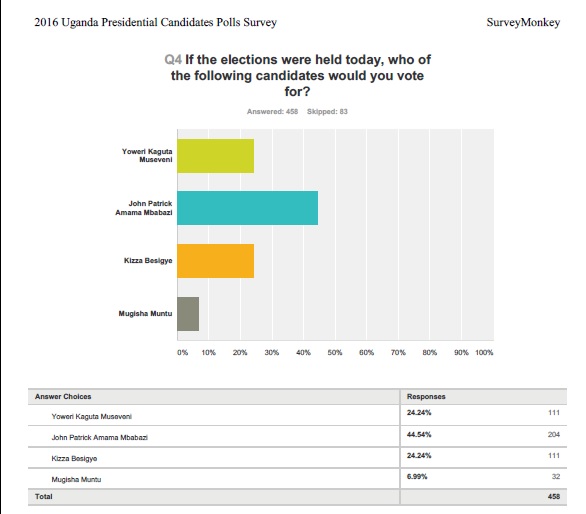
Other than Amama Mbabazi, both Yoweri Kaguta Museveni and Kiiza Besigye tied, with 111 respondents (24.24%) saying they would vote them for president. Only 32 respondents (6.99%) said they would vote for Mugisha Muntu.
19 other respondents indicated they would vote a variety of other aspirants that included: Venansius Baryamureeba, Erias Lukwago, Olara Otunu, Rebecca Kadaga, David Ssejusa & Nobert Mao among others.
Political Affiliation
161 respondents (31.45%) professed as subscribing to the NRM party/ ideology while 95 respondents (18.55%) subscribe to Forum for Democratic Change (FDC) and 19 (3.71%) reported as subscribing to the Democratic Party. Only 2 respondents (0.39%) reported subscribing to Uganda People’s Congress (UPC) and 6 respondents (1.17%) said they subscribed to the Federal Alliance.
The majority of the respondents- 229 or 44.73% said they did not subscribe to any political party, while 29 respondents did not answer the question.
444 respondents were male (88.8%) and 56 (11.2%) were female while 41 respondents, did not answer this question. Majority of the respondents (417) were aged between 17-35 years (77.08%).
Respondents were also asked on how they rated each of the 4 main aspirants on 5 selected key attributes of a good leader, namely:
• Honesty, trustworthiness & accountability
• Results-oriented, reliability & dependability
• Patience, respect & humility
• Patriotic & nationalistic
• Knowledgeable & creative
Kizza Besigye beat all the other aspirants on honesty, trustworthiness & accountability, scoring 62.39% as well as being the most patriotic & nationalistic (61.97%). Amama Mbabazi led other aspirants on being results-oriented, reliable and dependable, scoring 51.49% as well as on being knowledgeable & creative, garnering 70.52%.
Mugisha Muntu came out tops on patience, respect & humility, scoring 57.63% while Amama Mbabazi came out tops on being creative, with 70.52% of respondents rating him as being creative.
Among a variety of issues, respondents ranked justice, rule of law & human rights as the most important issue that they wanted addressed. Economic growth, household prosperity & job creation as well as democracy were ranked 2nd and 3rd respectively.
Fighting corruption & improving government efficiency and accountability was ranked 4th while improving social service delivery especially education, health & welfare of public servants came in the 5th place.
Other issues were energy & transport infrastructure, defense & security as well as equitable taxes & reasonable gov’t expenditure.
Trends, Implications & Disclaimer
This poll only takes into consideration a portion of Ugandans who have access to the internet – as it was conducted only online. It is not representative of the entire adult voting audience, since the majority of Ugandans do not have access to internet yet. Nevertheless it does capture the opinions of what you would call the influential middle class, largely composed of the working class, political analysts and opinion leaders whose influence cannot be under-estimated in any election.
According to the Uganda Communications Commission (UCC) Postal, Broadcasting and Telecommunications Annual Market & Industry Report 2013/14, as of June 2014, there were 4.3m internet subscribers and 8.5m internet users as of June 2014.
Internet penetration stood at 23.3%- meaning that 23 out of every 100 Ugandans had access to the internet. As a proportion of the adult audience however, penetration is estimated to be above 40%.
It should also be noted that most of the internet connected Ugandans are largely in urban areas, where opposition has enjoyed an advantage of over the ruling NRM. Most of the rural voters who are known to be staunch supporters of NRM were not polled. It should also be noted that females, who are ardent Musevenists did not largely participate in the poll (Only 11.2% of the respondents said they were female)- not by design but perhaps due to the fact that only 34% of Ugandans online are female, according to facebook statistics.
In the 2014 National Housing and Population census, out of a total of 34,856,813 Ugandans, there were 16,935,456 males and 17,921,357 females. 28,430,800 Ugandans were reported to be living in rural areas, while urban dwellers were only 6,426,013. Kampala Capital city reported a population of 1,516,210 Ugandans.
One major insight from the poll, though is the fact that there is increased opposition, especially amongst the 17-35 years age group(they formed 77% of the survey respondents). Only 31.45% of the respondents said they belonged to the ruling NRM, while the majority declared that they were either independent (44.73%) or belonged to other opposition parties. The opinion poll also clearly indicated that FDC remains the second strongest opposition party.
Should both Amama Mbabazi and Museveni go on to stand- one as NRM flag-bearer and the other as independent, there’s a greater risk to the ruling NRM’s ability to secure a straight 51% first-round majority win. This may come in handy for The Democratic Alliance (TDA) formed on June 10th , to dislodge NRM’s Colossus. TDA is a loose coalition announced by leaders of Uganda’s major opposition political parties, several prominent political leaders and representatives of various civil society organizations. Their strength lies in their ability to maintain unity and agree to present a single candidate.
FDC has set July 1st and 2nd as dates for nominating their flag bearer in the 2016 elections. So far, FDC president Mugisha Muntu and a little-known Moses Byamugisha have expressed intention of contesting. The NRM is yet to set a date when they will nominate their flag bearer, but so far Amama Mbabazi has declared his intentions. While President Museveni has not explicitly declared his intentions, the writing is on the wall that he too, is in the race for NRM’s flag-bearer.
Once all the parties have declared their flag-bearers, The CEO Magazine intends to conduct another poll, this time more deeper and more representative of all Uganda’s demographic and geographic print.
To get the full survey report, please mail ceomagazine@gmail.com or kyamutetera@yahoo.com