
When the Uganda Communications Commission (UCC) opened its doors over two decades ago, it was with a modest mandate to oversee the nascent communications landscape of a post-liberalisation era.
Today, the Commission stands as a giant, with digital footprints across the country and global recognition on the international stage.
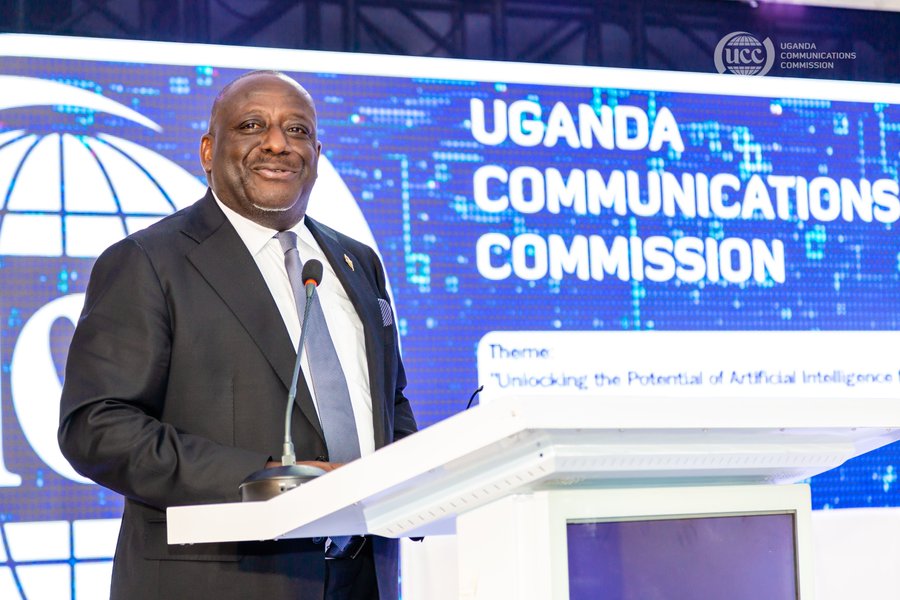
At the centre of this journey is Nyombi Thembo, UCC’s Executive Director, whose voice brims with conviction and pride as he reflects on the institution’s legacy and the path ahead.
“This journey has etched an enduring legacy across the country, propelling institutional growth and catapulting the broader communications sector into a new digital era,” Thembo says from the UCC headquarters in Bugolobi, Kampala.
From its foundation as a regulator of an emerging telecommunications industry, UCC has become a defining institution in Uganda’s digital transformation. As executive director, Thembo holds a front-row seat and a steady hand on the wheel.
From central to regional: Bridging the access gap
Asked about how UCC has brought services closer to the people, Thembo’s response is clear: expansion and decentralisation have been key.
“We have expanded our presence with regional offices in Gulu, Mbale, Mbarara and Masindi, ensuring that our services and regulatory tools, including monitoring sites and digital loggers, are readily accessible to consumers of communication services countrywide.”
These offices aren’t just outposts. They are regulatory touchpoints that reflect UCC’s commitment to national reach.
A fund for the forgotten
The transformation of the Universal Service and Access Fund (UCUSAF) is one of the Commission’s proudest achievements, giving life to a bold mission: digital equity for every Ugandan.
“The transition from the Rural Communications Development Fund to the Uganda Communications Universal Service and Access Fund (USAF) signifies our commitment to drive the adoption and usage of ICTs for ALL Ugandans, especially those who are unserved and underserved.”
In a world that moves faster each day, UCC insists that no one be left behind—not the farmer in Karamoja, not the student in Kabale.

Flagship initiatives driving innovation
On innovation, Thembo is passionate, listing off the Commission’s flagship programmes as if introducing old friends.
“Our flagship programmes and initiatives, including the Content Development Support Programme and Uganda Film Festival for the creative content sector, National Conference on Communications (NCC) for collaboration with academia, and Computer Emergency Response Team (UG-CERT) CEO breakfast have not only sparked creativity and innovation, but also fostered meaningful connections among our stakeholders and partners.”
From arts to academia, from cybersecurity to storytelling, UCC has placed its hands on every lever of the communications ecosystem.
UCC charting Uganda’s national development through ICT
The Commission’s work doesn’t exist in a silo. It is wired tightly into Uganda’s broader national development plans, step by step.
“In this journey, we have witnessed ICTs take their rightful pivotal place in the national development agenda,” Thembo reflects.
NDP I: Although ICT wasn’t directly mentioned as a sector, it laid the groundwork for connectivity and infrastructure.
NDP II: ICT took the driver’s seat, focusing on expanding coverage to underserved areas.
NDP III: ICT transformed into an enabler, emphasising usage and integration across sectors such as education, health, and agriculture.”
What started as a supporting character is now centre stage.
The sectoral ripple effect
From agriculture, education, tourism to SMEs, the impact of UCC’s work has rippled through every sector.
“In education, we have bridged the gap with digital resources, offering students and teachers countrywide access to computer labs, internet connectivity, school content, and e-learning platforms.
In agriculture, precision farming has empowered farmers with real-time data and market access, boosting digital skilling, ICT farmers extension services, free e-agricultural academy, and resources, as well as Apps.
The tourism sector thrives with seamless connectivity, enriching tourist experiences and propelling economic growth. SMEs have witnessed increased ICT adoption, leading to enhanced productivity and performance through digital skilling.”
In a single breath, Thembo outlines a digital renaissance stretching from classrooms to crop fields, from lodges to startups.
Uganda’s digital voice on the global stage
At the global level, UCC has made sure that Uganda’s voice isn’t drowned out.
Their global engagement has left an indelible footprint, shaped by three key pillars. Firstly, involvement in setting and aligning global standards has charted the course of international telecommunications, ensuring Uganda’s voice is heard on the world stage.
 Deal Makers: Meet Deloitte Advisors Behind Absa’s Acquisition of StanChart’s Wealth and Retail Business in Uganda
Secondly, UCC’s active participation in numerous treaty organisations and technical affiliations has forged a national brand synonymous with dependability and technical authority, strengthening our global reputation.
Thirdly, the leadership roles in esteemed international bodies such as ITU Council, International Telecommunications Satellite Organisation (ITSO), Pan-African Postal Union (PAPU), Universal Postal Union (UPU), and East African Communications Organisation (EACO) have not only elevated Uganda’s presence but also reinforced UCC’s commitment to playing a pivotal role in shaping the future of global communications.”
Here, Thembo makes it known: Uganda is not merely following trends. It is helping to set them.
25 years of UCC growth and numbers that tell the story
The numbers, too, speak of a journey well-travelled.
“Over the last 25 years, the communications sector growth has been nothing short of remarkable. We’ve witnessed an explosion in the number of service operators, now boasting 325 radio stations, 48 TV channels, broadcasts in every language, and 5,000 telecommunication masts,” he says.
Additionally, under UCC oversight, the sector has evolved through a technological journey, from 2G to 3G, 4G, and the cutting-edge 5G technology, while seamlessly migrating from analogue to digital terrestrial broadcasting.
And access? It is no longer a privilege.
“Our commitment to expanding access infrastructure has brought connectivity even to the most remote areas. Usage metrics have soared, with mobile phone penetration, internet penetration, and the adoption of value-added services such as mobile money and digital financial services reaching unprecedented levels,” he says.
A sector built on collaboration

Success, Thembo stresses, has been a shared endeavour, saying collaborations and partnerships have been the cornerstone of the journey.
“We owe our success to the unwavering support of our strategic partners, both locally and internationally, spanning the public and private sectors, and extending beyond our industry. As the saying goes, ‘a hand does not clap alone.’”
Driving quality, one regulation at a time
Asked about service experience, Thembo outlines the regulatory mechanisms in place:
“UCC has set standards for operators as contained in the Uganda Communications Quality of Service (QoS) Regulations 2019, and annually monitors QoS received from the operators.
The findings are published in the press and online as we continue to drive improvement of QoS enjoyed in Uganda.”
This ensures that service providers remain accountable and consumers are not taken for granted.

Tackling dropped calls and protecting the consumer
Dropped calls, though reduced, remain a concern as mobile dropped calls can occur due to various reasons. These are often attributed to issues within the mobile network or the device itself.
“Some of the common causes include limited network coverage, network congestion, radio frequency interference from other sources, equipment or software issues with the mobile handse. That is notforgetting problems with the mobile device, such as faulty hardware, outdated software, or incompatible settings,” Thembo explains.
Solutions are technical and consumer-driven.
To address and mitigate the challenge of dropped calls, mobile network operators continually work on improving network infrastructure, implementing advanced technologies, and optimising network performance.
“Users can also help minimise dropped calls by keeping their devices updated, ensuring good battery health, and providing feedback to their mobile service providers regarding areas with connectivity issues.”
The Commission backs this up with regulatory bite.
According to Section 5 (k) of the Uganda Communications Act of 2013, the Commission has a responsibility to promote and safeguard the interests of consumers and operators as regards the quality of communications services and equipment.
“We implement this through type approval of communications equipment, licensing of providers with minimum QoS obligations, benchmarking audits, complaint handling mechanisms, and consumer awareness campaigns like SIMU KLEAR.”
The road ahead: Nine UCC priorities for the future
Looking forward, Thembo lists UCC’s priorities for the next chapter:
- Expand broadband access: Broaden high-speed internet coverage to underserved areas by addressing infrastructure gaps, especially in electricity, through strategic partnerships.
- Make ICT more affordable: Collaborate with public and private stakeholders to lower the cost of ICT products, services, and devices across the country.
- Accelerate digital transformation: Support the Ministry of ICT in rolling out emerging technologies like AI, blockchain, and IoT across key sectors such as health, agriculture, and finance.
- Strengthen cybersecurity & data protection: Enforce robust standards to safeguard digital systems and user privacy in line with the national digital roadmap.
- Empower consumers: Prioritise citizens through digital skills training and awareness campaigns to boost ICT adoption in everyday life.
- Boost stakeholder collaboration: Deepen partnerships with media, government, private sector, and civil society to tackle sector challenges and maximise opportunities.
- Enhance global presence: Increase Uganda’s visibility in global ICT forums by shaping international policies and championing regional interests.
- Promote green ICT: Drive sustainable practices in the sector, focusing on energy efficiency, e-waste reduction, and eco-friendly innovations.
- Ensure transparency: Uphold high standards of openness and accountability in all regulatory functions.
As the Commission marks its 26th anniversary, Nyombi Thembo remains grounded in purpose, even amid celebration.
“This journey is about people. It is about connecting them, informing them, protecting their digital lives, and giving them the tools to thrive. Our work is far from over.”