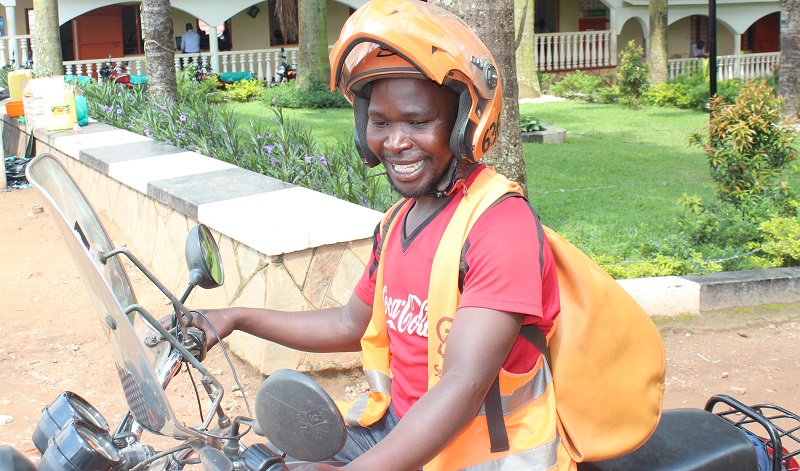
Sometime in 2015, Kyanzi Abdul-Karim, was like any other boda boda rider in Uganda- recklessly nonconformist, wore no helmets and daring to break every known traffic rule, so long as he made a living. Although life was not as he wanted it; he at least had chosen a good stage- the bustling agriculture produce Kalerwe Market, on the North Eastern outskirts of Kampala.
His peak time was always on in the morning hours as thousands of Kampala food vendors and households come to buy fresh food stuffs delivered by farmers and middlemen from upcountry. The excessive demand often meant that he always had had to overload his motorbike with sack loads of produce and most often the owner of the merchandise.
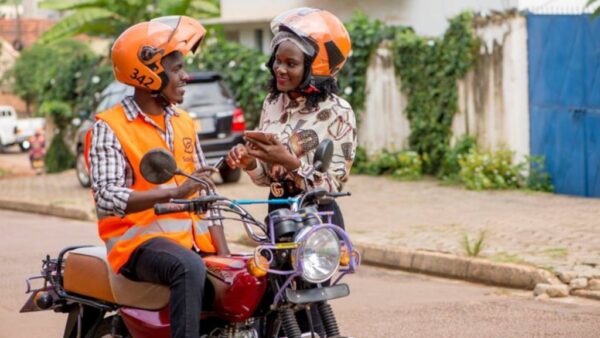
At the time SafeBoda a Ugandan based and birthed venture-backed bike-hailing start-up had just opened up in Kampala. At the time, the Uber-like service but for boda boda was recruiting new riders and Kyanzi had often given it a thought but every time he was repulsed by the company’s insistence on compliance with basic things like traffic rules.
“I used to see boda bodas who were wearing orange vests and one day I decided to call the number on the vests and I went to their offices. At the office they explained to me everything but at first, I decided to continue with things on my own. They wanted me to follow rules and stop at traffic lights and transport only one person. I realised that I would not make any money from them,” he reminisces.
“I used to work at the stage at Kalerwe market and I would transport people with their goods from the market and in the very worst I would at least transport two people and this was something Safe Boda didn’t want me to do,” he says.
However, it had to take a run-in with the law to have him rethink his options.
“However, one day, I transported someone from the market and I was arrested by the police and they took a lot of money from me and that is when I made the decision to go back and join SafeBoda and since then I have never looked back,” he says.
That was in 2015 and he was given number 636.
“At the time when I joined, we were very few and we were limited to Ntinda, Bukoto, Nakasero and Kamwokya. However, when the app (SafeBoda App) was launched, more riders were able to join and more so more areas were covered,” he recalls with delight.
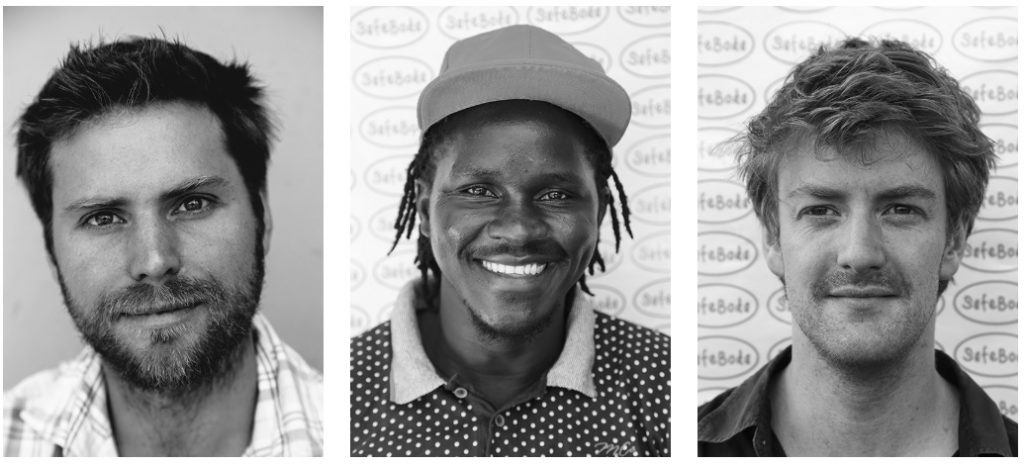
Safe Boda was the idea of three entrepreneurs- Ricky Rapa Thompson, a boda-boda rider and Maxime Dieudonne and Alastair Sussock, both economists, from Belgium and Scotland respectively. While Ricky Rapa had the local hands-on experience and knowledge about the riding business in Uganda the other two had some technology insights and were generally exposed to the outside world. But at the end of the day, the trio were united by a gap and opportunity presented in the chaotic boda industry.
That was in 2014.
Soon the ideas moved to paper and then to reality and Safe Boda was born in January 2015, in a small office in Kyebando, a Kampala poor suburb, and like they say, the rest is history. Today, Safe Boda has partnered with over 15,000 riders- most of whom are male youths between the age of 28-30 years. The business has also since diversified into different but related services like delivery of packages, purchasing of airtime and food delivery- their latest addition.
Moses Musinguzi a.k.a as Moses Namba Emu (Luganda for No.1), was the first ever Safe Boda rider (SB1). In 2014, he worked at the Endiro Boda Stage at Kisementi, Kamwokya. Before that, he was a mechanic, repairing motorbikes in Kamwokya where he had met Rapa Thompson, himself a rider at the time who used to come there to repair his bike. While at Endiro, he would meet up with Papa who brought up the idea and after a couple of explanations, Musinguzi bought into the idea and signed up. The second rider would be signed on two weeks later.
Musinguzi now is a business support manager who assists the senior management in running the business, rider recruitments and safety training at Safe Boda’s academy that inculcates the Safe Boda culture into their riders.
“Business was slow at the start- we were limited to areas of Ntinda, Bukoto, Nakasero and Kamwokya but in 2017 when we launched the Safe Boda App, the number of riders grew and we were able to cover more areas,” recalls Musinguzi.
Musinguzi explains that the whole idea behind Safe Boda was to safely transport people from one place to another at an affordable price. Affordability and safety would bring in the volumes thus allow them and their partnering riders make small margins but on many rides.
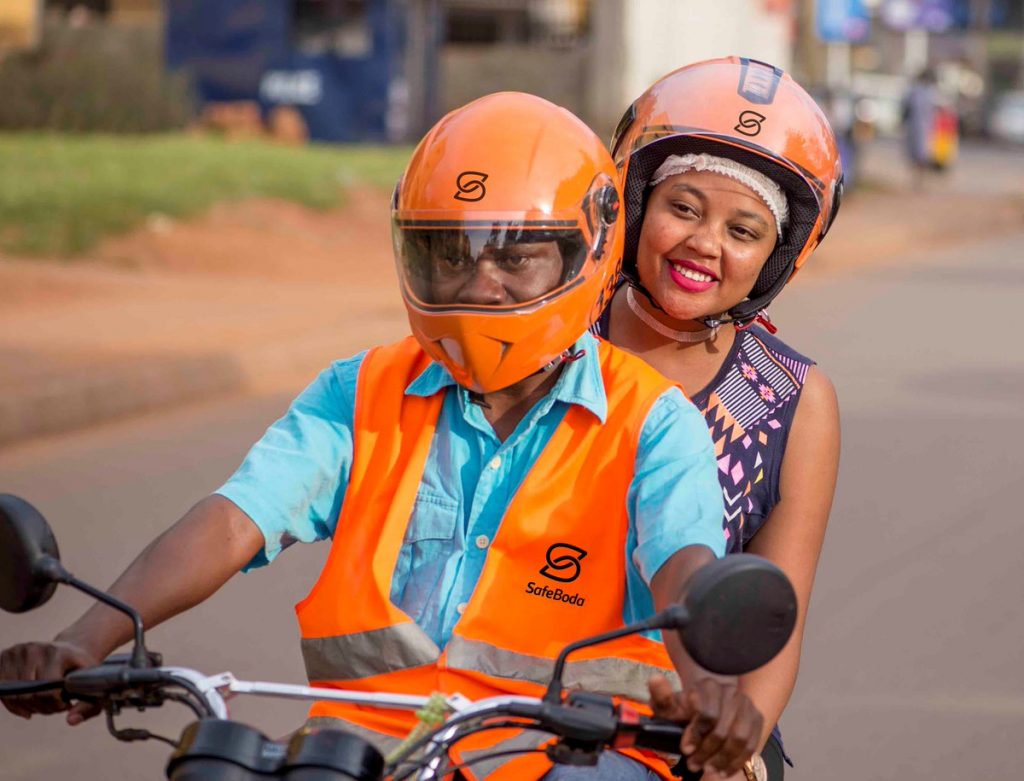
“At the end of the day, Safe Boda takes only 5% from our riders’ earnings in a day and the rest is left to the rider,” says Musinguzi.
But that’s not all, leveraging the big numbers of riders, Safe Boda through their Turako Insurance provides riders with personal accident at an affordable UGX6,000 premium per month. At an additional UGX4,000 per month riders also get medical insurance for up to 3 family members. To cushion the riders against financial eventualities, the also offer soft loans of up to UGX200,000 to their riders payable in 4 installments.
All riders have a life insurance package of UGX2,500,000.
Living the Safe Boda Vision
If there is a rider, who best exemplifies the Safe Boda dream, then it is Kyanzi. To date he is Safe Boda’s real No.1, at the time we interviewed him, he had the highest number of trips- 9,903 trips and a customer rating of 4.72 out of 5 stars. With an average 15 trips per day over an average 150km which translates into an average 10km per trip, Kyanzi, has done an estimated 99,030 kilometers- that is an equivalent of riding to London and back by road – a distance of slight over 20,000 kilometers, not just once four and a half times. Yes, four and half times.
 Aga Khan Fund Exits Troubled Nation Media Group After 66 Years, Sells Controlling Stake to Tanzanian Billionaire
“I honestly didn’t know but if I am that makes me very happy, it means I am doing something right,” he said with a wide grin when we broke to him the news that he is Safe Boda’s top rider ever.
“Safe Boda changed my life and that is why I am dedicated to doing my job,” he adds.
He says he earns between UGX 50,000 to UGX 70,000 a day from his customers. But on some days he makes more trips but he says with certainty that he has never made less than 15 trips.
“I cannot make less than 15 trips because this also comes with a bonus from the company. When you make 8 trips they give you a UGX 8,000 bonus, when you make 15 they give you UGX 16,000 and when you make 25 trips they give you UGX 30,000 as a bonus,” he says.
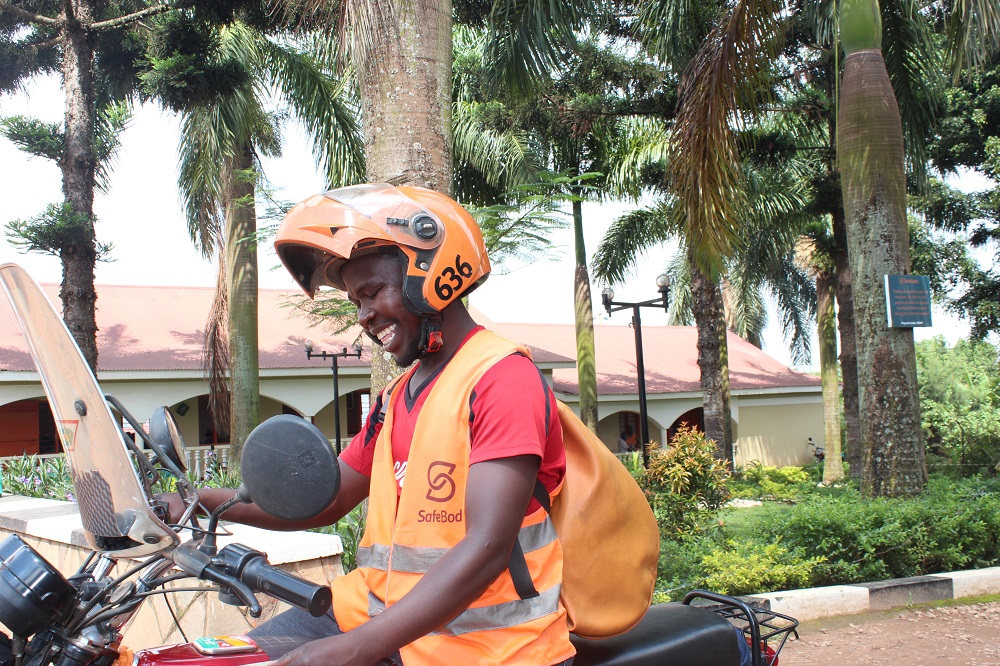
From these bonuses which he says are a motivation to work harder and his own direct earnings, Kyanzi makes an average of UGX 350,000 a week and about UGX 1,400,000 a month. But he spends an average of UGX 25,000 on fuel in a day, leaving a net of about UGX700,000 a month for himself and his family.
In a country where graduates earn a monthly median income of UGX 780,000 according to the Uganda National Household Survey 2016/17, and the average monthly household revenue is UGX416,000 (rural) and UGX703,000 (urban) that is something big, especially for Kyanzi who is not that educated.
The furthest he has taken a client is Mukono (25km East of Kampala) and Entebbe Town (45km south west of Kampala). He also boasts that he has never been arrested by a police officer because he follows the rules.
“I do not drive on pavements, I follow traffic lights, I wear a helmet and even my passenger gets to wear a helmet. Most of the customers I get appreciate the way I do my job, some of them even give me tips on top of their fee for the distance covered,” he says.
Asked about his worst experience, he says: “My bad experience are probably the rude customers but what helps me to go through that is that I know that I probably won’t meet them again so I just keep silent until they finish their insults. Besides them, I am not complaining because I love what I do.”
From this money, he has been able to transform his life and the lives of his loved one starting with his grandmother in his home village.
“When I realized that I was making some good money, I started saving and I built my grandmother a house in the village because she is one of the people that dedicated her life to raising me so I thought it was right for me to give back to her for the work that she had done in my life. After that, I bought land of 50 by 100 feet in Wakiso where I built a 3 bedroomed house,” he narrates.
He however plans on buying more land where he one day plans to build a storied house, “if Allah enables me to do so.”
“Aside from the material things, I have been able to get insurance for myself, my wife and kid under Turako Insurance. I only have to pay UGX 4,000 per month to get their family care package and this has helped me because you know medication can be expensive but once you are able to have insurance, everything is somehow covered at a small fee for myself,” he says, adding that Safe Boda has really made him put his time to good use.
“I hate being idle so I am always busy. I take small breaks for lunch and when I need to rest but most of the time I am on the road,” he says.
Making a difference, one trip at a time
Kyanzi also confesses that one big thing that Safe Boda has done is restore dignity in boda boda riding partly because of the good pay but also because of their insistence on strict adherence to safety and the law.
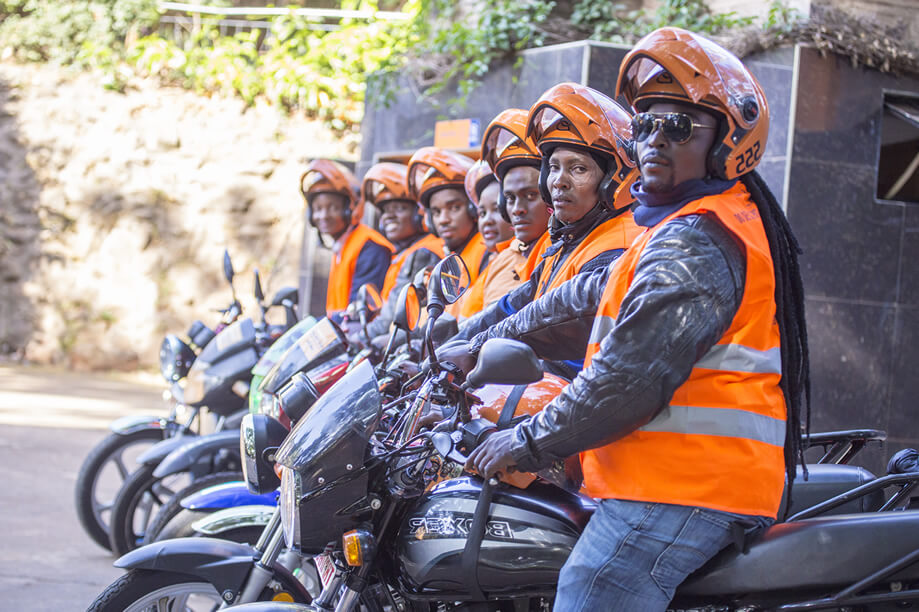
“You see people normally undermine boda boda riders but the truth of the matter is that we sometimes make more money than people who go to sit in offices everyday so they should not undermine us, because we are also trying to make a living,” he chuckles.
“It may seem like being a boda boda rider is the worst thing to do but when you are getting your money, you stop caring about how people look at you. Another thing is that some people join Safe Boda and they look at the small fees earned per trip and they give up easily. For example if you got a customer from town and they were going to Entebbe, an ordinary boda might charge close to UGX 50,000 but the Safe Boda App may charge half of that- it may seem demoralizing but what people have to remember is that ordinary bodas have a lot issues they face,” he says.
He says ordinary boda boda riders do not have a steady stream of customers on a daily basis thus have inconsistent revenues. Besides ordinary riders are not insured against accidents, they are generally at a risk.
“What I learnt with the Safe Boda App is that it is not about how much you make in a trip but rather how much you make at the end of the day and that is what keeps me going. Ordinary riders can make UGX40,000 on a good day and yet a Safe Boda makes more money because of the many customers using the App. So, my advice to people joining is that they should not look at the price of a trip because that can be demoralizing but the money made at the end of the day is what makes the app outstanding,” he counsels.