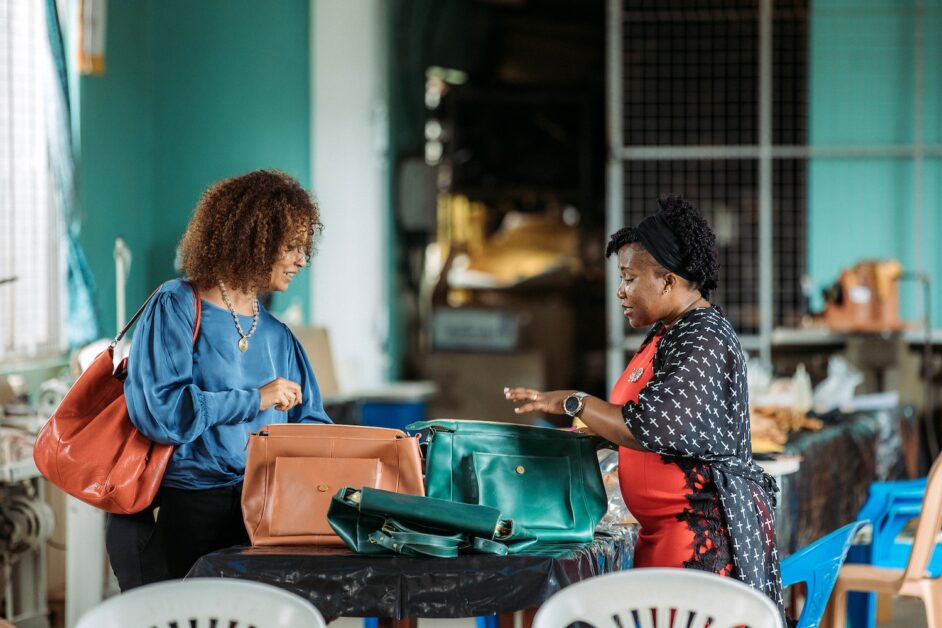
Arise Kollections manufactures and distributes high-end leather and textile fashion accessories such as handbags, footwear, jewellery, and hand-woven items to several foreign and local markets. Mrs. Kitumba’s luck came in 2012 when she met Ms Susan Muhwezi, former Uganda AGOA Country Head. She admits that her success under AGOA was born out of a merger that involved two companies; Sseko Designs LLC (USA) with Noonday Collection- the former being American, and the latter being Ugandan.
This merger enabled it to become a majority Ugandan female-owned independent company.
However, after the exit of Sseko Designs as a majority shareholder in 2022; Netunze rebranded the company to Arise Kollections. Mrs Kitumba says over the last 13 years, the company has made significant gains in the US market raking USD 1.3 million (UGX 5 billion) in export sales.
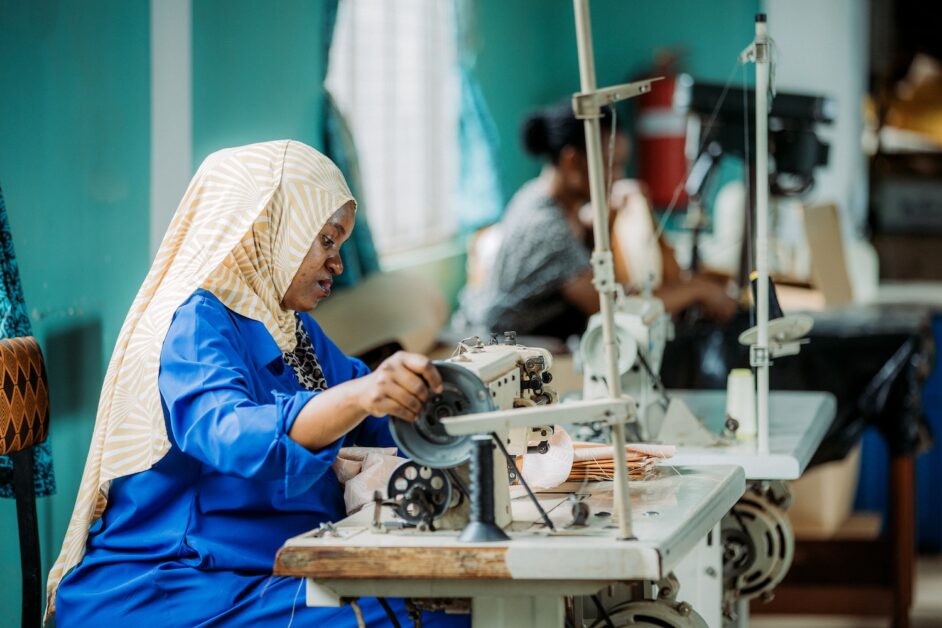
Even after the exit of AGOA, Mrs. Kitumba is still in the leather products business with a full-time staff of 15 highly skilled women and one Ethiopian man who works as a production manager. She sources most of her raw materials from several countries such as; India, Italy, Kenya, and as far as China, depending on her production needs.
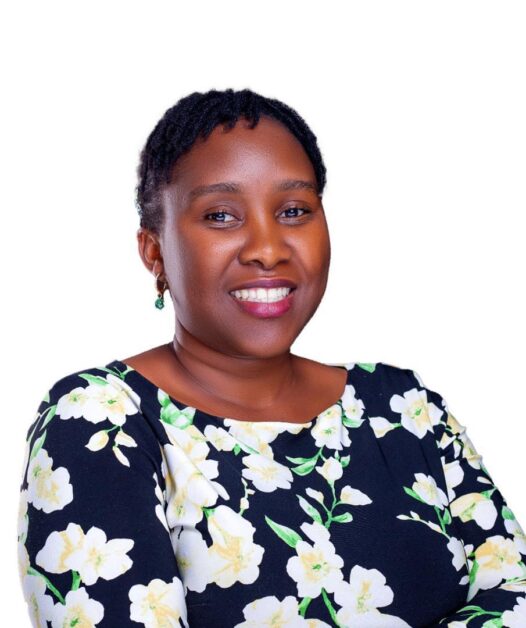
Five months down the road after Uganda’s dismissal from AGOA, the CEO Magazine’s Paul Murungi sat down with Mrs. Kitumba at her factory for an exclusive interview to discuss the fight for AGOA, African trade politics, Anti- Homosexuality Act, and her next big move.
What was your reaction when the U.S President Joe Biden issued a statement at the end of October last year to terminate Uganda’s membership under the Africa Growth and Opportunity Act (AGOA) with other three countries effective January 1, 2024?
That was a slap in the face, it came at a time when in August 2022 when I had a meeting with a Mexican proprietor who was very interested in moving all his container orders from China to Uganda just because I mentioned we don’t pay taxes while exporting to the USA.
It was that one thing that I was using to pitch because now as a company, we had moved away from producing for one main client, to other clients in the U.S.
Of course, there are other avenues where Ugandans can export to the U.S still under subsidised taxes, or even duty-free completely, but AGOA was made in such a way that even for the simplest small-scale exporter, it was very direct and simple to use and it even made work easier for the clearing agent at the Houston border in the U.S.
I believe the Biden administration knew how important AGOA was to a developing country like Uganda, and for them to make that decision, I thought they were trying to play it politically.
When I heard the announcement, I felt this was an issue we could amicably resolve so that we don’t affect lives.
And that period was also very short. From announcing to implementation, there was no room for discussion, so it meant the US government took time to think through their action; they didn’t give Uganda time to think as well and probably return to the table and ask what it meant for the people of the country.
Considering that you had worked with the Americans for over a decade, did it at any point occur in your mind that the enactment of the Anti- Homosexuality Act would have an impact on the relationship between Uganda and the USA, especially in trade terms, but also particularly AGOA?
No, it didn’t hit me that the signing of the bill would impact the U.S.- Uganda relationship, especially on a trade deal.
This is because Uganda is a country that has a Constitution and runs its own rules and regulations; secondly, there are states in the U.S. like Florida that have not fully embraced Homosexuality. This made me think that if the U.S. has states that have not fully been onboarded, it can’t impose stringent rules on other countries.
Shortly after Biden issued the statement, you joined Susan Muhwezi to travel for the 20th AGOA Forum 2023 that took place in Johannesburg, South Africa in early November last year. What discussions took place in South Africa?
AGOA exporting countries hold different AGOA conventions around Africa. This time around, it was happening in South Africa. Susan [Muhwezi] made very good deliberations on how Uganda and the other three countries shouldn’t be scrapped.
I strongly supported her comments in the sense that it wasn’t a one-man’s game. When the U.S. announced the opening of AGOA to Sub-Saharan African countries, we agreed to the initiative because it was a two- way traffic with mutual benefits.
In the same way, they scrapped these countries from AGOA, I think there was a need to return to the same process which is two-way traffic perhaps giving us a year to reform because these are policies, you can’t just threaten people’s livelihoods. These are policies that have to be read, and some have to go to Parliament to be debated.
Can we have democracy takeover? There are people who don’t support AGOA yet they are exporters, they literally don’t see the benefit, they celebrated it when it went away, and they mean well, and there are people who will die for it. How do you have those two people come together and agree?
Were there any American representatives at the AGOA Forum in South Africa to listen to the alternative views of African Trade Ministers?
Yes, there was a delegation of U.S government officials who attended including professional staff from the the United States Congress, Office of the Vice President, and senior government officials from the Departments of State, Commerce, Treasury, Agriculture, USAID, and other major U.S organizations.
They listened to the different views from the trade ministers of different countries, but what we also need is having more private sector people in these rooms where key decisions take place.
What lessons did you pick from that convention in South Africa? Did you realise that Africans are on their own?
We’re not on our own. My biggest lesson was the ability of Africans to show up for themselves. For me, that meant a lot and being able to acknowledge that with or without the U.S., Africans should stand up and trade between themselves. That was another voice.
I met two South Africans and one guy from Namibia, and we were all fascinated about the leather sector and how much we can grow between South Africa working with Uganda, and Uganda working with Namibia.
I met a Ugandan who has stayed in South Africa for 25 years, and all his life has been in the leather industry. I told him to return home and transfer the knowledge. And that’s where the African Continental Free Trade Area plays a huge role, we just need to capitalise on whichever global treaty or platform is failing, and then our regional trade comes in to bridge the gap.
To me, the AGOA summit was a wake-up call for Africans to rise up to the occasion, and look at how many billions of dollars we need to exchange between ourselves.
Then also, it was a mocking lesson to African Presidents and Ministers of Trade that attended. If you have a country thousands of miles away accepting your products at a duty-free rate, why is it not happening between Uganda and Namibia when the distance is short, or even when we can speak the same language if we choose to promote one?
I understand you were part of the Odrek Rwabogo delegation that went to Washington DC in the U.S. to renegotiate the AGOA deal in December last year. This was your last attempt to reverse the decision made by the Biden administration. What happened in your deliberations with the Americans?
We met a small community of business representatives of America and all we did was to have deliberations of what does AGOA mean to Uganda?
I spoke from my view as a private sector person who represented Uganda. It was basically laying the ground for the U.S government to understand that as you’re taking these steps, it’s not about Museveni’s government, or what Museveni’s government did in Parliament; it’s about the Ugandan people who were not even in that Parliament where these decisions were being made!
 Aga Khan Fund Exits Troubled Nation Media Group After 66 Years, Sells Controlling Stake to Tanzanian Billionaire
So you want to penalize people who didn’t even pen down the law? What do you want them to do? It would be much better if you came in with solutions and guidelines rather than just being ruthless and cutting us off.
So my role was to lay out what AGOA meant for me as a woman in business for the last 13 years exporting under AGOA, and the volumes we have exported.
Then also when they say, we’re cutting off AGOA, worldwide they paint a picture of our country being bad, and yet evil is done everywhere in the world.
Every day, a person gets shot in New York, we don’t label America bad. People still sell their land in Uganda to go to America which is a land of all opportunities. When I’m in Chicago, my friends tell me to avoid downtown Chicago because it’s dangerous. Is America bad, No?! So evil is in every country and every city.
If you read the 2021 Mastercard report, Uganda is ranked number 7 in achieving gender parity in entrepreneurship. We have more women in entrepreneurship than the U.S. When it comes to how many women are rising up, we rank at number 2 after Ghana.
These are statistics that are not being shared alongside AGOA, and I think, if they took more of that, and asked, how many Ugandan women are rising in business and in export that is looking up to this opportunity, it would have been a much better standpoint for them to make a decision than just using one Act made in Parliament!
These are the same people sending us funding and asking for more women in business, and we are achieving that. Almost 40 per cent of Ugandan women are in entrepreneurship. My mother didn’t enjoy that, but we’re seeing the trend grow among the young generation, and then you come to crush it. What are you preaching? Can we walk the talk?
On January 1st 2024, it hit home that Uganda would no longer export under the AGOA arrangement to the U.S. I guess you being the biggest exporter, you had to rethink and set new strategies. How were you affected in the first instance?
It hit hard. On January 6th, that’s when our first shipment made it to the Houston border in the U.S. For the first time in 10 years, I received an email notification for taxes.
It was a bitter-sweet moment for me. Have you ever been in a situation that is too hard to be true that you sarcastically laugh it off? When that email came, it was nighttime. It so happened that two hours later, I received an email from our supply chain coordinator in Texas writing to me about the same thing.
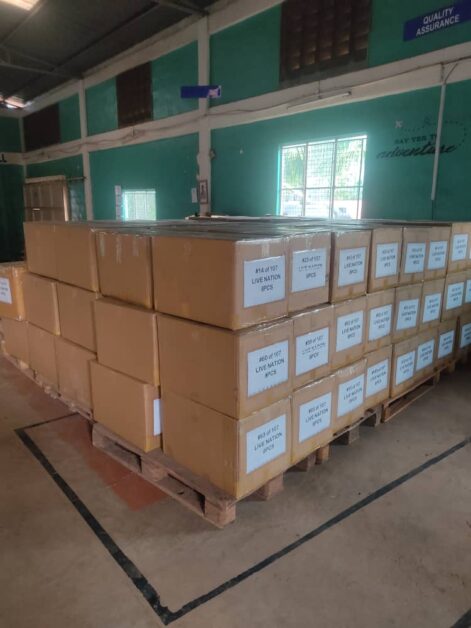
Our records show, that between January and April 2023, we had sent shipments of close to 5000 bags. But in 2024, we have only shipped 400 items since the beginning of the year.
They are feeling the impact of the taxes. Already, we were giving them at a slightly higher price because of the raw material shortages that are affecting us in Uganda but they would cover it up with no paying taxes, and now it’s the reality.
They would rather buy in India where they have to pay taxes but India’s unit price is very reasonable.
Apart from America, what other avenues are you trying to devise to keep afloat in the export business?
Of course, there’s a saying that necessity is the mother of invention. For 10 years I ran the business, we exported to only one country- the U.S. We exported to South Korea once, and we didn’t even follow through to see how much else they would buy.
We exported to France and South Africa once, and these were avenues which would have been harnessed but we had a big enough of a market that it didn’t make sense.
In my sector, the U.S. market is estimated by the Icon Group that by 2023, the bag market alone would be a USD 1.4 billion market base. It’s a very niche market for fashion, they understand what it means to buy a bag in summer, spring or winter.
In fact, if you position yourself well and do good marketing, America makes sense!
But like I say, necessity is the mother of invention, if you don’t have the market, do you fold your hands? No!
Last year, we were able to sign a partnership with a German company and we have already exported there.
That is because the European Union is open to us. So, as the US is still thinking about it, as an entrepreneur, you can’t sit and cry.
Last year, we also got ISO certified because the European Union is very strict with standards, and that has opened doors for us to be able to market our products in other countries where Uganda has favourable trade terms.
Have you considered penetrating the local market more, or even the East African Common Market?
I have just come back from Nairobi, it was the African Women Entrepreneurship Program by the U.S State Department. Different African countries were represented.
It was a good space to appreciate how much we can trade amongst ourselves in East Africa. We have the population and the resources and it can happen. We just need a lot of sensitisation, signing favourable trade agreements that let us trade freely amongst ourselves.
Mobility is key because if people are restricted, then you can’t move products.
As a local producer in the creative industry, what is your honest take on the government’s initiative of Buy Uganda Build Uganda (BUBU)?
It is, and it was a great initiative for the government to push nationals to buy Ugandan products. We appreciate how far we have come even from sensitisation alone.
The seeds were plants but my only challenge is the seeds have not been watered. My opinion has been, that after the government planted the seeds of BUBU, what did we do to make it grow?
That also calls for, have we identified factors that are killing BUBU and that’s the heavy importation of items that can be produced by Ugandans. I have no problems when Ugandans have to import raw materials, or machinery that we can’t make; it is a fact, and we don’t have to deny it but in the cases where items can be locally made, why are we still importing them, are we signing poor trade treaties that we have to be pushed regardless to bring in those items?