Uganda’s Economic Crime remains high. Business conditions continue to improve, shilling losing slight edge against the USD. Exports performed impressively in 2017.
Uganda has the second highest economic crime and fraud rate in East Africa, a new report says.
The PriceWaterCoopers (PwC) 2018 Global Economic Crime and Fraud Survey, using data from more than 7,200 respondents across 123 different territories, indicates that 49% of respondents said their companies had been victims of fraud or economic crime, up from 36% in 2016.
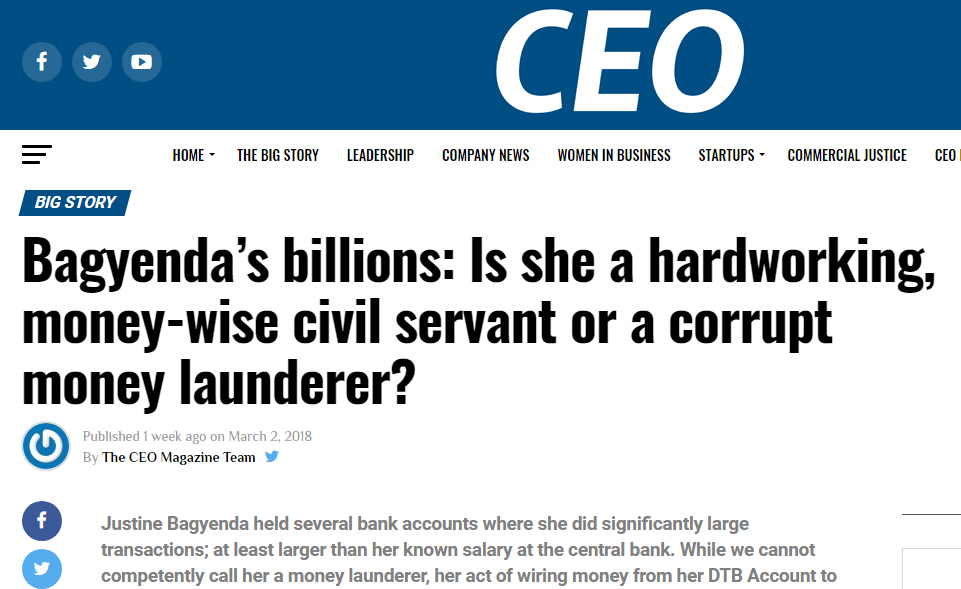
Read: Bagyenda’s billions: Is she a hardworking, money-wise civil servant or a corrupt money launderer?
Also read: Did Bagyenda intimidate or did she collude with banks to hide her billions?
Africa continent has the highest reported rate of economic crime at 62%. Uganda has a higher rate (66%) than African average, and East African average of 64%.
Two percent of Uganda’s 64 respondents reportedly USD5-50 million while 12% lost between USD1-5 million and an additional 24% lost between USD0.1m and 1 million in economic crime. Only Kenya had higher economic crime rate at 75% than Uganda. Tanzania rate is at 57% and Rwanda had the lowest at 46%.
Also see: Pulling fraud out of the shadows
Stanbic PMI on the rise
Stanbic Bank Uganda Purchasing Managers Index (PMI) shows continued improvement business Activity. The monthly PMI first conducted in June 2016 produced by IHS Markit covering the agriculture, construction, industry, services and wholesale and retail sectors indicated that headline index was 51.1 in February down from 52.0 in January, signalling a moderate improvement in business conditions in the private sector.
Related
 The Future is Creative: Gen Z, Talent, and the New Workforce Reshaping Uganda’s Advertising Industry
Readings above 50.0 signal an improvement in business conditions on the previous month, while readings below 50.0 show deterioration. February data marked the thirteenth consecutive month of strengthening operating conditions.
Output growth was observed in the industry, services, construction and wholesale & retail sub-sectors. Staffing levels also rose in the private sector in February.
However, February saw a contraction in the volume of new orders from abroad in the Ugandan private sector and purchasing activity contracted for the first time in nine months.
Contrary to the reported inflation figures by Uganda Bureau of Statistics for the February that saw headline inflation at zero, the PMI data collected for 12-27 February 2018 indicates that output prices, wages, total input costs, fuel and raw material costs increased. The PMI is a composite index, calculated as a weighted average of five individual sub-components: New Orders (30%), Output (25%), Employment (20%), Suppliers’ Delivery Times (15%) and Stocks of Purchases (10%).
World Bank set for Uganda dam refinancing talks despite criticism
The World Bank is set to decide whether to refinance loans on a $900m hydroelectric power plant in Uganda despite criticism from the bank’s own watchdog that workers’ rights were violated on the project. The 250MW Bujagali dam, which is part-owned by an affiliate of the Blackstone Group, the private equity investor, has been presented as a successful example of the World Bank’s push for public-private partnerships to fund infrastructure in the developing word.
This is despite complaints from campaigners that the Ugandan government has ridden roughshod over environmental safeguards.
Construction of the dam, completed in 2012, submerged the Bujagali waterfalls and flooded an environmentally sensitive area. To offset this, the Ugandan government agreed to preserve in perpetuity another section of the Nile around Kalagala.
The IFC, the lead investor in Bujagali, is meeting this week to discuss the refinancing deal and it is expected that the refinancing will help bring down electricity tariffs that campaigners say are among the highest in east Africa and unaffordable for many Ugandans. Lenders are proposing lengthening loan maturities, most of which have five years to run, to 15 years.
Following completion of Bujagali, it said, 90 per cent of Uganda’s power came from renewable resources. The World Bank has held the project up as an exemplar of public-private partnership, arguing in a 2013 strategy paper that it would double Uganda’s electricity capacity “while ensuring environmental, social and economic due diligence