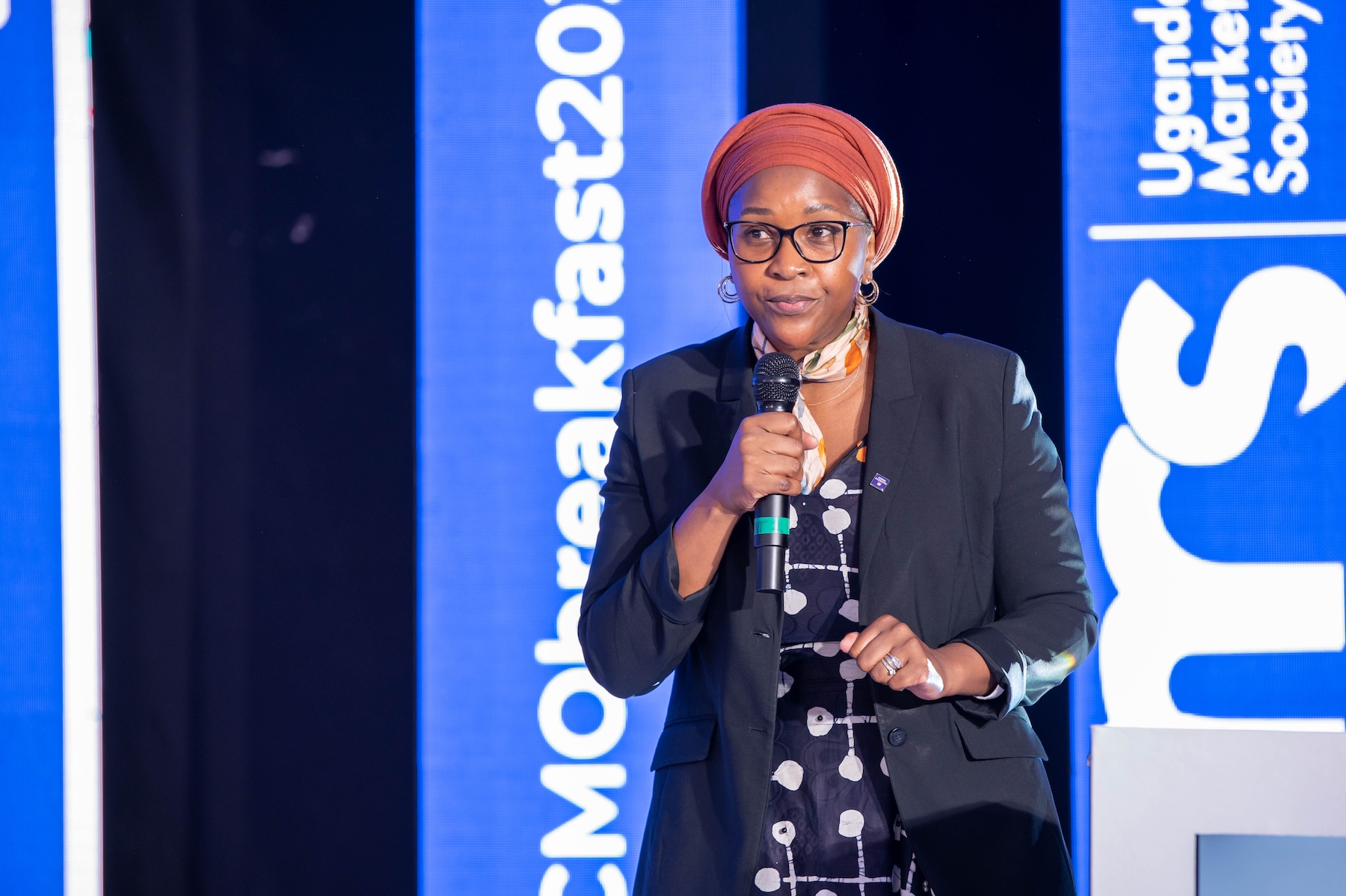
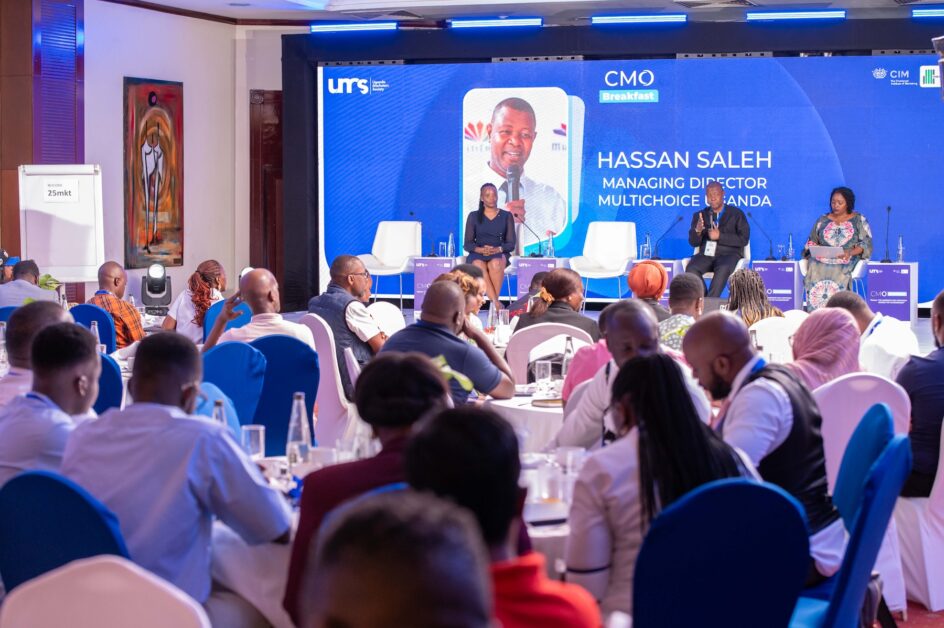
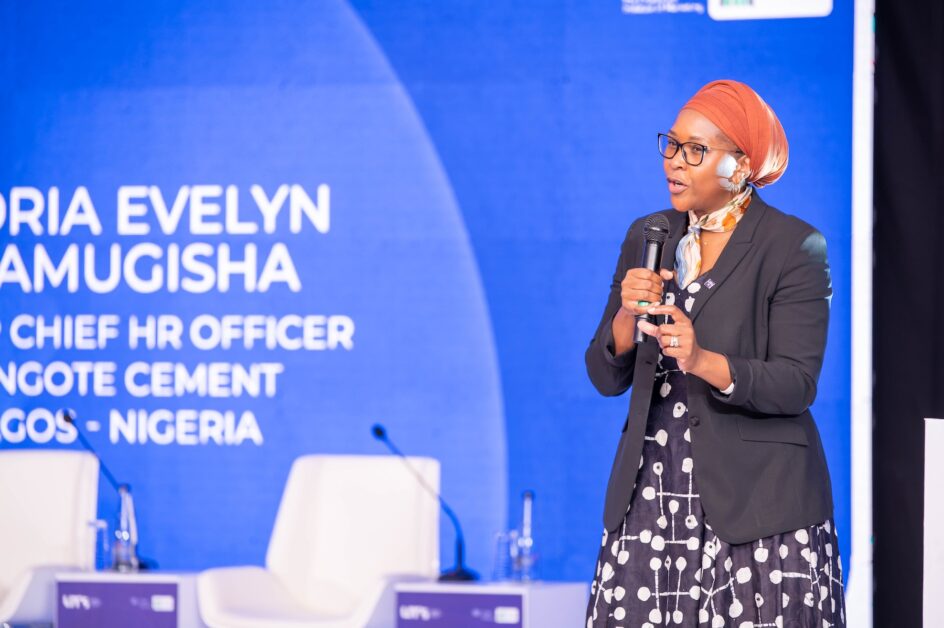
At the just-ended Uganda Marketers Society (UMS) CMO Breakfast, held on April 25, 2025 at the Kampala Serena Hotel, Gloria Evelyn Byamugisha, the Group Chief HR Officer at Dangote Cement Plc, delivered a compelling keynote address on the theme: “The Leadership Leap: Positioning Yourself for the Boardroom.”
Gloria is a seasoned multi-industry Human Resources executive with over two decades of leadership experience across Africa. She has held senior leadership positions in some of the continent’s leading organisations, including Dangote Cement Plc (Nigeria), Equity Group Holdings (Kenya), Ecobank (East and West Africa), and Bharti Airtel (Kenya and Uganda).
Her career has seen her lead strategic HR transformations across multiple countries — notably Uganda, Kenya, Tanzania, Rwanda, Burundi, South Sudan, Nigeria, and West Africa — giving her a rare depth of regional and cross-cultural leadership experience.
Gloria’s work has focused on change management, mergers and acquisitions, turnaround strategies, leadership development, organisational redesign, and building winning teams. She is deeply committed to growing leaders who focus on people, planet sustainability, and shareholder value in an ever-changing global business environment.
It is from this rich tapestry of over two decades of regional leadership, corporate transformation, and boardroom exposure that Gloria shared her profound insights with Uganda’s marketing leaders. She unpacked the realities of boardroom leadership and offered a comprehensive guide on how professionals can not only enter but thrive at the highest levels of corporate governance.
Here are the 15 key insights she shared:
1. Understand the Types of Boardrooms
Drawing from her personal experiences across Africa’s corporate landscape, Gloria emphasised that “the boardroom has small, medium, and large” and that it is critical to recognise the nature of the boardroom you aspire to join. “The boardroom has a private sector boardroom, a corporate sector boardroom, and an entrepreneurial boardroom, and all those boardrooms are completely different,” she explained.
She warned that entering a boardroom ill-prepared can expose weaknesses instantly. “When you miss the entry level and go to a large boardroom, this is when we get to ask how that person got here,” she remarked. Gloria stressed that the boardroom environment magnifies everything: your depth, your mastery, and unfortunately, any mediocrity or novice tendencies. “We get to see your weaknesses. We get to see your mediocrity. We get to see your novicehood. We get to see your rookie factor,” she said bluntly.

Moreover, Gloria painted a vivid picture of boardroom dynamics: a place where critical decisions around sustainability, livelihoods, and market share are made. It is also a place of prestige, but not without danger. “You will find scorpions, you will find pythons, you will find lionesses, you will find human beings, and you will discover sloths, to mention but a few,” she cautioned. The boardroom, she underscored, is a “very lonely place” and “not meant for every person.” For those who are crafted for it, however, it is also a place of great purpose, power, and potential impact.
Understanding the landscape, politics, and expectations of the specific boardroom you aim for is, therefore, a foundational step in positioning yourself for enduring success.
2. Develop Depth and Mastery
Gloria made it unequivocally clear: “You don’t go to the boardroom as a generalist. The boardroom needs depth. The boardroom needs mastery. The boardroom needs people who know their sphere.” She emphasised that in a competitive, high-stakes environment like the boardroom, superficial knowledge will not sustain a leader’s presence or credibility.
She illustrated this point by describing marketing itself — a discipline so vast that it encompasses content marketing, geo-marketing, public relations, product positioning, and much more. “Can you please pick one and have depth in it?” she challenged. Mastery, she explained, is what gives leaders authority, influence, and staying power once they cross into senior executive realms.
According to Gloria, depth is acquired through three channels: education (“you go to school for theory”), experience (“you move around and get exposure”), and practice (“you apply, you learn by doing”). Boardrooms, she warned, will swiftly expose those who lack substance — and in such arenas, depth is non-negotiable.
“You can only be a king in your kingdom,” she emphasized. Leaders must define their area of specialisation and dominate it with authority and excellence. Whether it is PR, product management, financial marketing, or customer analytics, true boardroom leaders are masters of a core discipline.
In Gloria’s words, failure to build mastery invites “a professional coup d’état” — where a more capable leader will inevitably replace you. Her call was clear: depth is not just an asset; it is the ultimate boardroom survival strategy.
3. Prepare Professionally and Intentionally
For Gloria, preparation for the boardroom goes far beyond technical competence. “Today, we have people who land in the boardroom because of their technical capabilities,” she said, “but they’ve got no clue that when you smile in the boardroom, you should make sure that your smile is compelling.”
She shared how, early in her career at Zain, she and a select group were rigorously trained — not just in their technical roles, but in the finer nuances of executive presence. “I was taught how to hold a microphone, how to dress in public, how to lean back, fine dining etiquette, how to present ideas, and that silence is golden,” she recalled.
Professional preparation, she emphasized, includes mastering the unwritten rules of boardroom behavior: when to speak, when to interject, how to carry oneself, and how to represent one’s organization’s brand flawlessly.
Gloria cautioned that without intentional preparation, many leaders struggle to maintain their position once inside the boardroom. “We send our boys and girls into the boardroom to make decisions around lives and livelihoods, but they have no clue what it means to sit there,” she warned. True boardroom readiness demands preparation mentally, physically, emotionally, and spiritually. It is the cumulative discipline of professional grooming that ultimately enables leaders to thrive, rather than merely survive, at the highest levels.
4. Find a Sponsor, Mentor, or Advocate
Gloria emphasised that no leader climbs to the boardroom alone. She asked the reflective question: “Who is your sponsor? Who is your mentor, your coach, your attorney, your advocate?” For leadership growth, she stressed, you must have people who not only open doors but also tell you the uncomfortable truths about your readiness.
Sharing a deeply personal story, Gloria recounted how, early in her career at Airtel, she once considered a high-level move to Uganda Breweries Limited. Though young, energetic, and passionate, she was pulled aside by her mentor, Mark Ocitti Ongom, who advised her bluntly: “Gloria, you are not yet ready. You will fail.” Despite receiving an offer, she turned it down, heeding his counsel to stay and prepare more thoroughly.
That decision, she reflected, was pivotal in her career. Without a trusted voice guiding her through ambition’s haze, she could have taken a leap that would have harmed her long-term prospects.
Gloria urged that every professional must have a mentor or sponsor who “helps you cross” — someone who not only sees your potential but ensures you climb with the readiness, strength, and wisdom required for boardroom success.
5. Lead from the Heart
In today’s world, Gloria emphasised, “we don’t want leaders without a human heart, we want a leader who connects with our thoughts, with a heart, empathetic, and, of course, a leader who is not disconnected from the world.” Citing a moving example of her boss, Alhaji Aliko Dangote, who shed tears publicly during a memorial for his close friend, the late Herbert Wigwe, the Group Managing Director and CEO of Access Bank Plc, Gloria reminded the audience that leadership is not about stoicism but about authentic emotional connection. “Alhaji Aliko Dangote has cried our cry,” she recalled the media reporting, noting how powerful it was for thousands to witness a leader so profoundly connected to shared human grief.

She stressed that empathy, compassion, and authenticity are not “soft” attributes — they are critical leadership imperatives. A leader must be grounded in the real world and must recognize that amidst political instability, economic shifts, pandemics, and other disruptions, “you want a leader who actually says it’s going to be okay.”
6. Value Clarity and Communication
Gloria stressed that clarity is non-negotiable for leaders aiming to succeed at the board level. “Can you imagine if you have a leader who does not tell you where to go, how to go, when to go, or which place to go?” she posed. Without a clear and compelling vision, leaders risk losing the trust and direction of their teams.
Clarity, she explained, serves as the compass that guides organisations through the complexities of today’s volatile environment — from political instability to economic shocks to public health crises. Leaders must be able to clearly define the path forward and articulate it in a manner that rallies teams and stakeholders alike. Effective communication, therefore, is not just about speaking; it is about ensuring that the message is understood, internalised, and acted upon. In the boardroom, where decisions impact livelihoods, sustainability, and market survival, the power to communicate clearly can make the difference between success and failure.
7. Build and Maintain Trust
Gloria described trust as “a very delicate fabric” and the cornerstone of effective leadership. Drawing from her extensive experience, she emphasised that trust is not simply assumed; it must be intentionally built and consistently maintained. “The only way to earn trust is to give it,” she said, highlighting the reciprocal nature of real leadership trust.
She introduced her “tripartite code of trust” — a powerful combination of loyalty, professionalism, and competence. According to Gloria, trust collapses if even one of these pillars is missing. “If you are competent but not loyal, or professional but not competent, trust cannot survive,” she warned.
Sharing her personal experience with Alhaji Aliko Dangote, she revealed how deep trust enabled her to be entrusted with the Group’s most valuable resource — its people. “When I joined Dangote, after rigorous interviews, Alhaji told me, ‘I need you to build a sustainable workforce. When people look at it, they should feel it’s the best thing that ever happened,'” she recounted. The level of trust he placed in her was immense and sacred.
In Gloria’s world, leaders must realise that trust is not public property; it is “privatized” and closely guarded. To thrive in the boardroom, building a brand rooted in loyalty, consistent professionalism, and unquestionable competence is not optional — it is existential.
8. Communicate with Proficiency and Clarity
In the boardroom, communication is not just an accessory skill — it is a survival tool. Gloria emphasised that impactful leaders must communicate “prolifically and proficiently.” She explained that it is not enough to speak; leaders must be understood.
“When you communicate with somebody, they can’t understand what you’re saying unless you’re clear,” she said. Proficiency in communication means structuring thoughts, presenting arguments logically, and ensuring clarity in every engagement.

Beyond clarity, Gloria stressed that communication must also carry weight. In decision-making rooms where millions or even billions are at stake, vagueness or ambiguity can erode credibility. Leaders must, therefore, ensure that their contributions are sharp, insightful, and aligned with the strategic needs of the organization.
“Clarity is very important,” she reinforced. Communication, in Gloria’s framework, is not a soft skill — it is a core leadership competence that signals readiness, authority, and reliability in the boardroom.
9. Be a Transformational Leader
In the boardroom, what differentiates exceptional leaders is their ability to drive bold, transformative change rather than simply maintain the status quo. Gloria challenged leaders with the question: “Can you lead the transformational agenda in your company?”
Transformational leadership requires vision, strategic foresight, and the willingness to champion large-scale change even amidst uncertainty. It involves reimagining business models, improving sustainability, leveraging innovation, and taking decisive action to reposition organisations for future success.
According to Gloria, transformational leadership is not about small improvements; it is about courageously leading initiatives that fundamentally shift the direction and fortunes of an organization. “Transformation is not maintenance — it is a bold leap into the future,” she emphasized.
Leaders aiming for the boardroom must be recognised as catalysts of transformation — individuals trusted to manage complexity, drive sustainability, and deliver lasting impact. Those who can lead such bold agendas position themselves not only for boardroom entry but for lasting boardroom influence.
10. Show Up Especially During Tough Times
In her powerful keynote, Gloria Byamugisha underscored the critical leadership principle that true leaders distinguish themselves by showing up — especially during adversity.
“The next one, ladies and gentlemen, in the leadership league, please show up. Just show up.”
Gloria emphasised that leadership is not about being present only when things are easy or when applause is abundant. It is about being physically, mentally, and emotionally present when challenges arise.
She elaborated: “When issues are in the boardroom and you want to enter the boardroom, please show up. And how do you show up? Be present. Be diligent. Be deep.”

Gloria challenged leaders not to retreat when the going gets tough, but to step up, raise their hand, and offer solutions — especially during crises or when transformational changes are needed.
She also noted that merely succeeding locally is not enough for leaders who aspire to boardroom influence.
“I always tell people, thank you, when you do it very well in Uganda. You’re not yet tried and tested. You need to do it very well in Kenya. You need to do it very well in South Africa. You need to do it very well in Tanzania. When you do it very well there, then you need to enter West Africa, because West Africa is a different ball game, completely different ball game.”
Gloria warned that leadership opportunities — and the ability to lead in a transforming world — depend heavily on the willingness to consistently show up and deliver results across increasingly challenging terrains:
“But you can’t sail unless you show up, and you only show up when things are tough. If you don’t show up, if you don’t put up your hand, if you don’t support, your chances of leading a transforming world will be at stake.”
 Stanbic Bank reveals UGX 270 billion EACOP debt financing as pipeline project advances
Showing up, according to Gloria, is the unglamorous but non-negotiable discipline that positions a leader for boardroom trust, respect, and sustainability.
11. Take Responsibility and Be Accountable
In her powerful remarks, Gloria Byamugisha made it clear that leadership at the boardroom level demands personal responsibility and unwavering accountability.
“The other thing is responsibility and accountability. Many a time, people want to enter the boardroom, but they don’t want to be soiled. It’s always somebody’s fault.”
She challenged the audience to recognise that pointing fingers and blame-shifting are signs of immaturity and unreadiness for true leadership.
Drawing from Christian allegory, Gloria illustrated how the failure to take responsibility dates back to the story of Adam, Eve, and the serpent:
“Remember when Adam did what he did? When they asked him, What did you do? He said it was the woman. They asked the woman, What did you do? She said it was the snake. They asked the snake; the snake took responsibility.”
She explained that the snake’s acceptance of responsibility ultimately led to the reclaiming of authority through redemption, symbolising how leadership maturity is tied to ownership of one’s actions.
Her message was direct and uncompromising:
“The point I want to tell you is that you must take charge. The moment you point fingers at somebody, you’re not ready for leadership. You’re not ready for leadership in today’s boardroom.”
In Gloria’s framework, responsibility and accountability are not negotiable traits — they are foundational to earning trust, exercising power responsibly, and building a lasting leadership legacy.
12. Avoid Professional Arrogance
Gloria Byamugisha gave a strong caution against the dangers of pride once leaders ascend to boardroom positions.
“There is a danger of arrogance, there is a danger of pride, there is a danger of seeming like you know it all; this is the worst deterrent for anyone in the boardroom.”
She emphasised that professional arrogance is the deadliest:
“The biggest deterrent is professional arrogance, ladies and gentlemen. Professional arrogance is the worst thing anyone can have.”
According to Gloria, no matter how skilled or talented a leader is, arrogance will quickly erode credibility and trust among peers and stakeholders.
She advised that humility, not hubris, should be the guiding light for sustainable leadership:
“Humility is the candle that keeps you going.”
Her message was simple but powerful: in the boardroom, expertise and depth matter, but humility is what sustains influence, relevance, and respect. Without it, leaders risk self-sabotaging their careers, regardless of their early accomplishments.
13. Build a Legacy, Not Just a Career
Gloria Byamugisha transitioned into an even deeper reflection, calling on leaders to think beyond short-term success and focus on their enduring impact.
She reminded the audience that leadership is not permanent:
“Leadership is seasonal. If you’re in a leadership position today or tomorrow, you will not be in it.”
Therefore, she urged that leaders must intentionally work toward creating a legacy:
“What is your legacy? What is your legacy?”
For Gloria, legacy is not defined by personal wealth, titles, or accolades:
“In my world, legacy is how you touch a life, how you pass on the mantle, and how you let others be.”
She urged leaders to invest in the growth of others, to build sustainable institutions, and to create opportunities that would outlive their individual tenure.
True leadership, Gloria stressed, is measured by the quality of lives a leader uplifts and the strength of the systems they leave behind.
14. Deepen Regional and Global Exposure
Gloria Byamugisha emphasized that for any leader aspiring to boardroom influence, excelling only in their home market is no longer sufficient. She stressed the necessity of building both regional and global exposure to truly prepare for high-level leadership.
She challenged the audience: “I always tell people, thank you when you do it very well in Uganda. You’re not yet tried and tested.”
True leadership capability, she explained, is demonstrated through consistent excellence across different countries, cultures, and market conditions: “You need to do it very well in Kenya. You need to do it very well in South Africa. You need to do it very well in Tanzania.”
However, she cautioned that even success across East and Southern Africa was only part of the test.
She raised the bar higher: “When you do it very well there, then you need to enter West Africa, because West Africa is a different ball game, completely different ball game.”
Gloria’s point was clear: The complexity, diversity, and dynamics of different regional markets sharpen leadership depth.
To be taken seriously in the boardroom, leaders must demonstrate an ability to adapt, perform, and deliver across broader, more complex geographies.
Building regional and global exposure, according to Gloria, is not just about career progression — it is about proving one’s resilience, agility, and leadership relevance in a highly interconnected and competitive world.
15. Handle the Emotional and Psychological Demands
In one of her most personal and candid reflections, Gloria Byamugisha emphasised that boardroom leadership is emotionally and psychologically taxing, and those who aspire to it must be prepared.
She shared a vivid personal experience: “Let me give you an example. In 2023 — I was already in the boardroom — but I had a French leader. We all know how the French can be sometimes. It was a very tough conversation with me, very tough. I went home and broke down. I cried, and I called one of my mentors, and I was sobbing.”
Her mentor’s response was blunt and transformative: “He said, Gloria, stop it. Stop it. You have two options. Tender in your resignation because you’re not suitable for the role, or pick yourself up and go to your depth; you sit in a boardroom of Africa’s finest, you don’t expect to find friendships and people to pat your back. You expect in the boardroom respect and thoroughness, and you get respect out of results.”

Gloria drove home a critical lesson for all leaders: “So emotional — we don’t take emotion to the boardroom. I’m so sorry. Emotion doesn’t go to the boardroom.”
She explained that boardroom leadership is about facts, performance, and outcomes — not personal feelings: “Because you’re dealing with lives and livelihoods. You’re dealing with purpose and sustainability. You’re dealing with business continuity and market shares. You’re dealing with people’s lives and livelihoods. You can’t take emotion. You will never be treated with emotion. We treat you with facts and thoroughness.”
In Gloria’s world, emotional resilience is a non-negotiable leadership skill. The boardroom demands psychological stamina, the ability to absorb pressure without cracking, and the discipline to operate on clarity, objectivity, and results.
A Final Reflection
In sharing her deeply personal journey and hard-won lessons, Gloria Evelyn Byamugisha offered Uganda’s next generation of boardroom leaders a rare and practical blueprint for success.
Her message was clear: the road to the boardroom is not paved with titles, connections, or technical skills alone. It requires profound self-work — cultivating depth over superficiality, clarity over confusion, service over ambition, resilience over emotion, and transformation over maintenance.
The boardroom, she taught, is a sacred trust — a space where lives, livelihoods, and futures are shaped. Those who seek to sit at this table must first earn the right through diligent preparation, transformational action, ethical leadership, and an unwavering commitment to legacy.
As Gloria so poignantly concluded, the boardroom may not be for everyone — but for those willing to answer the call, the opportunity to lead, to inspire, and to build enduring impact is one of the greatest privileges of leadership.
Her final challenge was simple, yet profound: Be intentional. Be open-minded. Be deep. And above all, be ready to serve with purpose.