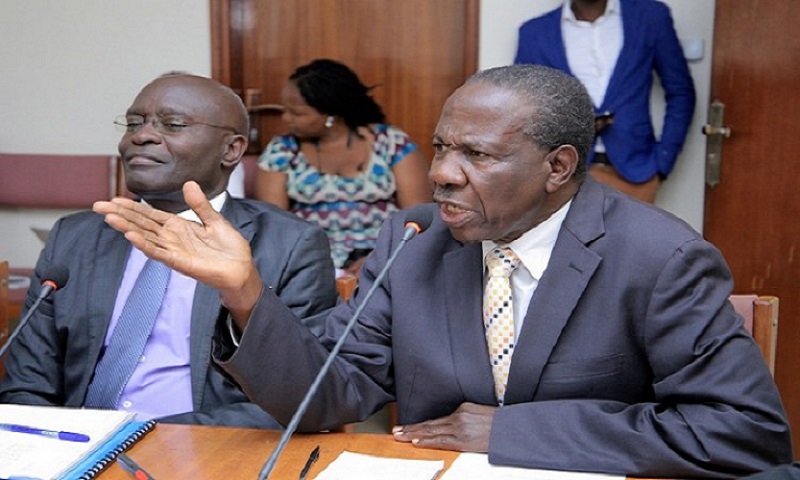
The Uganda Minister of Finance, Planning and Economic Development has today told Parliament that Corona Virus Disease- COVID-19 will significantly affect Uganda’s economy, so much so that up to 2.6 million could sink bank into poverty depending on the severity of the disease.
In his statement on the economic impact of COVID-19 on Uganda, presented to parliament today, Matia Kasaija, the Finance Minister said that the biggest impact will be on the services sector especially travel and tourism, including hotels and accommodation, adding that the resulting supply chain disruptions especially caused by travel restrictions will curtail import and export trade and subsequently dislocate demand and supply in the foreseeable future till the virus is contained.
“The low activity in industry and services sectors will result in loss of jobs further leading to a decline in economic growth and an increase in the level of poverty. The number of people that could be pushed into poverty is estimated at approximately 780, 000,” Kasaija told MPs.
“Given the current situation, the projection for economic growth in FY2019/20 has been revised downwards from 6.0 percent to between 5.2- 5.7 percent depending on the severity of the COVID-19 impact on Uganda,” Kasaija added.
He, however, said that this is however based on optimistic assumptions that the “coronavirus does not enter Uganda or that it is quickly contained hence avoiding widespread infections within the population.”
By the time of writing this story, Uganda had not yet reported any case of COVID-19.
Disrupted balance of payments
Kasaija said that travel restrictions in the USA, Europe, and Asia – Uganda’s biggest sources of leisure tourists, coupled with Uganda’s own travel restriction on COVID-19 worst affected countries will see tourism earnings “decline significantly in the last four months of the financial year.”
Yesterday, President Museveni announced a 32-days travel ban on Uganda travelling to and or through, as well as travellers from: Italy, France, South Korea, China, USA, United Kingdom, Netherlands, Switzerland, Sweden, Belgium, Germany, Spain, Norway Austria, Malaysia, Pakistan and San Marino. These are some of the world’s most corona affected countries.
Kasaija also predicted that exports are expected to decline in the last four months of the financial year, on account of a sharp reduction in global demand and travel restrictions imposed by Uganda’s key trading partners in the Middle East, European Union, and Asia.
Imports will also be affected by travel restrictions and a reduction in demand within the local economy.
“The majority of Uganda’s imports come from Asia, particularly China which has been the most affected country. Overall, imports are expected to decline by 44% in the last four months of this financial year,” predicted Kasaija.
He however, said this “provides an opportunity for the country to produce some of the imports locally in line with our import substitution and export promotion strategy.”
“We therefore need to put more effort in the implementation of this strategy in order to reduce our dependence on imported inputs and final goods in the case of such emergencies,” he said.
Kasaija also said that worker’s remittances and Foreign Direct Investments (FDI) will also be affected by the slowdown in the global economy especially in the last four months of the financial year. In a further cash squeeze on Uganda, the finance minister said that loan disbursements are projected to decline by 50 percent in the last five months of the financial year because of the likely delays in project execution and a disruption in the supply of inputs for the projects.
Due to the travel restrictions, scarcity of goods and lower inflows (tourism, remittances, exports and FDI), Kasaija said the balance of payments is likely to deteriorate leading to a likely depreciation of the exchange rate and consequently inflation.

He said that already Uganda’s Shilling had generally depreciated by 1 percent between February and 10th March 2020 and was expected to slide further with negative effects on the country’s foreign exchange reserves.
“Given the above assumptions, the current account balance (CAB) in FY20I9/20 is projected to widen by USD 363.1 million (12.7%). Consequently, foreign exchange reserves are expected to decline from 4.2 future months of imports to about 3.5 months,” he warned.
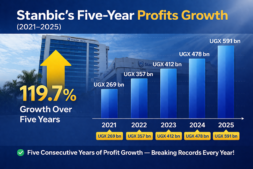 Stanbic’s Five-Year Scorecard: How Profit Growth, Deposits, Lending and Dividends Reshaped Performance
Impact of the coronavirus on banking system and government revenue collection
Kasaija warned that because of the projected intense impact on trade, tourism, transportation and construction sectors, the banking system would likely experience a rise in non-performing loans (NPLs). These sectors, according to 45 of private sector credit.
He warned that “if NPLs in these sectors increase by 50 percent due to fallout from the COVID-19 outbreak, the ratio of non-performing loans to total loans would worsen from 4.7 percent to 5.9 percent which has a negative impact on private sector credit growth as well as economic growth,” he said.
Kasaija also warned that government would “register an additional shortfall of about UGX 82.4 billion for the remaining period of the FY2019/20 March-June) and about UGX187.6 billion in FY2020/21.
“The coronavirus will mainly impact international trade taxes (reduction in value of imports) as well as consumptive taxes (VAT and Excise duty) due to the slowdown in the industry and services sectors,” he said.
He also warned that there would be a likely slowdown in the rate of execution of Government’s development projects, especially in the transport and the energy sectors due to the impact on project financing as well as the likely impact on required inputs that are imported.
He said that due to the above challenges, “in total, the Government of Uganda is faced with a preliminary additional financing gap of approximately UGX370 billion (equivalent to approximately USD 100 million in FY 2019/20) and UGX350 billion (approximately USD90
million in FY 2020/21) due to revenue shortfalls and additional expenditure needs to deal with the challenges in the health sector, needs arising from the desert locust invasion and related support to people whose livelihoods will be affected.
More harm and mayhem should COVID-19 intensify
An optimistic Kasaija however said that in the event that the “virus enters Uganda and spreads rapidly (as experienced in some African countries such as Egypt, South Africa and Algeria), the impact on the economy, the budget and the population would be significantly higher than discussed above.”
“In the worst-case scenario, there would be countrywide restrictions on the movement and gathering of people (closure of schools, places of worship, entertainment venues, sporting events, etc) and closure of borders. This would have more significant effects on the economy and livelihoods of people,” he said.

“In this scenario, economic growth for FY2019/20 would decline to between 4.6 percent and 5.1 percent. An additional 2.6 million Ugandans would be pushed into poverty,” he warned.
This will be hard-hitting for a Uganda that reported that between 2012/13 and 2016/17 the number of poor people had increased from 6.7 million to 10.1 million.
“Following the resultant severe reduction in exports, tourism receipts and workers remittances, the current account, balance would deteriorate significantly. On the fiscal side, there will be larger revenue shortfalls than anticipated, and additional expenditure requirements to cater for the health sector response to the virus spread as well as livelihood support for affected persons,” he warned.
“Domestic Revenue would register much larger shortfalls of about UGX288.3 billion in FY 2019/20 and UGX350 billion in FY2020/21,” he further said.
Without specifying the details, Kasaija said that to “deal with this economic shock, both fiscal and monetary policy adjustments would be required.”
“The fiscal policies will play a critical role in mitigating the negative impact of the pandemic on economic activity and the challenges in the affected sectors particularly health, while monetary policies will help to reduce the impact of the deterioration of the Balance of Payments,” he said, adding: “To deal with the possible negative impacts on our balance of payments, the Government will seek support from the International Monetary Fund to support the Central Bank in ensuring that international reserve buffers remain strong and that the exchange rate remains stable.”