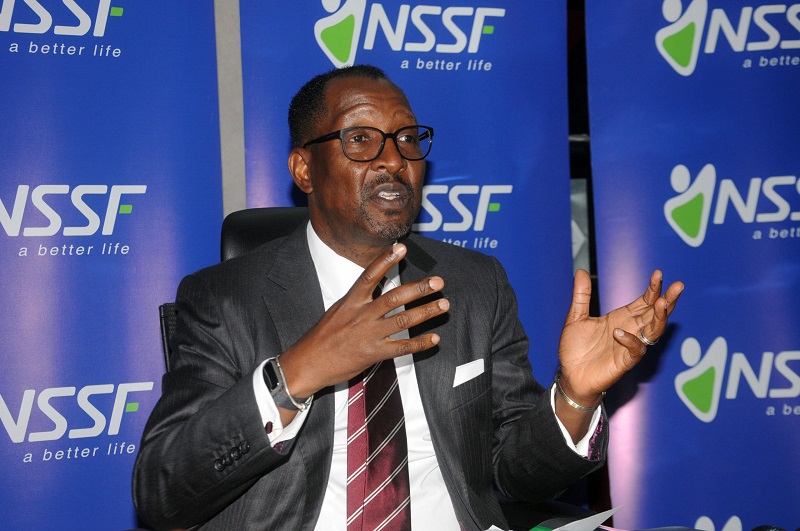
The National Social Security Fund has today 31st March 2020, announced measures to allow businesses/employers facing economic distress to reschedule their NSSF contributions for the next three months without accumulating a penalty.
This follows a failure by 33% of employers to remit their February 2020 contributions- which should have been filed by 15th March 2020.
“The decision is informed by the fact that some employers are grappling with inadequate cash flows, stemming from limited consumer demand and disruptions in supply value chains. The Fund’s internal analysis indicates that the number of contributing employers in the mentioned sectors has declined by 33% in the immediate aftermath of the COVID-19 pandemic. Overall, it is estimated that about 6,800 employers will be directly affected,” Byarugaba said.
According to Mr. Richard Byarugaba, the Fund’s Managing Director, the affected Employers majorly fall in 7 sectors: recreation (hospitality), accommodation and food services; education; trade; transport, storage, real estate & construction; human health & social work; manufacturing & mining; and agriculture, forestry & fishing.
“Employers in the above categories must agree with the Fund a payment schedule, after which they will sign a Deed of Settlement. This is because employers still have an obligation to pay Social Security contributions for their employees,” Byarugaba added.
He also said that the move was geared at supporting the Government of Uganda’s interventions to combat the effect of COVID-19, on businesses in the private sector.
He, however, clarified that businesses that do not apply for this amnesty will be expected to continue honoring their statutory obligation to remit NSSF contributions by the 15th day of every month.
Last week, CEO East Africa Magazine reported that several hotels had sent most of their staff home, including big names such as Serena Hotels, Speke Group of Hotels, Protea and Hotel Africana.
In our analysis this is just the beginning as most of the internal and external travel and assembly restrictions instituted after March 15th will fully reflect at the End of March and April, inflicting further damage on the economy.
The government has warned that due to depressed global demand and travel restrictions associated with COVID-19, there will be a severe reduction in exports, tourism, FDI and foreign workers’ remittance receipts.
The government has also warned that banking industry non-performing loans could worsen from 4.7% to 5.9%- although industry experts have warned it could go up to between 7-10%.
The resultant reduction in international trade, as well as consumptive taxes, will lead to shortfalls in government revenue, that could reach anywhere between SHS82.4 billion and SHS288.3 billion in FY 2019/20, possibly worsening to between SHS187.6 billion and SHS350 billion in FY2020/21 should the pandemic’s prevalence be prolonged. Overall, government growth prospects for FY2019/20 have as a result been reduced from 6.0 percent to anywhere between 4.6% to 5.7% and in a worst-case scenario, this could see up to 2.6 million people relapse into poverty.
About NSSF Uganda
The National Social Security Fund Uganda is a multi-trillion Fund mandated by the Government through the NSSF Act, Cap 222 (Laws of Uganda) to provide social security services to employees in the private sector.
The Fund manages assets worth over UGX 12.5 trillion invested in fixed income, equities and real estate assets within the East Africa region. As the largest Fund in East Africa by value, we have the ambitious goal of growing our Assets Under Management to 20 trillion by 2025.
Since 2012, the Fund is regulated by the Uganda Retirement Benefits Regulatory Authority while the Minister of Finance, Planning and Economic Development is responsible for policy oversight.

How Stanbic Bank CFO Ronald Makata Blends Governance, Technology and Human Leadership to Drive Performance