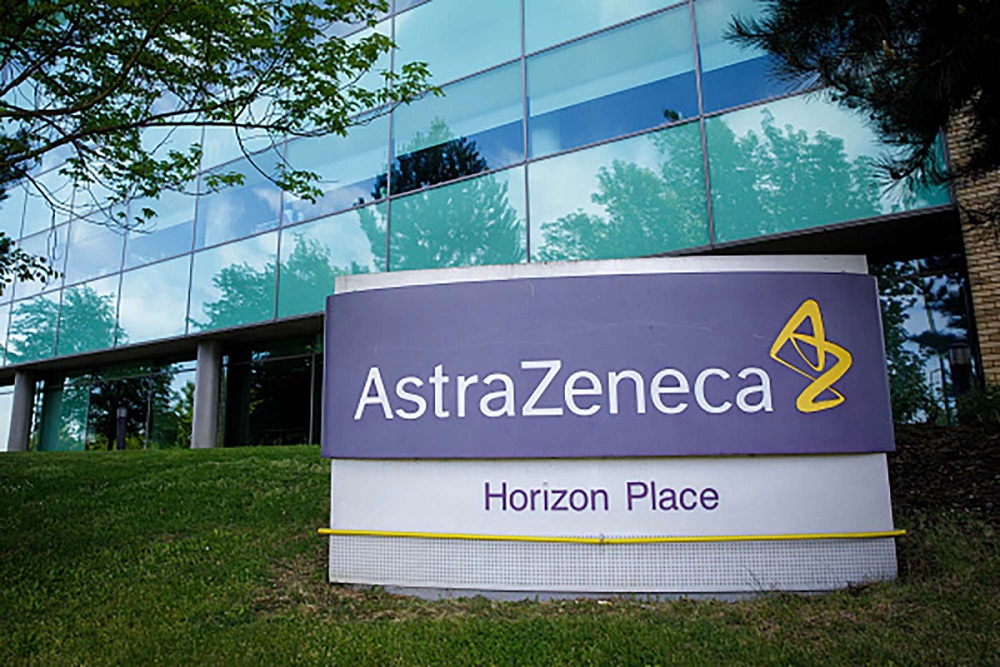
British Pharmaceutical Company AstraZeneca has said they are gunning to start manufacturing and distributing as many as 2 billion doses of a coronavirus vaccine, including 400 million for the U.S. and U.K. and up to 1 billion for low and middle income countries by as early as September this year.
If all goes well, the inoculation doses for the US and UK may go into distribution this September or October, while the first 400 million of the 1 billion doses to low and middle income countries will go into distribution at the end of 2020, AstraZeneca CEO Pascal Soriot, told journalists on a call on Thursday, June 4th.
The announcement by Astra Zeneca, coincides with a June 4th announcement that governments and businesses around the world had raised USD8.8 billion for the Vaccine Alliance (Gavi), a public–private global health partnership with the goal of increasing access to immunisation in poor countries. Gavi is backed by the Bill & Melinda Gates Foundation which donated USD1.6 billion towards the initiative. The foundation and the World Health Organization have created a mechanism known as the Access to Covid-19 Tools Accelerator to make sure the vaccine is distributed fairly to the world’s rich and poor countries.
In late May, the British drug maker AstraZeneca also got a US government contribution of USD1.2 billion for the development, production and delivery of its potential shot starting this September.
Mr. Soriot said that AstraZeneca had signed a licensing deal with the Serum Institute of India to provide 1 billion doses to low- and middle-income countries. He also said the distribution was dependent on clinical trials taking place by August. Clinical trials and manufacturing are set to occur concurrently, which is an unprecedented move for the pharmaceutical industry because of the risk of producing a drug that might not work.
The vaccine, named AZD1222, was originally developed by the Oxford University in the U.K. and AstraZeneca is working with pharmaceutical industry partners to manufacture and distribute the drug. The vaccine, contains the genetic material of the SARS-CoV-2 spike protein that stops the virus from replicating thus inhibiting its ability to cause an ongoing infection in recipients, according to AstraZeneca. The company hopes the vaccine can deliver a strong immune response from one dose by triggering the body to produce the spike protein and attack the novel coronavirus upon infection.
“We are very focused and very committed. When you have something like this with this sort of pandemic and the tremendous impact it has on people, the economy, et cetera, you can’t second-guess what’s going to happen. You can’t spend your time figuring out is it going to work or not going to work, you just have to commit. … We come in and make a bet on some of these things,” Soriot told the media during the call.
 Ruparelia Group Wins Key Entebbe Land Case, Clearing Path for the New Mega Speke Resort and Convention Centre, Entebbe
The drug is currently undergoing late-stage Phase II/III clinical trials in around 10,000 adult volunteers and so far it has been “safe and well-tolerated,” according to AstraZeneca’s press release.
Soriot told the media that “The chance of the vaccine working I would say we all have pretty good hope from what we’ve seen so far, but we can’t be sure of course,” adding that the company is creating a comprehensive database of safety information and expects to eventually have clinical trials with more than 50,000 volunteers taking part.
Richard Hatchett, the CEO of the Coalition for Epidemic Preparedness Innovations (CEPI), which is working with AstraZeneca on the drug’s production was reported by American news channel CNBC as saying that trials are running concurrently with manufacturing so as to make the vaccine available as early as possible.
“Obviously, if the vaccine is successful, placing that early bet on the manufacturing gives a huge payoff because you end up with tens or even hundreds of millions of doses that become available at the earliest possible moment,” he said on the call with journalists Thursday.
“We believe we can get the vaccine to hundreds of millions of people around the world, importantly, including those in the countries with the lowest income. So our goal is really to not leave anybody behind,” Soriot added.