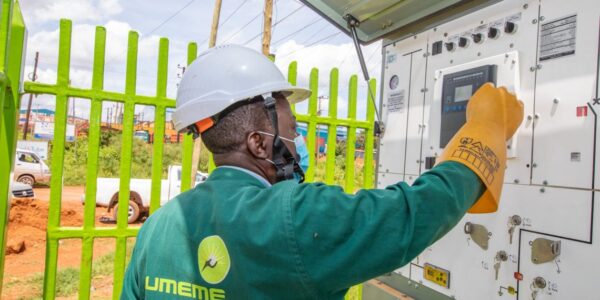
When the clock struck midnight on April 1, 2025, Uganda turned a historic page in its power sector.
The familiar “Umeme Yaka” brand, etched into the daily lives of millions of Ugandans, vanished from mobile menus overnight.
In its place appeared “UEDCL Light”, a symbolic turn of the page that ended Umeme’s two-decade concession and began a state-run era under Uganda Electricity Distribution Company Limited (UEDCL).
For boardrooms and living rooms alike, it wasn’t just a rebrand; it was a test. Would the lights really stay on?
At the center of that question is Paul Mwesigwa, UEDCL’s Managing Director.
He is a calm but determined leader tasked with balancing the politics and technical demands of running Uganda’s electricity distribution network.
Mwesigwa, who took the helm of UEDCL in July 2019, has been the steady hand behind the state utility’s reorganization and eventual takeover of Uganda’s electricity distribution.
With more than two decades of experience spent in the electricity distribution sub-sector, he has risen through the ranks in roles that shaped his grasp of both numbers and risk.
He has previously worked as a financial controller, chief internal auditor, and later, chief finance officer, before he was appointed CEO.
An economist by training with a degree from Makerere University, he is also a fellow of the UK’s Chartered Certified Accountants, a member of Uganda’s Institute of Certified Public Accountants, and holds an MBA from Oxford Brookes University.
Blending financial discipline with operational grit, Mwesigwa embodies the technocrat-CEO charged with steering Uganda’s grid through its most consequential transition in decades.
Every hum of a factory line, every glow of a household bulb, every outage alert now traces back to his desk.
He carries the burden of proving a public utility that can deliver where a private concessionaire left unease.
Taking over from the legacy of Umeme
Umeme’s departure was not without scars. For years, the private distributor had been lauded for improving revenue collection and expanding grid access.
But when government announced in 2022 that the concession would not be renewed, Umeme allegedly turned off the tap of capital investment.
The national grid was left thirsty and fragile. By April 2025, when UEDCL took over, more than 47,000 wooden poles were rotting, transformers had gone unrepaired, and substations groaned under the weight of demand.
Energy Minister Ruth Nankabirwa admitted the paradox during the handover.
“We appreciate Umeme for its work in revenue collection and loss reduction,” she said.
“But we must now protect infrastructure and advance reliable power supply for Ugandans.”
Her words carried both gratitude and indictment, a reminder of a partly broken network that Mwesigwa inherited.
The challenge for UEDCL’s new boss was not only to repair physical assets but to restore public faith in a sector long accused of neglecting its own backbone.
People were the first stress test. Nearly 2,200 former Umeme employees returned “home” to UEDCL.
At least 2,712 roles were approved and, by mid-year, 96% of positions consisting of 2,601 staff had been slotted in from the combined UEDCL–Umeme pool.
Other remaining specialized roles were advertised externally.
Inductions ran across 100 service offices to imprint a new performance culture and stabilize service delivery.
To accelerate last-mile access in line with ERA and World Bank ambitions, 550 technicians were recruited and deployed nationwide, with plans to add 400 more by the close of July 2025.
It was an aggressive push to meet connection targets without surrendering quality control.
“Every effort is being made to manage change, preserve institutional knowledge, and build a resilient workforce to serve the country,” said ERA CEO Ziria Tibalwa Waako at the license handover in April.
Yet behind the polished induction speeches lay real anxieties. Could a hastily assembled workforce hold under pressure, or would old habits resurface in the bureaucracy of a state entity?
Power outages
If there is one battlefield where perception has clashed with reality, it is the outages.
A Business Climate Index survey by the Economic Policy Research Centre (EPRC) reveals that 42 percent of businesses experienced power instability between April and June 2025.
The outages have sparked a lot of storms on social media, forcing UEDCL to keep daily alerts on emergencies and planned shutdowns.
Yet UEDCL’s monitoring systems seem to tell a different story: outages accounted for only about 2 percent, translating to roughly 15 hours a month.
Mwesigwa admits the contradiction but frames it as an inheritance problem.
“The system we inherited is stubborn and yearning for investment,” he says.
Since April, UEDCL has replaced 205 transformers and ordered UGX 300 billion worth of materials, though deliveries could take up to six months.
He has promised “serious stability” within a year. Until then, rationing and planned maintenance remain necessary evils.
Mwesigwa has staked his reputation on continuity, working with his team to maintain a 24/7 call center, service centers stay open, and staff have been deployed to reassure customers.
The real challenge, however, remains psychological. Ugandans, long wary of state-run utilities, still need proof that this time will be different, and that UEDCL could deliver electricity with speed, courtesy, and efficiency.
In an interview with the CEO East Africa Magazine responding to critics on social media, Mwesigwa downplayed concerns, insisting that the utility’s performance remains strong despite online commentary.
“There’s no big issue that can cause alarm because the average availability of the network is 98 percent, which means we’re even over and above the regulated target of 95 percent,” he explained. He further noted that much of the noise circulating online is driven by groups intent on discrediting government efforts.
 Modernising General Insurance: SanlamAllianz CEO Ruth Namuli on Building Uganda’s Insurance Powerhouse with Trust, Innovation, and Scale
“Some of the social media issues are from certain groups of people who want to tarnish the government image,” Mwesigwa said, urging the public to focus on facts rather than manufactured narratives.

Network availability: Fixing what was broken
The network UEDCL inherited was stubborn. On day one, 116 faulty transformers had to be replaced.
By June, network availability had edged up from 97.1% to 97.8%, a modest but symbolic improvement.
With national demand at 1,044 megawatts and generation at 1,099 megawatts, load-shedding has been avoided, except for some pockets of the country.
But beneath the numbers lies fragility. Critical substations in Namanve North, Namugongo, Mutundwe, Nkenda, Kasana, and Namungoona remain severely constrained.
Worse still, vandalism still stalks the network. Copper theft, often linked to insiders, has been bleeding the system.
The Economic Policy Research Centre (EPRC) warns that vandalism has become a “critical and dangerous problem,” threatening not just infrastructure but the economy itself.
Cash, collections and capital
If people and outages were the first tests, money perhaps remains the more daunting.
An Auditor General’s report at the start of 2025 revealed UEDCL’s debt ratio stood at a worrying 70.4%, raising doubts about its ability to absorb a trillion-shilling distribution business.
The specter of financial fragility still looms large, but UEDCL’s monthly sales of up to UGX 2.1 billion in May, achieving a 104 percent rate, reveal an institution on a path of financial recovery.
Mwesigwa has also moved swiftly to clear transmission bills worth UGX 220.5 billion to UETCL on time, a rare show of financial discipline.
But the real coup is the negotiation of a $50 million (UGX 175 billion) loan from Absa Bank, part of a $74 million (UGX 258 billion) funding package combining external finance and internally generated resources.
“Our goal is to ensure a reliable and sufficient power supply that meets the growing needs of our customers,” UEDCL noted in its statement.
The $74 million injection is only the beginning. Over the next five years, UEDCL plans to channel $350 million (UGX 1.2 trillion) into reviving and expanding the network.
Yet the debt shadows remain, raising the critical question: can UEDCL’s fragile balance sheet carry such ambitious investments without buckling?
System improvements and investments
Even as UEDCL fights fires, it has begun laying bricks for tomorrow.
In June, the Mbarara North substation was upgraded from 20 megavolt-amperes (MVA) to 40 MVA, and Kabale–Kisoro doubled its capacity from 2.5 to 5 MVA.
Work on Kumi’s refurbishment and the construction of Magigye substation promise to ease pressure on Kampala’s ballooning suburbs.
A July UEDCL status update revealed that 11 critical substations were running at maximum capacity, with reserve margins of less than 20%.
These include high-demand hubs such as Lugogo, Mutundwe, Kawanda, Kireka, Kampala South, Kajjansi, Lumpewe, Kisugu, Mbarara North, and Kumi, among others.
This signaled that demand had already outstripped available capacity. UEDCL flagged these substations for urgent upgrades and refurbishments under its five-year investment plan.
Several distribution lines have also been earmarked for refurbishment, with the goal of boosting their capacity and improving reliability in delivering electricity to consumers.
These upgrade works are already underway and are expected to be completed before the end of this year.
“These projects mark the first steps in undoing three years of frozen investment,” Mwesigwa said while marking UEDCL’s first 100 days in ‘power’ in July.
His words carried both ambition and urgency: the system would not forgive delays.
But still, losses remain UEDCL’s Achilles’ heel. Within six months, they fell from 19.1% to 16.8%, a commendable dip but still far from the single-digit levels of efficient utilities.
The disparities are stark: in Eastern Uganda, losses hover at 11%, but in the West, they surge to above 22%.
Sustaining collection efficiency above 104% has kept the company afloat, but lasting reform will demand technology, enforcement, and heavy capital
The brighter story lies in connections. In just six months, UEDCL added 648,404 new customers, raising coverage from 1.78 million to 2.43 million households.
Grid length expanded from 3,431 to 5,140 kilometers. Installed capacity surged to 2,049 megawatts, boosted by the long-awaited Karuma Hydropower Plant.
For a government promising universal access by 2030, the numbers speak louder than speeches.
Can Mwesigwa Deliver?
Mwesigwa’s first months in the hot seat have been marked by contrasts.
Early wins tempered by stubborn legacies, bold investments overshadowed by fragile finances, and hopeful statistics weighed down by skeptical public perception.
He has shown that UEDCL can collect, invest, and connect at scale. But questions remain. Can he tame losses fast enough? Can he fend off vandalism? Can he navigate debt without sinking under it?
As Minister Nankabirwa declared during the handover, “This is the beginning of a new era for Uganda’s electricity sector built on affordability, access, and reliability under full public control.”
Her words ring with optimism. Yet for Mwesigwa, optimism is not enough. The flick of every switch, the hum of every factory, and the quiet of every darkened home remain the real votes of confidence.
For now, he has steadied the ship. But in a sector where trust is fragile and failure is unforgiving, one question lingers over the man in charge: will he keep the lights on?