“Board members must shift their approaches; they must adopt digital tools to enhance governance.”
These were remarks made by Francis Kamulegeya during a high profile convention was organized by the League of East African Directors (LEAD).
Kamulegeya, a thought leader and adviser on corporate strategy, leadership, governance and policy, was the keynote speaker at the event.
Richard Byarugaba the Managing Director at National Social Security Fund (NSSF) echoed Kamulegeya’s sentiments by stating that technology has become so important.
“You need to have a board that appreciates technology,” Byarugaba told the audience during the convention that was held on Thursday at Sheraton Kampala hotel.
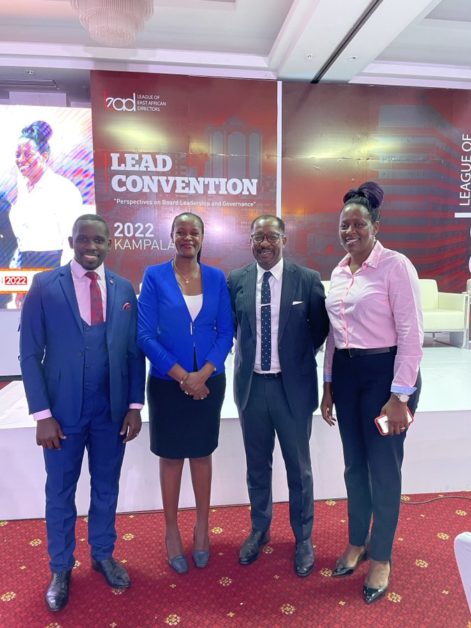
A collection of top business executives from across the various sectors like pensions, oil and gas as well as banking and capital markets and other sectors met at a convention on Thursday.
Gertrude Karugaba is the Chairperson of the League of East African Directors (LEAD).
In her opening remarks, Gertrude Karugaba the Chairperson at the League of East African Directors (LEAD) said; “we are equipping boards to lead better.”
Another panelist at the convention, Ernest Rubondo the Executive Director of Petroleum Authority of Uganda (PAU) said that when the oil starts flowing in about 3 years’ time, the revenues could bring in close to US$8 to 9 billion in the next 4 to 5 years.
“The significant opportunities from Uganda’s oil and gas activities, are now evident, but come with huge responsibilities. Governance is therefore key in ensuring that these opportunities create lasting value,” noted the PAU Executive Director Rubondo.
He added: “It’s been recognized that revenue is not the only thing that Uganda will get from its oil and gas resources.”
The successful executive leaders’ convention was held on Thursday at the prestigious 5-star Sheraton Kampala hotel.
This executive event involved a lot of networking as well as remarks from key sponsors like KPMG, National Social Security Fund (NSSF), Uganda Development Bank ((UDB), Uganda Bankers Association (UBA), Uganda Breweries Limited, Uganda Development Corporation (UDC) plus the CEO Summit that birthed the League of East African Directors.
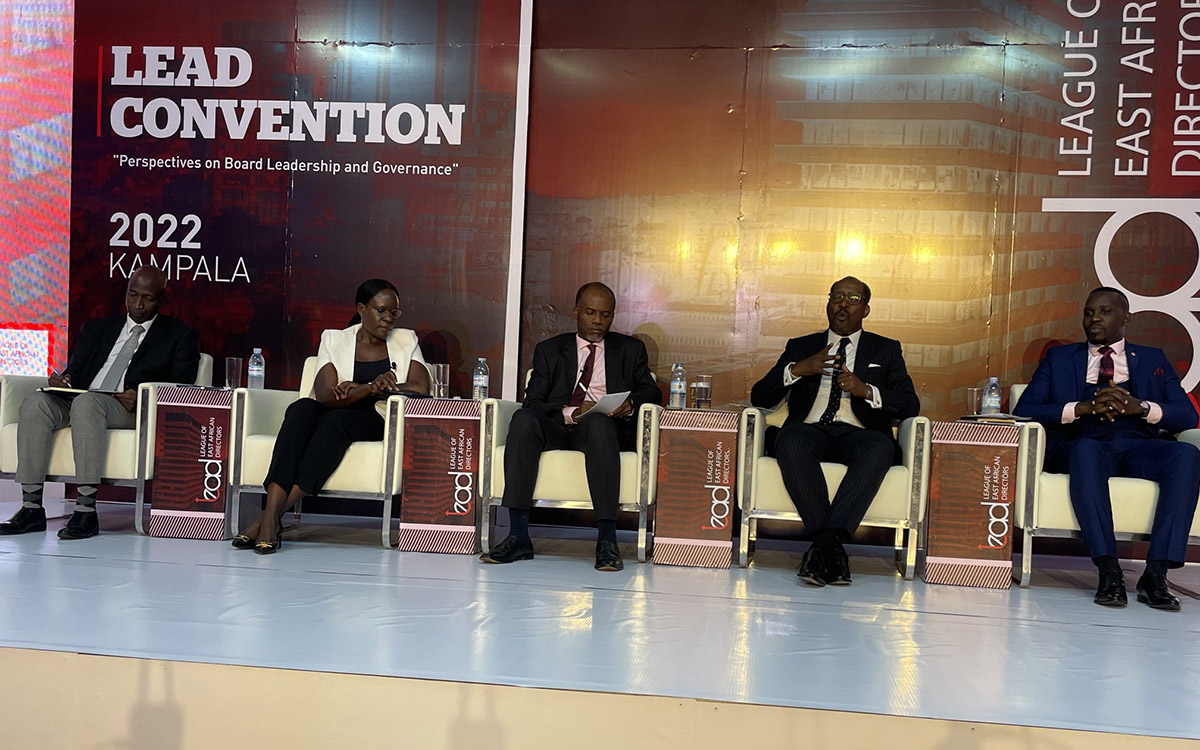
The panel discussion included the following speakers;
Keith Kalyegira – Chief Executive, Capital Markets Authority (CMA), Ms Joseline Kateeba – Managing Director Crest foam, Ernest Rubondo the Executive Director of Petroleum Authority of Uganda (PAU), Richard Byarugaba the Managing Director of National Social Security Fund (NSSF), Joel Ssenyonyi – Chairperson, Committee on Commissions, Statutory Authorities and State Enterprises of Parliament of Uganda.
“LEAD is a not for profit organization which was created to develop talent,” she said acknowledging that when they started out “some had no experience serving on boards,” said Karugaba, the LEAD Chairperson.
She also noted that LEAD aims at equipping boards to have well led businesses that thrive on credibility, ethics and values.
“We have built a database of executives,” she told the attentive audience that mostly comprised of top corporate and government administrators who attended the event.
Membership to join the League of East African Directors is open to individuals and corporate entities.
Some of the newly recruited executive members of LEAD include; Florence Bamwine, Ruchira Chakrarati from India.
Dr. Peter Kimbowa was one of the speakers at the event; he also shared his opinions on board trends, thoughts and ideas.
“All our panel members are all very well-known members in their circles,” said Jackie Rukare the host of the event.
Adding that; “We welcome those who are recruiting to come to us because we have what they want.”
Francis Kamulegeya is a Certified Public Accountant (CPA) that worked with pwc for 27 years to the influential position of Managing Partner at pwc – an executive search and lead recruitment company.
He spoke about how one should prepare him or herself to become a board member.
“Corporate governance during the industrial age was very much influenced by the role of the corporation,” said Mr Kamulegeya.
 Rajiv Ruparelia Legacy Lives On in UGX 1.7 Billion Bukedea Eye Camp for 2,000 Patients by Ruparelia Foundation & Partners
He also touched on the subject of why it is important to distinguish yourself from who you are and what you do.
Mr. Kamulegeya during his speech noted that the committees of yesteryear have influenced the boards of today.
“Boards need to address new issues like social and environmental impact, cyber security,” he explained.
Also stating that, board members in the modern digital age can no longer confine themselves to their areas of expertise.
“Your role is one of stewardship because you can’t control everything,” he said.
It was noted that in 2020 the biggest corporations in the world don’t necessarily have stuff (plant, machinery and equipment) like it was in the 80s and 90s.
“LEAD is a match-making process, you must have the right motivation, your education is just the foundation,” said Mr. Kamulegeya.
Leading the board of directors is a major challenge, requiring great wisdom and sensitivity.
According to an affiliate publication published by Strathmore Business School, those who have led boards know it is a role that requires a delicate touch as well as a firm hand. Unlike leading other teams; meetings are infrequent, limiting the opportunities for bonding; the routines are often stilted and rigid; and fellow directors are all accomplished individuals, leaders in their own right.
Joseline Kateeba the CEO of Crest Foam during her submission revealed that boards are very time consuming. She also sits on the boards of NCBA bank, Biyinzika Poultry (a mega family business), she also sits on the board of Total Energies and was formerly on the board at Capital Markets Authority (CMA).
“When I joined these boards I was the youngest in the room,” she noted.
Ms Kateeba remarked that the world we are living in is very fast paced and needs constant evolution.
“As a CEO what I look for in a boardroom is a bouncing board I look up to them for guidance,” she emphasized.
Richard Byarugaba the NSSF Managing Director says technology has become so important.
“You need to have a board that appreciates technology,” he told the audience. Adding; that a board must have a tenure for a specific period.
“You may want to keep a board for at least 6 years as opposed to 3 years because they might not have enough time to transform the organization,” Byarugaba said noting that he has outlived two of his boards at the pensions fund that he leads as Managing Director because the boards have a limited tenure.
One of the speakers at the convention KPMG’s Asad Lukwago said that;
“The environment and climate change has risen to become the most risk factor that many CEOs are focusing on,” said Mr. Lukwago.
His point was echoed by Richard Byarugaba who revealed that his NSSF is building over 3,000 units in Lubowa; “we are creating a city that depends on itself.”
“So use incorporating the use of solar reusable sewerage which is a great thing,” he said adding that; “even in bonds there are companies which are preferable to invest in those that are of a green nature.”
Even Mr. Rubondo added his voice to this topic saying; the challenge is going to be popularizing the use of liquid petroleum gas (LPG). He also voiced his concern that; “it’s environmentally friendly for Uganda to produce crude oil than to continue to cut down trees.”
The politically influential panelist, Joel Ssenyonyi who is the Chairman of COSASE in parliament and spokesperson of National Unity Platform (NUP) the leading opposition political party in Uganda said;
“Some boards fear their management,” he said noting that some CEOs are too powerful that they can’t be easily corrected by the the board since they seek favours from those that they should be supervising.
In his capacity as COSASE Chairman, Ssenyonyi has most government entities reporting to him and his ‘feared’ parliamentary committee. Some of the entities represented on the panel like NSSF, CMA and PAU all report to COSASE in the course of their duties