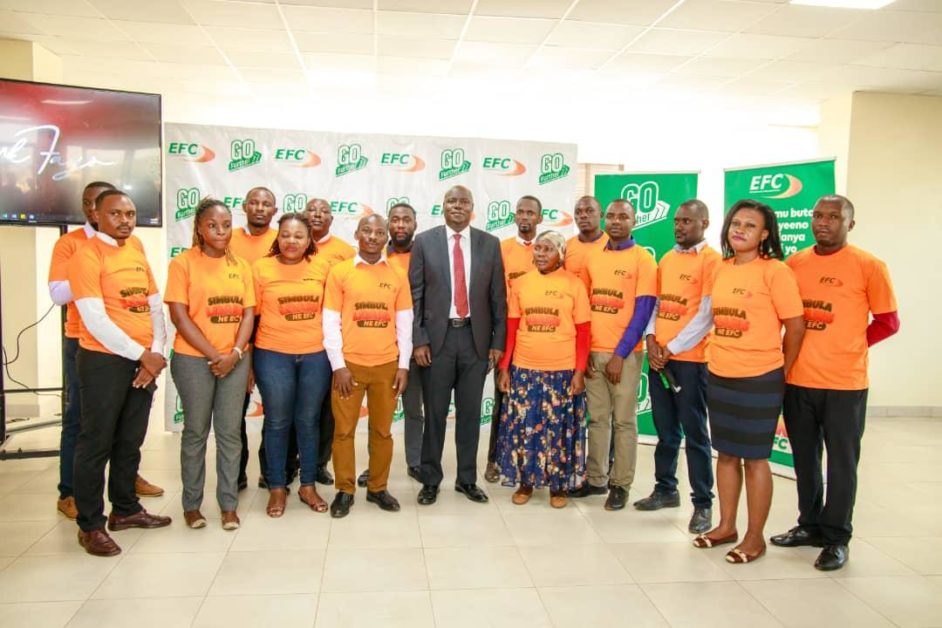
EFC Uganda Limited (MDI), now in its tenth year, is relatively young in Uganda’s banking arena but has grown over the years by leaps and bound; being listed among the fastest growing financial institutions supervised by Bank of Uganda between 2018 & 2020.
Shem Edmond Kakembo -Managing Director speaks to CEO East Africa Magazine, and among other areas, states that theirs is a niche player serving exclusively small and medium enterprises in Uganda
Briefly take us through EFC Uganda & it’s journey to being one of the fastest growing micro financial institutions in Uganda.
EFC Uganda is a relatively young institution and was incorporated in Uganda in 2012 by Développement international Desjardins (DID), which is a subsidiary of the Desjardins Group (the leading financial cooperative group in Canada and sixth largest in the world). It is the 6th largest bank in Canada. DID partnered with Gatsby Trust of Uganda. This was a good marriage that birthed EFC Microfinance. In January 2013, we were joined by Belgian Investment Organization (BIO) and in November 2013, applied to receive the MDI license from Bank of Uganda. We are a niche player serving exclusively small and medium enterprises in Uganda. We have grown over the years by leaps and bound and indeed between 2018 & 2020, EFC Uganda was listed among the fastest growing financial institutions supervised by Bank of Uganda.
EFC Uganda is striving to be the “leading SME financial Institution in Uganda by 2025”; how are you working towards achieving this goal as an institution?
We know that SMEs world over are true engines of economic growth and in Uganda it’s not different. In so many ways we have set out to become that bank that exclusively services SMEs as we are on the same growth journey and projectory as SMEs. They grow quite fast in an enabling environment which we are striving to provide through different products and services. We are looking to and in some years have doubled our balance sheet meaning that we have doubled the business. We think that we can continue along that trajectory & that by 2025 we will be the leading SME Bank in Uganda.
What is your view on SME growth in Uganda and what does the future look like?
SMEs in Uganda are vibrant. In 2013 World Bank studies listed Uganda as one of the most entrepreneur countries in Africa. However, in the last two years due to the Covid – 19 pandemic, SMEs took a beating. Surprisingly Uganda is a very resilient country, in 2022 we are seeing SMEs coming back and we hope that in both the coming & long-term future SMEs will continue on this growth path that we have never seen before. There are a few other economic wins like the discovery of oil in western Uganda which is expected to create a lot of knock-on effects for Uganda’s entrepreneurs. The last study on SMEs in Uganda by the Private Sector Foundation showed significant growth and expressed that SMEs continue to drive Uganda’s economic growth. Therefore, the future of SMEs in Uganda is very bright.

What is your take on Uganda’s Savings & Investment culture?
Undeniably, Uganda is a low-savings level country, but we are making strides towards getting there. Our saving level is about 19% of GDP; the true economies that have grown substantially tend to keep a level of just 50%. Economies like – UAE is touching 50%, Norway – an economy that we deeply admire and would like to emulate given how they have managed their oil business, averages at about 48%. So, we are still running quite a low savings level. Uganda’s issue is that we are a developing nation and poverty levels are still high. However, my observation is that also the poor save but maybe not in monetized terms and the challenge is monetizing these savings. For instance, one can save a cow worth UGX 500, 000 and with a problem that needs UGX 100,000 as a solution, they must sell it all off. So, the idea is to encourage Ugandans to own a savings account, make financial transactions a little more fluid. With more financial opportunities coming through, we should see higher savings levels in Uganda.
The Covid-19 pandemic has affected several businesses in wide ranging ways. As a leader, what have been your key take-a-ways in the last two years?
The pandemic mostly devastated SMEs because Uganda’s SME industry is quite unique. In banking we have a term called Key man risk/owner managed where one person is the manager, marketer, auditor etc. In such a scenario if this person can’t access their business for whatever reason, the business struggles. Over the last 2 years of the pandemic we have seen SMEs struggle and indeed there have been quite a number of lessons to learn. Those that were found better prepared were able to ride the tide a lot better than others. The larger SMEs market survived a lot better than the smaller ones. The pandemic taught us that planning is important. Digitization is a key takeout; people could not access businesses and customers could not access shops and online business was the way to go. Frankly speaking, if we were to have a repeat of the pandemic, I think we would be better prepared if we could only apply the many lessons learnt in the last 2 years
Youth & Women are key to Uganda’s economic growth, what role is EFC playing when it comes to this specific group of people?
First and foremost, it’s important to note that women make up almost up to 50% of Uganda’s population. Anybody who wants to do business in this country cannot exclude 50% of the population or target market. Uganda is a very young country as close to 75 % of Ugandans are under 24 years of age. In all we do, we must look at harnessing this youth fold. On the other hand, EFC Uganda is relatively a young organization, we are only about 10 years in this market, and we have a lot of financial solutions put in place for the youth like the savings accounts to encourage them save. On top of this we have lined up several financial literacy trainings for both customers and prospects who include the youth, this aims at sharpening their skills and arming them with financial lessons.
For the women, we have a specific product called the Women Market trader loan which targets easy financing of women businesses and not just those in markets but all women in business.
The Banking sector has rapidly grown in a span of 5 to 10 years, what opportunities do you see as EFC Uganda?
This is true; we see a convergence between banking and fin- techs because the traditional banking products can be gotten from anyone lately. Banking used to be a place where someone went to do something but now banks are coming to the customer. Banking is morphing into our everyday life; it is coming to our mobile phones and computers. Interestingly, banking decisions are going to be made seamlessly soon. I foresee that in the next few years, as one is making a car purchase in the bond, their bank will be right there to advise them on how to finance and go about the whole purchasing process. Financial decisions will be a lot better soon.
Lastly, highlight some of EFC’s Key milestones over its years of existence and what is your area of focus for the next 5 years?
We have had a couple of milestones with the biggest one so far being acquiring the MDI license in 2014.The second one was EFC being listed among the fastest growing financial institutions in Uganda between 2018 & 2020. In the near future, we will be working to upgrade our current license to a full banking license so that we can grow & service many more SMEs.