

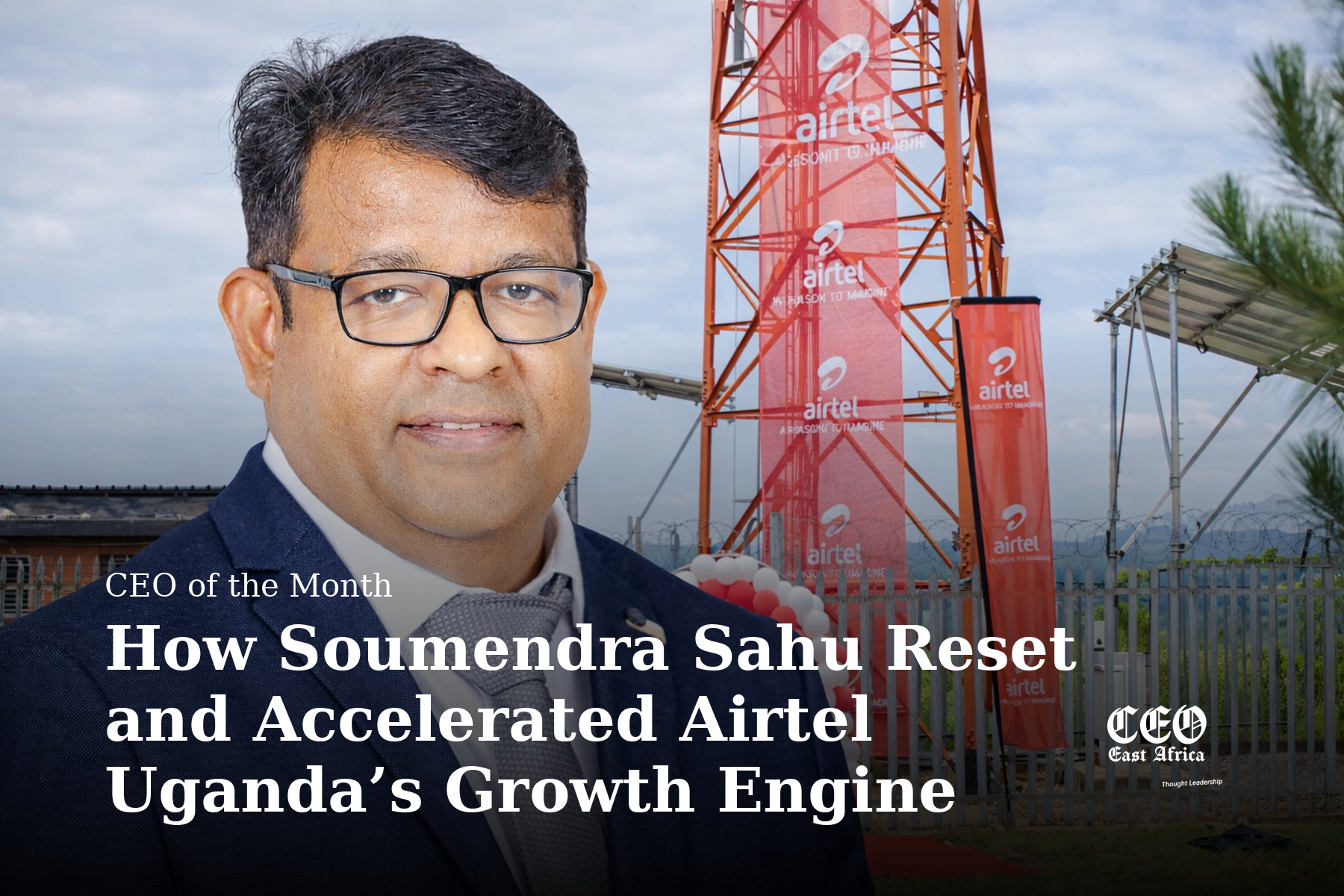
Last week, Airtel Uganda released its full 2025 financial results, underscoring a year of accelerated growth, tighter operational discipline, and structural digital transformation under Managing Director Soumendra Sahu and Board Chairman Hannington Karuhanga.
The headline figures are striking.
Revenue rose to UGX 2.25 trillion, up 13.3% from UGX 1.99 trillion in 2024. Operating profit surged 35% to UGX 849 billion, while profit after tax jumped 41.1% to UGX 447 billion.
EBITDA climbed 24.5% to UGX 1.235 trillion, with margins expanding from 50.0% to 54.9%. Net profit margins improved from 15.9% to 19.9%.
For a company that had seen operating profit decline 3.9% in FY2023 and grow only 6.3% in FY2024, the FY2025 strong double-digit performance represents the sharpest profitability acceleration in recent years.
It is against that backdrop that CEO East Africa Magazine recognises Soumendra Sahu as CEO of the Month – February 2026.
A Break from the 2022–2024 Growth Pattern
To understand the magnitude of the shift in 2025, the comparison must be explicit.
Between 2022 and 2024, Airtel Uganda’s growth trajectory was steady but measured. Revenue rose from UGX 1.594 trillion in FY2022 to UGX 1.777 trillion in FY2023, representing 11.5% growth.
In FY2024, revenue increased again to UGX 1.986 trillion, up 11.8%. For three consecutive years, top-line expansion remained broadly within the 11–12% range — consistent, reliable, but not explosive.
Revenue climbed to UGX 2.25 trillion, accelerating to 13.3% growth — the fastest top-line expansion in the recent cycle.
On its own, that would have marked a strong year. But the real story lies beneath the surface.
Profitability tells a sharper story.
In FY2023, operating profit declined by 3.9%, while profit after tax fell 8.8%, reflecting margin pressure and regulatory headwinds.
FY2024 brought stabilisation: operating profit rose 6.3%, and net earnings grew 6.7%. It was a recovery year — but a modest one.
Then came FY2025.
Operating profit surged 35%. Net earnings jumped 41.1%.
That is not incremental improvement. It is a decisive break from the trend.
For two consecutive years, profitability had either contracted or expanded in single digits.
In 2025, earnings grew at double-digit multiples of the prior year’s rate. Revenue increased, but profits increased far faster — signalling stronger operating leverage and improved earnings conversion.
This was not a continuation; it was an acceleration. And acceleration — particularly after a period of contraction and modest recovery — marks a genuine inflexion point in performance.
Earnings Conversion Velocity: The Real Story
Revenue growth alone does not define leadership impact. What ultimately distinguishes FY2025 is what might be described as earnings conversion velocity — the speed and efficiency with which top-line growth was translated into bottom-line expansion.
In FY2024, revenue grew 11.8%, while operating profit rose 6.3%. Profit trailed revenue. Growth was steady, but margins were largely stable, and earnings expansion mirrored — rather than exceeded — the pace of revenue.
FY2025 tells a different story.
| Metric | FY 2022 | FY 2023 | % YOY Change | FY 2024 | % YOY Change | FY 2025 | % YOY Change |
| Revenue (UGX bn) | 1,594 | 1,777 | 11.50% | 1,986 | 11.80% | 2,250 | 13.30% |
| Operating Profit (UGX bn) | 616 | 592 | –3.9% | 629 | 6.30% | 849 | 35.00% |
| Profit After Tax (UGX bn) | 326 | 297 | –8.8% | 317 | 6.70% | 447 | 41.10% |
| Total Subscribers 30-day base (mn) | 13.8* | 14.8 | 7.50% | 16.9 | 13.9 | 19.2 | 13.90% |
| Data Subscribers 30- day base (mn) | 4.8* | 5.7 | 19.60% | 7.3 | 29.20% | 8.9 | 19.60% |
| Smartphone Customers (mn) | 4.3* | 5.3 | 21.90% | 6.53 | 22.80% | 8.36 | 28.60% |
Revenue increased 13.3%. Yet operating profit surged 35%, and net earnings climbed 41.1%.
Profit growth did not simply follow revenue growth — it dramatically outpaced it.
That widening spread between top-line and bottom-line expansion signals several things at once: improved operating leverage, tighter cost discipline, more efficient capital allocation, and ultimately higher-quality growth.
It suggests that incremental revenue in 2025 was being converted into profit more efficiently than in previous years.
In practical terms, Airtel was not just growing larger — it was growing stronger. This is not merely a bigger year. It is a structurally different year — one in which the business model demonstrated enhanced efficiency and earnings power.
Growth Across All Engines — Not Just One
The acceleration in 2025 was not confined to profitability alone. It was visible across nearly every major operating metric, reinforcing the view that this was a systemic uplift rather than a one-dimensional spike.
Customer growth provides the first signal. In FY2023, the customer base expanded by 7.5%. In FY2024, that pace accelerated to 13.9%.
In FY2025, Airtel sustained that higher growth rate, expanding the base by another 13.9% to reach 19.2 million subscribers.
Maintaining double-digit expansion at that scale reflects commercial momentum, distribution depth, and competitive resilience.
The digital layer continued to expand strongly, though at a more measured pace.
Data customers increased by 19.6% in FY2023, then accelerated sharply to 29.2% in FY2024. In FY2025, growth moderated to 19.6%, bringing the total data customer base to 8.7 million.
While this represents a deceleration from the unusually high growth recorded in FY2024, it remains a robust expansion at scale.
Sustaining nearly 20% growth on a larger base suggests that data adoption is becoming structural rather than promotional.
The moderation reflects market maturation, not loss of momentum — reinforcing the view that digital participation is embedding itself more deeply across Airtel’s customer base.
Smartphone adoption — a leading indicator of monetisation potential — also strengthened. Growth of 21.9% in FY2023 and 22.8% in FY2024 was followed by a further acceleration to 28.6% in FY2025.
As more customers migrated to smartphones, the platform for higher data usage, digital services, and value-added offerings expanded materially.
Data revenue had already been growing steadily before 2025, expanding in the high-teens in FY2022, rising around 19–20% in FY2023, and remaining in the low-20% range in FY2024 as smartphone adoption and 4G usage deepened.
In FY2025, growth held firm at 22.4%, lifting data revenue to UGX 1.102 trillion, marginally ahead of voice revenue at UGX 1.057 trillion for the first time.
While not a dramatic spike relative to prior growth rates, the crossover reflects sustained digital momentum — supported by 19.6% growth in data customers to 8.7 million, 28.6% growth in smartphone users, and a 46% surge in data traffic — signalling that broadband consumption is steadily becoming the company’s primary growth engine rather than a supplementary revenue stream.
Viewed together, the metrics tell a cohesive story: customer scale expanded, digital adoption deepened, smartphone penetration accelerated, and data monetisation strengthened.
Growth in 2025 was not confined to one lever.
It was systemic — across scale, usage, revenue mix, and profitability — reinforcing the conclusion that this was not merely a good year, but a structurally stronger one.
Strategy, Scale and Intentional Acceleration
Announcing the full-year results, Managing Director Soumendra Sahu and Board Chairman Hannington Karuhanga, in a joint statement, emphasised the operational foundations behind the numbers: “Through our relentless focus on improving the customer experience, we have reported a 13.3% growth in revenue and a 24.5% growth in EBITDA with EBITDA margins increasing to 54.9%.”
The emphasis on customer experience was not rhetorical. It was strategic.
In a market where pricing is constrained and regulatory shifts can compress margins, differentiation increasingly depends on network quality, reliability, and digital depth.
They further stated: “We will drive higher data consumption across our markets by delivering a brilliant network experience, promote wider smartphone adoption and expand access to home broadband.”
That statement captures the core of the 2025 acceleration: shifting from coverage to usage, from infrastructure presence to digital intensity.
The underlying levers were concrete. Airtel rolled out 258 new 4G sites and added 164 new 5G sites during the year. Fibre infrastructure expanded by 1,600 kilometres.
By year-end, 100% of sites were 4G enabled. These investments strengthened capacity, improved speeds, and supported the surge in data traffic and broadband adoption.
At the same time, sustained cost-efficiency measures ensured that operating expenses grew by only 2.0%, even as the network footprint expanded significantly.
The combination of infrastructure expansion and disciplined cost control created operating leverage — the engine behind the sharp rise in profitability.
This alignment between strategy and execution is what distinguishes structural acceleration from cyclical uplift. The results were not accidental; they were born out of deliberate execution.
The Soumendra Reset: Breaking Silos, Building Accountability
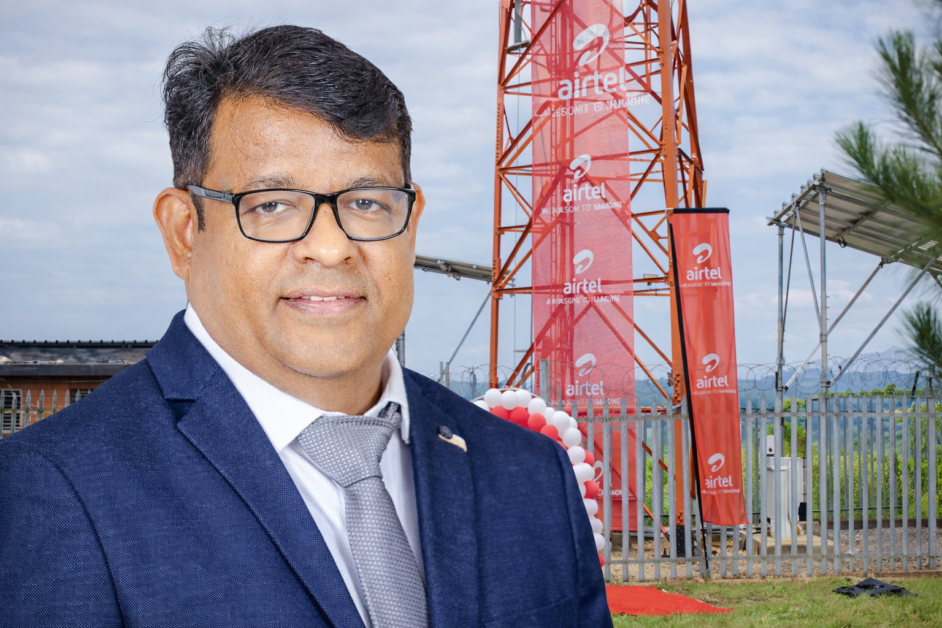
If infrastructure investment was the visible driver of Airtel Uganda’s 2025 acceleration, the organisational reset was the invisible one.
In a November 2025 interview marking his first full year in office, Soumendra Sahu told CEO East Africa Magazine that one of his earliest realisations at Airtel Uganda was not about infrastructure or market share — it was about internal execution.
While the company possessed strong functional expertise, he observed that performance was being slowed by traditional departmental silos.
The issue was not capability — it was coordination. Execution often stalled at the seams, where accountability blurred and priorities competed.
His response was both structural and cultural.
For the first time, the company’s strategy was formally cascaded across the entire organisation at the beginning of the year, giving clarity on how each role contributed to enterprise-wide outcomes.
Rather than operate strictly through conventional department-led hierarchies, Airtel shifted toward cross-functional project teams organised around clearly defined results.
Network, commercial, finance, technology, and customer operations teams were brought together around priority areas such as network experience, new site delivery, ARPU growth, cost discipline, and customer satisfaction.
“For productivity and efficiency, we are not only organised around departments. We’ve broken the cycle,” Sahu explained.
The intention was not to dilute accountability — but to sharpen it. Each team was assigned measurable targets and clear ownership. Success or failure became visible and shared.
That shift aligns directly with the financial outcomes of 2025. When operating expenses grow by just 2% while revenue grows 13.3% and operating profit surges 35%, it reflects tighter execution coordination.
It suggests the organisation was moving faster internally, not just expanding externally.
Sahu has been equally clear about the cultural tone required to sustain performance.
“For me, effectiveness matters more than popularity. Sometimes the right decisions are uncomfortable, but they are necessary if you want the organisation to move faster and work better together.”
That philosophy was tested during the SIM swap and fraud episode that erupted mid-year.
Rather than deflect, Airtel tightened controls, commissioned audits, reinforced zero-tolerance policies, and enforced accountability.
“Partial measures don’t work. If you want trust, you have to be consistent — even when it’s uncomfortable.”
Yet discipline was only one pillar of the people strategy. Engagement was the other.
Over the course of the year, Airtel hosted multiple large-scale employee engagement events, introduced new performance recognition platforms such as the MD Platinum Club, and strengthened commission and bonus structures to directly link improved profitability with employee reward.
Sahu also engaged junior employees directly, often seeking their ideas on customer propositions and digital products.
The organisational shift combined three elements: cross-functional alignment, sharper accountability, and visible recognition of performance.
Infrastructure may have enabled scale, but people alignment enabled velocity, setting Soumendra’s first year apart.
The Next Phase: Scaling the Usage Economy
If 2025 was the year of inflection, the years ahead will test whether Airtel Uganda can convert acceleration into endurance.
Soumendra Sahu is clear that the investment cycle is far from complete.
“We will be making our highest investment in the next two years. That commitment is already approved at the board level.”
After pushing 4G population coverage to 96%, expanding to 364 5G sites, rolling out 258 new 4G sites, and adding 1,600 kilometres of fibre in 2025 alone, the strategy now shifts decisively from infrastructure build-out to usage monetisation.
The GSMA Digital Economy Report identifies Uganda’s defining challenge: a 75% usage gap. Millions live within broadband coverage yet remain offline.
Sahu sees this as the real frontier.
“Smartphone penetration directly affects household consumption, productivity, and GDP. This is not just a telecom issue — it’s an economic one.”
That framing elevates Airtel’s next chapter beyond telecom competition. The company is positioning itself not merely as a network operator, but as a central actor in Uganda’s digital transformation — advocating for device affordability, financing access, regulatory coordination and ecosystem alignment.
The next growth wave will not come from simply building towers. It will come from activating participation.
“We will drive higher data consumption across our markets by delivering a brilliant network experience, promote wider smartphone adoption and expand access to home broadband.”
Data usage per customer already grew 14.8% in 2025. Data traffic surged 46%. Data revenue surpassed voice for the first time. Yet the runway remains long.
Enterprise demand is also rising. Expansion of 5G across major cities and Network-as-a-Service offerings signals deeper engagement with education, health, manufacturing, agro-processing and tourism — sectors that require capacity, reliability and speed.
At the same time, financial discipline remains embedded in the growth plan.
“In line with our objective to maximise shareholder value, we will maintain a robust capital structure, uphold disciplined cost management through efficiency initiatives, and sustain strategic investments in our network to deliver profitable growth and long-term value creation.”
The 2025 surge was not achieved by sacrificing balance sheet strength. Leverage improved to 1.5x. Lease-adjusted leverage improved to 0.6x. EBITDA margins expanded to 54.9%. Profit after tax grew 41.1%.
Invest aggressively — but protect margins.
Beyond infrastructure and finance lies capability — Sahu has repeatedly emphasised organisational readiness for disruption: “Everybody’s knowledge has to be enhanced. So when disruption comes, people can handle it.”
With AI-powered spam protection already launched and VoLTE traffic now contributing more than 20% of smartphone voice usage, the next competitive battleground will be intelligence, automation and ecosystem trust.
2025 proved that Airtel Uganda can accelerate. The years ahead will determine whether it can compound.
The ingredients are in place: record board-approved investment commitments, structural digital migration, enterprise expansion, disciplined capital management, and a people-aligned execution model.
If the first year under Soumendra Sahu was about resetting the engine, the next two years are about sustaining higher velocity.
And it is precisely this combination — measurable financial acceleration, structural revenue transition, disciplined capital allocation, organisational realignment, and a clearly articulated forward strategy — that sets Soumendra apart.
He did not merely oversee a good year. He engineered an inflection point — and positioned the business for its next phase of growth.
For that reason, CEO East Africa Magazine names Soumendra Sahu CEO of the Month for February 2026.








Follow