For nearly a decade now, state-owned telecom has been locked in a cycle of crisis and hopeful relaunches.
The story of the Uganda Telecom Limited (UTL) revamp is one of serial decline, a brush with liquidation, a government-led rescue, rebranding to UTeL, and, most recently, a promised equity investment that appears to have fallen through, leaving the telecom strained and its future uncertain.
People familiar with the matter indicate that the investor behind the promised capital injection, Rowad Capital Commercial, may have quietly retreated from the deal for reasons that remain unclear.
At its height, Uganda Telecom Limited (UTL) was one of the country’s major network operators, but by the mid-2010s it was plagued by poor governance, low investment, and rising competitive pressure from private rivals.
Administrators appointed to run UTL during its insolvency revealed that its liabilities had ballooned into hundreds of billions of shillings. In 2019, the administrator reported verified debts of around UGX530 billion, down from even larger creditor claims, while monthly revenues were barely keeping the network alive, averaging about Shs4.2 billion per month under administration.
GSM service revenue had shrunk by more than 60% as the network deteriorated and customers migrated to better-capitalised competitors.
Estimates from subsequent years put the insolvent UTL’s total debts at roughly Shs1 trillion against assets valued at about UGX250 billion, underscoring the depth of the balance-sheet collapse.
As part of the rescue plan, government incorporated Uganda Telecommunications Corporation Limited (UTCL) in April 2021 and, by February 2022, signed an Asset Sale and Purchase Agreement to acquire UTL’s remaining assets, such as spectrum licences and network infrastructure, while explicitly ring-fencing most of the old company’s liabilities.
The total consideration for the assets was equivalent to about Shs316 billion ($81.3 million), including payments to settle selected historic obligations such as a $15.6 million Trade and Development Bank facility prior to transfer.
While these figures capture the scale of UTL’s distress, officially published revenues or profitability figures for the successor entity, UTeL/UTCL, remain scarce in public regulatory or audited disclosures.
Unlike larger private operators, such as Airtel, which reported $457 million in revenue and $76 million in net income in 2023, with assets of around $564 million, UTeL has not issued comparable financial statements.
This is partly because it is a government-owned operator and not publicly listed, and partly because its relaunch has yet to mature into a stable reporting cycle.
What is clear from Uganda Communications Commission is that the market UTeL is trying to re-enter has expanded rapidly without it, or its negligible contribution.
By the 2025 second quarter, the Uganda Communications Commission reported approximately 44.3 million active mobile subscriptions, making Uganda one of the region’s fastest-growing telecom markets.
That growth, however, has also intensified competition, penalising operators that lack capital to expand coverage, modernise networks, and sustain aggressive pricing.
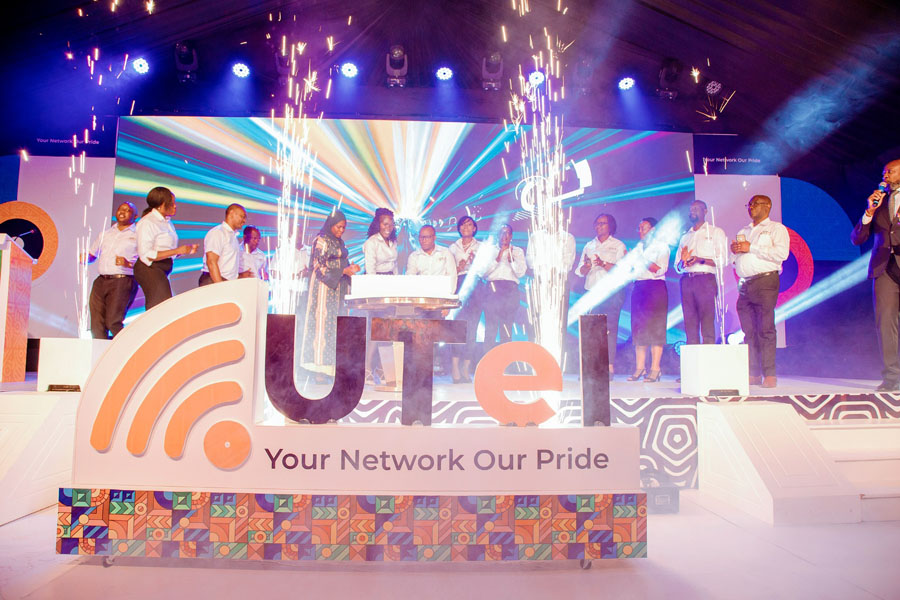
UTeL’s rebrand and relaunch under state ownership was intended to position it to tap into this expanding market.
But without evidence of meaningful revenue growth or sustained capital expenditure, the company continues to look like a marginal player.
For comparison, MTN reported gross revenues of about UGX1.5 trillion (approximately $407 million) as far back as 2019, illustrating the scale gap UTeL would need to close to compete effectively.
Rowad Capital had promised President Museveni a capital injection of $225 million at a meeting in State House in return for a 60% stake.
Following that commitment, the President directed that the telecom be handed to the equity firm as part of the revival plan.
In subsequent months government spoke of a revival plan, but the plan has since faded with little or no comment at all.
In April 2025, ICT Minister Chris Baryomunsi told the ICT Parliamentary Committee that Rowad’s proposed investment would be structured with an initial $25 million tranche, followed by $200 million over the next three years, funds that were expected to support network rehabilitation and expansion.
Nearly a year later, however, there has been no public confirmation that the initial tranche has been injected, and the transaction has yet to reach financial close.
People familiar with the matter say the process appears to have stalled, although no official explanation has been offered, and government has not publicly clarified whether Rowad Capital remains committed to the deal.
People familiar with the matter say Rowad Capital may have silently stepped back from the transaction.
Both Investment Minister Evlyne Anite and ICT Permanent Secretary Aminah Zawedde did not respond to phone calls or message inquiries seeking clarification on the status of the promised capital injection or whether Rowad Capital remains committed to the deal.
Emails to Rowad Capital remained unanswered by press time.
Stripped of the revival capital, UTeL is left exposed. Its historical financial performance as UTL was deeply distressed, with debts far exceeding assets and revenues too weak to sustain a modern telecom network. There is little evidence to suggest that the telecom could by itself mount a decisive turnaround.
Thus, without fresh capital and a credible, settled governance framework, UTeL remains financially fragile, caught between its symbolic role as a national telecom and the unforgiving economics of a fast-growing, highly competitive market that is steadily moving on without it.