
In Uganda’s crowded media landscape, the story of Galaxy FM’s birth on a bar napkin stands out as a testament to visionary hustle.
Its founder, Dr Innocent Nahabwe, is an unlikely media disruptor; a veterinary doctor by training who never practised his trade.
His journey from a newsroom rookie at 17 to the architect behind Galaxy FM, Blue Cube, and a suite of tech innovations is a masterclass in spotting gaps and solving problems.
He didn’t just start a radio station; he pioneered mobile-based services that connected millions, creating new audiences and building a platform that has become a cornerstone of Uganda’s media and tech ecosystem.
This is the story of how relentless drive, forged in childhood scarcity, led one man to disrupt industries and build an enduring legacy.
Early life and education: A hustler’s foundation
Nahabwe grew up in a bustling household of 17 children and countless cousins.
With both parents working as teachers, their home was another classroom, a hive of activity where resources were scarce.
His first lesson in entrepreneurship came early. “My father bought us shorts, but I bought my first pair of trousers, a pair of Walkers with an Azaro shirt, from the coffee boom of 1990,” he recalls.
The money came from selling coffee beans he had quietly collected from the ground, while his father gathered the main harvest. “I sold them back to him at a subsidised price,” he laughs.
From making pancakes to tending small gardens, young Nahabwe learnt self-reliance fast. “I never want to go back to a place of dire need,” he says.
He remembers the rare luxury of rice, eaten only twice a year, and the thrill of sneaking UGX 500 from his father to buy a small sachet of popcorn.
“It might sound trivial now, but those moments shaped my ambition,” he reflects. “I always wondered if I’d ever make enough money to afford such small joys.”
The story that marked him
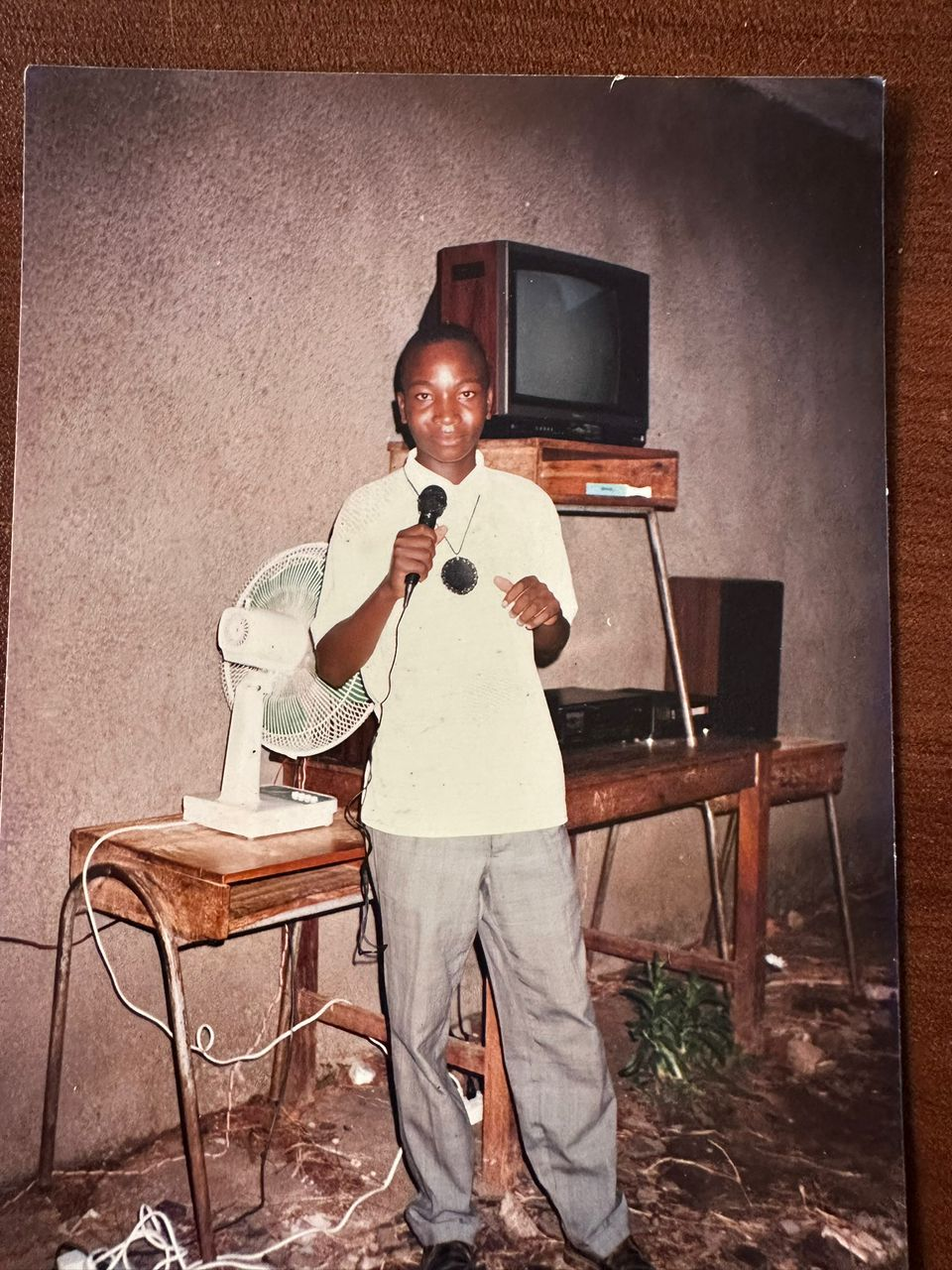
At St Joseph’s Vocational School, his budding writing talent almost derailed his education.
After he published a satirical article in the school paper that mocked a cancelled dance, chaos erupted. Students stormed his cubicle, police intervened, and he had to flee for safety.
“I ran to the headmaster’s office, but they pelted it with stones. He told me to run for my life,” he remembers. When he tried to return, chants of “We gooooo, we gooooo!” drove him away.
He sat his UACE exams under police protection, but, having missed many classes, narrowly missed qualifying for human medicine, his first dream.
Plan B was veterinary medicine at Makerere University, a course he chose simply because it came with a government scholarship. “I didn’t think my father would pay my tuition,” he admits.
Breaking into media and marketing
Though trained as a vet, he never practiced. The closest he came was importing animal vaccines, a business that collapsed after a fallout with his partner.
“It wasn’t a deliberate pivot from medicine,” he says. “It just happened naturally.”
While at university in 2001, the Red Pepper tabloid launched, and he joined as a reporter.
“They had few journalists, so I covered everything and met many marketers. When the paper started running adverts, those marketers came to me for business. Soon, I was making more than the marketing director.”
By his fifth year, he was appointed Marketing Manager, and later pursued an MSc in Marketing at Makerere University Business School. In 2006, he joined SMS Media as marketing manager.

The hustle
At one point, he juggled three jobs at SMS Media, Blue Cube, and Red Pepper. His days began at 7:30 am and ended late at night.
“I sold adverts, SMSs, and promo plans, then spent evenings reviewing performance and collecting debts,” he says. Despite the pressure, he kept winning “Best Employee” awards.
“I believe that if you want something done quickly, give it to someone who is either lazy or very busy; they’ll want to get it off their plate fast,” he quips.
A journey of firsts
In 2007, he co-founded Blue Cube, a trailblazer in mobile communication. The company introduced Uganda’s first subscription-based SMS services, allowing users to receive instant news updates, football scores, Bible verses, or horoscopes, long before smartphones became common.
“At a time when Google was a luxury, we connected over a million users to on-demand information,” he says proudly.
Blue Cube also launched MCycle, an SMS-driven menstrual tracker that predated modern health apps. They later developed Uganda’s first mobile betting gateway, a USSD platform that revolutionised the betting industry.
“Today, over 80% of betting transactions in Uganda happen through mobile. That infrastructure was born from those early innovations,” he notes.
When a wrong email changed everything
Ironically, one of Blue Cube’s biggest breakthroughs came from a mistake. “Someone accidentally sent an email meant for staff@bluecube to staff@smsmedia,” he recalls.
“It exposed us to competitors, but it forced us to refocus and innovate. That period of undivided attention changed our trajectory.”
The birth of Galaxy FM
By 2012, advertising had become painfully expensive. “I asked Sanyu FM for a three-month promo quote; they wanted UGX 54 million,” he says. “That was more than the promo’s profits.”
A friend suggested he start his own station. After researching online, he realised it was possible.
Industry consultants warned that Kampala’s airwaves were saturated until media strategist Billy Bakiringana drew a simple diagram on a napkin.
“He showed me that one side of the market was occupied by Luganda stations, another by English ones, but none served the hip, educated, urban youth who spoke both. That’s the gap Galaxy FM filled,” he recalls.
He recruited nightlife personalities and comedians like Kere Kere, Dolibondo, Little Joe, and Prince Emma, and Galaxy FM 100.2 was born.
 Ruparelia Group Wins Key Entebbe Land Case, Clearing Path for the New Mega Speke Resort and Convention Centre, Entebbe
Building a living business ecosystem
From its humble beginnings at Kati House in 2007 with just four employees, Nahabwe’s ventures have grown into an integrated ecosystem employing nearly 100 people across media, digital communications, technology, and entertainment.
The portfolio now includes Galaxy FM 100.2, Galaxy TV, and Blue Cube, serving millions weekly across platforms.
“We’ve helped hundreds of SMEs and major brands engage Uganda’s youth market. Our digital channels alone reach over three million users monthly,” he says.
The impact extends beyond numbers. His companies have launched artists, powered national campaigns, and built digital tools that have reshaped industries.
“The goal was never empire-building,” he says. “It was about building opportunity, empowering talent, and driving lasting innovation.”
Nurturing the next generation
Talent development is part of the Galaxy DNA. The station has been a launchpad for some of Uganda’s top radio and TV personalities.
“Nearly every major station has professionals who started at Galaxy,” he says.
They also scout and train raw talent; not just broadcasters, but producers, coders, and marketers.
“We want young Ugandans to see possibilities; to know that creativity can build real careers.”
Sustaining the business engine
Nahabwe credits systems and partnerships for longevity. “A business shouldn’t run from one pocket to the other,” he says. “You need structures, policies, and accountability.”
He is constantly scanning for new ventures. “We future-proof by thinking differently,” he explains.
“When the pure SMS business died in 2014, we had already diversified into marketing promotions and digital media.”
Philosophy on business and money
Experience has taught him to expect turbulence. “When things are good, I ask myself when the storm is coming. If you prepare, you don’t have to be ready,” he smiles.
He, however, cautions against mixing business with family. “You can’t hold relatives accountable; and you don’t want your mother calling to ask why you’re ‘harassing your cousin.’”
Money, he adds, must be respected. “It’s a bad visitor; easy to lose if not treated carefully. Income must always exceed expenditure.”
Hard lessons
Some scars run deep. In 2012, a partner who had sold his shares returned to claim ownership, alleging forgery.
After four years in court, Nahabwe won. “That taught me the power of documentation. Always formalise before profits come,” he advises.
He also learned that friends vanish in crises. “When I was detained, the people I drank with disappeared. Family is key. In the end, you’re your own rescue team.”
Life, legacy, and perspective
Today, Nahabwe oversees several ventures, including Galaxy Motel (Katwe), the Howie.biz music streaming platform, and real-estate projects.
“In Uganda, something is always coming at you: URA, KCCA, tenants, or the weather. There’s always something to fix,” he jokes.
He has never really taken a formal leave since 1997. “I rest when I get tired; it’s spontaneous,” he says.
Sundays are sacred for family. “If you live honestly, you don’t need to separate public and private life.”
On legacy and parenting
He’s clear about one thing: his children must carve their own path. “They’re in normal schools, eating posho, crossing roads, taking taxis. They must learn survival.”
He doesn’t want them inheriting his empire prematurely. “If you show them everything is mapped out, why should they work? They need that gap between where they are and where they want to be.”
As for legacy, he shrugs. “I don’t mind being forgotten. I’m not building monuments with my name. I just want to live, enjoy, and make an impact.”
The dream ahead
Uganda’s market is small, but his ambitions aren’t. “I want to take what we’ve built beyond Uganda; across Africa,” he says. “Our story proves great ideas can be born here and thrive globally.”
With strong models in media, tech, and youth engagement, his next chapter is about scale, partnerships, and pushing boundaries.
“The goal,” he says, “is to keep building, keep innovating, and keep proving that Ugandan ideas can change the world.”
Nahabwe’s journey is not a rags-to-riches cliché; it’s a blueprint for Ugandan innovation: pragmatic, resilient, and deeply local.
His legacy lies not just in the airwaves or the code his teams write, but in the conviction that Ugandan ingenuity can compete, and lead, on the African stage.