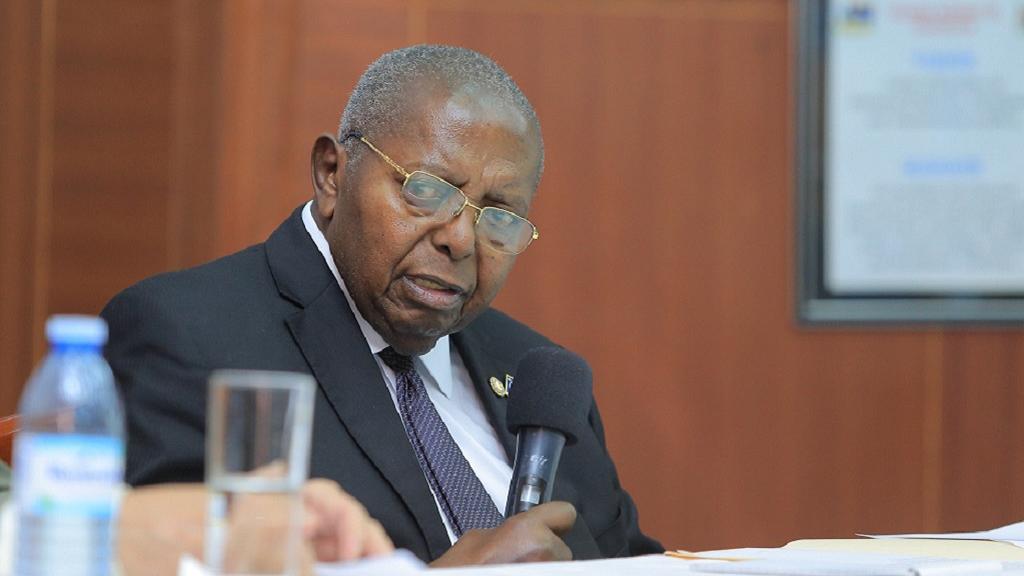
Bank of Uganda governor Professor Emmanuel Tumusiime Mutebile. He notes that the Omicron variant that has injected renewed uncertainty to the global economic picture.

The Bank of Uganda (BoU) at the Monetary Policy Committee meeting of December 2021, maintained the Central Bank Rate (CBR) at 6.5%.

The Central Bank says maintaining the CBR at 6.5% is meant to meet the inflation target of 5 per cent in the medium term.

In a monetary policy statement, BoU Governor Emmanuel Tumusiime Mutebile, said economic activity is gradually normalizing after the second wave of Covid-19, and the high-frequency indicators of economic activity for October and November 2021 suggest that the economy had considerable momentum into the fourth quarter.

“Although resurgence of the Covid-19 variants has undoubtedly clouded the near term outlook, the economic growth momentum is still expected to improve, supported by expansion in global demand, higher private sector expenditure and continued policy support.

“If the economy is fully opened in 2022, as currently being projected, this will release the pent-up domestic demand from the past two years that should stimulate economic activity,” Mutebile says.

The governor states that risks to the growth outlook, however, remain tilted to the downside, consisting of weaker than-expected global economic growth due to supply-chain disruptions and the Omicron variant that has injected renewed uncertainty to the global economic picture. Persisting global supply chain disruptions could spawn into the domestic industry, which could weigh on the economic performance.

He notes that a third wave of COVID-19 outbreak could trigger a need for more stringent and protracted containment measures that would drag growth down. Some contact-intensive sectors, especially education and hospitality that faced the brunt of the pandemic continue to face challenges. Import growth is expected to outpace export growth due to recovery in import-intensive household consumption and private investment. As a result, the contribution of net exports to GDP growth will be negative for an extended period.

The Monetary Policy Statement states that annual headline inflation and annual core inflation each rose to 2.6 percent in November 2021, from 1.9 percent and 2.1 percent in October 2021, respectively. The upturn has largely been driven by rapidly rising energy and food crop prices. Energy, fuel, and utilities (EFU).

Inflation rose to 2 percent in November 2021 from minus 0.2 percent in October 2021, food crops and related items inflation rose to 3.6 percent from 1.7 percent in the same period. Inflation forecasts in the near term amid high uncertainty, suggest that inflation will likely continue to rise as the economy recovers further and spare capacity is gradually absorbed.

The rise in inflation will also reflect strong producer price inflation domestically and abroad and import prices. In the medium-term (2-3 years ahead), as demand recovers with the full reopening of the economy and the release of pent-up demand, inflation is forecast to rise but stabilize around the 5 percent target, contingent on the evolution of the pandemic and the efficacy of vaccines.

“The BoU will continue with interventions for those sectors that remain under lockdown. Furthermore, BoU will maintain the COVID-19 Liquidity Assistance program (CLAP) to ensure financial stability until the economic situation normalises,” Mutebile says in the statement.

Tagged:
beylikdüzü escort