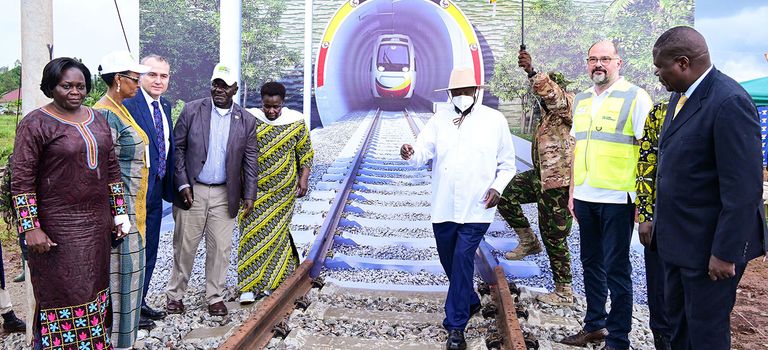
The World Bank has pledged financial support for Uganda’s long-anticipated Standard Gauge Railway (SGR) project following high-level discussions with President Yoweri Kaguta Museveni at State Lodge, Nakasero.
The financial pledge adds fresh momentum to the 2.7-billion-euro (about UGX 11.67 trillion) railway set to be constructed by Turkish firm Yapi Merkezi between Tororo and Kampala.
The development comes as government races against time to kick-start full-scale construction of the 272-kilometre line, a flagship infrastructure project expected to transform Uganda’s transport network.
The project will be financed through a mix of domestic resources and support from development banks, amid ongoing efforts to close a critical funding gap.
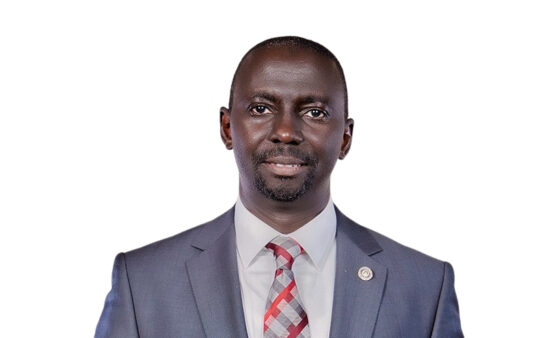
The World Bank financial commitment was made by Mr. Qimiao Fan, Division Director for Kenya, Rwanda, Somalia, and Uganda.
The delegation included the World Bank Country Manager for Uganda, Ms. Francisca Ayodeji Akala, and Senior Operations Officer Ms. Tonderai Fadzai Mukonoweshuro.
Also present were key government officials, including the Minister of Finance, Planning and Economic Development, Hon. Matia Kasaija; the Attorney General, Hon. Kiryowa Kiwanuka; the Permanent Secretary to the Treasury, Mr. Ramathan Ggoobi; and Ms. Maris Wanyera, Acting Director for Debt and Cash Policy at the Ministry of Finance.
During the meeting, President Museveni welcomed the World Bank’s decision to support the SGR project, describing it as a transformative investment critical to lowering transportation costs and boosting regional trade.
“These are the funds I want. I want funds for capacity building and to give the basics for production at lower costs,” President Museveni said, emphasizing the need for strategic financing that strengthens Uganda’s productive sectors.
The President underscored the importance of integrated transport systems, noting that the railway will be primarily used for heavy cargo, while pipelines will handle petroleum products and roads will serve passengers and light cargo.
“The railway and water transport should handle cargo, whereas roads will remain for passengers and light cargo,” he said.
He further highlighted affordable electricity, access to low-cost financing, and efficient transport infrastructure as key pillars for accelerating Uganda’s economic growth.
Beyond infrastructure, President Museveni welcomed the World Bank’s proposal to support agricultural industrialisation and agro-processing, stressing the need to shift from raw material production to value addition.
“The system here even in university was to train people… to produce raw materials but no value addition was taught,” he noted, calling for reforms that enhance skills and productivity in the agriculture sector.
On his part, Mr. Qimiao Fan commended Uganda’s progress in maintaining economic stability and reaffirmed the World Bank’s commitment to financing priority projects, including the SGR.
“I’m happy to say that I have the documents and the World Bank seriously pledges to support you financially,” he said.
He added that the World Bank will continue to invest in key sectors such as energy, transport, and agribusiness, recognizing their central role in driving sustainable development.
Related
 New Reporting Standards Sink FINCA Uganda into UGX 665 million Loss from UGX 4.9 billion Profit
The Bank also plans to support agribusiness through training programs aimed at enhancing skills and promoting value addition, a move expected to strengthen Uganda’s agricultural value chains and export capacity.
The renewed partnership signals a major boost for Uganda’s infrastructure ambitions, with the SGR project seen as a cornerstone for improving regional connectivity and positioning the country as a logistics hub in East Africa.
SGR Progress
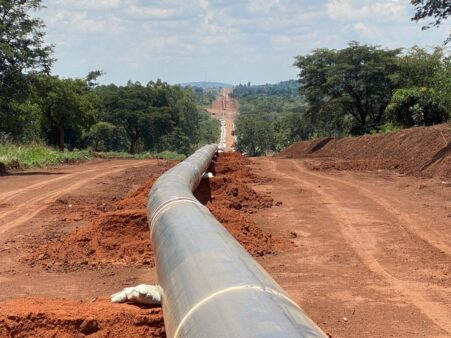
In 2024, government signed a 2.7-billion-euro (about Shs11.67 trillion) contract with Turkish firm Yapi Merkezi to construct a 272-kilometre Standard Gauge Railway line between the Malaba eastern border in Tororo District and Kampala capital city.
According to Mr. David Mugabe, the Senior Public Relations Officer for the SGR Project, government is already in advanced negotiations with several external development finance institutions, including the Islamic Development Bank, which has pledged 600 million euros (about Shs2.59 trillion), the African Development Bank, and export credit agencies expected to provide financing through technology transfer, equipment, and expertise.
Mr. Mugabe noted that most of the ongoing SGR activities are currently being financed by the government following the issuance of a Limited Notice to Proceed.
These activities include the contractor setting up labour camps in Iganga, as well as establishing a concrete sleeper factory and an industrial-scale batching plant.
He added that the contractor has also undertaken geotechnical surveys to support the design and construction phases of the project.
On land acquisition, government had, by November 2025, completed compensation in 9 out of the 12 affected districts. These include Tororo, Butaleja, Namutumba, Luuka, Iganga, Bugweri, Mayuge, Jinja, and Buikwe.
The remaining districts—Mukono, Wakiso, and Kampala—are currently in the final phase, with valuation reports under approval to facilitate compensation.
Overall, land acquisition and compensation had reached Buikwe by late 2025, with the process for the remaining three districts expected to conclude before the end of the year.
Construction of the railway, to be undertaken by Yapi Merkezi, is scheduled to commence in early 2026. The government has so far invested over Shs328 billion in compensation.
Once completed, Uganda’s SGR section will connect to Kenya’s railway network, ultimately linking the country to the Port of Mombasa and significantly easing both cargo and passenger transport.
Despite this progress, the project has faced challenges, particularly high compensation rates and valuation disputes in some areas. However, government has continued to push for expedited implementation to meet the planned 2026 construction timeline.